II. Orbital and Periodicity

Key focus of this chapter: periodic table with groups

This chapter reviews atomic orbitals, electron configurations, quantum numbers, and periodic trends in atomic radius, ionization energy, and electron affinity.

A. Orbital theory

1. Bohr’s atomic model

  • A model for the hydrogen atom.
  • In the Bohr model, the electron occupies allowed circular orbits around the nucleus. Each orbit corresponds to a shell with a specific energy.
  • Each shell is identified by its principal quantum number, n → higher shells have higher energies, but the gaps between successive energy levels become smaller as n increases → K(n=1) < L(n=2) < M(n=3) < N(n=4)

Fig. 1 Bohr’s atomic model

• Energy change when electrons move to other electron shells

Category


Features

Ground state

electrons

• Lowest-energy electron configuration of an atom

• An electron absorbs energy to move from a lower energy level to a higher one.

K (n=1) → L (n=2)

Excited state

electrons

• Electron configuration with energy above the ground state

• When an electron moves from a higher energy level to a lower one,

energy is emitted.

L (n=2) → K (n=1)

Fig. 2 Ground and excited electron states

2. Lyman, Balmer, and Paschen series

Category


Features

Lyman series

• When excited state electrons at a high shell go down to K (n=1) shell,

  energy is emitted.

• Ultraviolet region

Balmer series

• When excited state electrons at a high shell go down to L (n=2) shell,

energy is emitted.

• Visible and ultraviolet regions

Paschen series

• When excited state electrons at a high shell go down to M (n=3) shell, energy is emitted.

• Infrared region

3. Modern atomic model

: limitations of Bohr’s atomic model  → modern atomic model (orbital theory)

a. Orbital theory

  • An atomic orbital is a wavefunction describing an electron in an atom; its squared magnitude gives the probability density for finding the electron.
  • Each electron shell contains subshells (s, p, d, f, and higher types when allowed); each subshell contains one or more orbitals.

b. Electron shells and orbitals

  • A shell with principal quantum number n has n subshells and n2 orbitals; the allowed angular momentum quantum numbers are l = 0 through n − 1.

Electron shells

Subshells


n= 1

1s

n=2

2s

 2p

n=3

3s

 3p

 3d

Fig. 3 Modern atomic model

B. Shapes of orbitals

Category


Features

s orbitals

• Spherical shape

• Within the same shell, s orbitals generally penetrate closer to the nucleus than p, d, or f orbitals.

• Spherically symmetric probability density; no preferred spatial orientation.

• Magnetic quantum number, ml =0

• Orbital holds 2 electrons → 1×2 = 2 electrons in s orbitals

p orbitals

• Dumbbell shape

• 3 orientations of X, Y, or Z coordinate axes →  Px, Py, or Pz

• Magnetic quantum number, ml = -1, 0, +1

• Each orbital holds 2 electrons → 3×2 = 6 electrons in p orbitals

d orbitals

• Usually have a cloverleaf shape

• 5 d orbitals → dxy, dxz, dyz, dx2- y2, dz2

• Each orbital holds 2 electrons → 5×2 = 10 electrons in d orbitals

• Transition metals region in periodic table

f orbitals

• Complex shapes with lobes and, in some cases, rings

• 7 orbitals in each f subshell

• Each orbital holds 2 electrons → 7×2 = 14 electrons in f orbitals

C. Rules for filling atomic orbitals

: electrons are represented by arrows (↓,↑­) in the orbital filling diagram.

Classification

Features

Pauli exclusion principle

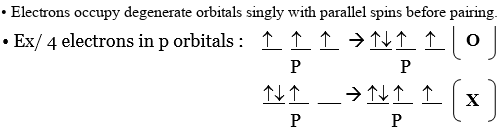
Hund’s rule

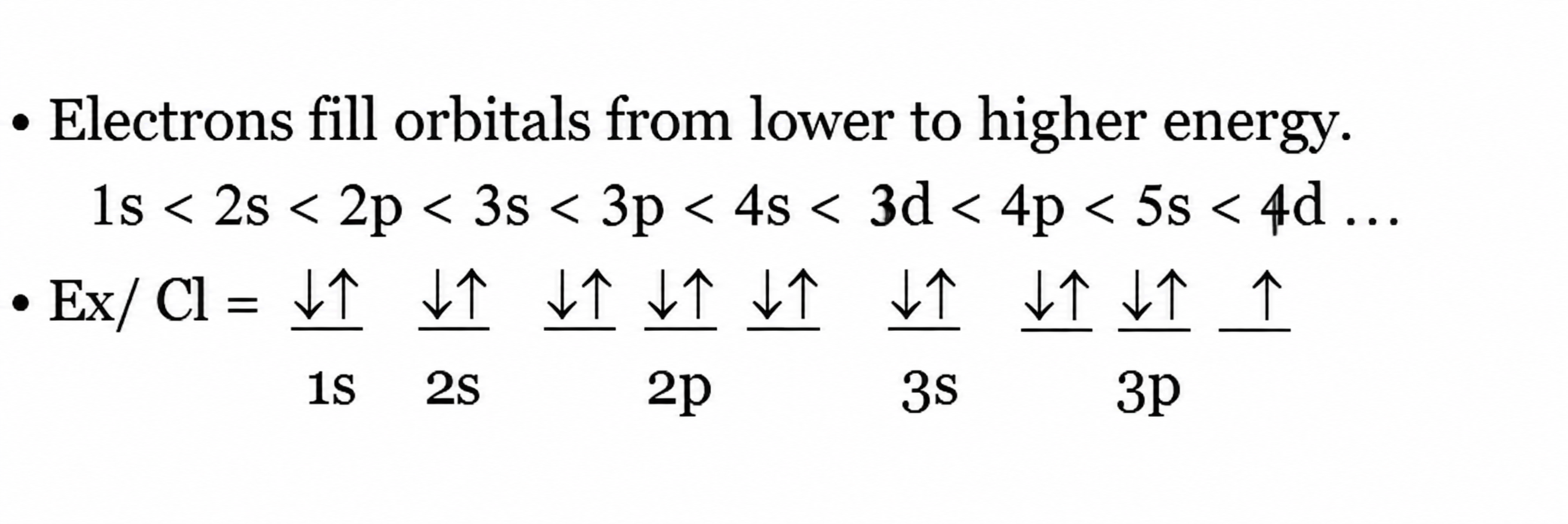
Filling order of different orbitals

D. Quantum numbers

: three quantum numbers (n, l, ml) specify an atomic orbital. A fourth, the spin quantum number ms = +½ or −½, specifies the electron’s spin state.

Classification

Features

The principal quantum

 number (n), shell

Angular-momentum quantum number, subshell (l)

Magnetic quantum

 number (Ml)

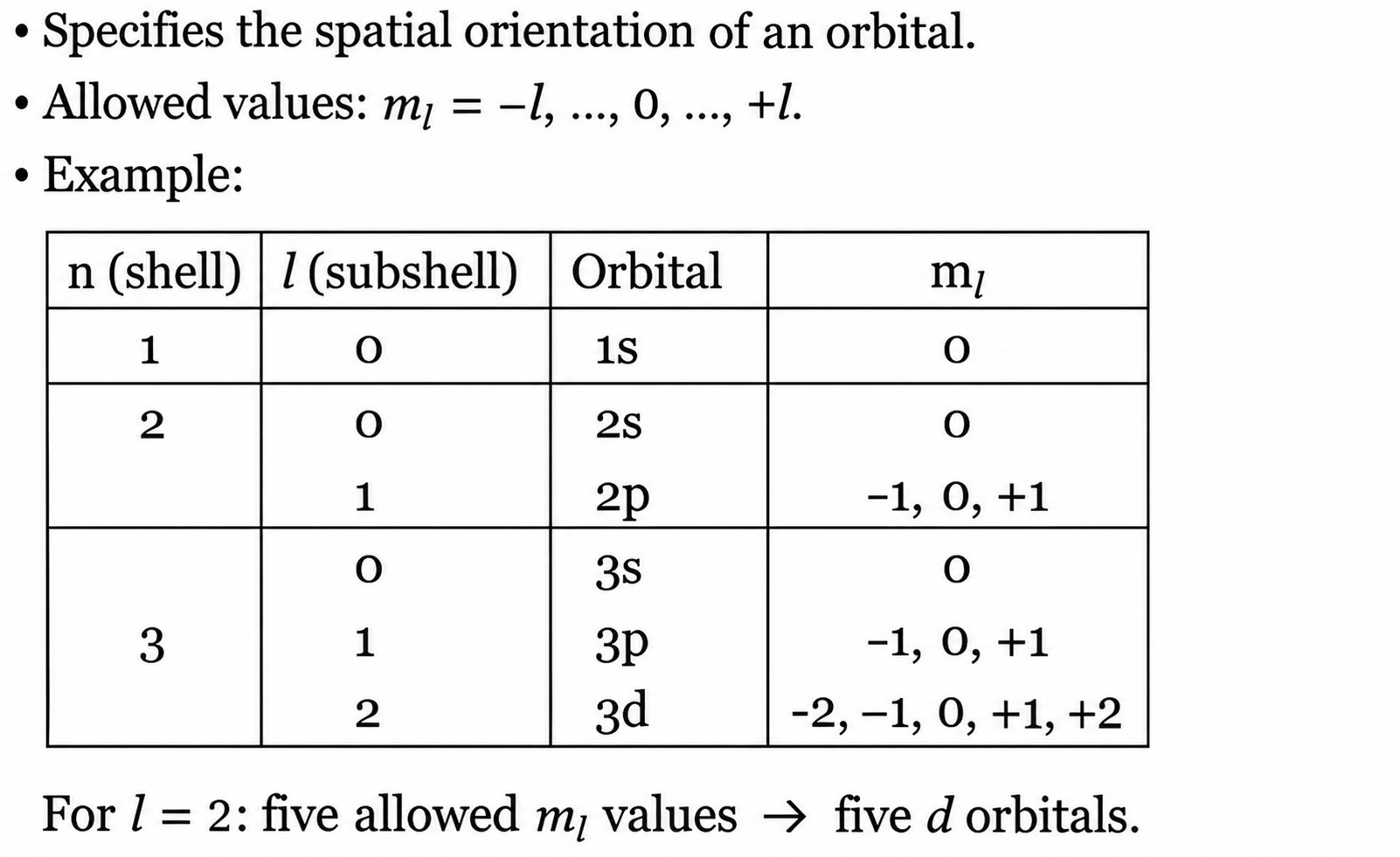
Magnetic quantum number: orientation and allowed values; l = 2 gives five d orbitals.

• Combined quantum numbers (n, l, ml)

Shell (n)

Subshell (l)

Orbital

Magnetic mₗ

Orbitals in subshell

Maximum electrons in shell (2n2)

1

0

1s

0

1

2

 0

  1

2s

 2p

 0

  -1, 0, +1

1

 3

3

0

1

 2

3s

3p

3d

0

 -1, 0, +1

  -2, -1, 0, +1, +2

1

 3

  5

4

0

1

 2

 3

4s

4p

4d

4f

   1

    3

    5

    7

E. Electron configuration

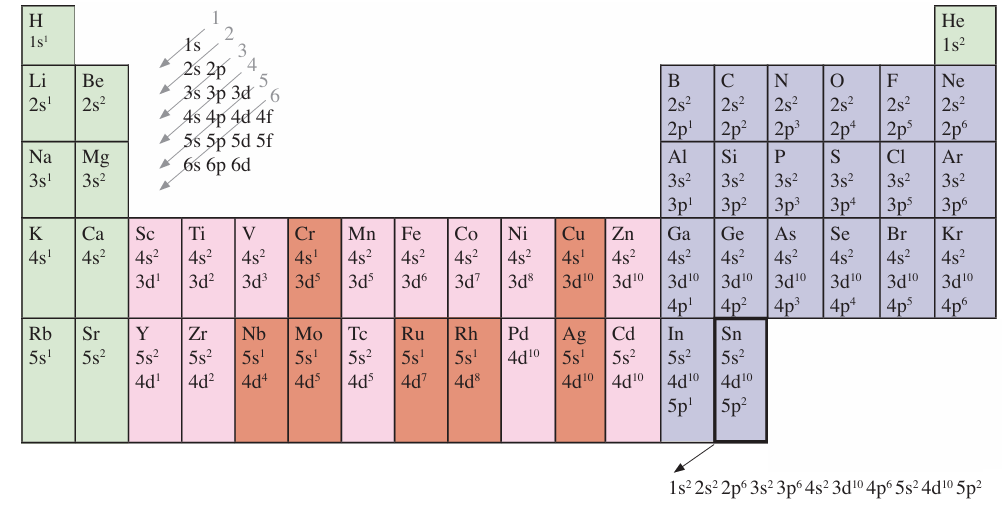
1. Filling order of electrons in orbitals (from low to high energy)

1s → 2s → 2p → 3s → 3p → 4s → 3d → 4p → 5s → 4d → 5p → ….

Fig. 4 Position of orbitals in the periodic table

2. Electron configuration

: the distribution of electrons among the orbitals of an atom or ion.

Ground state electron configuration

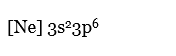
Shorthand electron configuration

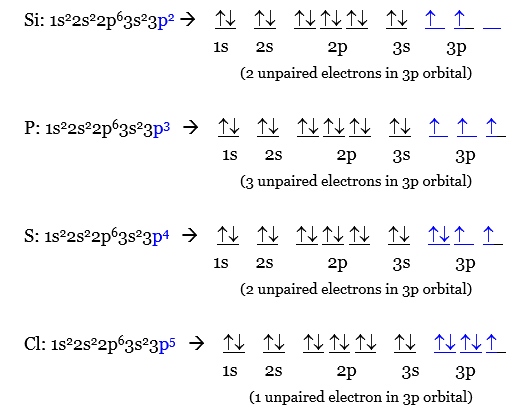
Orbital filling diagrams

Be

Ar

V

Fig. 5 Ground state electron configuration in the periodic table

** Examples of exceptions to the predicted electron-filling order

Cr, Cu, Nb, Mo, Ru, Rh, Ag (dark red color above)

Examples: Cr: 1s22s22p63s23p64s23d4 (X)  →  1s22s22p63s23p64s13d5 (O)

Cu: 1s22s22p63s23p64s23d9 (X)  →  1s22s22p63s23p64s13d10 (O)

F. Application of electron configuration

1. Counting unpaired electrons: count singly occupied orbitals in the orbital diagram

2. Ground state and excited state

  • Ground state: the lowest-energy electron configuration of an atom or ion.
  • Excited state: an electron configuration with greater energy than the ground state, often produced by promoting an electron to a higher-energy orbital.

G. Electromagnetic spectrum

1. Light

  • Classified by wavelength (λ)
  • The speed of light in a vacuum is c = 3.00 × 10⁸ m/s, independent of wavelength. Light travels more slowly in matter.
  • Frequency (ν): number of wave peaks per second (hertz, Hz, s-1)

** Photoelectric effect: emission of electrons from a metal when incident photons have enough energy to overcome its work function; the light must meet a threshold frequency.

2. Energy (E)

  • Long wavelength → low frequency → low energy
  • Short wavelength → high frequency → high energy
  • Example: Gamma rays → short wavelength → high energy

3. Order of energy

H. Periodicity

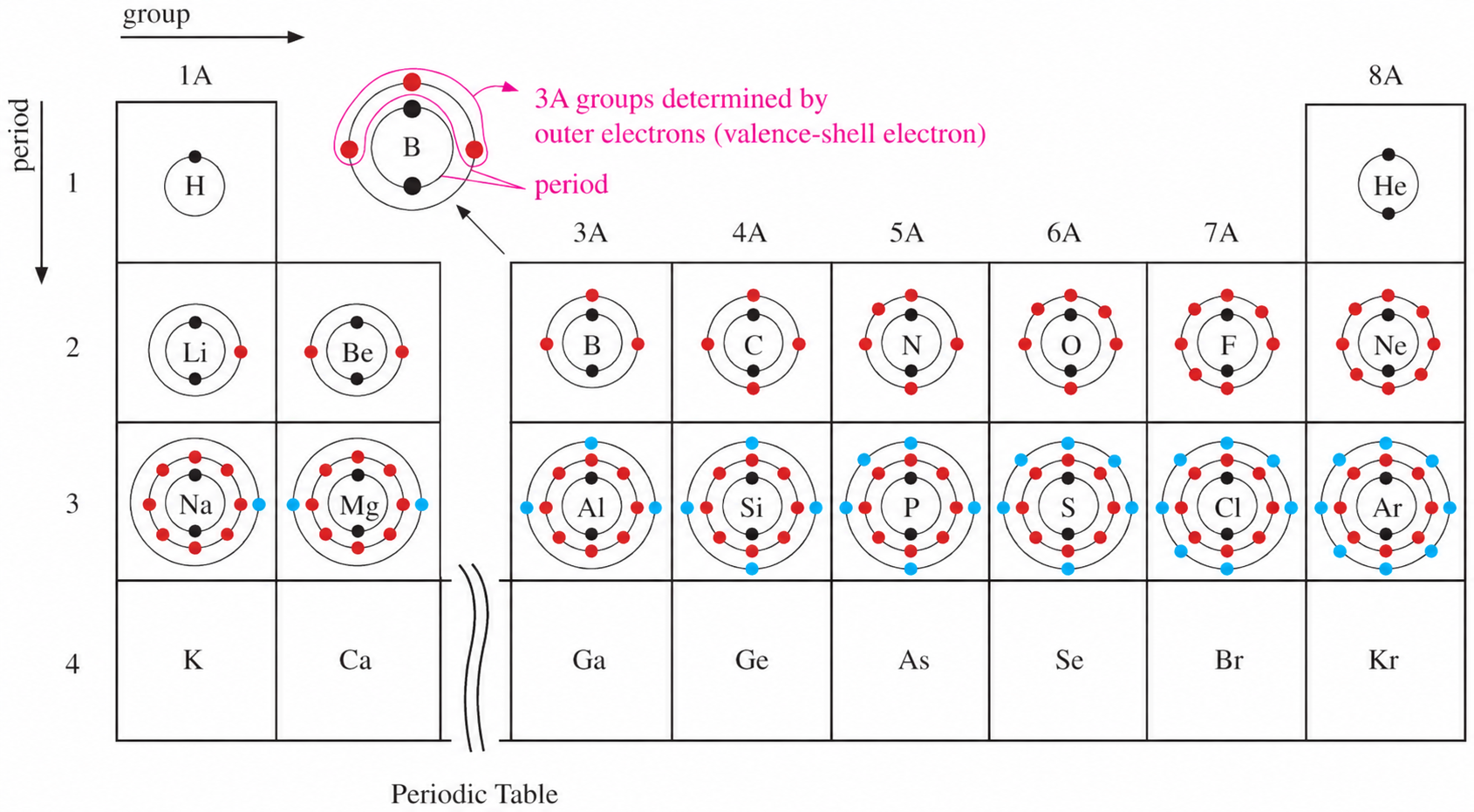
1. Periods

  • Seven horizontal rows, numbered 1–7
  • Atomic number increases by one from one element to the next across a period.

2. Groups

  • 18 columns, numbered 1–18 (older notation uses A and B groups).
  • Elements in the same main group generally have similar chemical properties and the same number of valence electrons; helium is an exception to the group 18 octet.

Example: Be, Mg, and Ca (group 2A) have similar chemical characteristics (they have 2 outermost electrons).

Fig. 6 Periods and groups

a. Metal and nonmetal

Category


Characteristics

Metal

• Often lose electrons to form cations and act as reducing agents. Metals generally conduct heat and electricity well.

• Malleability

• Ductility

• Shiny luster

• Typically solids

Nonmetal

• Often gain electrons to form anions or share electrons in covalent bonds. Many act as oxidizing agents. Most are poor conductors of heat and electricity.

• Brittle when solid

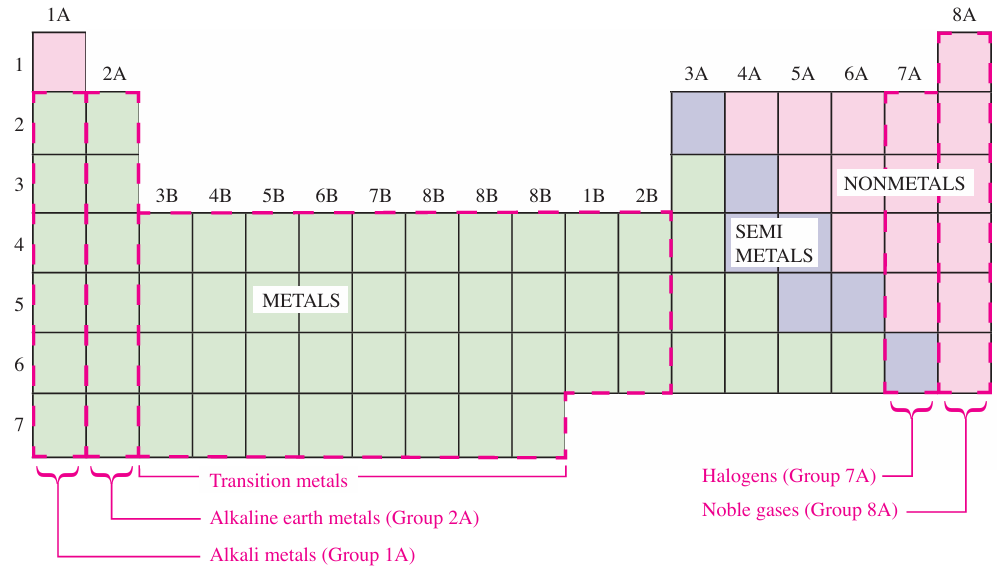
b. Classification of groups

Fig. 7 Classification of groups in periodic table

Category


Group

Features

Metal

groups

Alkali metals

• Group 1A except H (Li, Na, K, Rb, Cs, Fr)

• One valence electron; commonly lose one electron to form +1 cations.

• Reactive metals and strong reducing agents; form basic oxides and hydroxides.

• Generally have low melting points and low densities compared with many other metals.

• Occur naturally in compounds, commonly salts.

Alkaline earth metals

• Group 2A (Be, Mg, Ca, Sr, Ba, Ra)

• Two valence electrons; commonly form +2 cations.

• Strong reducing agents; many oxides and hydroxides are basic, but beryllium oxide and hydroxide are amphoteric.

• Generally have higher melting points than alkali metals in the same period.

• Occur naturally in compounds, commonly salts.

Transition

metals

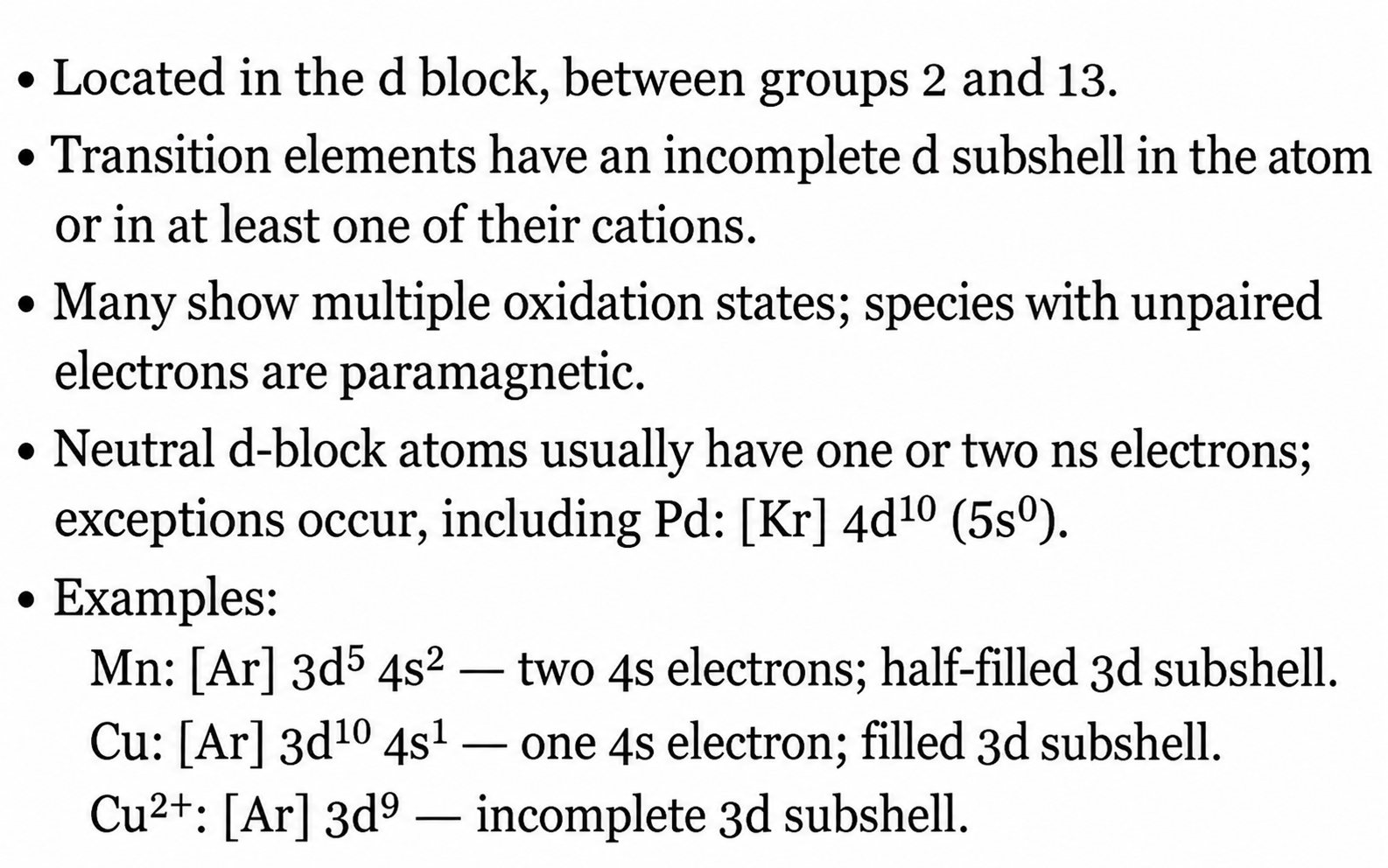
Transition elements: d subshells; Pd exception; Mn, Cu, and Cu2+ configurations.

Semi metals (metalloid)

• Intermediate characteristics between metals and nonmetals

• B, Si, Ge, As, Sb, Te, At

Nonmetals

Halogen

group

• Group 7A (F, Cl, Br, I, At)

• Seven valence electrons; often gain one electron to form −1 anions.

• Strong oxidizing agents, especially fluorine and chlorine.

• Colored nonmetals; many are corrosive.

• Commonly occur naturally in compounds such as halide salts.

Noble gas

group

• Group 8A (He, Ne, Ar, Kr, Xe, Rn)

• Very low reactivity because of 8 electrons (except He) in their outermost shells

• Colorless and odorless

I. Atomic radius

: a measure of atomic size, often defined as half the distance between the nuclei of two identical bonded atoms. An electron cloud has no sharp outer boundary.

1. Atomic radius in periodic table

  • In the same period, when the atomic number is increased, the atomic radius generally decreases because the attraction force between the protons (+) and outer electrons (-) is increased.

Li > Be > B > C > N > O > F

  • In the same group, when the atomic number is increased, the atomic radius generally increases because the electron shells are increased.

Li < Na < K < Rb < Cs < Fr

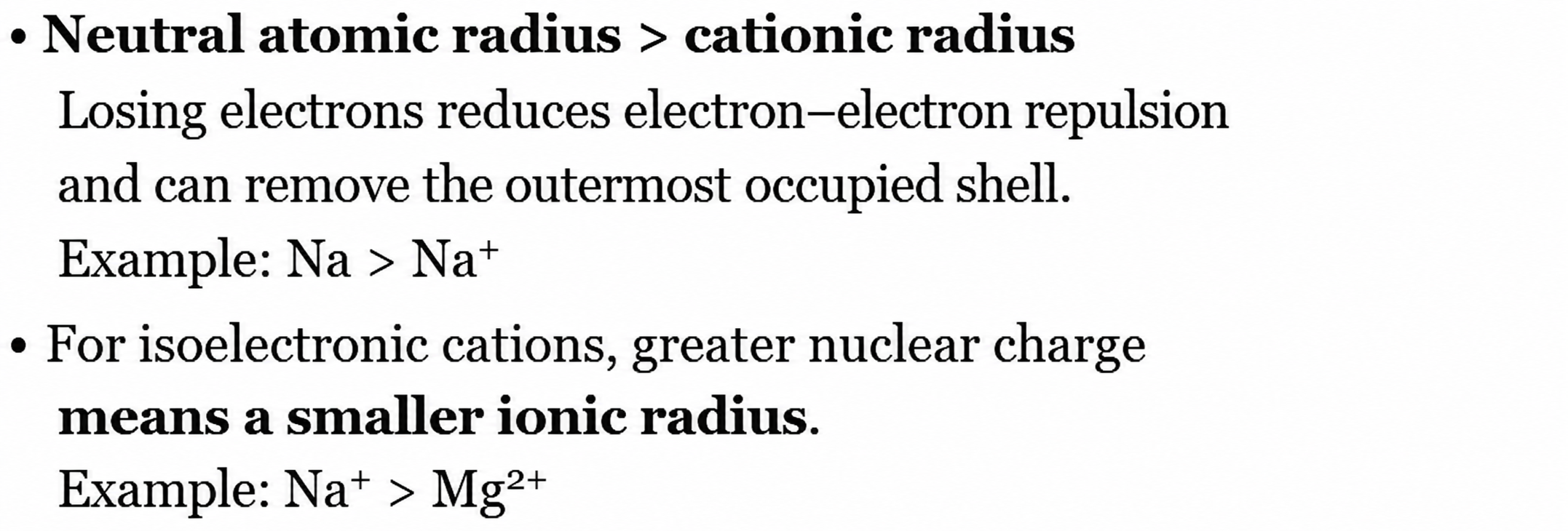
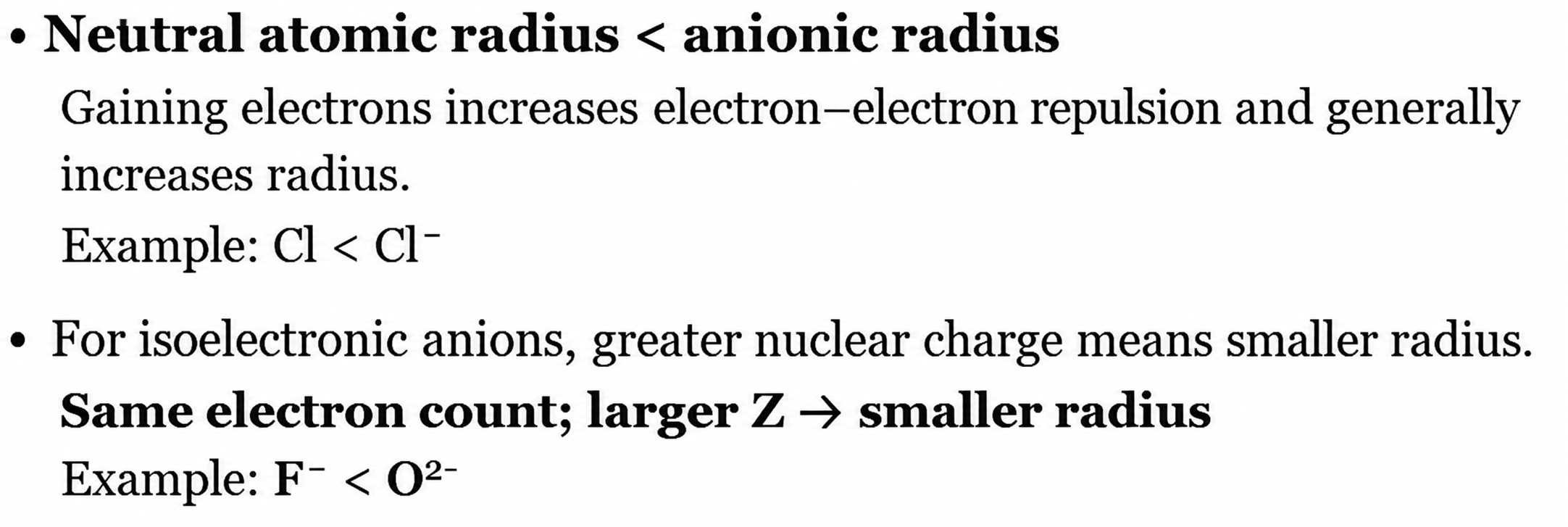
  • A cation is generally smaller than its neutral atom, and an anion is generally larger. Within an isoelectronic series, radius decreases as nuclear charge increases.

Ca2+ < K+ < Ar < Cl– < S2-

2. Cationic and anionic radii

Category


Features

Cations

Cations are smaller than their neutral atoms; within an isoelectronic series, greater nuclear charge means smaller radius.

Anions

J. Ionization energy (Ei)

: energy required to remove an electron from an isolated gaseous atom.

Atom(g) + energy  →  cation+(g) + e–

Fig. 8 Ionization energy of Li

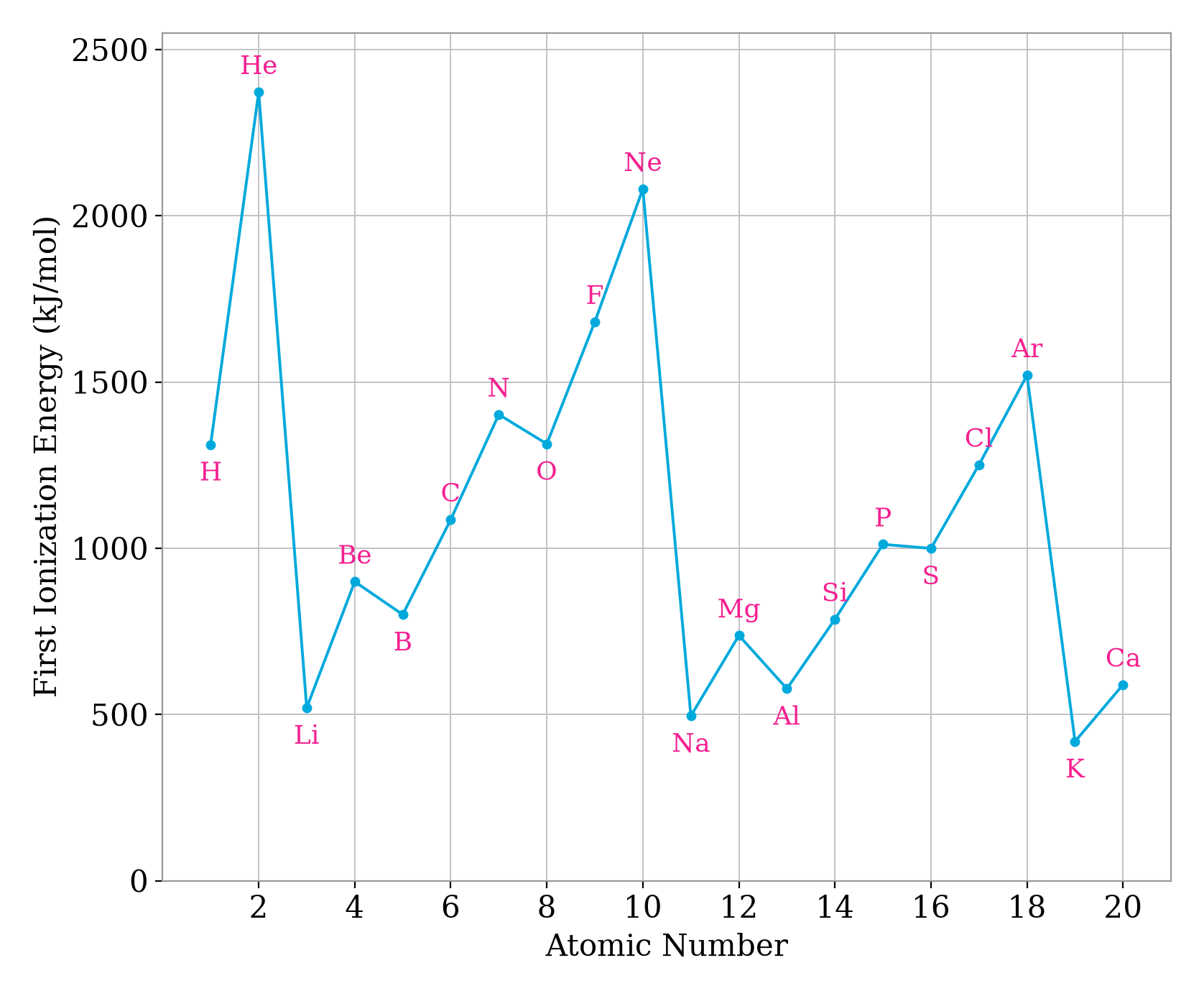
  • First ionization energy: the energy required to remove an electron from an isolated gaseous atom. A filled valence shell generally makes electron removal more difficult.

Ar > Be > Li

  • Second ionization energy: the energy required to remove an electron from a gaseous +1 ion. It is especially large when the first ionization leaves a filled shell, as in Li+.

Li > Ar > Be

Ground state electron configuration

Outermost electron(s)

Ei 1

(kJ/mol)

Ei 2

(kJ/mol)

Ei 3

(kJ/mol)

Li

1

520

7,300

11,820

Be

2

900

1,760

14,850

Ar

8

1,520

2,670

3,930

a. General trend

  • In the same period, with the increasing atomic number, the Ei generally increases.

O < F < Ne

  • In the same group, with the increasing atomic number, the Ei generally decreases.

He > Ne > Ar

  • Filled and half-filled subshells are relatively stable; this helps explain ionization-energy exceptions such as Be > B and N > O.

     Therefore, ionization energy: Be > B

     Therefore, ionization energy: N > O > C

Fig. 9 Ionization energy of the atoms

K. Electron affinity (Eea)

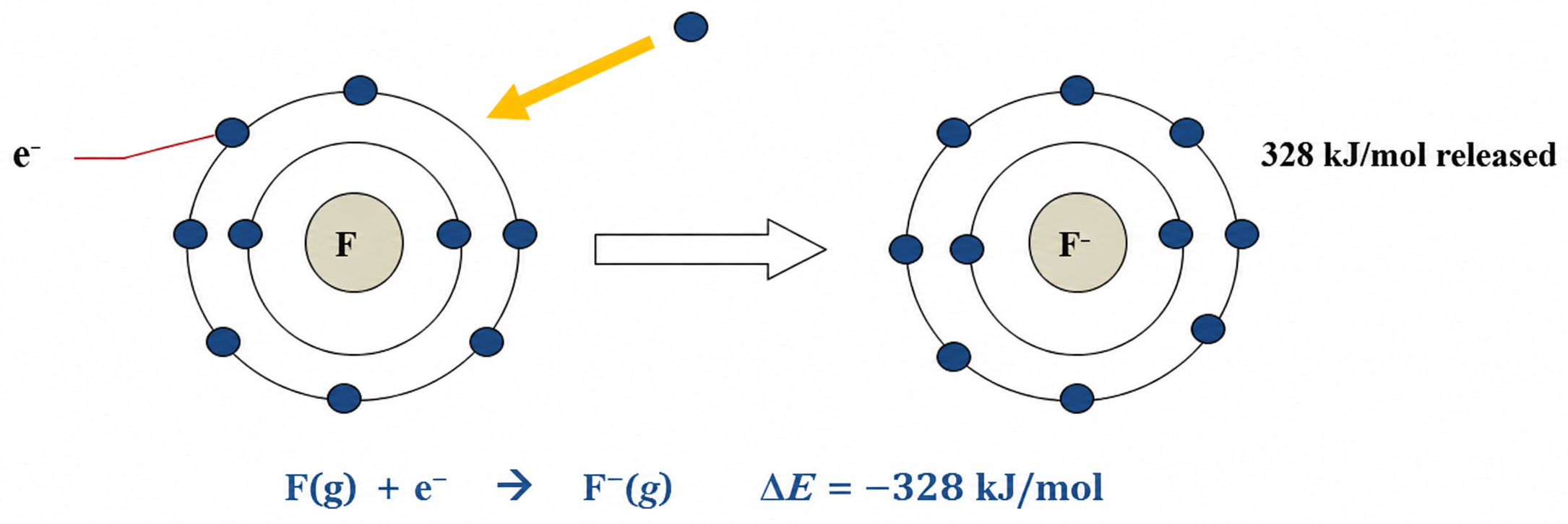
: the energy released when an isolated gaseous atom gains an electron. The energy released is positive for favorable attachment; the corresponding energy change of the atom is negative. Electron attachment can also require energy. The comparisons below use the amount of energy released.

Atom(g) + e– → anion(g)

Fig. 10 Electron affinity of F

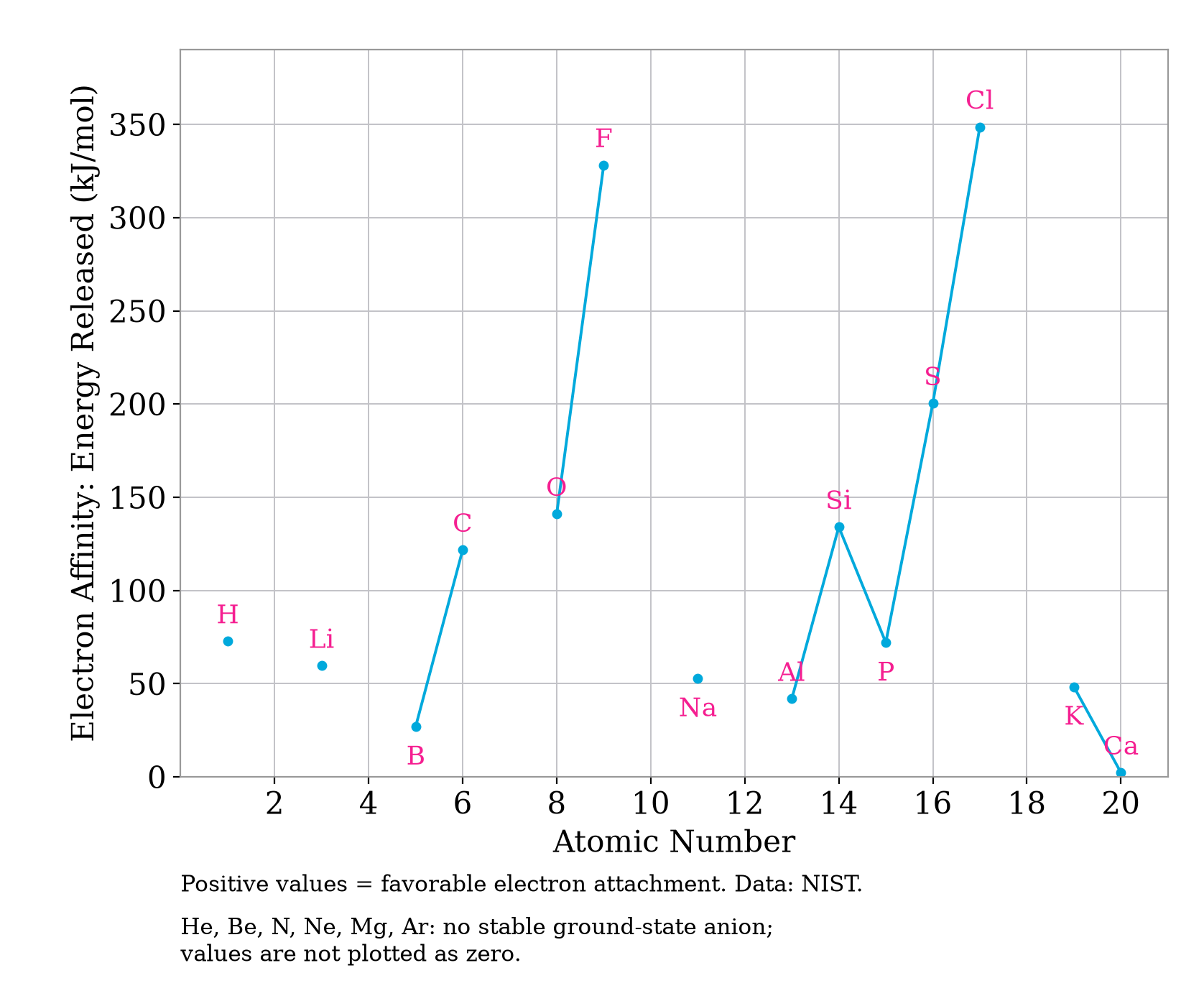
a. General trends

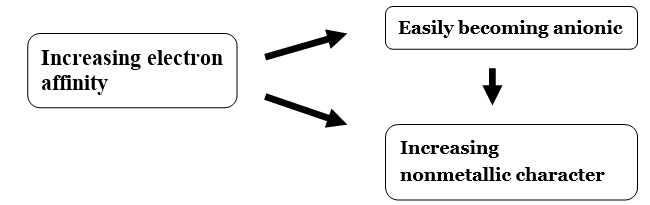
  • The Eea of 8A group (noble gases) is unfavorable for electron attachment; stable isolated anions are generally not formed.
  • In the same period, with the increasing atomic number, the Eea generally becomes more favorable, with important exceptions.

N < O < F

  • In the same group, with the increasing atomic number, the Eea often becomes less favorable; this is not a strict trend.

Cl > Br > I        ** exception (F < Cl)

  • For example, adding an electron to carbon is more favorable than adding one to nitrogen because nitrogen already has a half-filled 2p subshell.

Therefore, electron affinity: C > N

  • Electron attachment to fluorine completes its 2p subshell and releases energy; adding an electron to neon would require occupation of a higher shell and is unfavorable.

Therefore, electron affinity: F > Ne

Fig. 11 Electron affinity of the atoms

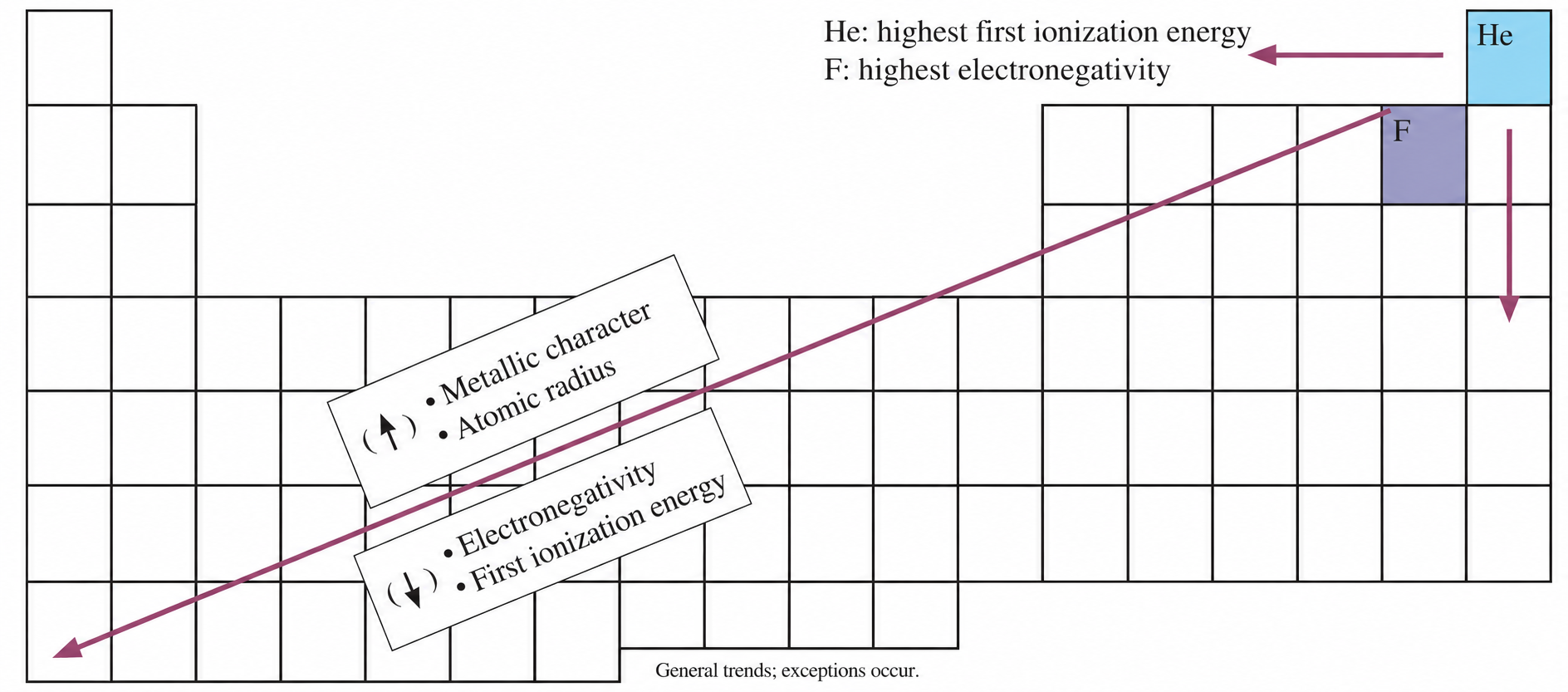
L. Tendency of atoms in periodic table

  • Metallic character and atomic radius generally increase toward the lower left of the periodic table. London dispersion forces often increase down a group as polarizability increases; they do not follow a universal diagonal trend.
  • Electronegativity and first ionization energy generally increase toward the upper right. Electron affinity has more exceptions and must be compared using a stated sign convention.

Increasing

Decreasing

Going left and down (general trends) on the periodic table


• Metallic character

• Atomic radius

Dispersion forces have no universal diagonal trend.

• Electronegativity

• First ionization energy

Electron affinity has many exceptions and no simple downward trend.

Fig. 12 General periodic trends