V. Genetics
Key focus of this chapter: DNA and Chromosome
This chapter focuses on DNA and Chromosome and gives concise summaries of the important things about cell division, mendelian genetics, making protein, and mutation.
A. Cell Division
1. Cell cycle
a. Controlling cell cycle
- G1 checkpoint
– determines whether cell cycle goes to S phage or G0 phage, which is no dividing state.
– cell growth checkpoint
- G2 checkpoint
– checkpoint before M phage.
– DNA synthesis checking point.
– controlling MPF molecule, which is to promote mitosis and composed of Cdk and cyclin.
- M checkpoint
– checking mitotic spindle at metaphase.
b. Mitosis
- Produces genetically identical daughter cells (2N → 2N) in somatic cell.
- Occurrs for repairing tissues and growing organisms.
Cell phages | Classification | Descriptions | |
Interphase | G1 phase | • Cell growth • First gap • The longest phase of cell life | |
S phase | • DNA synthesized • Duplicated chromatin | ||
G2 phase | • Cell growth and preparing for mitosis • Second gap | ||
M Phage | Mitosis | Prophase | • Nuclear envelope disappears • DNA condenses into chromosomes • Spindle microtubule begins to form • Centrosomes move into opposite ends of the cell |
Metaphase | • Chromosomes align along the metaphase plate • Spindle fibers attach to the kinetochores | ||
Anaphase | • Separating and moving sister chromatids to opposite poles by spindle fibers | ||
Telophase | • Nuclear envelopes reappears • Chromosomes begin to be less condensed | ||
Cytokinesis | Cytokinesis | • Two daughter cells form • Plant cell: forms cell plate • Animal cell: forms cleavage furrow | |
c. Meiosis
- Sexual reproduction resulting in spores or gametes.
- Reducing chromosome sets from diploid to haploid (2N → N) in germ line cells.
- Genetic diversity increased by independent assortment.
** Interphase in mitosis is same as in meiosis.
Meiosis I | Prophase I | • Nuclear envelope disappears • DNA condenses into chromosomes and then forms homologous chromosome pairs (tetrad) • Synapsis and crossing over of homologous chromosomes at chiasma • Spindle microtubule begins to form • Centrosomes move into opposite ends of the cell |
Metaphase I | • Pairs of homologous chromosomes line up along the metaphase plate • Spindle fibers attach to the kinetochores | |
Anaphase I | • Pairs of chromosomes separate and move to opposite poles by spindle fibers. | |
Telophase I & Cytokinesis | • Forming two haploid daughter cells • Plant cell: forming cell plate • Animal cell: forming cleavage furrow | |
Meiosis II | Prophase II | • Spindle microtubule begins to reform • Centrosomes move into opposite ends of the cell |
Metaphase II | • Chromosomes align along the metaphase plate • Spindle fibers attach to the kinetochores | |
Anaphase II | • Chromosome separate and sister chromatids move to opposite poles by spindle fibers | |
Telophase II & Cytokinesis | • Nuclear envelopes reappear • Chromosomes begin to be less condensed • Haploid daughter cells form • Cell plate of plant cell and cleavage furrow of animal cell |
2. Cycle of sexual life
- Gametes
– reproductive germ-line cells
– haploid cells (n)
– eg/ Sperm and eggs
- Zygote
– fertilized egg
– diploid cell (2n)
- Somatic cells
– forming body of eukaryotic species except reproductive germ-line cell
B. Population genetics
1. Hardy-Weinberg equilibrium
a. Equation
![]() |
b. Condition
- Large population
- Isolation (no gene flow)
- No mutation
- Random mating
- No natural selection
2. Genetic Drift
: reducing genetic variation from one generation to next generation.
a. Bottleneck effect
- Sudden disasters drastically reduce the drastic size of population.
b. Founder effect
- Isolated group from large population loses genetic variation and establishes new population.
3. Genotype Frequency
a. Inbreeding
- Breeding between closely related animals to increase homozygotes of progeny.
b. Hybridization
- Breeding between different related animals to increase variation of species and characteristics of both parents.
C. Mendelian genetics
1. Terminology
- Allele
– alternative form of a gene.
– eg/ P: dominant allele, p: recessive allele
- Phenotype: observable trait
- Genotype: genetic constitution
- Dominant allele
– determining the phenotype of organism.
– appearance of the treat from dominant homozygotes and heterozygotes.
- Recessive allele
– not affecting the phenotype of organism.
-only appearance of the traits from recessive homozygotes.
- Hemizygous – describing sex-linked genes such as male chromosomes (XY).
- Pair of homologous chromosomes.
– same staining pattern (same length and centromere position) between two chromosomes.
- Homozygous: A pair of identical alleles.
- Heterozygous: A pair of different alleles.
Pair of homologous chromosomes | Homozygous | Heterozygous |
![]() | AA, aa | Aa |
- Law of segregation
– separating two alleles into one allele to be different gametes during gamete formation.
- Law of independent assortment
– separating each pair of alleles and assorting independently of one another during gamete formation.
- Testcross
– to determine the genotype of parent organism, crossing a recessive homozygous individual with the dominant phenotype of daughter organism.
– the result of all dominant phenotype is homozygous type of parent.
– the result of half dominant and half recessive phenotype is heterozygous type of parent.
2. Mendelian experiments
Classification | Figures | Features |
P generation | ![]() | ![]() |
F1 generation | ![]() | ![]() |
F2 generation | ![]() | ![]() |
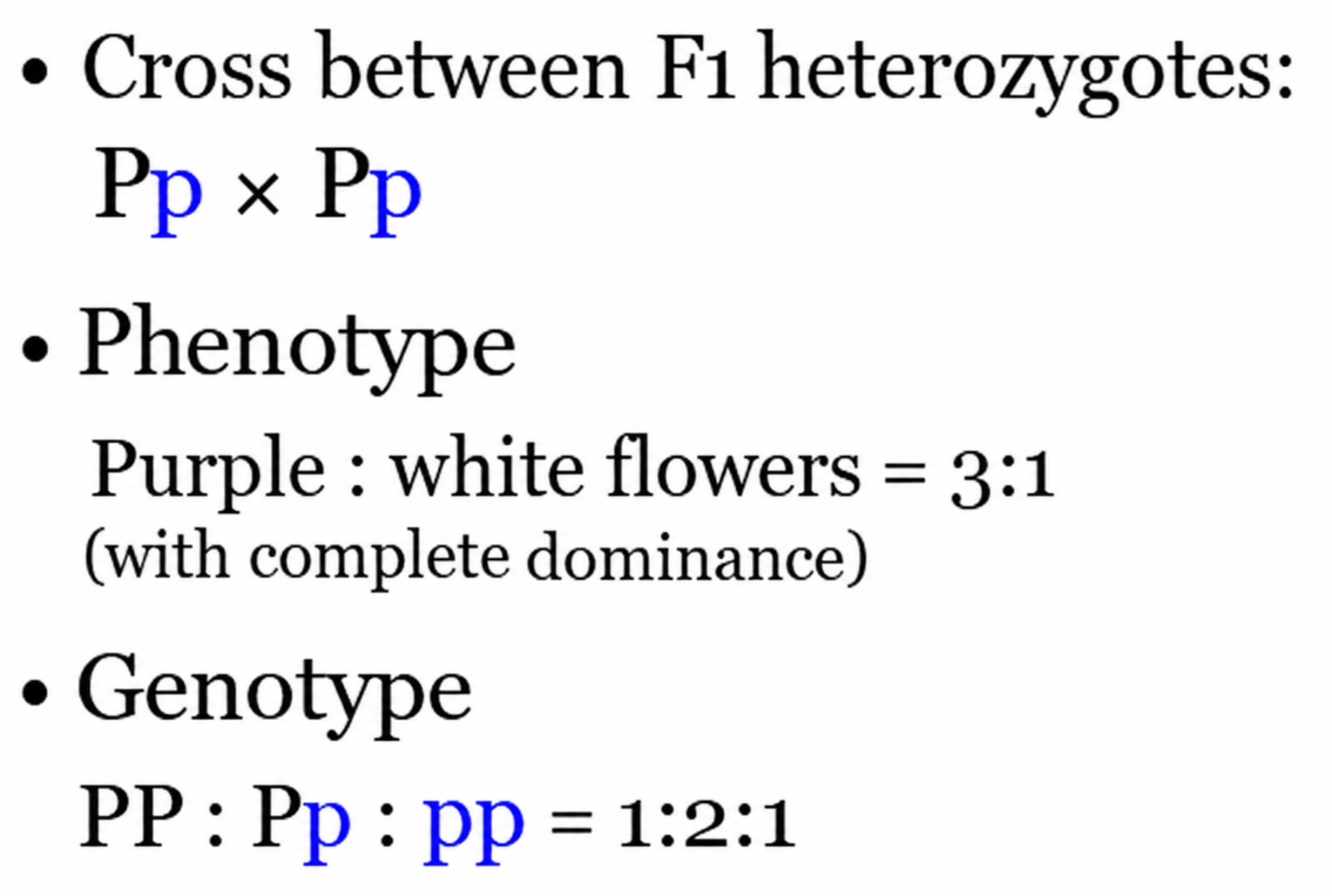
- Monohybrids
– crossing between two heterozygotes of F1 generation having a single characteristic.
– eg/ Bb × Bb → Phenotypic ratio with 3:1
- Dihybrids
– crossing between two heterozygotes of F1 generation having two characteristics.
– eg/ BbDd × BbDd → Phenotypic ratio of 9:3:3:1 from F2 generation
3. Law of probability
Traits | Figures | Features and diseases |
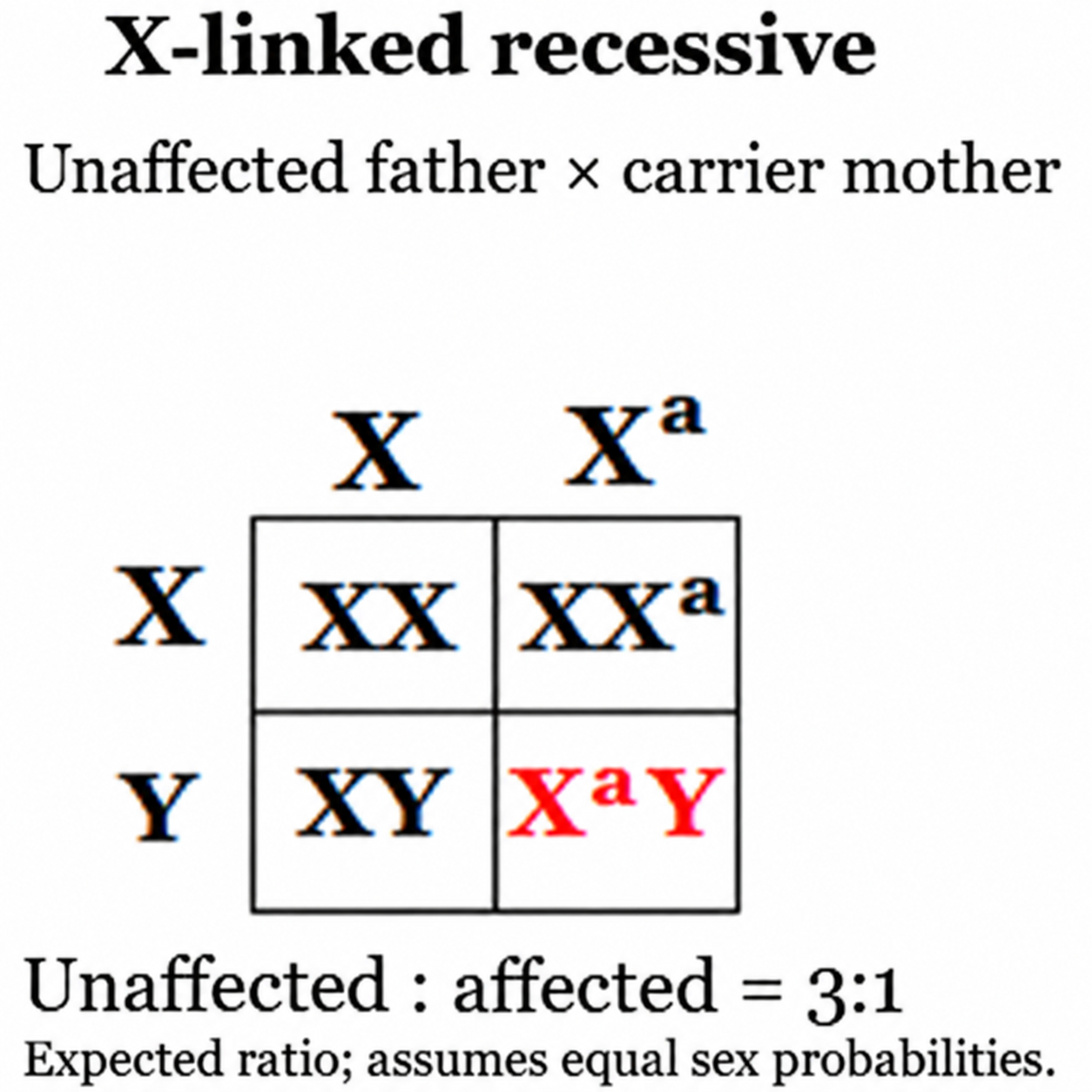
Sex-linked traits | ![]() | • Passing the traits on X chromosome to offspring • Male offspring have the traits when the female parent have the gene • Female offspring have the traits when both of the parents have the gene. • Eg/ Hemophilia, color blindness |
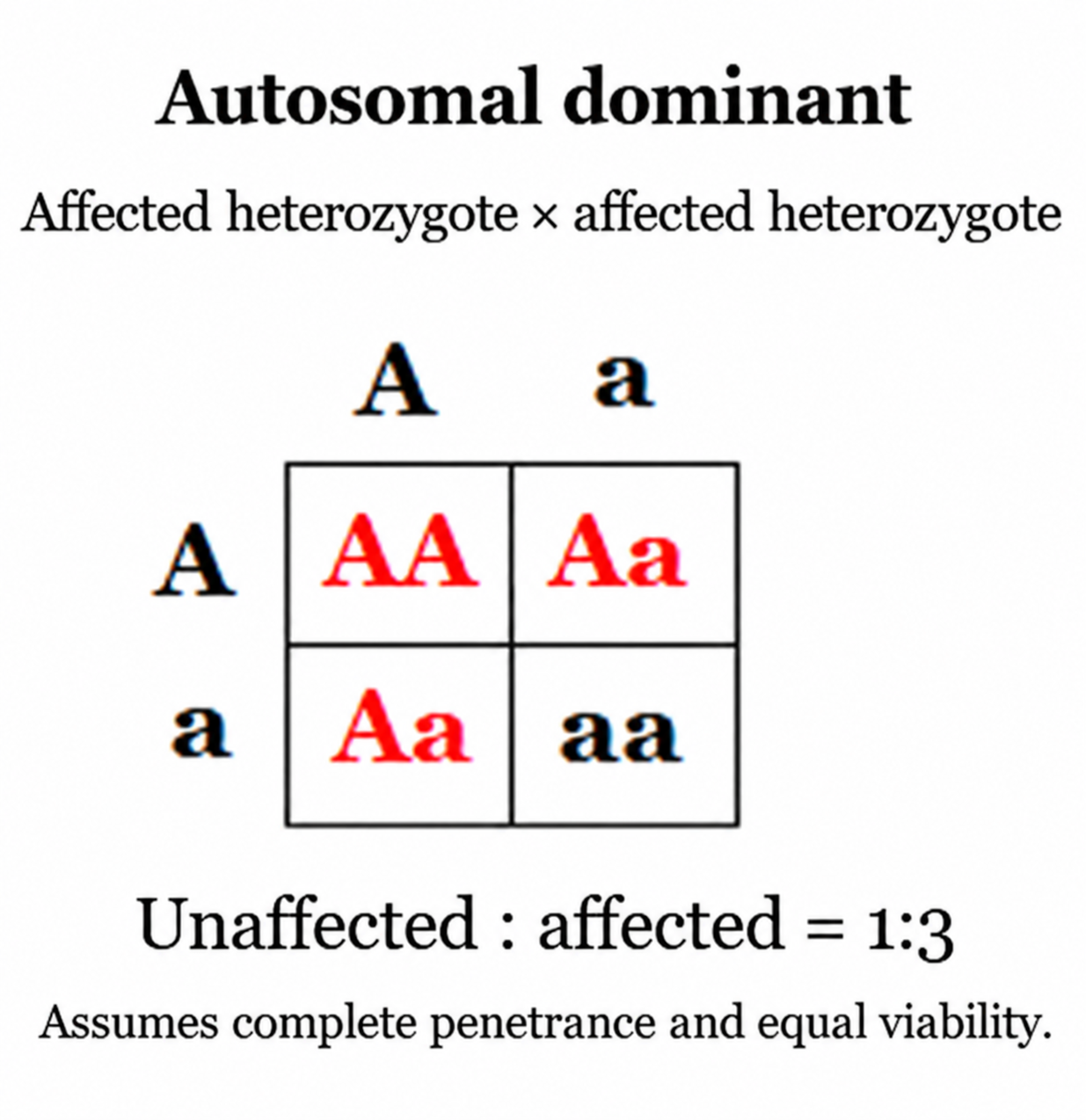
Autosomal traits | ![]() | • Diseased offspring with heterozygous and homozygous recessive • Eg/ Achondroplasia dwarfism, Huntington’s disease, progeria (premature aging) |
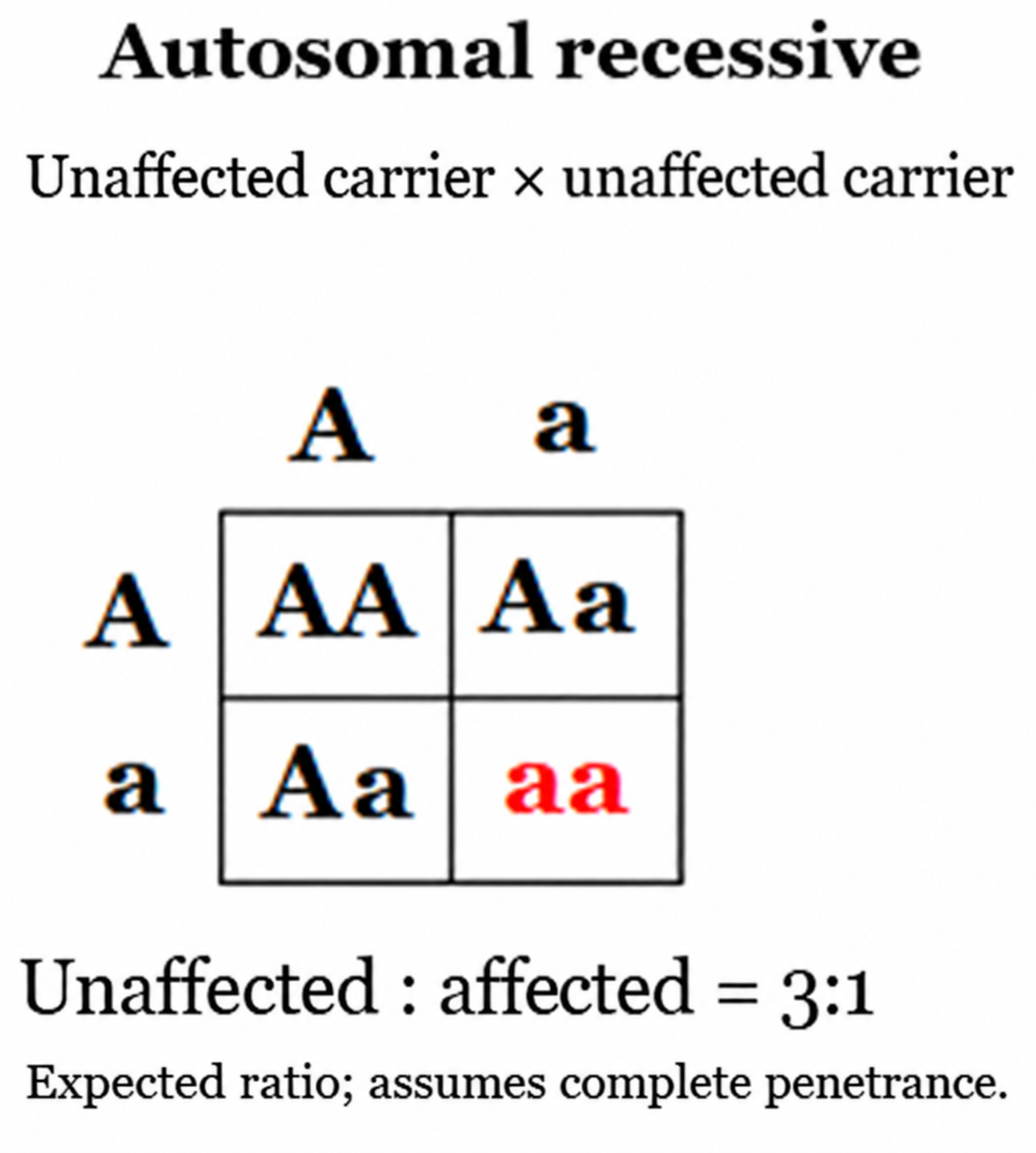
![]() | • Diseased offspring with homozygous recessive • Eg/ Sickle cell anemia, PKU disease, albinism, Galactosemia, Tay-Sachs disease |
4. Pedigrees
- Autosomal traits
– father has no disease but one female offspring has disease.
- Dominant traits
– do not skip diseases in every generation.
- Recessive traits
– both parents has no disease but at least one offspring has disease.
5. Inheritance
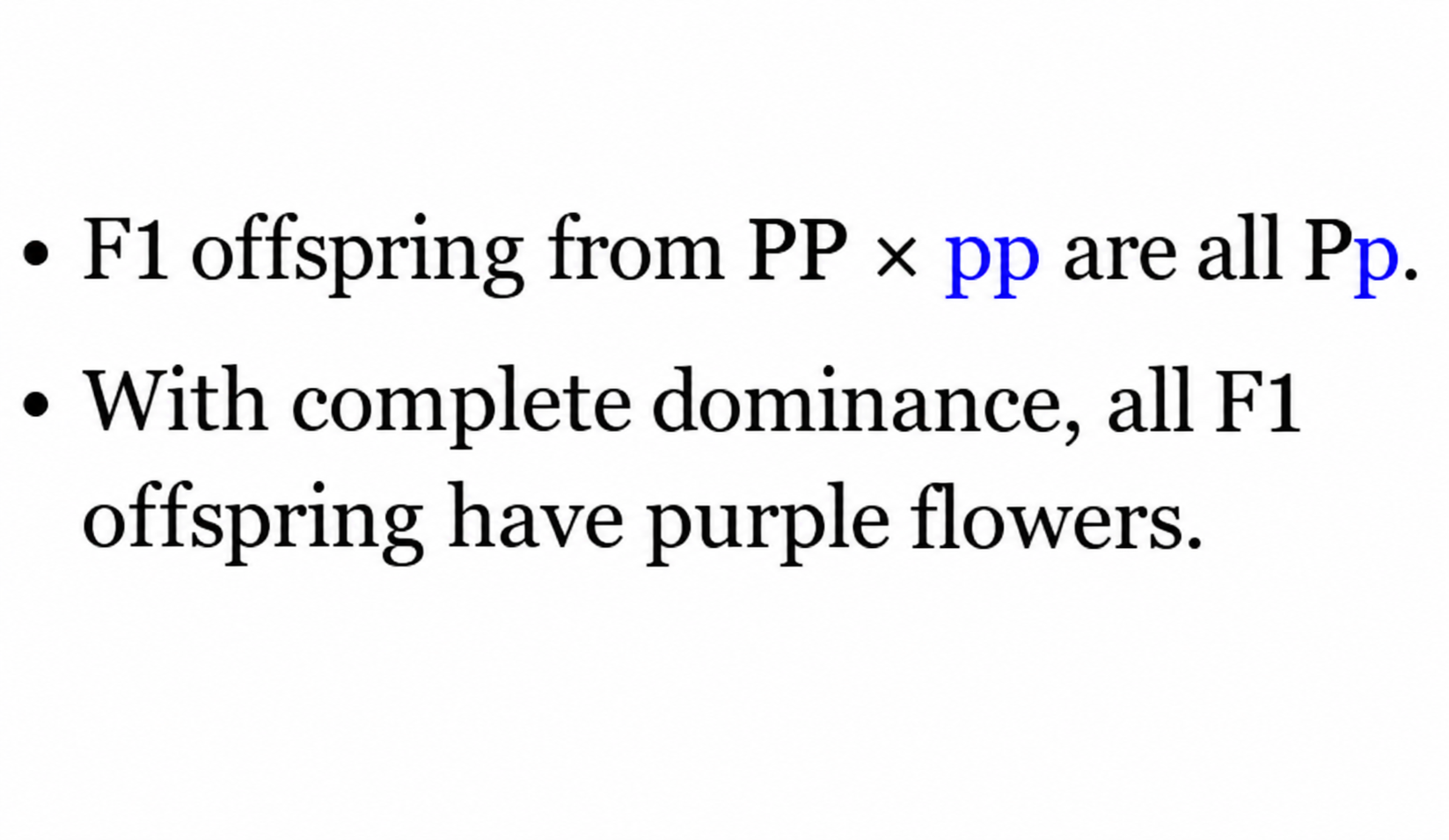
a. Complete dominance
- Having one phenotype of F1 generation from both parental traits.
- Purple flower × white flower → purple flower
b. Incomplete dominance
- Having an intermediated phenotype of F1 generation from both parental traits.
- Eg/ White flower × red flower → pink flower
c. Codominance
- Having both phenotypes of F1 generation from both parental traits.
- Eg/ roan horse (black coat × white coat → black and white coats)
- Eg/ blood group (IA, IB, Io), (multiple alleles or polymorphism)
Phenotype | Genotype | Antibodies |
A | ![]() | Anti-B |
B | ![]() | Anti-A |
AB | ![]() | None |
O | ![]() | Anti-A, Anti-B |
d. Pleiotrophy
- A single gene affects symptoms of the multiple phenotypic traits.
- Eg/ Sickle-sell disease
e. Epistasis
- Phenotypic expression by alternation one gene to the second gene.
- Eg/ Color of mice
f. Polygenic inheritance
- Phenotypic expression by quantitative variation of gene.
- Eg/ Skin color
g. Penetrance
- Percentage of individuals showing mutant genotype.
h. Multifactorial disorder
- Disorder with genetic component from environmental effects.
i. Maternal effect
- Inheritance of mitochondrial DNA from the mother.
D. Gene experiment
1. Griffith transforming experiment
a. Experiment
– 1) injection living S cells (encapsulated bacteria) into a mouse → mouse dies
– 2) injection living R cells (nonencapsulated bacteria) into a mouse → mouse lives
– 3) injection heat-killed S cells into a mouse → mouse lives
– 4) injection mixture of heat-killed S cells and living R cells into a mouse → mouse dies
b. Conclusion
- The living R bacteria were converted into the pathogenic S bacteria by an unknown.
2. Avery, Macleod, Mc Carty experiment
a. Experiment
– 1) mixture heat-killed S cells, living R cells, and protease → living S cells
– 2) mixture heat-killed S cells, living R cells, and ribonuclease → living S cells
– 3) mixture heat-killed S cells, living R cells, and deoxyribonuclease → no living S cells
b. Conclusion
- DNA is the transforming factor.
E. Chromosomal basic
1. Chromosomes in humans
- 46 chromosomes in diploid cells (2n).
- 23 chromosomes in haploid gametes (n).
- 2 sex chromosomes (X and Y) and 44 autosomes.
2. Chromosome appearances
Classification | Features |
Metacentric | Location of centromere at middle of chromosome |
Acrocentric | Location of centromere at close to end of chromosome |
Telocentric | Location of centromere at end of chromosome |
3. Level of chromosomal organization
- Histone: DNA packing molecules composed of protein.
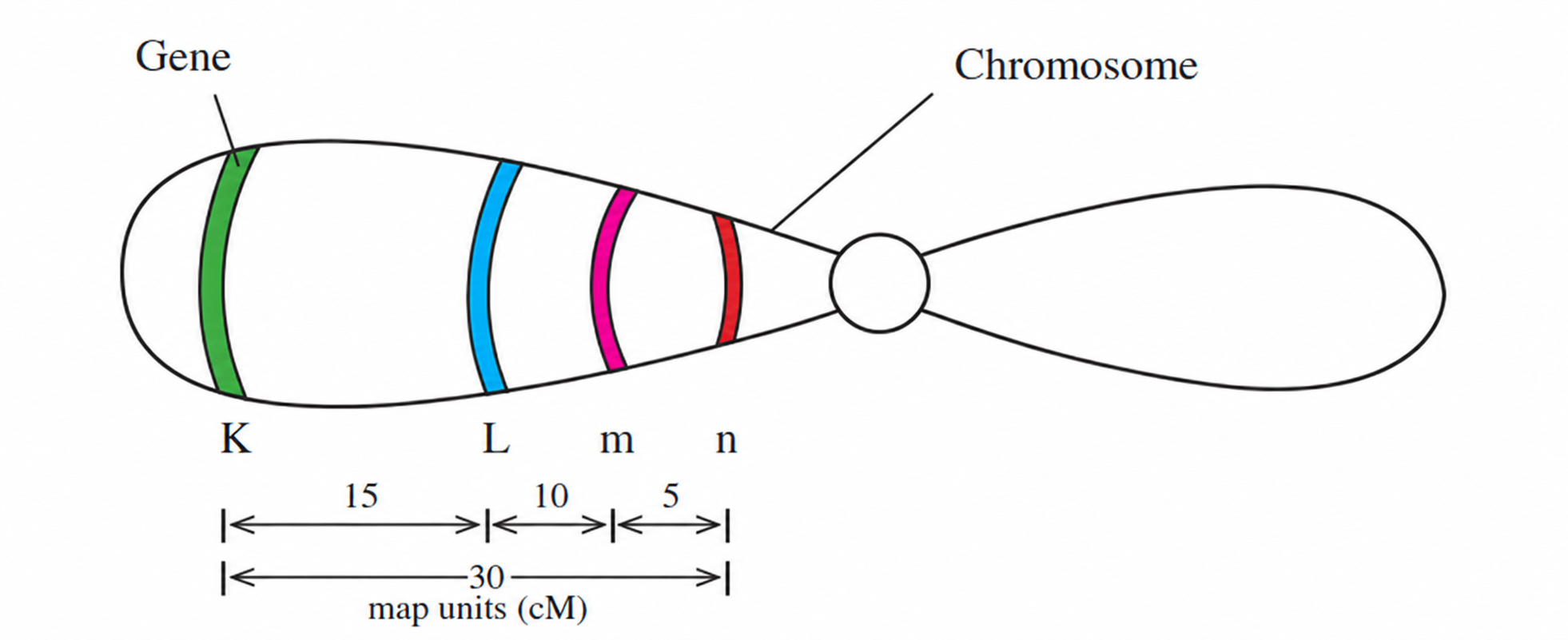
4. Linked genes
: genes on the same chromosome are inherited jointly in crossing over.
- Measuring the gap between two linked genes by probability of crossing over.
- Increased probability of crossing over with greater the gap between two linked genes.
- Linkage map
5. Sex-linked genes
: genes on X or Y chromosomes.
- Sex-linked recessive traits
– hemophilia
– color blindness
- Barr body: an inactivated x-chromosome
6. Chromosomal alteration
a. Changing chromosome number
- Nondisjunction
– separation failure of pairs of homologous chromosomes in meiosis I or chromosomes in meiosis II.
- Aneuploidy
: abnormal number of chromosomes from the nondisdunction of meiosis I or II.
– monosomic (n –1): Presence of one chromosome
– trisomic (n+1): Presence of three chromosomes
- Polyploid
: more than two sets of chromosomes.
– triploidy (3n)
– tetraploid (4n)
b. Changing chromosomal structures
- Translocation
– breakage and rearrangement of chromosome.
- Deletion
– lost chromosomal segment.
- Duplication
– repeating chromosomal segment.
- Inversion
– reverse attachment of chromosomal segment.
7. Human disorders
a. Down syndrome
- Nondisjunction of chromosome 21 (Trisomy 21)
- 47 chromosomes
b. Klinefelter syndrome
- Nondisjunction of X chromosome
- Sterile male with XXY chromosomes
- Female body characteristics
- 47 chromosomes
c. Turner syndrome
- Nondisjunction of X chromosome
- Sterile female having only one X chromosome
- Monosomy of sex chromosome
- 45 chromosomes
F. DNA replication
1. DNA structure
- Rosalind Franklin made X-ray diffraction photograph.
- James Watson and Francis Crick corrected DNA model of double helix structure.
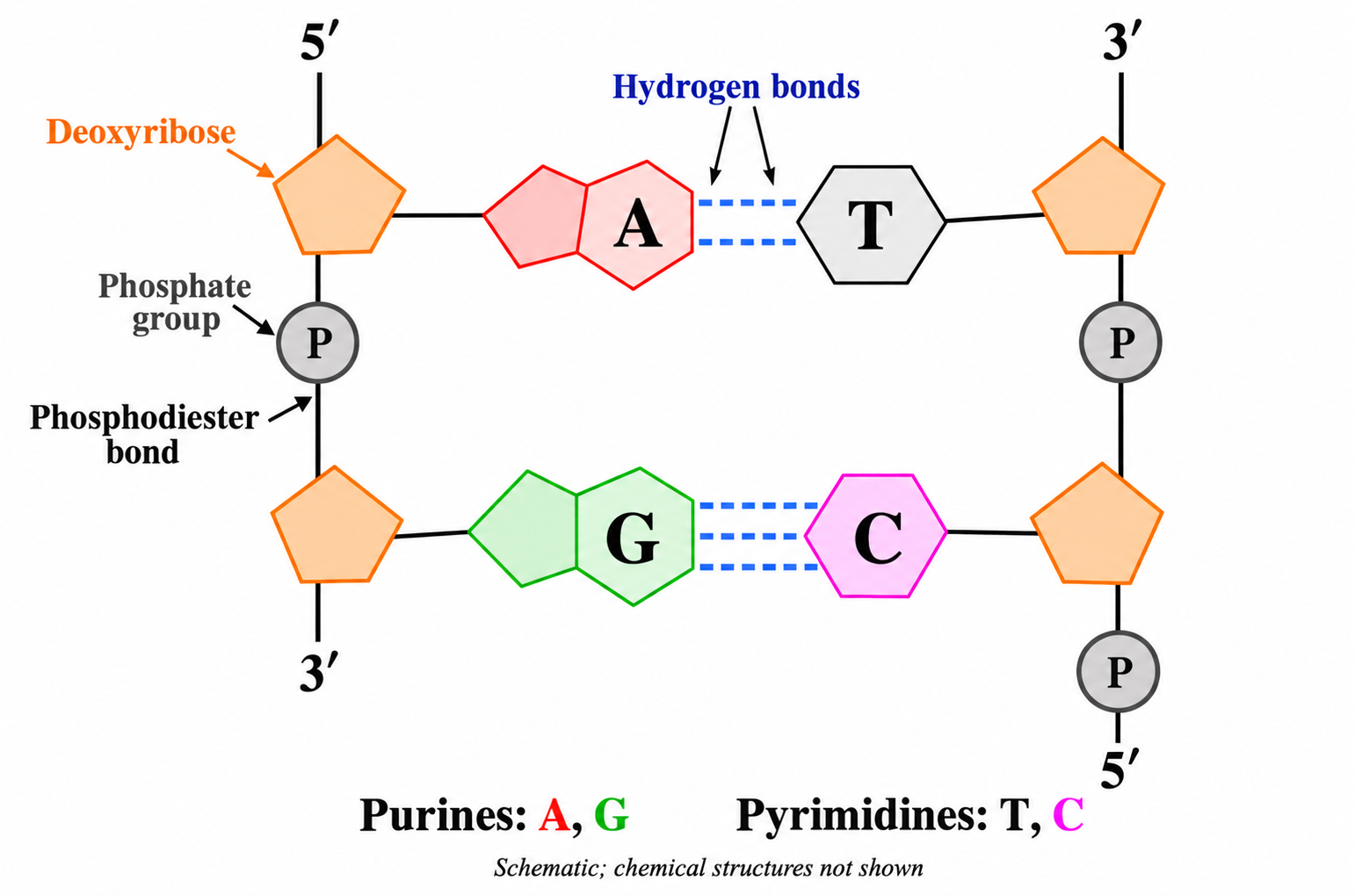
- DNA backbone: carbon sugars bound to phosphate groups.
- Purine: A (adenine), G (guanine).
- Pyrimidine: C (cytosine), T (thymine).
- Two hydrogen bonds between A and T, three hydrogen bonds between G and C.
- Molecules containing G and C have a higher melting point than those containing A and T.
2. Chargaff’s rules
- A+G = C +T
- Eg/ A = 30%, G = 20%, C = 20%, T = 30%
3. Semiconservative model
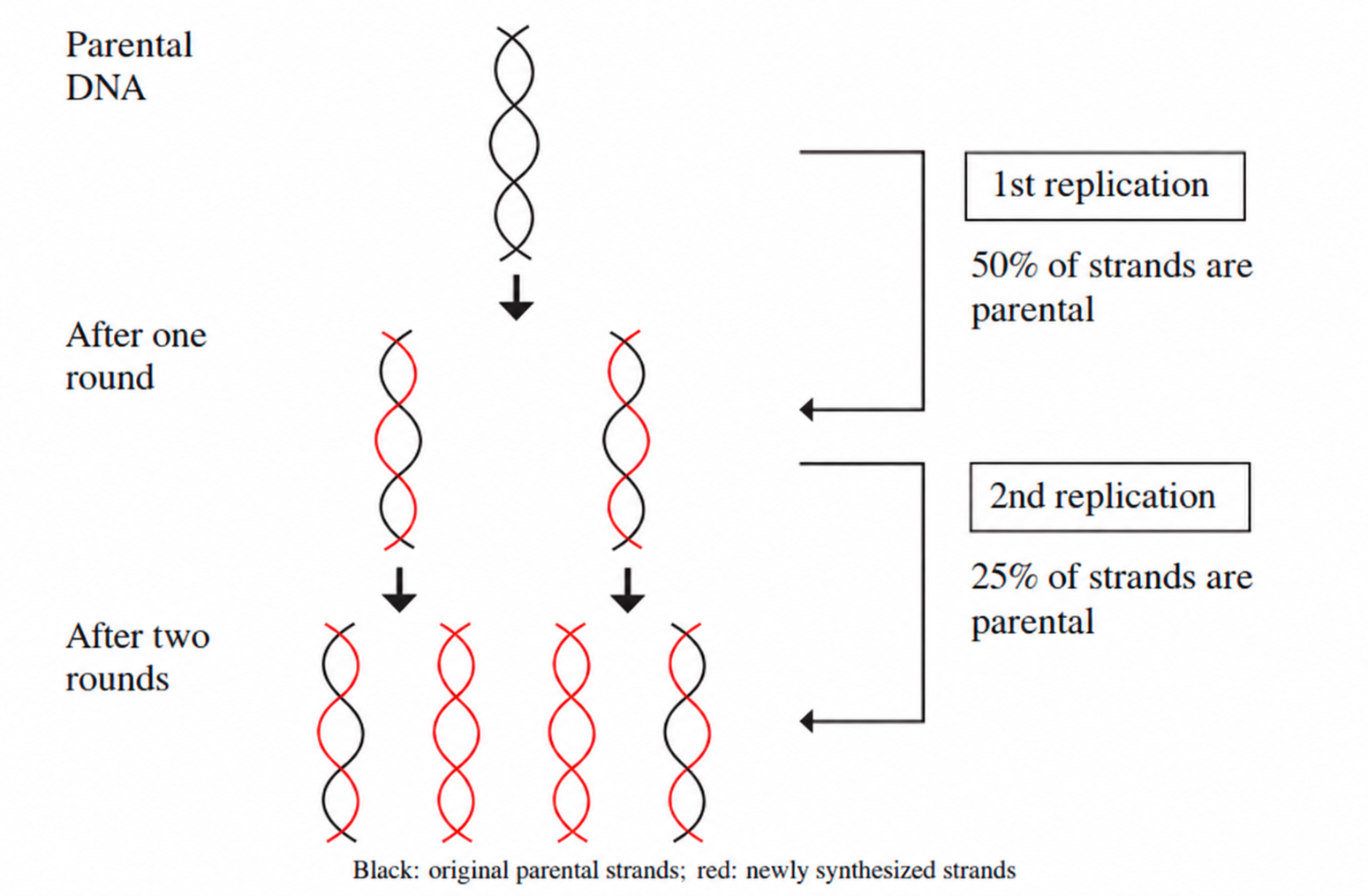
- Parents strands separate and give template. strands to each daughter
- Each daughter strand contains one template strand and new strands.
- 1/2 radioactivity of daughter strands from the parents.
4. DNA replication
DNA replication | RNA replication |
A ⇔ T G ⇔ C | A ⇔U G ⇔ C |
a. Origins of replication
- Replication fork
– Y shaped site by helicases.
– places of elongation of new strand DNA.
b. Elongation
- Leading strand
– DNA Pol III elongates continuously new strand of DNA from 5´ to 3´.
– same direction with movement of replication fork.
- Lagging strand (Okazaki fragments)
– DNA Pol III creates short segments of new DNA from 5´ to 3´.
– opposite direction against movement of replication fork.
– overall direction of lagging strand is from 3´ to 5´.
c. Enzymes for DNA synthesis
- Topoisomerase
– relieving the strain of tighter twisting from untwisting of parental DNA.
- Helicase: Separating the parental double strands of DNA
- Single-strand binding protein
– preventing the unwound parental strands of DNA.
- Primase
– synthesizing short segments of RNA primer which is nucleotide chain for starting point of DNA synthesis and putting down the RNA primer on new strands of DNA.
- DNA polymerase
– DNA Pol III: Synthesizing new DNA nucleotides.
– DNA Pol I: removing RNA primer and replacing with DNA.
– proof reading (DNA error correction).
- DNA ligase
– joining the ends of new strand of DNA.
- Telomerase
– adding TTAGGG nucleotides to the end of DNA in order to prevent eroding DNA strands from DNA replication.
d. Repairing DNA
G. Making protein
1. Central dogma
2. Transcription
a. Initiation
① Transcription factors bind to the TATA box of promoter.
② RNA polymerase binds to promoter along with the transcription factors.
③ RNA polymerase binding on DNA begins to synthesize pre-mRNA.
b. Elongation
- RNA Polymerase elongates pre-mRNA from 5´ to 3´
c. Termination
- Finishing pre-mRNA transcript
3. RNA processing
a. Modifying of pre-mRNA ends
- Adding 5´cap and poly-A tail to pre-mRNA ends
b. RNA splicing
: spliceosome removes introns from pre-mRNA and splices exons together to make mRNA.
- Introns: noncoding segments of nucleic acid
- Exons: coding segments of nucleic acid
- Spliceosome: snRNPs + other proteins
4. Translation
a. Codons and anticodons
- Codons: triplet nucleotides at mRNA and translated into amino acids
– start codon: AUG (met)
– stop codon: UAA, UAG, UGA
- Anticodons: triplet nucleotides at the end of tRNA and complementary on codon
- Wobble: only necessary at the first two codons when tRNA meet with mRNA (degeneration of genetic code)
b. tRNA
- Features
– hydrogen bonds with short double stranded RNA.
– presence of unusual bases: methyliosine, pseudoridine, 4-thiouridine.
- Aminoacyl-tRNA synthetase binds an amino acid to 3´ end of tRNA
c. Ribosomes
: making polypeptide after reading m-RNA from from 5´ end to 3´ end and requiring energy (GTP → GDP).
- A site
– aminoacyl-tRNA binding site.
- P site
– peptide bond formation.
– translocation of peptide bond.
- E site
– exit of tRNA site.
H. Mutation
1. Point mutation
: substitution of one nucleotide molecule.
- Missense: result of a different amino acid by altering codon
- Nonsense: result of stop codon
- Silent: result of same amino acid although altering codon
2. Frame shift
: insertion or deletion of a single nucleotide molecule.
- Causing serious genetic diseases
- Missing or insertion
3. Cancer
- Oncogenes: genes leading to cancer.
- A mutation in a gene of somatic cell induces to tumor.
I. Gene technology
1. Polymerase chain reaction (PCR)
- Quickly copy and amplify an original double strand of DNA.
- Useful for critical forensic analysis.
2. X-ray diffraction
- Method to know the three-dimensional molecular structure.
- X-ray crystallography.
3. DNA fingerprint
- Identification of an individual’s DNA by their DNA profiles.
4. Transgenic organism
- Genetically altered organism from another organism.