IX. Chemical Equilibrium

Key focus of this chapter: equilibrium constant

This chapter focuses on equilibrium constant and gives concise summaries of the important things about Le Chatelier’s principle, acid and base equilibrium, pH, and solubility product constant in more detail.

A. Reversible and irreversible reactions

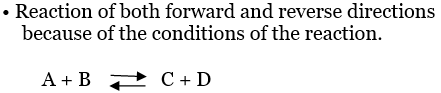
Reversible reaction

Irreversible reaction

B. Equilibrium state

: a state of balance in a reversible reaction, which is reached when the forward and reverse reactions have the same reaction rate (velocity) and the concentrations of reactant and product are no longer changing.

Fig. 1 Equilibrium state of reaction rate and concentration over time

  • Does not stop forward and reverse reaction (same rate between forward and reverse reaction).
  • Not the same concentration between the reactants and the products.

C. The equilibrium constant, K

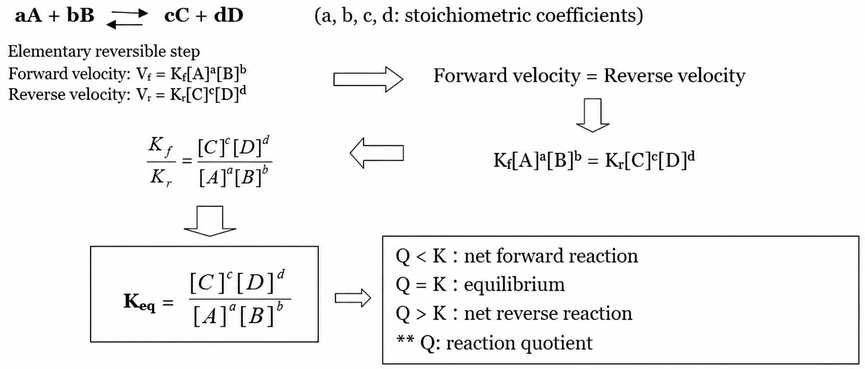
1. Keq

  • Dependent on temperature but independent of the concentrations or catalysis
  • Does not apply to solid and liquids in the equilibrium equation
equilibrium constant, Keq

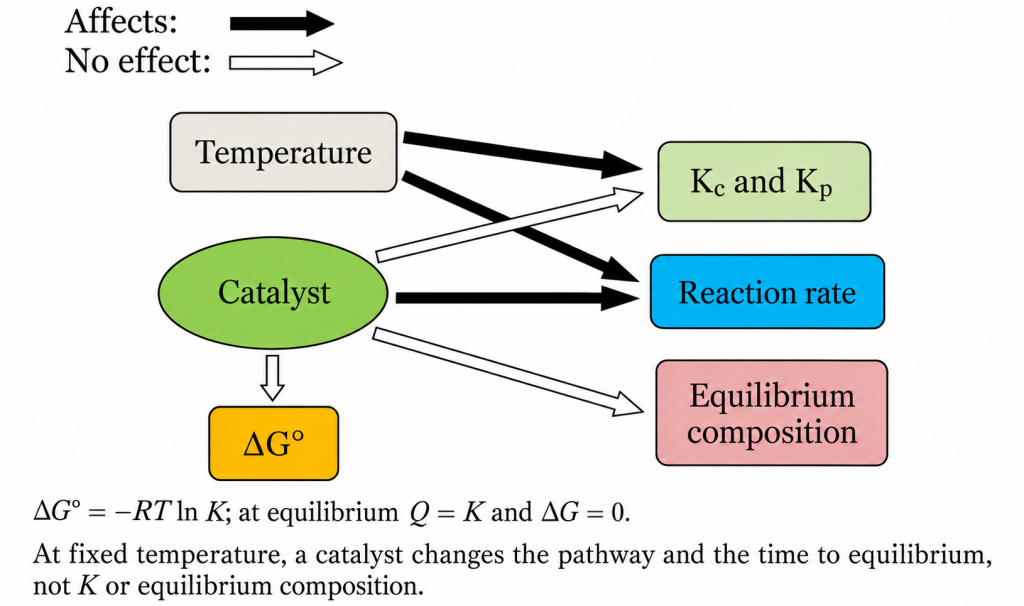
2. Kc and Kp

Fig. 1 Factors that affect Kc and Kp, reaction rate, and equilibrium

D. Le Chatelier’s principle

: a system stressed by external conditions is relieved by a shift in the equilibrium.

Changes of conditions

Direction of reactions

Concentration

Pressure (volume)

& Mole

Temperature

 & ΔH

Qs/ Which of the following shifts the equilibrium in the forward direction in the reaction shown?

     A. Adding WO3

     B. Adding H2

     C. Removing W

     D. Removing H2O

     E. Both B and D

     ANS: E   Adding WO3 or removing W does not affect the direction of equilibrium, because they are solid. When adding H2 or removing H2O, the equilibrium moves in a forward direction to relieve the stress of the different concentrations between the reactants and products.

Qs/ Which of the following is the reverse direction of the equilibrium from the reaction shown?

     A. Increasing pressure

     B. Decreasing pressure

     C. Increasing volume

     D. Removing Y

     E. A and C

     ANS: A   When the pressure is increased, the equilibrium moves from big moles of the product (2Y + 2Z) to small moles of the reactant (3X).

Qs/ Which of the following shifts the equilibrium in the forward direction in the reaction shown?

     A. Adding X

     B. Removing Y

     C. Decreasing pressure

     D. Increasing temperature

     E. All are correct

     ANS: E   When the reaction is endothermic (ΔH >0), the direction of the equilibrium is shifted forward by an increase in temperature.

E. Acid and base equilibrium

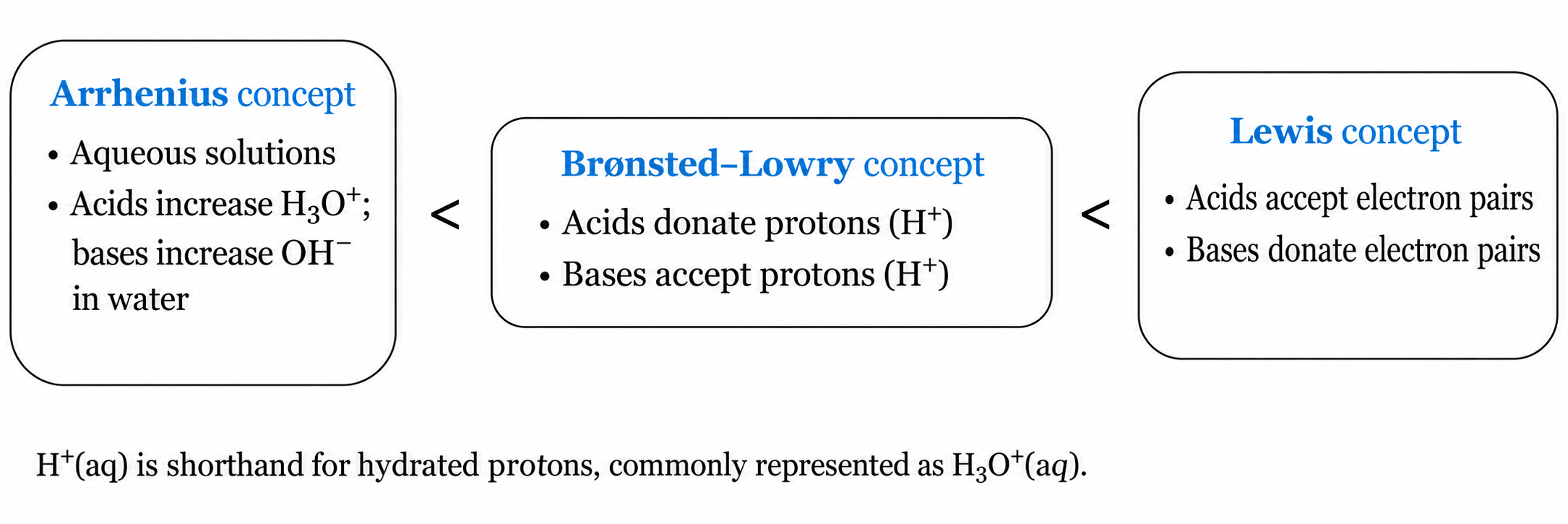
1. Acid and base theory

Acid

Base

2. Acid and base strength

a. Acid strength

b. Acids and bases in a solution

  • Transferring H+ from stronger acid to stronger base

Strong acids

• 100% dissociation of H

Weak acids

• Partial dissociation of H

Strong acids and strong bases

Strong acids and weak bases

Weak acids and strong bases

Weak acids and weak bases

with halogens

with soluble compound anions

with 1A group

with 2A group

3. Equilibrium constant, Ka, Kb, and Kw

a. Ka (acid-dissociation constant) and Kb (base-dissociation constant)

: expression of equilibrium reactions for acid and base dissociations.

  • The equilibrium constants Ka and Kb depend on temperature, but are independent of the concentration of acids and bases
  • Stronger acids and bases have higher values of Ka and Kb

b. Kw (ion-product constant for water)

: Eexpression of dissociation of water

Equilibrium

constants

Equilibrium Equations

Qs/ Calculate the value of Ka when 0.002M of HOBr is 0.1% dissociated in a solution.

Qs/ Ka of HNO2 is 4.5 × 10⁻⁴. Calculate the value of Kb.

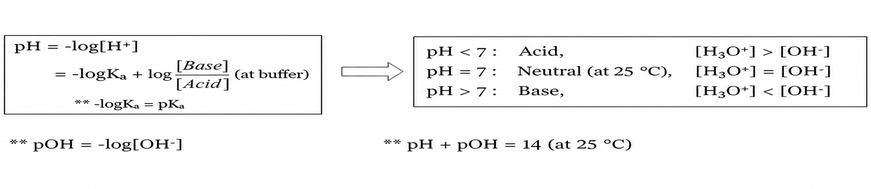
F. pH

Qs/ Calculate the pH of a solution containing [H+] = 0.000035 M.

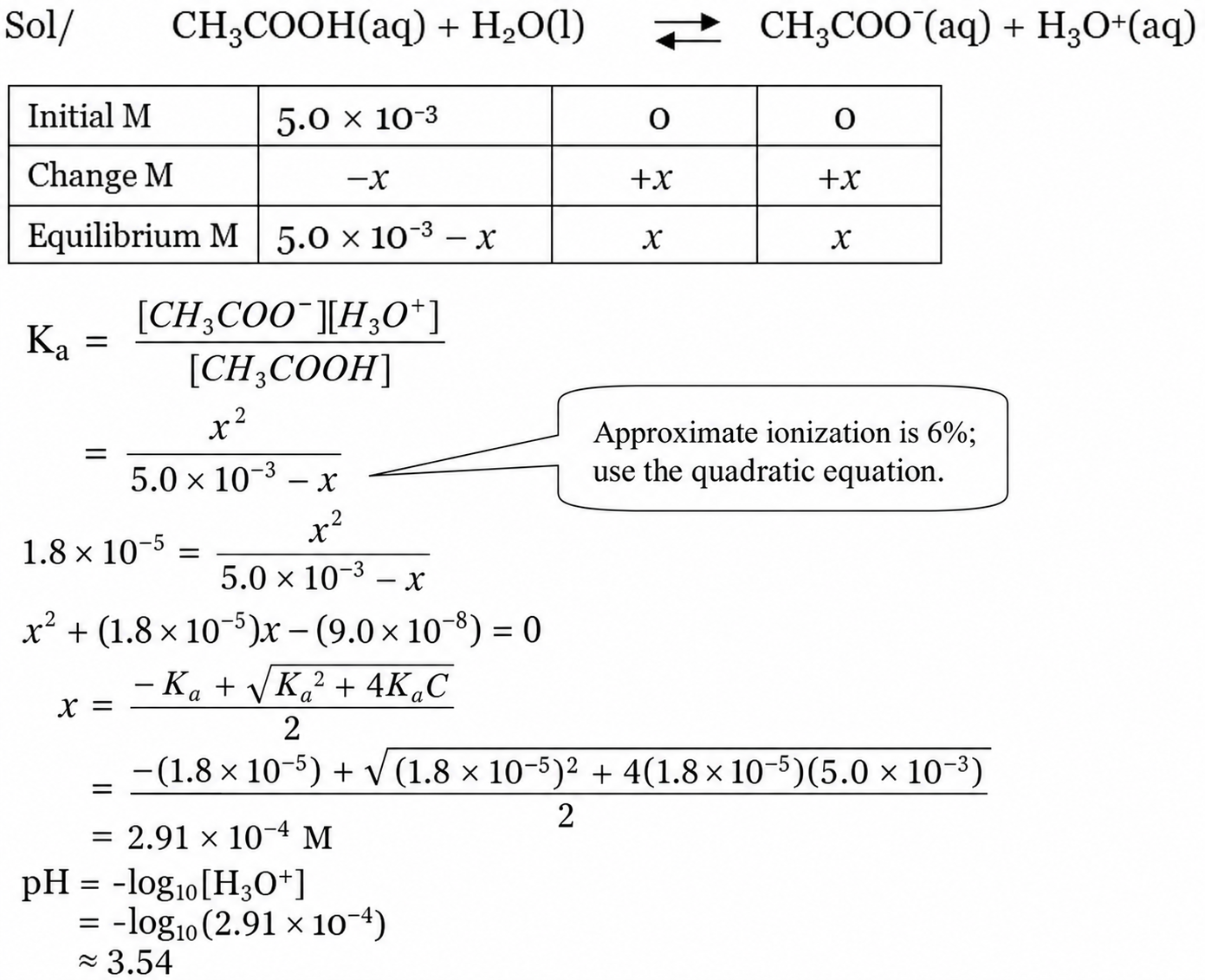
Qs/ 0.005M CH3COOH is dissociated in a solution. When the Ka of CH3COOH is 1.8×10⁻⁵, calculate the pH of the solution.

G. Solubility product constant, Ksp

: expression of equilibrium reaction for a soluble ionic compound in a solution

Qs/ What is the expression for Ksp of Ca3(PO4)2 in a solution?

Qs/ Calculate Ksp for a saturation of BaF2 when the concentration of Ba2+ is 2.0 × 10⁻⁵ M.