II. Orbital and Periodicity

Key focus of this chapter: periodic table with groups

This chapter focuses on periodic table with groups and gives concise summaries of the important things about orbital theory, shapes of orbitals, rules of filling up electrons in orbitals, quantum numbers, electron configuration, atomic radius, ionization, and electron affinitive in more detail.

A. Orbital theory

1. Bohr’s atomic model

  • Model for hydrogen atom.
  • The paths of electrons, which are circling around a nucleus, are called electron shells.
  • Each electron shell (number of electron shell =n) has an energy difference level → the farther from the nucleus, the greater the difference of energy level → K(n=1) < L(n=2) < M(n=3) < N(n=4)

Fig. 1 Bohr’s atomic model

• Energy change when electrons move to other electron shells

Classification

Features

Ground state

electrons

• Normal and stable state of electrons with low energy

• When ground state electrons at a lower shell go to the higher shell, energy is absorbed.

  K (n=1) → L (n=2)

Excited state

electrons

• Abnormal and unstable state of electrons with the high energy

• When excited state electrons at a higher shell go to the lower shell,

  energy is emitted.

L (n=2) → K (n=1)

Fig2. Ground and excited state electrons

2. Lyman, Balmer, and Paschen series

Classification

Features

Lyman series

• When excited state electrons at a high shell go down to K (n=1) shell,

  energy is emitted.

• Ultraviolet region

Balmer series

• When excited state electrons at a high shell go down to L (n=2) shell,

  energy is emitted.

• Visible region

Paschen series

• When excited state electrons at a high shell go down to M (n=3) shell, energy is emitted.

• Infrared region

3. Modern atomic model

: limited theory of Bohr’s atomic model  → modern atomic model (orbital theory)

a. Orbital theory

  • Electrons travel around nucleus, but not in a fixed path → high probability of finding an electron in a certain position → orbital
  • Each electron shell is composed of several orbitals (s, p, d, f)

b. Electron shells and orbitals

  • With the increasing number of electron shells (n), the number of orbitals (s, p, d, f) at each electron shell is increased.

Electron shells

Orbitals

n= 1

1s

n=2

2s

 2p

n=3

3s

 3p

 3d

Fig. 3 Modern atomic model

B. Shapes of orbitals

Classification

Features

s orbitals

• Spherical shape

• Closest orbital to nucleus

• Spatial orientation of the orbital = zero → S orbital electrons are spread near nucleus with no direction

• Magnetic quantum number, ml =0

• Orbital holds 2 electrons → 1×2 = 2 electrons in s orbitals

p orbitals

• Dumbbell shape

• 3 orientations of X, Y, or Z coordinate axes →  Px, Py, or Pz

• Magnetic quantum number, ml = -1, 0, +1

• Each orbital holds 2 electrons → 3×2 = 6 electrons in p orbitals

d orbitals

• Usually have a cloverleaf shape

• 5 different orbital shapes → dxy, dxz, dyz, dx2- y2, dz2

• Each orbital holds 2 electrons → 5×2 = 10 electrons in d orbitals

• Transitional metals region in periodic table

f orbitals

• Complex shape with eight lobes

• 7 different orbital shapes

• Each orbital holds 2 electrons → 7×2 = 14 electrons in f orbitals

C. Rules of filling up electrons in orbitals

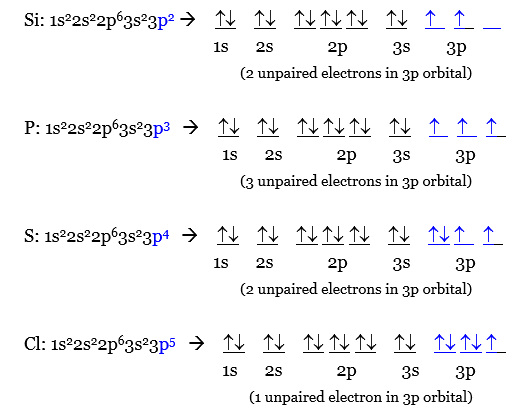
: electrons are expressed by arrow (↓,↑­) in the orbital filling diagram.

Classification

Features

Pauli exclusion principle

Hund’s rule

Filling order of different orbitals

D. Quantum numbers

: expressing three variable wave functions (n, l, ml) by electrons in a space.

Classification

Features

The principal quantum

 number (n), shell

Angular-momentum quantum number, subshell (l)

Magnetic quantum

 number (Ml)

• Combined quantum numbers (n, l, ml)

Principal

quantum number

 n

Angular momentum quantum number

    l

Orbital

notation

Magnetic quantum

number

 ml

Number of

orbital(s) in

subshell

Maximum electrons in shell (2n2)

1

0

1s

0

1

2

 0

  1

2s

 2p

 0

  -1, 0, +1

1

 3

3

0

1

 2

3s

3p

3d

0

 -1, 0, +1

  -2, -1, 0, +1, +2

1

 3

  5

4

0

1

 2

 3

4s

4p

4d

4f

   1

    3

    5

    7

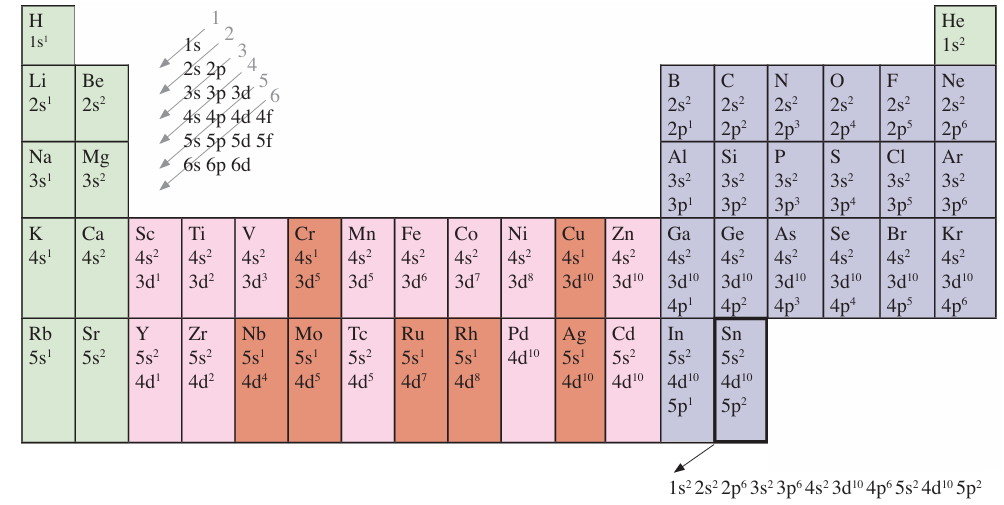
E. Electron configuration

1. Filling order of electrons in orbitals (from low to high energy)

1s → 2s → 2p → 3s → 3p → 4s → 3d → 4p → 5s → 4d → 5p → ….

Fig. 4 Position of orbitals in the periodic table

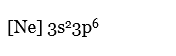
2. Electron configuration

: expressing of energy level for every element by occupied electrons in orbitals.

Ground state electron configuration

Shorthand electron configuration

Orbital filling diagrams

Be

Ar

V

Fig. 5 Ground state electron configuration in the periodic table

** Exceptional atoms of electron configuration

Cr, Cu, Nb, Mo, Ru, Rh, Ag (dark red color above)

       Ex/ Cr: 1s22s22p63s23p64s23d4 (X)  →  1s22s22p63s23p64s13d5 (O)

           Cu: 1s22s22p63s23p64s23d9 (X)  →  1s22s22p63s23p64s13d10 (O)

F. Application of electron configuration

1. Counting of unpaired electrons: half filling electrons in orbital

2. Ground state and excited state

  • Ground state: normal state of electron(s)
  • Excited state: moving electron(s) from low level of orbital to high level of orbital

G. Electromagnetic spectrum

1. Light

  • Classified by wavelength (λ)
  • The speed of light (C), C=3.00 × 10⁸ m/s (all lights have same speed)
  • Frequency (ν): number of wave peaks per second (hertz, Hz, s-1)

** Photoelectric effect: ejected electrons from metal surfaces by irradiation

2. Energy (E)

  • Long wavelength → low frequency → low energy
  • Short wavelength → high frequency → high energy
  • Ex/ Gamma rays → short wavelength → high energy

3. Order of energy

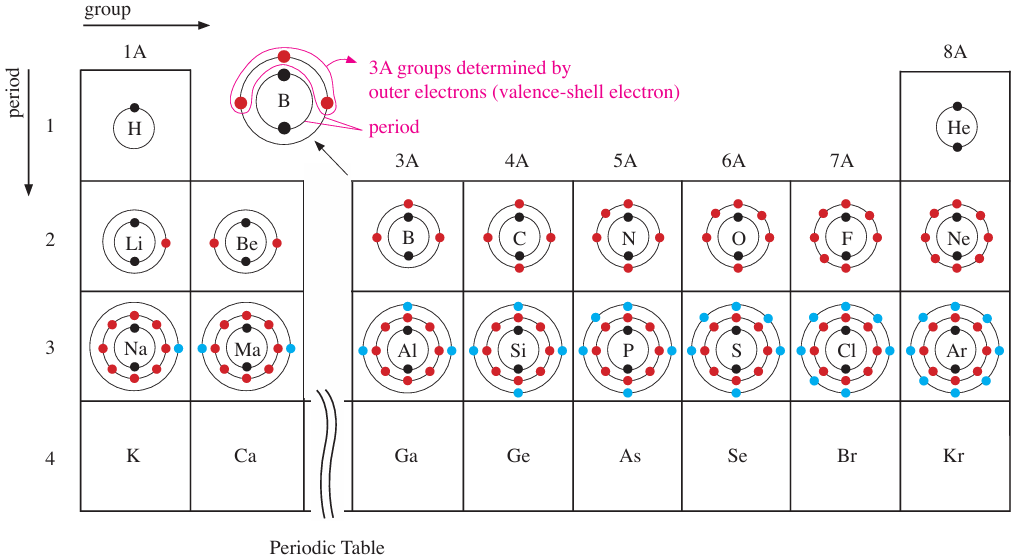
H. Periodicity

1. Periods

  • Seven rows (n = 1, 2, 3, 4, 5, 6, 7)
  • Indicating number of shell

2. Groups

  • 18 columns (1A – 8A, 1B –8B)
  • Indicating similar chemical characteristics within the same group (atoms in the same group have the same outermost electrons)

 Ex/ Be, Mg, and Ca (group 2A) have similar chemical characteristics (they have 2 outermost electrons).

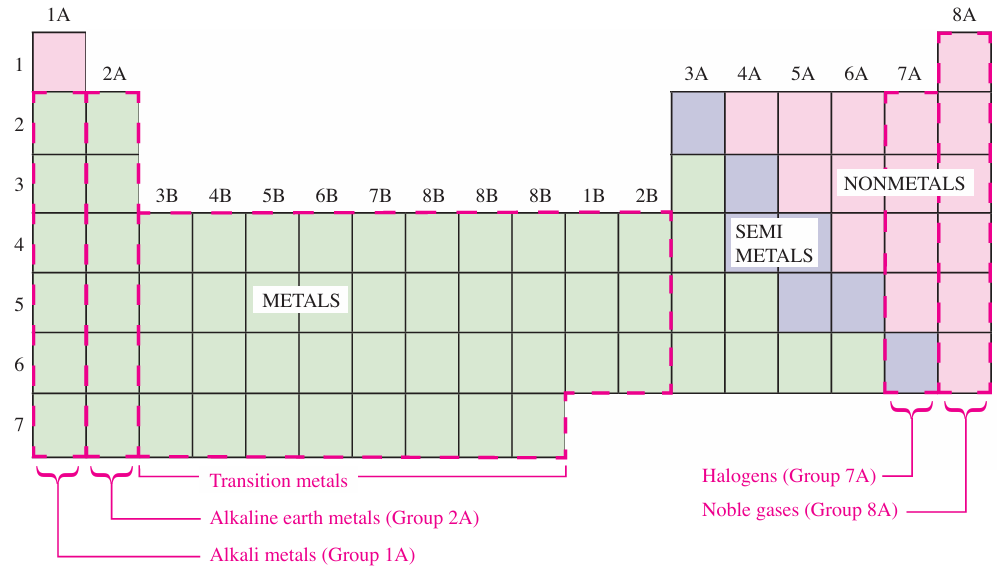
Fig. 6 Periods and groups

periodic table with groups

a. Metal and nonmetal

Classification

Characteristics

Metal

• Tendency to move out electrons from atoms → tendency to become cation by losing electrons (reducing agents) → good conductivity for heat and electricity

• Malleability

• Ductility

• Shiny luster

• Typically solids

Nonmetal

• Tendency to move electrons into atoms → tendency to becoming anions by gaining electrons (oxidizing agents) → poor conductivity for heat and electricity

• Brittleness

b. Classification of groups

Fig. 7 Classification of groups in periodic table

Classification

Sub classification

Features

Metal

groups

Alkali metals

• Group 1A except H (Li, Na, K, Rb, Cs, Fr)

• One electron at their outermost shell → tending to lose one electron to become (+1) cation (good conductors)

→ the strongest reducing agent groups → highly basic

• The lowest M.P, B.P, and density group

• Found as salt forms

Alkaline earth metals

• Group 2A (Be, Mg, Ca, Sr, Ba, Ra)

• Two electrons in their outermost shell → tending to lose two electrons to become (+2)cations → the second

 strongest reducing agents  → basic

• The second lowest M.P, B.P, and density group

• Found as salt forms

Transition

metals

Semi metals (metalloid)

• Intermediate characteristics between metals and nonmetals

• B, Si, Ge, As, Sb, Te, At

Nonmetals

Halogen

group

• Group 7A (F, Cl, Br, I, At)

• Seven electrons in the outermost shell → tending to gain one electron to become (–1)anion → strong oxidizing

 agent → acidic

• Corrosive and colorful nonmetals

• Found in binary compound

Noble gas

group

• Group 8A (He, Ne, Ar, Kr, Xe, Rn)

• Very low reactivity because of 8 electrons (except He) in their outermost shells

• Colorless and odorless

I. Atomic radius

: distance from a nucleus to outermost electrons.

1. Atomic radius in periodic table

  • In the same period, when the atomic number is increased, the atomic radius is decreased because the attraction force between the protons (+) and outer electrons (-) is increased.

     Li > Be > B > C > N > O > F

  • In the same group, when the atomic number is increased, the atomic radius is increased because the electron shells are increased.

     Li < Na < K < Rb < Cs < Fr

  • In the isoelectronic, cationic (metallic) radius is smaller than its neutral atom and anionic (non-metallic) radius is greater than its neutral atom.

     Ca2+ < K+ < Ar < Cl < S2-

2. Cationic (metallic) and anionic (nonmetallic) radius

Classification

Features

Cationic(metallic) atoms

Anionic(nonmetallic) atoms

J. Ionization energy (Ei)

: positive energy to get rid of an outermost electron of an atom.

   Atom + energy  →  Cationic atom + e

Fig. 8 Ionization energy of Li

  • Ei 1, (first ionization energy): positive energy to get rid of the first outermost electron in an atom → (high energy with stable outermost electrons, such asoctet rule)

     Ar > Be > Li

  • Ei 2, (second ionization energy): positive energy to get rid of the second outermost electron in an atom → (high energy with 1 outmost electron)

     Li > Ar > Be

Ground state electron configuration

Outermost electron(s)

Ei 1

(kJ/mol)

Ei 2

(kJ/mol)

Ei 3

(kJ/mol)

Li

1

520

7,300

11,820

Be

2

900

1,760

14,850

Ar

8

1,520

2,670

3,930

a. General trend

  • In the same period, with the increasing atomic number, the Ei is increased.

     O < F < Ne

  • In the same group, with the increasing atomic number, the Ei is decreased.

     He > Ne > Ar

  • The half-filled or fully-filled electrons in each orbital have a strong Ei to remove an outermost electron.

     Therefore, ionization energy: Be > B

     Therefore, ionization energy: N > O > C

Fig. 9 Ionization energy of the atoms

K. Electron affinitive (Eea)

: negative (emitting) energy when atom accepts an electron and becomes an anionic atom.

     Atom + e  anionic atom + energy

Fig. 10 Electron affinitive of F

a. General trends

  • The Eea of 8A group (noble gases) is zero.
  • In the same period, with the increasing atomic number, the Eea is increased.

     N < O < F

  • In the same group, with the increasing atomic number, the Eea is decreased.

     Cl > Br > I        ** exception (F < Cl)

  • An atom that is 2/3 half-filled in orbitals has the stronger Eea than 3/3 half-filled in orbitals.

     Therefore, electron affinitive: C > N

  • An atom that is 2/3 fully-filled in orbitals, has the stronger Eea than 3/3 fully-filled in orbitals.

     Therefore, electron affinitive: F > Ne

Fig. 11 Electron affinitive of the atoms

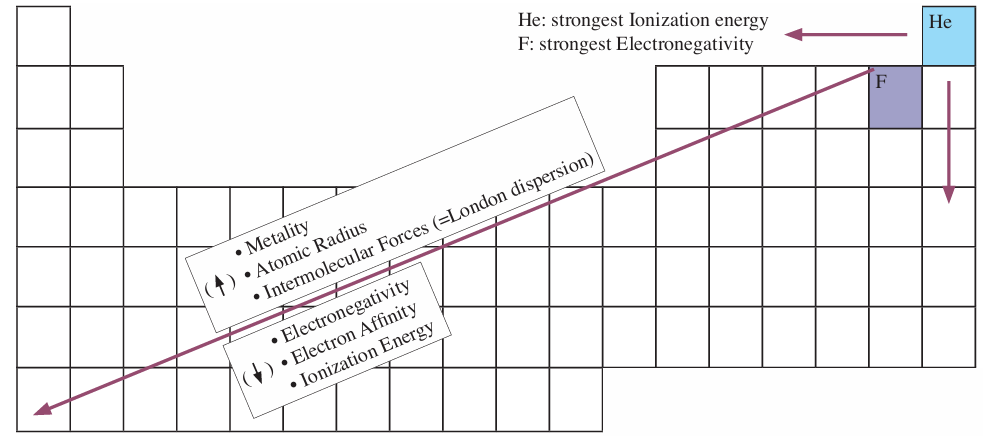
L. Tendency of atoms in periodic table

  • In the direction left and downward, metallic properties, atomic radius, and intermolecular forces are increased.
  • In the direction right and upward, electronegativity, ionization energy, and electro affinity are increased.

Increasing

Decreasing

Going left and down (from periodic table)

• Metallic character

• Atomic radius

• Intermolecular forces

 (London dispersion)

• Electronegativity

• Ionization energy

• Electro affinity

Fig 12. Tendency of atoms in periodic table