X. Electrochemistry
Key focus of this chapter: reduction potential
This chapter reviews standard reduction potentials, electrochemical cells, standard free-energy changes, and quantitative electrolysis.
A. Standard reduction potential, Eo (V)
: a measure of the tendency of a half-reaction to gain electrons, referenced to the standard hydrogen electrode
(2H+(aq) + 2e– → H2(g) Eo = 0 V)
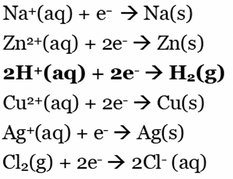
A more positive standard reduction potential indicates a greater thermodynamic tendency for reduction. Standard conditions use unit activities (approximately 1 M for ideal dilute solutes), gases at 1 bar, and the specified temperature; tables are commonly quoted at 25 °C. Reversing a half-reaction reverses the potential’s sign. Multiplying stoichiometric coefficients does not multiply the potential.
1. Standard electrode potential
Meaning | |
The reduced form is more readily oxidized than H₂ under standard conditions → oxidation. | |
The oxidized form is more readily reduced than H⁺ under standard conditions → reduction. |
Reduction half-reaction | Oxidation tendency (anode) | Reduction tendency (cathode) | |
|
|
|
|
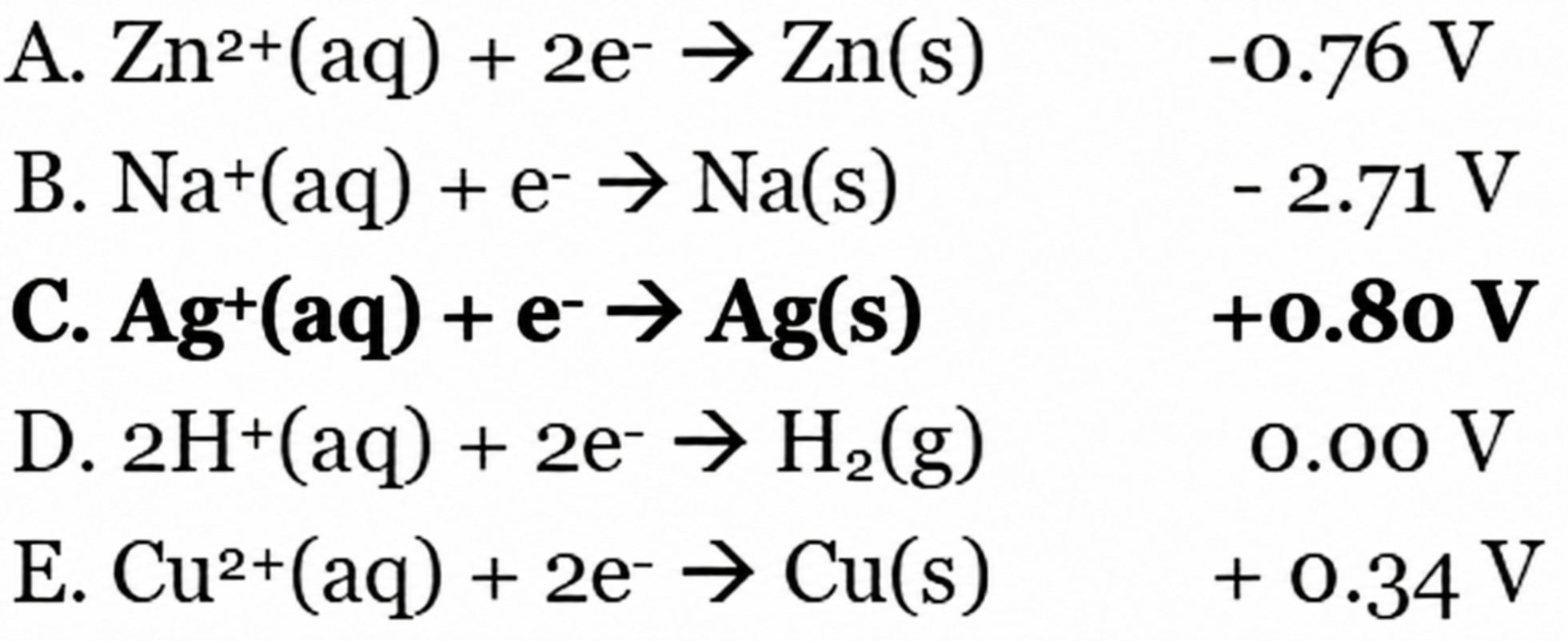
Question: Which listed half-reaction has the greatest tendency to undergo reduction under standard conditions?
|
Answer: C. Ag+ has the most positive standard reduction potential among the choices (+0.80 V), so it has the greatest tendency to accept electrons under standard conditions.
2. Anode and cathode
Meaning | Galvanic cells | Electrolytic cells | |
Anode | Loss of electrons (oxidation) | Negative (-) | Positive (+) |
Cathode | Gain of electrons (reduction) | Positive (+) | Negative (-) |
B. Cell potentials
1. Electromotive force (EMF)
The electromotive force is the open-circuit potential difference between the cathode and anode, measured in volts (1 V = 1 J/C).
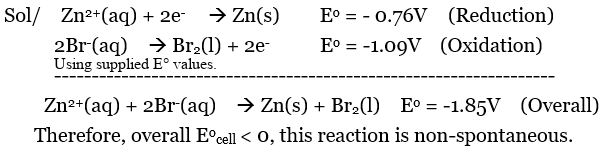
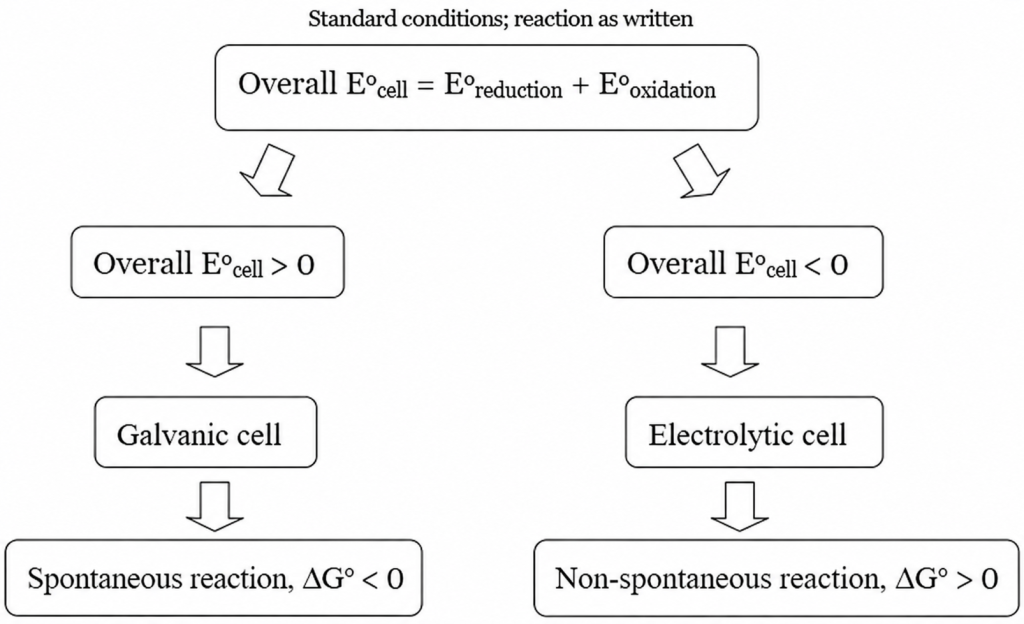
E°cell = E°red,cathode − E°red,anode = E°reduction + E°oxidation. Under standard conditions, E°cell > 0 corresponds to ΔG° < 0 for the reaction as written. Under other conditions, use the actual E and ΔG.
Question: Determine whether the reaction as written is spontaneous under standard conditions.
|
|
2. Shorthand notation
- Example: Write the cell notation for the spontaneous reaction between Cu(s) and Ag+(aq).
Cu(s) is oxidized at the anode, and Ag+(aq) is reduced at the cathode. The listed Cu2+/Cu reduction potential is +0.34 V; reversing that half-reaction gives an oxidation potential of −0.34 V. Thus E°cell = +0.80 V − 0.34 V = +0.46 V.
Step | Reactions | |
Reduction half-reactions |
| |
Oxidation and reduction |
| |
Multiply coefficients to balance electrons |
| |
| ||
Galvanic cell notation | Shorthand notation |
|
Galvanic cell diagram |
| |
C. Electrochemical cells
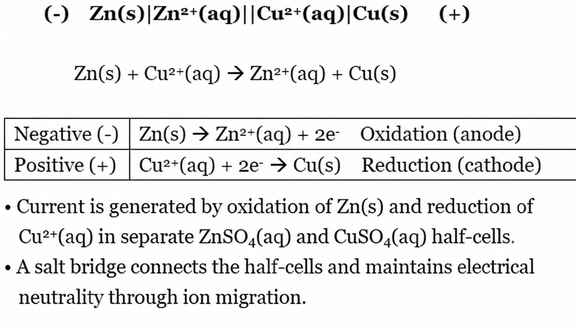
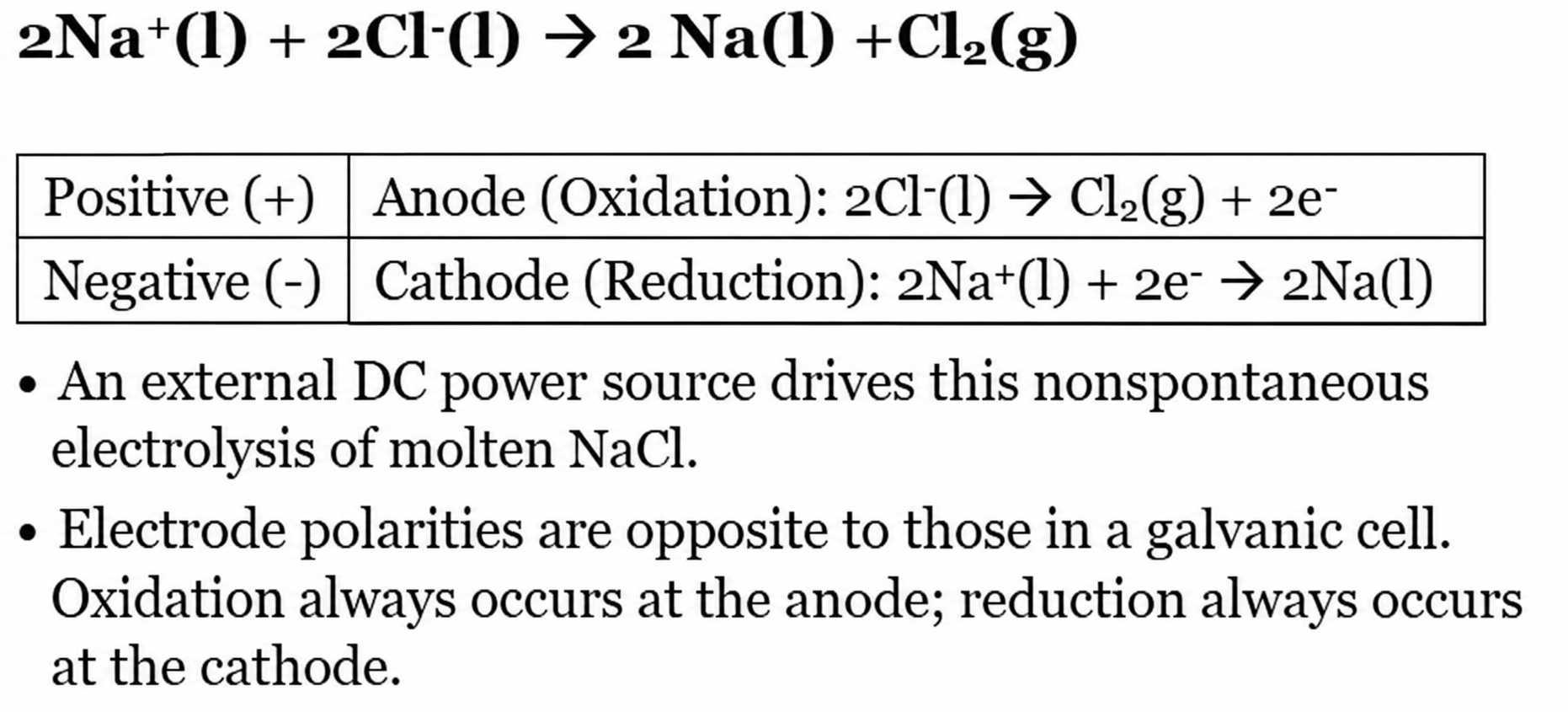
: devices in which redox reactions and electrical energy are coupled: galvanic cells generate electrical energy, whereas electrolytic cells consume it to drive a nonspontaneous reaction.
Oxidation always occurs at the anode and reduction at the cathode. Electrode polarity changes with cell type. Electrons travel through the external circuit; ions carry current through the electrolyte and salt bridge. The E° sign summaries refer to standard-state reaction thermodynamics.
Cell type | Features | |
| Voltaic cell |
|
Daniell cell |
| |
|
| |
D. Standard free-energy change
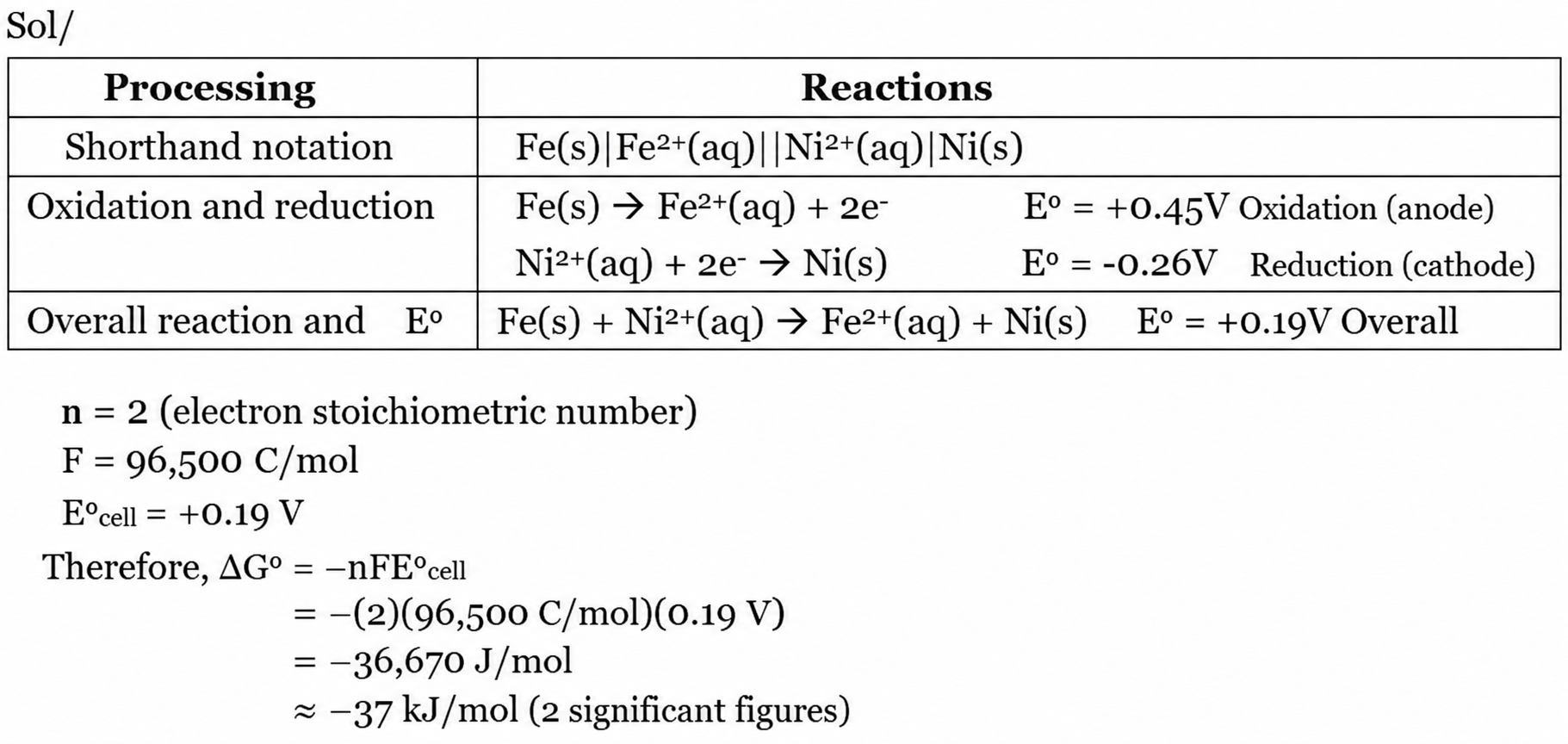
ΔG° = −nFE°cell, whereas ΔG = −nFE for the actual cell conditions. Here n is the number of electrons transferred per balanced reaction and F is the Faraday constant. With F in C/mol and E in V, molar reaction free energy is in J/mol.
The Nernst equation is E = E° − (RT/nF)ln Q. At 25 °C, E = E° − (0.05916 V/n)log10Q. Q uses activities; pure solids and liquids are omitted. At equilibrium, E = 0 and Q = K, giving ln K = nFE°/(RT).
|
Question: Calculate the standard molar free-energy change, ΔG°, for the reaction as written.
![]() |
|
E. Quantitative electrolysis
1. Electric charge Q (coulombs, C)
Q = It: current I is measured in amperes (A), time t in seconds (s), and charge Q in coulombs (C). One ampere equals one coulomb per second.
2. Faraday constant, F
F ≈ 96,485 C/mol is the charge per mole of electrons; the worked examples use the rounded value 96,500 C/mol. One faraday of charge is the charge carried by one mole of electrons. The amount of electrons transferred is n(e−) = Q/F.
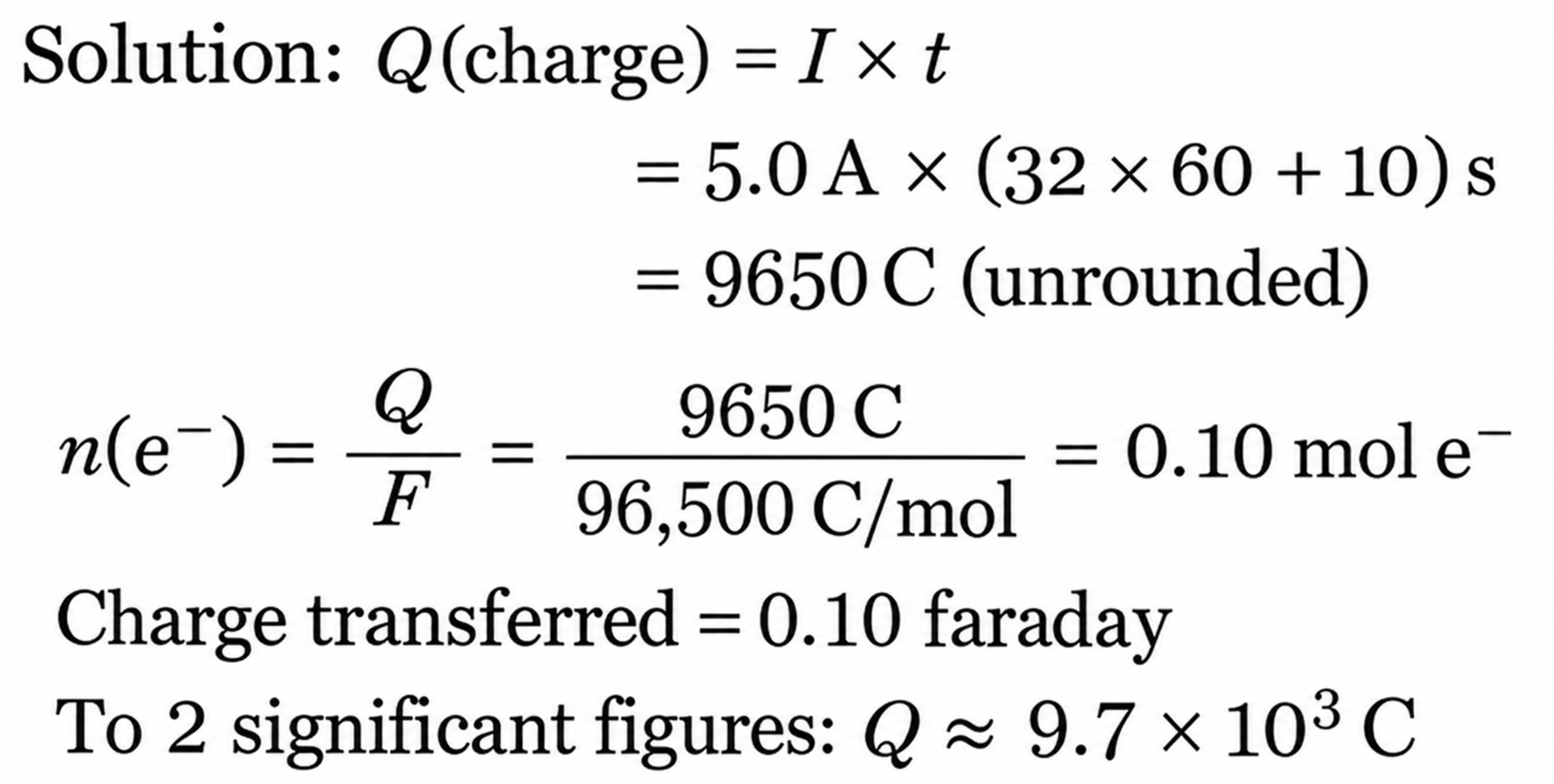
Question: What charge, in coulombs and faradays, is transferred when a direct current of 5.0 A is passed through an aqueous solution of AgNO3 for 32 minutes and 10 seconds?
Use Q = It and 1 faraday ≈ 96,500 C. Distinguish the Faraday constant F from the amount of charge expressed in faradays.
|
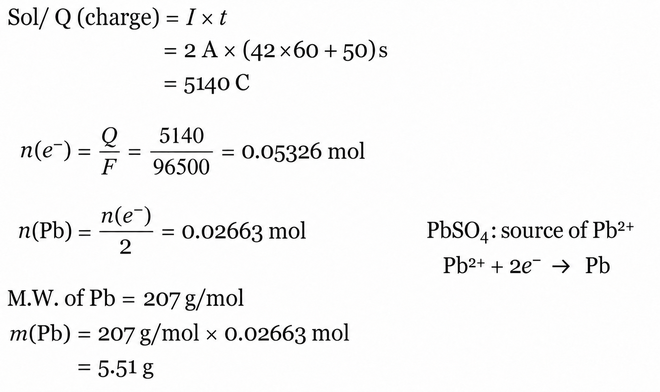
Question: How many grams of Pb are produced from a lead storage battery when this battery is charged for 42 minutes and 50 seconds with a constant current of 2 A?
PbSO4(s) + H+(aq) + 2e– → Pb(s) + HSO4–(aq)
Assume 100% current efficiency and use M(Pb) = 207 g/mol and F = 96,500 C/mol. Treat the specified current as exact for this idealized exercise.
|