IX. Anatomy

Key focus of this chapter: 4 types of tissues

4 types of tissues - epithelial tissues

This chapter focuses 4 types of tissues and gives concise summaries of the important things about glands in tissue cells, skeletal muscles, bone, ear, and eye.

A. Tissues

: groups of similar cells organized to work a common function.

1. Four types of tissues

a. Epithelial

: covering the outside of the body and the external or internal surfaces of organs for secretion, absorption, and protection.

  • Simple epithelium is single layer and stratified epithelium is two or more layers.
  • Cuboidal epithelium is cube shaped and squamous epithelia is flat.

b. Connective

: functions to transport, support, connect, and protect the other three kinds of tissue.

  • Types – cartilage, bone, and blood

c. Muscle

: contains contractile muscle fibers and function for movement.

  • Types – smooth muscle, skeletal muscle, and cardiac muscle

d. Nerve

: transmission of electrical information to central and peripheral nervous system.

  • Types – spinal cord tissues, brain
  • Grey matter (information processing) and white matter (information transmission)

2. Features and functions of each tissue

Tissues

Classification

Shapes

Features and functions

Epithelial

Cuboidal epithelia

• Cube shape

• Specialized for glands, secretion

Columnar

epithelia

• Column and elongated shapes

• Lining of intestine and stomach for secreting digestive enzymes and absorbing nutrients

Squamous epithelia

• Flat shape

• Lining and cover of lungs for exchanging gases and diffusion of nutrients

Connective

Cartilage

• Covers skeletal joint, outer ear, nose, larynx, trachea, bronchial tubes

• Chondrocytes – secrete collagen and chondroitin sulfate to absorb physical impact

• Avascular form

Bone

• Supports body of vertebrates

• Osteocytes – bone cells

• Provides rigidity and hardness by calcium, phosphate, magnesium ions

Blood

• Platelets – clotting aid

• Leukocytes – white blood cells, immunity aid

• Plasma – liquid matrix

• Erythrocytes – red blood cells, carry oxygen, lack nuclei

Fibrous connective tissue

• Tendon - connects bone to muscle (origin is connection of stationary bone to muscle and insertion is connection of moveable bone to muscle)

• Ligaments – connects bone to bone

Muscle

Skeletal

muscle

• Voluntary and striated muscle

• Array of actin and myosin filaments with multiple nuclei

• Sarcomeres – contractile units

• Myofibrils fibers

Cardiac muscle

• Found in wall of heart

• Involuntary and striated muscle

• Branched cells

• Intercalated discs -interconnects the signaling of heartbeats between the end of cells

Smooth muscle

• Found in digestive tract, arteries, urinary bladder

• Involuntary and not striated muscle

• Thin and elongated cells with spindle shape

B. Glands in tissue cells

1. Exocrine gland

  • Secrete their products via duct to external environment
  • Eg/ Sweat gland, mammary gland, salivary gland

2. Endocrine gland

  • Secrete their products into capillaries in the internal environment
  • Eg/ Adrenal gland, pituitary gland, thyroid gland

    ** Sweat gland and capillaries function for thermoregulation

C. Skeletal muscles

1. Structure of skeletal muscle

a. Sliding filament model of muscle contraction

  • Myofibril contains repeated sarcomeres.
  • During muscle contraction, the actin (thin filament) and the myosin (thick filament) overlap each other.
  • Myosin is linked by M line and actin is linked by Z line.
  • During muscle contraction, the width of I band and H zone are reduced but the width of A band is not changed.

b. Process of the contraction of a skeletal muscle fiber

  • ① Acetylcholine (ACh) is released from synaptic terminal of motor neuron.
  • ② Acetylcholine (ACh) is bound to ACh receptors on muscle fiber’s plasma membrane.
  • ③ Action potential spreads along sarcolemma and goes down T tubules.
  • ④ Action potential launches Ca2+ from sarcoplasmic reticulum (SR) to troponin
  • ⑤ Ca2+ binds to troponin.
  • ⑥ Myosin cross-bridge alternately contacts and detaches to actin, then muscle fiber contracts.
  • ⑦ Ca2+ is removed from troponin and back to sarcoplasmic reticulum (SR) when action potential ends, then muscle fiber relaxes.

2. Neural control

a. Tetanus

: continuous muscular contraction

– summation of tension

– the higher frequencies of stimulation leads muscle fibers to a state of tetanus sustained contraction.

  • Motor unit – many muscle fibers are controlled by one motor unit.
  • Twitch – mechanical response of muscle fibers from stimulation.
  • Tonus – partial contraction of muscle during resting state.

b. Isometric and isotonic muscle contractions

  • Isometric muscle contraction – force generates with the constant length of the muscle
  • Isotonic muscle contraction – force does not generate with the shortened length of the muscle

D. Bone

1. Functions

  • Making blood cells
  • Framework for movement
  • Protection of organs

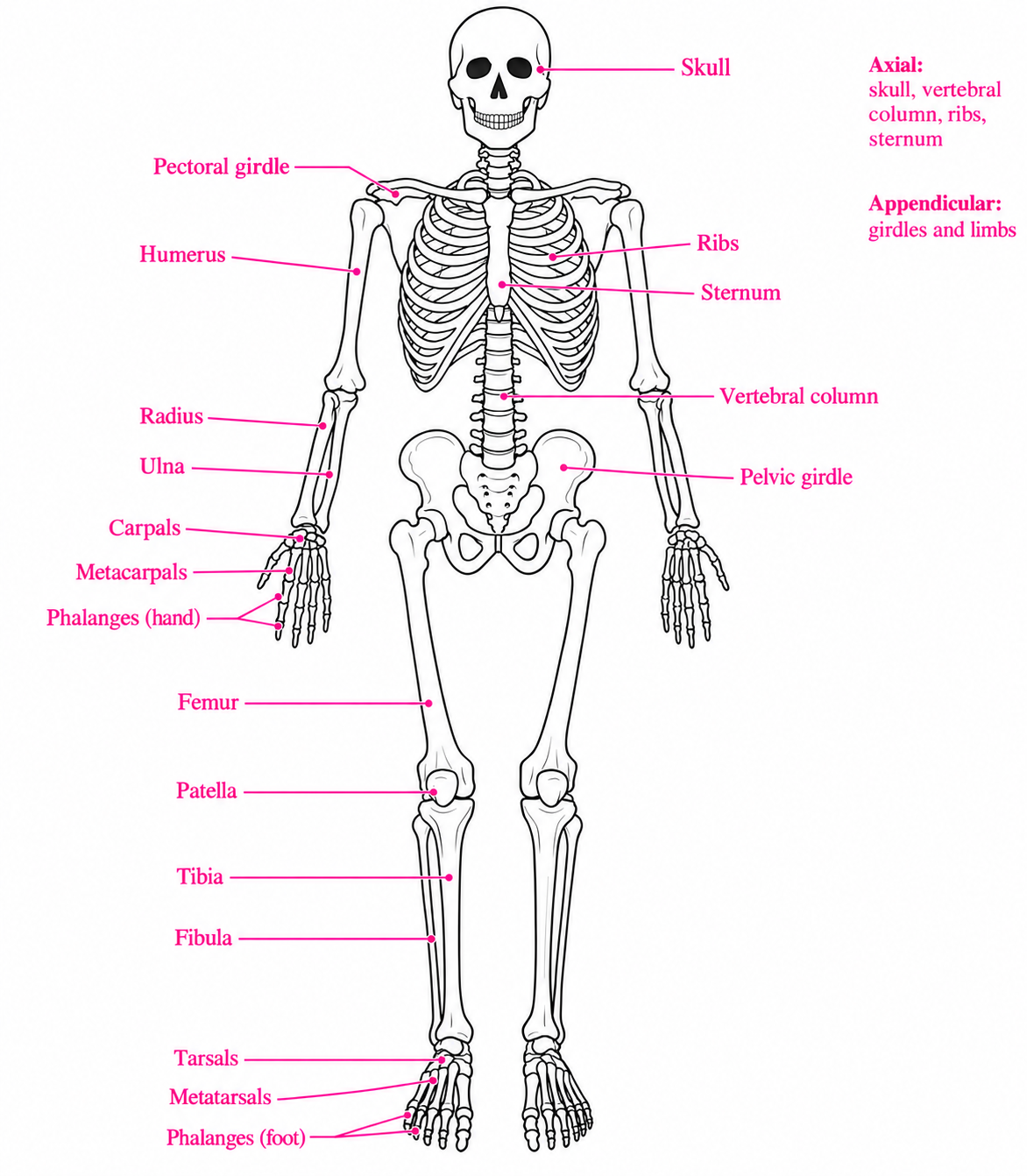
2. Bones of human skeleton

  • Axial skeleton

– skull, vertebra, sternum, rib

  • Appendicular skeleton

– arm bones: humerus, radius, ulna

– hand bones: carpals, phalanges, metacarpals

– leg bones: femur, patella, tibia, fibula

– food bone: Tarsals, metatarsals, phalanges

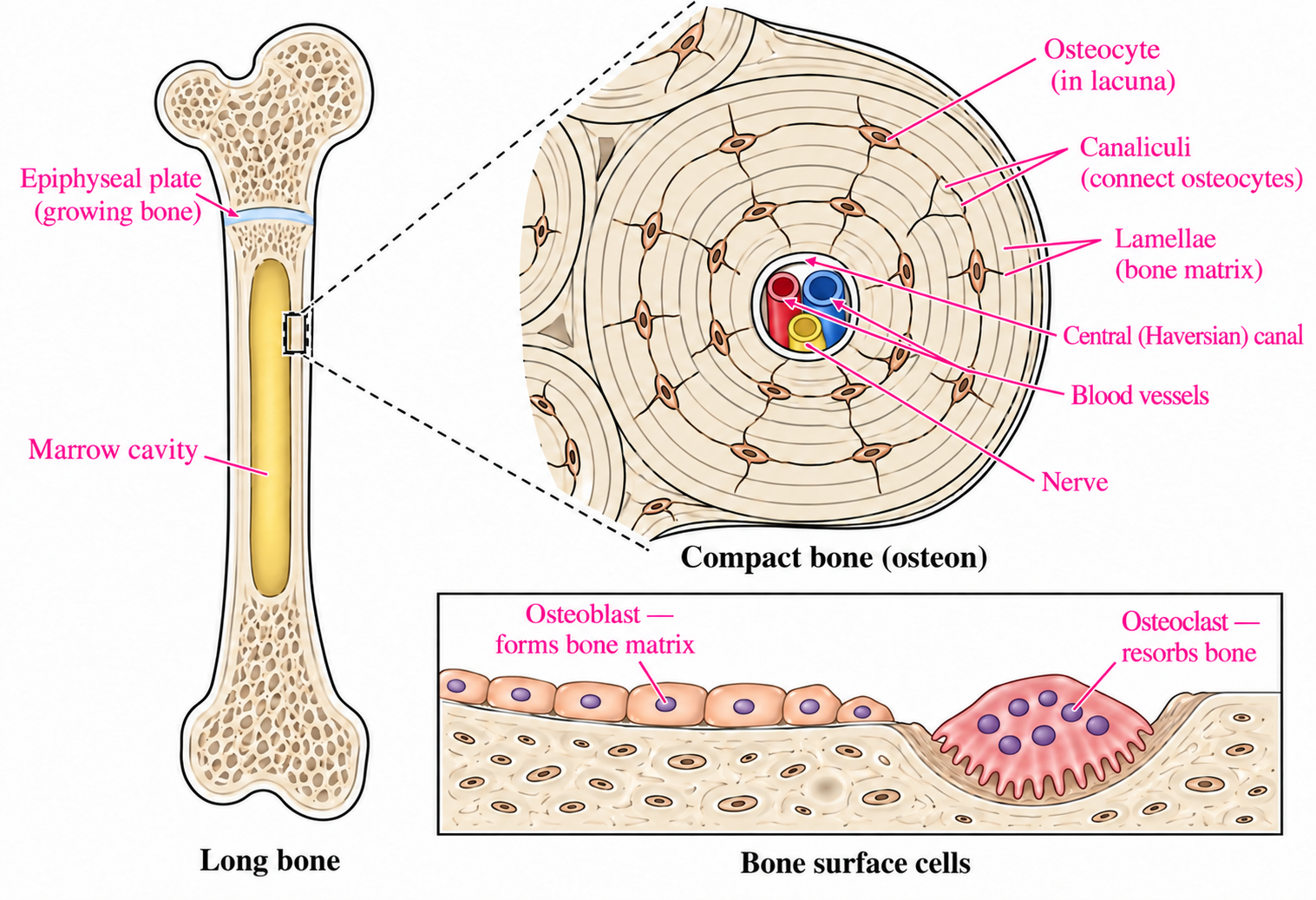
3. Structure of bone

Classification

Functions and features

Osteoclast

• Breaks down bone by releasing calcium

Osteoblast

• Makes bone by deposition of calcium

Osteocyte

• Immobilizes bone and transformed by osteoblast

Haversian canal

• Covers blood vessels and nerves and communicate with osteocytes

Epiphyseal plates

• The region of bone growth at the ends of long bones

E. Eye

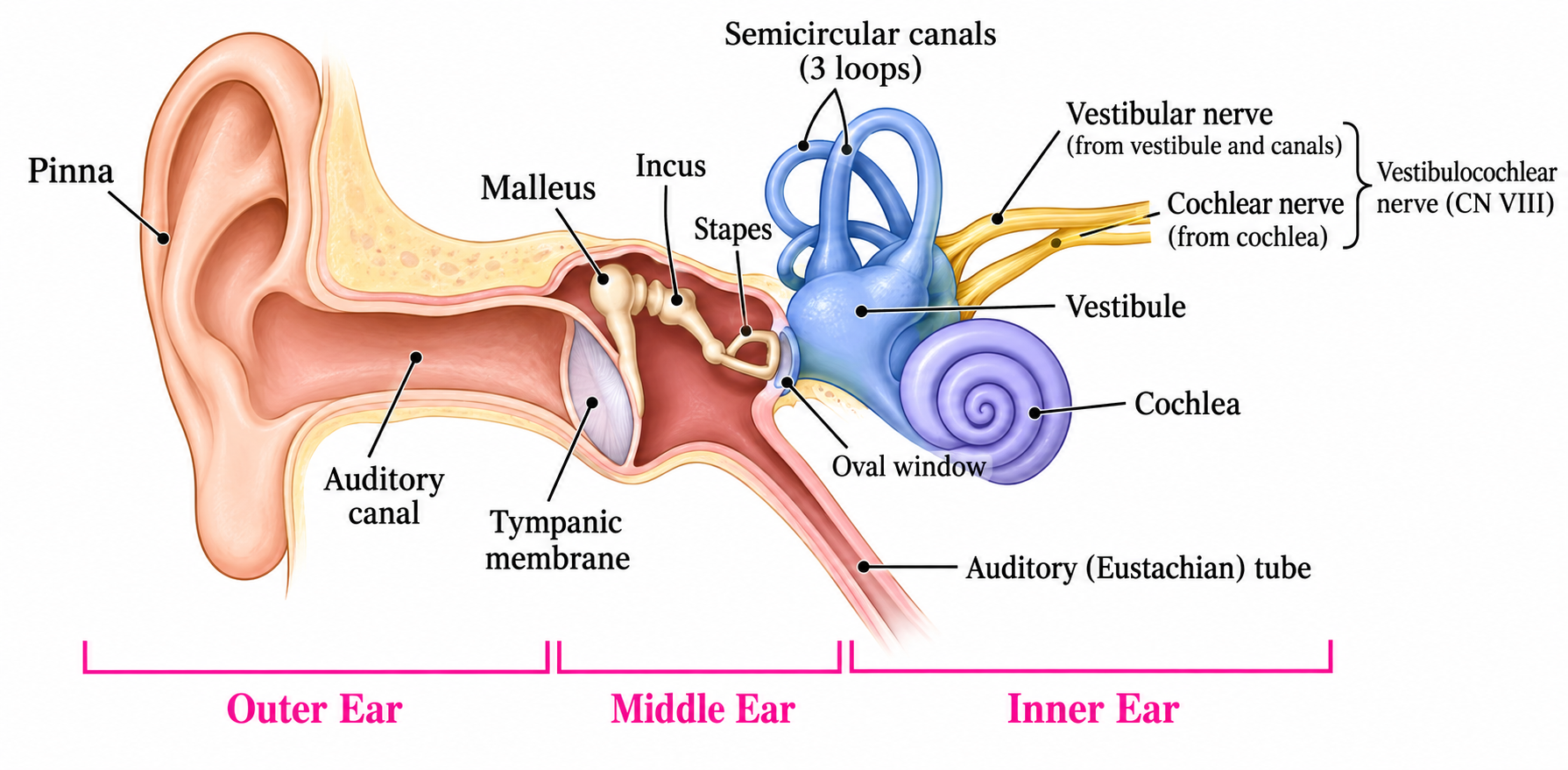
1. Structure of eye

a. Outer ear

  • Collects outside sounds
  • Consists of pinna and auditory canal

b. Middle ear (ossicles)

  • Functions as amplifying primary sound energy
  • Consists of three small bone – malleus, incus, stapes

c. Inner ear

  • Fluid – filled chambers
  • Consists of semicircular canals and cochlea

Classification

Functions and features

Outer

 ear

Pinna

• Collecting sound

Auditory canal

• Transmission of sound to tympanic membrane

Tympanic membrane

• Ear drum

• Dividing outer ear from middle ear

• Transmission of sound to middle ear

Middle

 ear

(ossicles)

Malleus

• Hammer shaped small bone

Incus

• Anvil shaped small bone

Stapes

• Stirrup shaped small bone

Inner

 ear

Semicircular

canals

• Three half circular canals

• Sensor for equilibrium of body

Cochlea

• Distinguishes the different vibrations of sound and sends these signals to auditory nerve

Auditory nerve

• Transmission of sound signals to brain

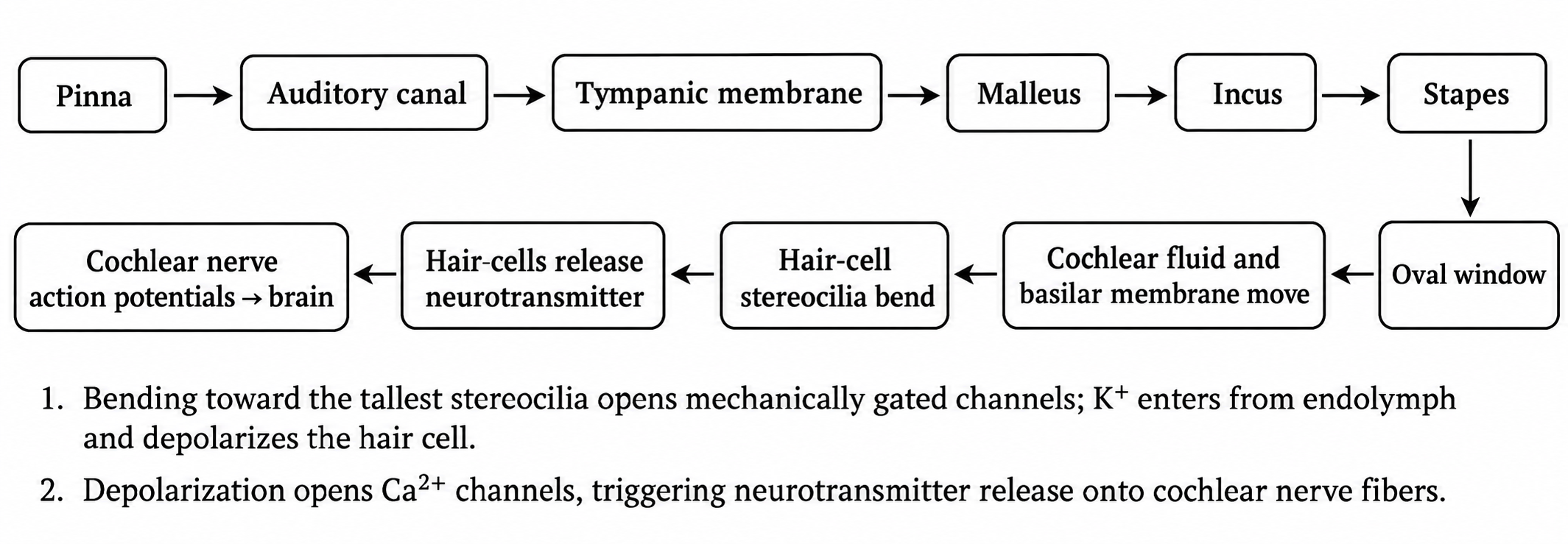
2. Processing sound information

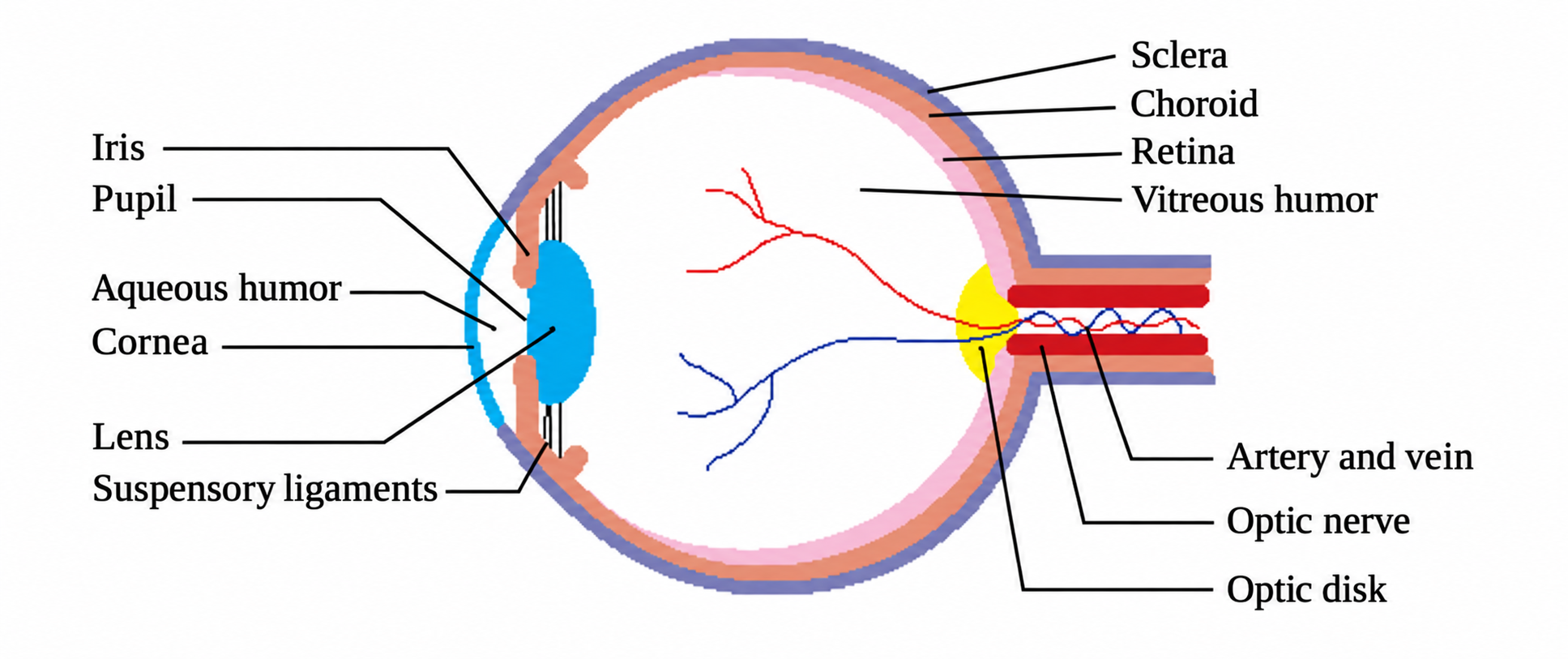
F. Eye

1. Structure of eye

Classification

Functions and features

Sclera

• Consists of white and tough outer layer of eye

Cornea

• Front part of sclera and fixing lens

• Passes and initial focusing of light 

Choroid

• Inner pigmented vascular layer

Retina

• Photoreceptor tissues and innermost layer

Iris

• Controls the amount of light by regulating pupil size

Pupil

• Center of iris and hole of light

Lens

• Focuses light on the retina

Aqueous humor

• Watery matter and anterior cavity

Vitreous humor

• Jellylike matter and posterior cavity

Optic disk

• No sensitivity to light (blind spot)

• Connecting to optic nerve

2. Light response in retina

a. Rod and cone cells

  • Rod cells – sensitivity of black and white in less intense light
  • Cone cells – sensitivity of colors in strong intense light    

b. Light and dark responses

  • Response in light

– active rhodopsin

– close Na+ channels

– rod and cone cells are hyperpolized

– no glutamine secreted

  • Response in dark

– inactive rhodopsin

– open Na+ channels

– rod and cone cells are depolarized

– glutamine secreted