II. Taxonomy
Key focus of this chapter: domains and kingdoms
This chapter reviews the three domains and the traditional five-kingdom classification system, with concise summaries of major organism groups.
A. Chronological order of pre-biotic chemicals
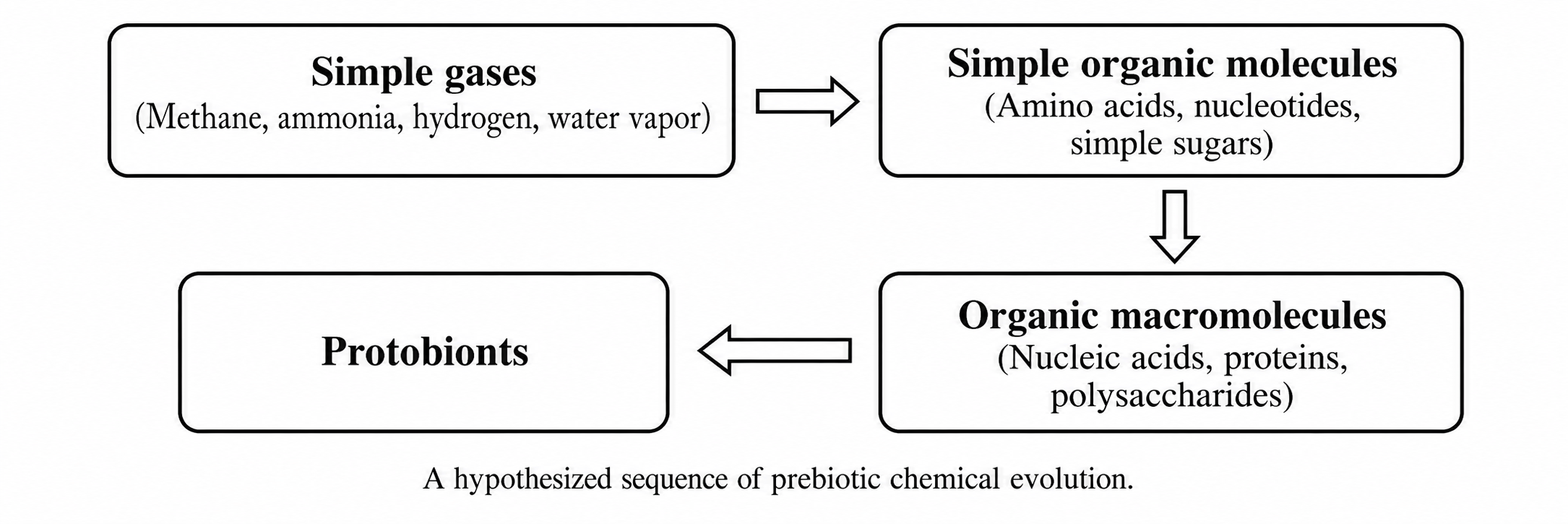
* Early origin-of-life models proposed a reducing atmosphere containing CH4, NH3, H2, H2O, and H2S; the actual composition of the early atmosphere remains uncertain.
B. Hierarchy
Domain – Eukarya, Bacteria, Archaea
Kingdom – Monera, Protista, Fungi, Plantae, Animalia
Phylum – Chordata
Class – Mammalia
Order – Carnivora, Primates
Family – Hominidae
Genus – Homo
Species – Homo sapiens
** Human classification is indicated in bold
C. Three domains and five kingdoms
3 Domains | 5 Kingdoms | Characteristics | |
Bacteria | Monera (Prokarya) | • Unicellular prokaryotes; DNA is usually organized in a chromosome, and plasmids may also be present • Most reproduce by binary fission • Some are motile and respond to stimuli by taxis • Horizontal gene transfer may occur • Cyanobacteria are bacteria; they are not archaea | |
Archaea | |||
Eukarya | Protista | • Sexual or asexual reproduction • Photoautotrophs, heterotrophs, or mixotrophs • Endosymbiosis • e.g., protozoa, slime molds, multicellular algae | Most unicellular |
Fungi | • Sexual or asexual reproduction • Heterotrophs and parasites • Mutualists and decomposers (Saprobes) • e.g., Mold, yeast, mushroom | Most | |
Plantae | • Photosynthetic organisms • Cell wall with cellulose | ||
Animalia | • Heterotrophs • Most are motile during at least one stage of the life cycle | Multicellular | |
1. Domain Bacteria
- Diverse and widespread prokaryotic microorganisms.
- Common shapes include spiral, rod-shaped, and spherical forms.
- Energy metabolism varies among species and may include glycolysis, fermentation, respiration, or photosynthesis.
- e.g., Proteobacteria, Gram-positive and gram-negative bacteria, blue-green algae (cyanobacteria), Spirochete, Chlamydias
2. Domain Archaea
- Archaea inhabit a wide range of environments; some species are extremophiles.
- e.g., Crenarchaeotes, euryarchaeotes, korarchaeotes, nanoarchaeotes, Sulfolobus
D. Diversity of metabolic adaptations
Classification | Energy source | Carbon source | Organisms |
Photoautotroph | Light | 
| Cyanobacteria, plants, algae |
Photoheterotroph | Light | Organic compound | Chloroflexus, Rhodobacter |
Chemoautotroph | Inorganic chemicals |
| Sulfolobus |
Chemoheterotroph | Organic chemicals | Organic compound | Many prokaryotes and protists, fungi, animals |
E. Kingdom Protista
Main Clade | Classification | Characteristics & Examples |
Diplomonadida • Two nuclei • Lack plastids • Multiple flagella • Reduced mitochondria | • e.g., Giardia | |
Parabasalids • Mutualists or parasites • Lack plastids • Reduced mitochondria | • Trichomonads move using flagella and an undulating membrane • Some parabasalids are mutualists in termite guts; others are parasites • e.g., Trichomonas | |
Euglenozoa • Predatory heterotrophs and photosynthetic autotrophs | Euglenids | • Mostly aquatic • Flagellar pocket and eyespot • Photosynthetic species have chloroplasts; many species are mixotrophic • e.g., Euglena |
Kinetoplastids | • Kinetoplast – containing DNA in mitochondria • e.g., Trypanosoma | |
Alveolates • Alveoli membrane bound sacs | Apicomplexans | • Apical complex organelles • Sporozoites in plasmodium • Intricate life cycle • e.g., Plasmodium (causing malaria) |
Ciliates | • Numerous cilia are used for movement and feeding • Micronuclei and macronuclei • e.g., Paramecium, Stentor | |
Dinoflagellates | • Phytoplankton and red tide • Symbiosis with coral or clam • e.g., Ceratium, Pfiesteria | |
Stramenopiles • Hairy flagella in flagellated stages • Photosynthetic or heterotrophic | Oomycetes | • Cell walls made of cellulose • Having hyphae to absorb nutrients • Resembling fungi • Irish potato blight • e.g., Water mold, downy mildews |
Diatoms | • Two shells made of silica • e.g., Marine phytoplankton | |
Golden algae | • e.g., Dinobryon | |
Brown algae | • Multicellular • e.g., Seaweeds, Laminaria, Macrocystis | |
Amoebozoans • Moving by pseudopodia | Gymnamoebas | • Live in soil, freshwater, or marine environments • e.g., Amoeba |
Entamoebas | • Some species are parasites; others are commensals • e.g., Entamoeba | |
Myxogastrida | • Plasmodial slime molds • Multinucleate plasmodium • Acellular slime molds • e.g., Physarum | |
Dictyostelida | • Cellular slime molds • Fruiting bodies with asexual reproduction • Living independently as haploids • Dictyostelium | |
Rhodophyta | Red algae | • Most are multicellular • Photosynthetic accessory pigment (phycoerythrin) • Diverse life cycles; many show alternation of generations • No flagellated stages • e.g., Bonnemaisonia, Palmaria |
Chlorophyta | Green algae | • Chlorophytes have chloroplasts with chlorophylls a and b; land plants arose from the charophyte lineage of green algae • Some green algae form lichens with fungi • e.g., Chlamydomonas, Ulva, Volvox, Caulerpa |
F. Kingdom Fungi
: heterotrophic organisms that break down molecules and absorb nutrients
- Important roles in ecosystems and human welfare
– decomposers that recycle chemical elements
– symbionts (mycorrhizae, lichens)
– yeast, food source, antibiotic producer
- Cell walls with chitin
- Lack chloroplasts
- Both asexual and sexual reproduction
- Some species are human pathogens
1. Structure
- Cell wall made of chitin
- Mycelium: Interwoven mass of hyphae
- Hyphae: Threadlike filaments composed of tubular cells
– septate hypha: Hyphae divided into cells by cross-walls called septa
– coenocytic hypha: a continuous, multinucleate cytoplasm without septa
- Mycorrhizae: Symbiotic mutual relationship with plants
– plants supply organic nutrients to fungi
– fungi enhance plant uptake of water and minerals, especially phosphate
2. Classification
Phylum | Characteristics |
Basidiomycota | • Club fungi • Sexual basidiospores are produced on basidia • Many species form fruiting bodies called basidiocarps • e.g., mushrooms, rusts, smuts |
Ascomycota | • Sac fungi • Sexual ascospores are produced in sacs called asci • Many filamentous species form fruiting bodies called ascocarps • Asexual spores called conidia are common • Many lichens have an ascomycete fungal partner • e.g., yeasts, truffles, morels |
Chytridiomycota | • Aquatic and terrestrial habitats • Saprobic or parasitic • Motile, flagellated zoospores • e.g., Batrachochytrium • Allomyces, historically grouped with chytrids, is now placed in Blastocladiomycota |
Glomeromycota | • Arbuscular mycorrhizal fungi • Symbiotic relationship with plants • e.g., Arbuscular mycorrhizae |
Zygomycota | • Traditional grouping; modern classifications divide these fungi among several lineages • Resistant zygosporangia form during sexual reproduction • e.g., Rhizopus (black bread mold) |
** Lichens (symbiotic associations between a fungus and a green alga and/or cyanobacterium; many are pioneer organisms)
G. Kingdom Plantae
1. Classification of plants
Land plants | Classification | Characteristics & Examples | |
Bryophytes | Liverworts | • Liver shaped gametophytes of Marchantia • Single-celled rhizoids | |
Hornworts | • Gametophytes grow horizontally | ||
Mosses | • Leafy gametophytes • Leaflike structures lack true vascular tissue | ||
Vascular plants | Seedless Vascular Plants | Lycophytes | • An early-diverging lineage of vascular plants • e.g., club mosses, spike mosses, quillworts |
Pterophytes | • e.g., Ferns, horsetails | ||
Seed Plants | Gymnosperms | • Naked seeds • e.g., Pines, ginkgo, cycads, conifers | |
Angiosperms | • Flowering plants • Seeds enclosed in fruits that develop from ovaries • Include monocots and eudicots • e.g., maple, banana, lily, apple | ||
2. Angiosperms
a. Monocot and dicot
Monocot | Dicot |
• One cotyledon • Floral parts usually in multiples of three • Parallel leaf veins • Scattered vascular bundles • Fibrous root system • Typical vascular-cambium secondary growth is absent | • Two cotyledons • Floral parts usually in multiples of four or five • Reticulated leaf veins • Vascular bundles arranged in a ring • Taproot with lateral roots • Secondary growth often present in woody species |
b. Floral structures and functions

Structures | Classification | Functions |
Female part (Carpel) | Stigma | • Receives pollen during pollination, before fertilization |
Style | • Connects the stigma to the ovary and provides a pathway for pollen-tube growth | |
Ovary | • Contains ovules and usually develops into the fruit after fertilization | |
Male part (Stamen) | Anther | • Produces pollen in microsporangia (pollen sacs) |
Filament | • Holding the anther | |
Other parts | Petal | • Attracting insects into the flower |
Receptacle | • Flower’s attachment to the stalk which sometimes becomes part of the fruit after fertilization | |
Sepal | • Small leaves under the flower -protecting flower during budding |
c. Plant tissues
Plant tissues | Functions and features |
Parenchyma cells | • Thin and flexible primary cell wall • Metabolic functions, photosynthesis, and storing organic molecules • e.g., Mesophyll |
Collenchyma cells | • Unevenly thickened, flexible primary cell walls • Support growing plant parts without preventing elongation • Living cells |
Sclerenchyma cells | • Thick, rigid secondary cell walls, usually lignified • Provide mechanical support • Typically dead at functional maturity |
d. Anatomy of leaf

Structures | Functions |
Guard cell | • Controlling the size of opening |
Stoma | • A pore for exchanging gas |
Cuticle | • Wax layer for protecting epidermal cells |
Epidermis | • Outer protective cell layer • Secretes the cuticle, which reduces water loss |
Mesophyll | • Parenchyma and chlorenchyma tissues • Primary site for photosynthesis |
Bundle sheath | • A layer of cells surrounding the vascular bundle (xylem and phloem) • Regulates exchange between vascular tissues and mesophyll; in C4 plants, it is a major site of the Calvin cycle |
** Transpiration
– loss of water vapor from aerial plant parts, mainly through stomata in leaves; temperature, wind, humidity, and light affect the rate
– evaporation lowers leaf water potential and creates tension that pulls a cohesive column of water upward through xylem.
e. Anatomy of stem
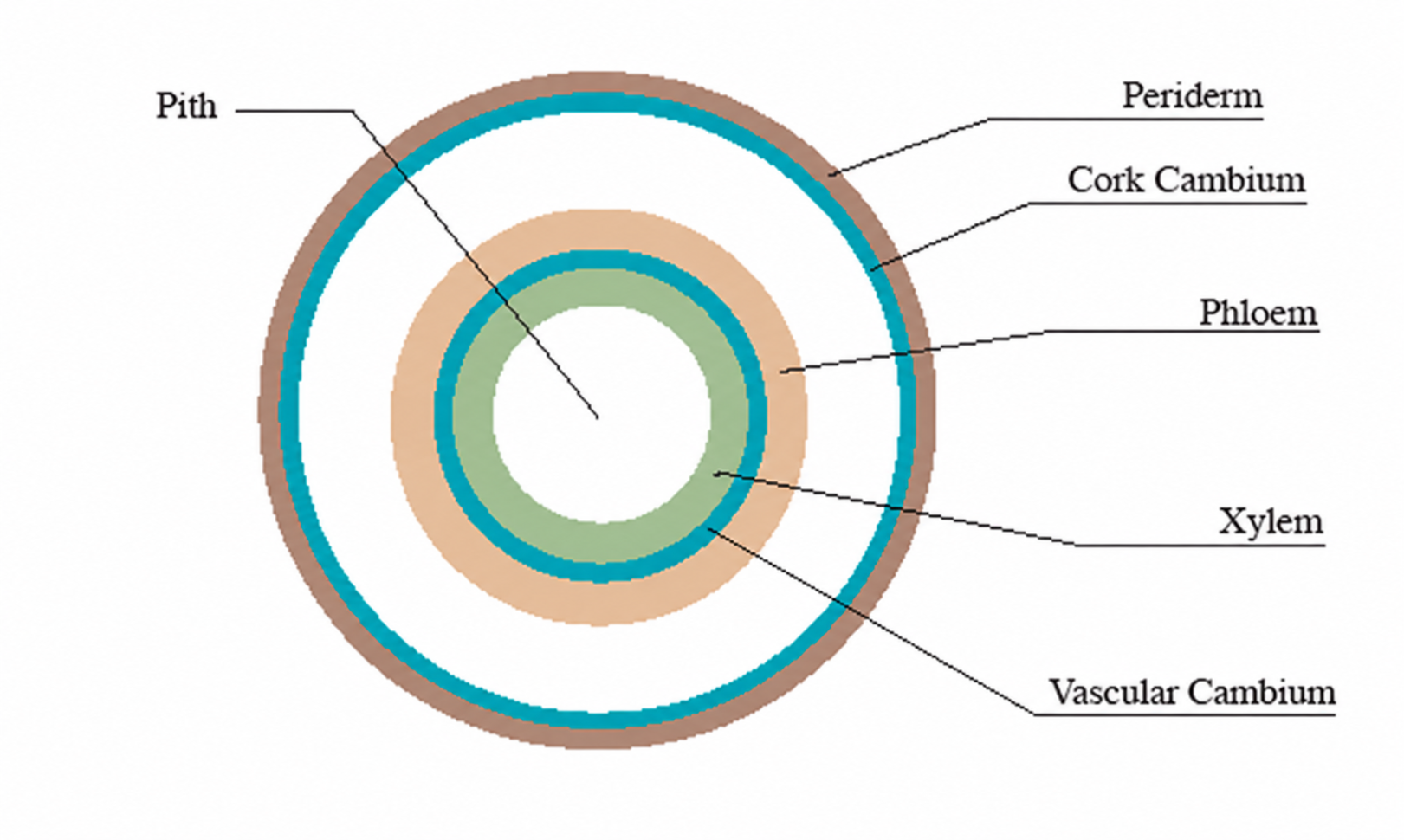
Structures | Functions |
Periderm | • Secondary protective tissue that replaces the epidermis • Consists of cork, cork cambium, and phelloderm |
Cork cambium | • Responsible for growing secondary dermal tissue • Undifferentiated and actively dividing cell |
Phloem | • Transports sugars and other organic solutes from sources to sinks through sieve tubes • Bulk flow is driven by a hydrostatic pressure gradient; loading and unloading may involve active transport • Composed of living sieve-tube elements and companion cells • Sieve plates and plasmodesmata |
Vascular cambium | • Produces secondary xylem toward the inside and secondary phloem toward the outside • Undifferentiated, actively dividing cells |
Xylem | • Transporting water and minerals (upward only) • Composed of dead cells (vessel elements and tracheids) • Main force of transporting – surface tension and negative pressure • Pit pairs |
Pith | • Ground tissue composed mainly of parenchyma cells • Located at the center of many stems |
f. Modified stems
Modified stems | Features |
Bulbs | • Short and vertical underground stem • Storage food in the enlarged leaves • e.g., onions |
Stolons | • Horizontal stem along the surface of the ground • Producing rooted plantlets at the end of their nodes • e.g., strawberry and spider plant |
Tubers | • Underground storage stem • Enlarged ends of rhizomes • e.g., potatoes |
Rhizomes | • Horizontal stem along or below the surface of ground • e.g., ginger |
g. Plant hormones
Hormones | Functions |
Auxin | • Phototropism – shoot growing toward light • Gravitropism (geotropism) - root growing downward in response to gravity (positive gravitropism) - stem growing upward against gravity (negative gravitropism) • Hydrotropism – growing toward water |
Cytokinins | • Stimulate cell division and growth |
Gibberellins | • Stem elongation • Stimulate flowering |
Abscisic acid | • Promotes seed dormancy and inhibits germination • Promotes stomatal closure during water stress |
Ethylene | • Promotes fruit ripening |
Kinins | • Promote cell division |
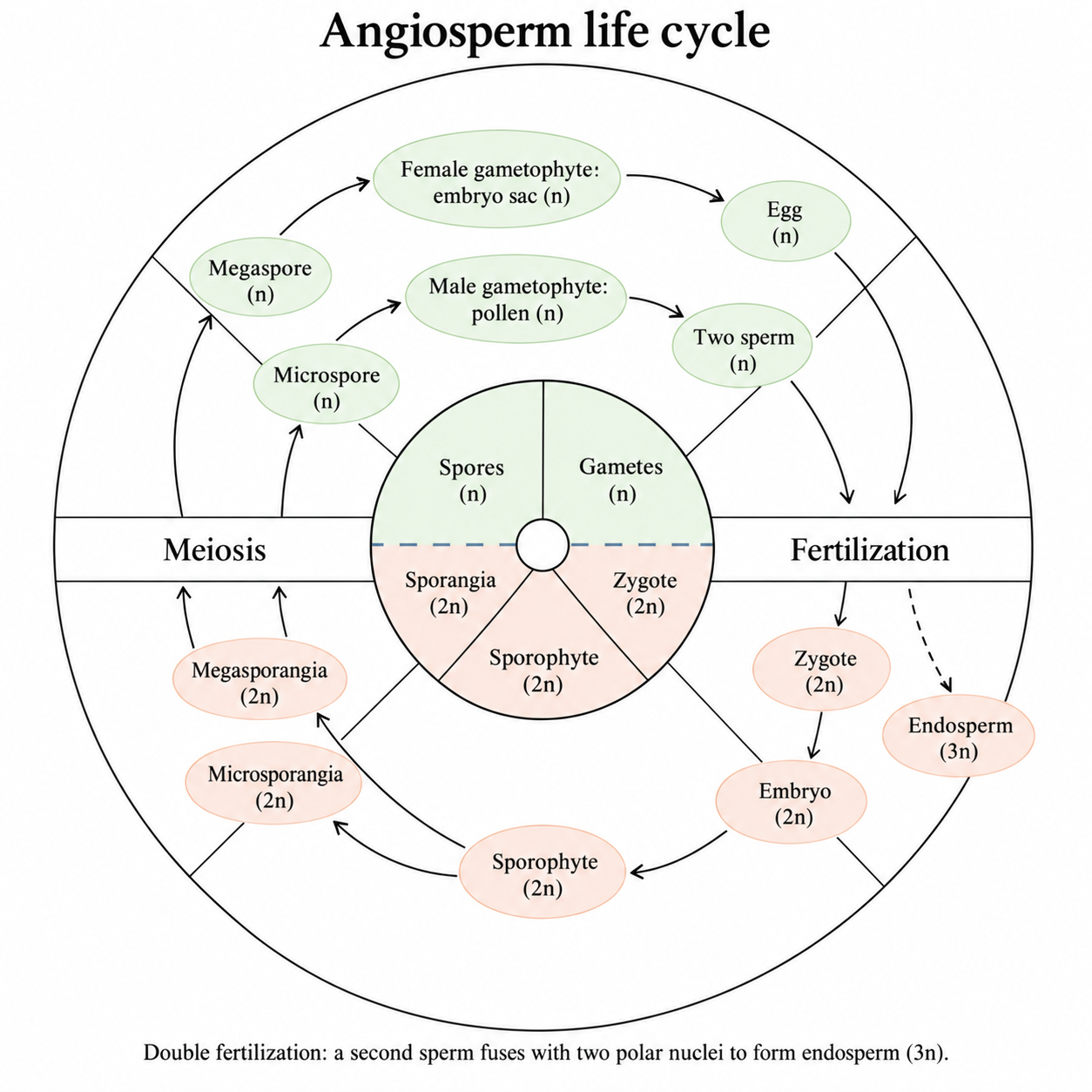
h. Angiosperm life cycle
H. Kingdom Animalia
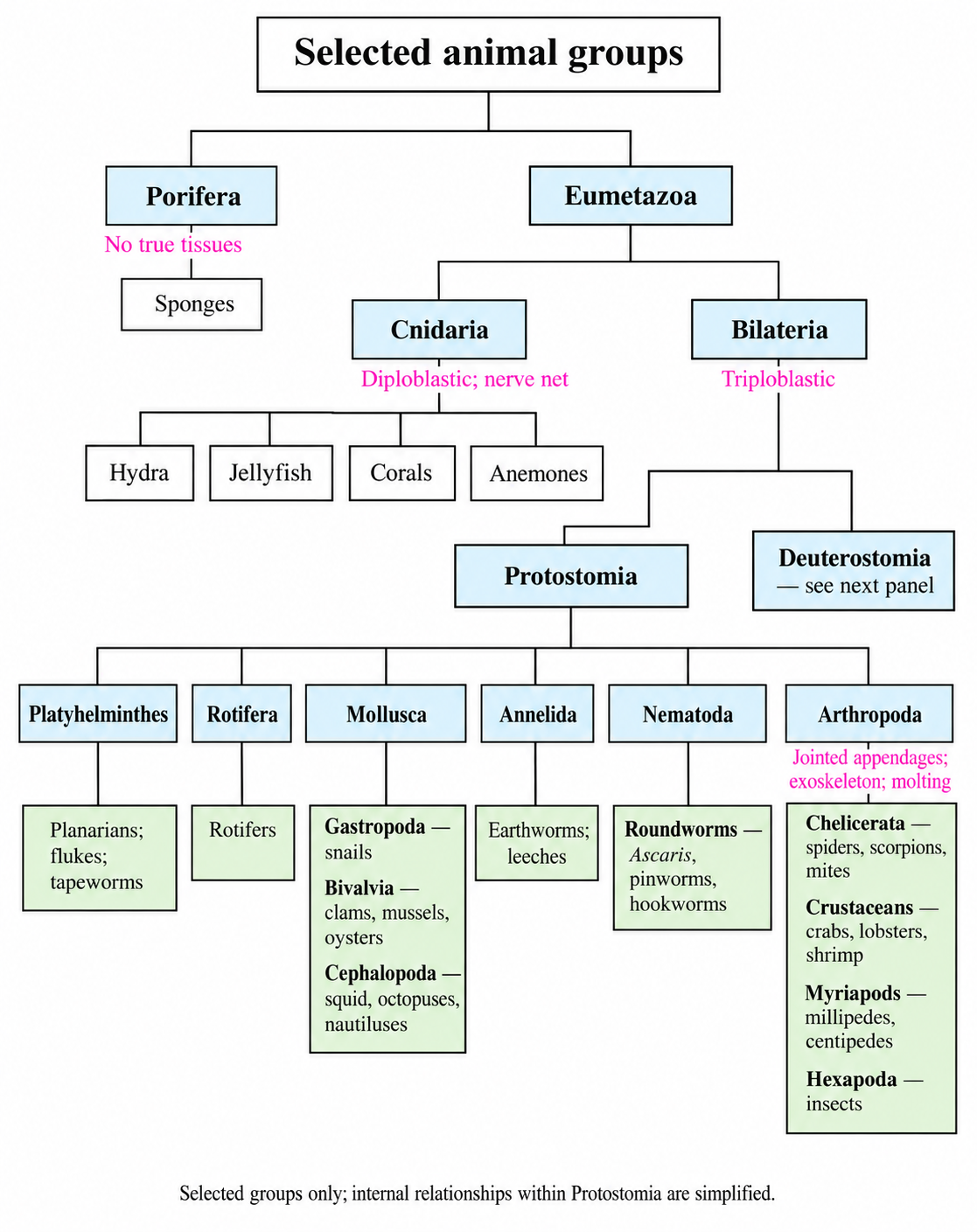
1. Major animal groups and features
Phylum | Class | Animals and Distinctive features |
Porifera - respiration and excretion by diffusion | Sponge • Choanocytes – creating a water current through water channels to get food particles | |
Cnidaria - mostly radial symmetry - tentacles with cnidocytes - gastrovascular cavity - polyp and/or medusa forms - nerve net | Hydra (polyp only) • Cnidocytes contain nematocysts, stinging capsules • Polyps often reproduce by asexual budding • Medusae, when present, commonly reproduce sexually; Hydra has no medusa stage | |
Platyhelminthes - dorsoventrally flattened body - incomplete digestive cavity in many species; tapeworms lack a digestive tract - anterior ganglia and longitudinal nerve cords | Turbellaria | Planaria • Protonephridia- containing flame bulbs, excretory system |
Cestoda | Tapeworms • Scolex is an attachment structure with suckers and/or hooks • Digestive tract absent; nutrients are absorbed across the body surface | |
Mollusca | Gastropoda | Snails • Open circulatory system • Respiration by gills in many aquatic species or by a vascularized mantle cavity in terrestrial pulmonates • Embryonic torsion • Radula |
Bivalvia | Clams, mussels, oysters • Open circulatory system • Two shell valves and adductor muscles • Gas exchange mainly through gills • Siphons move water into and out of the mantle cavity | |
Cephalopoda | Octopus & Squid • Cephalization - the highly advanced sensory equipment and the central nervous system on the head of body. • Closed circulatory system • Tentacles for grasping or movement | |
Annelida - closed circulatory system - double ventral nerve cord | Earthworm • Metanephridia collect coelomic fluid and eliminate wastes through external pores • Septa partition the coelom • Gas exchange occurs across moist skin | |
Arthropods - exoskeleton of cuticle - well developed sensory structures - open circulatory system - metamorphosis | Insecta | Grasshopper • Malpighian tubules transfer wastes from hemolymph to the gut • Respiration through tracheal tubes • Three body regions: head, thorax, abdomen • Three pairs of legs; adult grasshoppers have two pairs of wings, but wings vary among insects |
Diplopoda | Millipedes • Mandibles are jawlike feeding appendages • Typically two pairs of legs per fused trunk segment • Centipedes belong to the separate class Chilopoda | |
Arachnida | Spiders • Usually eight simple eyes; number varies among species • Four pairs of legs • Respiration by book lungs and/or tracheae | |
Echinodermata - adults usually pentaradial; larvae bilateral - water vascular system - endoskeleton of calcareous ossicles - nerve ring and radial nerves | Sea star • Tube feet – water vascular system • Madreporite • Ampulla | |
Chordata | Agnatha | Jawless fishes (lampreys, hagfishes) • Main heart has one atrium and one ventricle; single circulation • No paired fins • Lack jaws |
Chondrichthyes | Cartilaginous fishes (sharks, skates, rays) • Jaws and paired fins present • Ventral mouth in many species • Usually placoid scales • No swim bladder • Lateral line system | |
Osteichthyes | Bony fishes • Gills usually covered by an operculum • Many have a swim bladder; lungfishes have lungs | |
Amphibia | Frogs, toads, salamanders • Usually a three-chambered heart and two circuits • Usually four limbs • Gas exchange through skin, lungs, and/or gills, depending on species and life stage • Metamorphosis | |
Reptilia | Snakes, lizards, turtles, alligators, crocodiles • Skin protected by keratinized epidermal scales or scutes • Amniotic eggs; internal fertilization | |
Aves | Birds • Four-chambered heart and double circulation • Feathers and scales on the legs • Toothless beak | |
Mammalia | • Mammary glands and hair • Highly developed brain • Most species have estrous cycles; humans and some other primates have menstrual cycles |
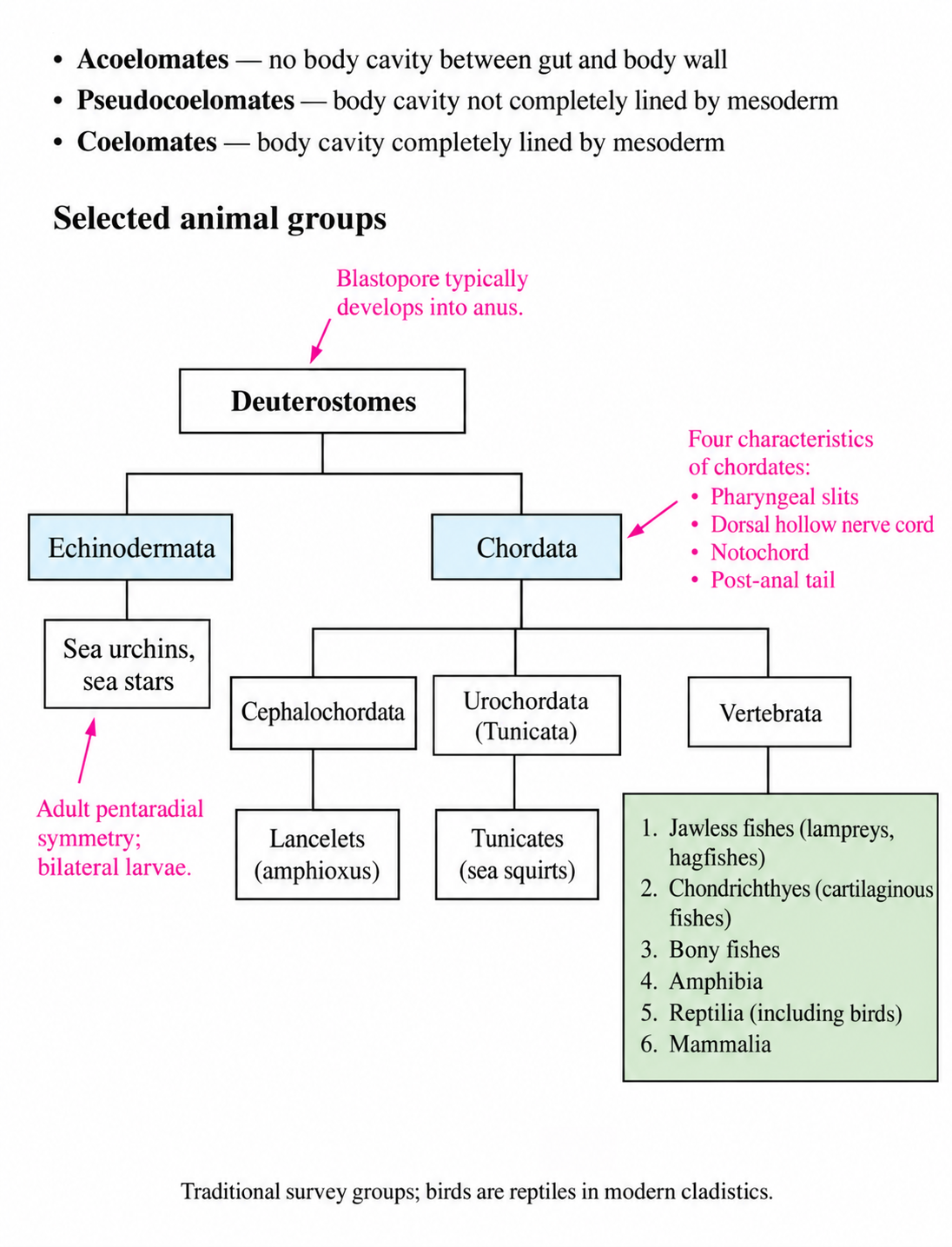
2. Animal classification diagram
| 
|
I. Animal Reproduction
1. Asexual reproduction
- Budding: new individual arises from parent body
- Fission: the separation of a parent body into two parts
- Fragmentation: the breaking of the parent body into several pieces and growing into complete adults.
- Regeneration: Regrowth of a lost body part; it contributes to asexual reproduction when a fragment develops into a complete new individual.
- Parthenogenesis: Development of a new individual from an unfertilized egg
2. Sexual reproduction
Reproduction of vertebrates | Descriptions |
Oviparity | • Fertilized eggs are laid and hatched outside mother’s body. • e.g., All birds |
Ovoviviparity | • Fertilized eggs are retained within the mother until they hatch, or hatch shortly after release • Embryos obtain nourishment mainly from egg yolk • e.g., some sharks and some snakes |
Viviparity | • Embryos develop within the mother and receive nutrients from her • In placental mammals, nutrients cross the placenta; maternal and fetal blood normally remain separate • e.g., most mammals |
** Duck-billed platypus: an oviparous (egg-laying) mammal.
3. Sexual and asexual reproduction
- Hermaphroditism: An individual can produce both male and female gametes, either simultaneously or sequentially
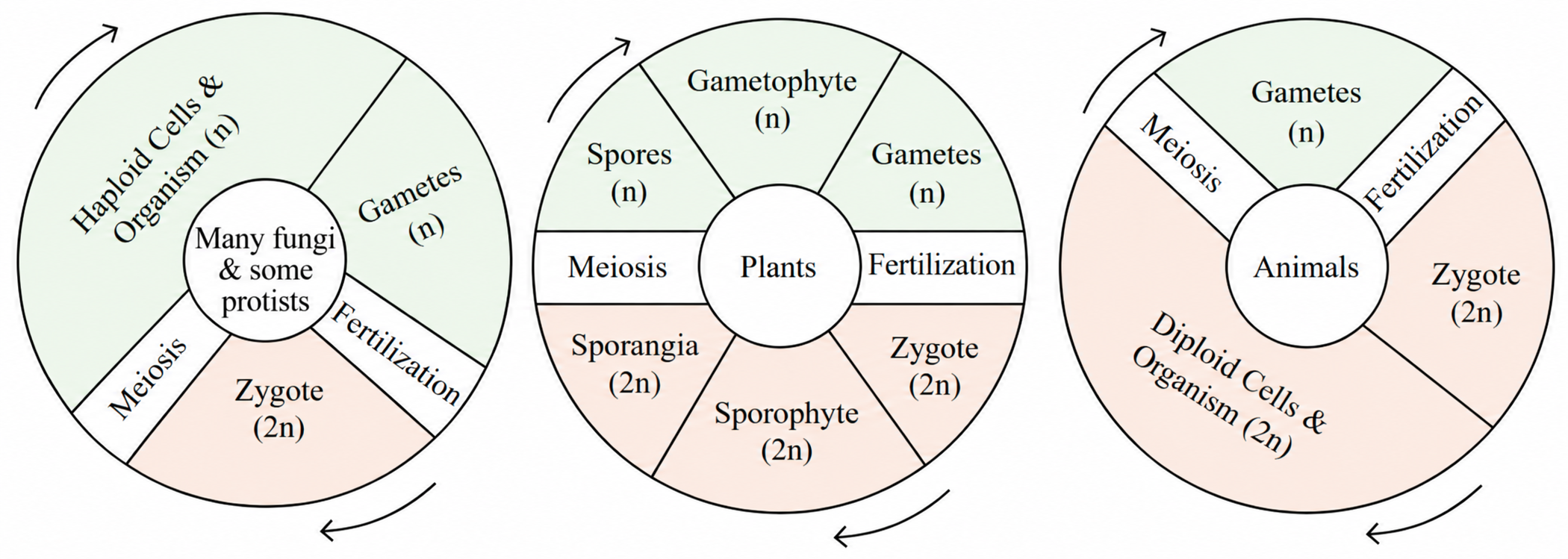
J. Life cycle of animals, plants, and fungi
- Many fungi: Haploid stages predominate; some also have a prolonged dikaryotic stage. Protists have diverse life cycles.
- Plants: Alternation of generations
- Animals: Diploid life cycle predominates