V. Thermochemistry

Key focus of this chapter: enthalpy change

This chapter focuses on percent yield of enthalpy change and gives concise summaries of the important things about energy, work by pressure, heat energy, Hess’s law, and entropy change in more detail.

Thermochemistry: relationships between the absorption or release of heat energy by chemical reaction.

A. Energy (E)

: ability to do work (W) or transfer heat (Q).

  ΔE (change energy) = Efinal -Einitial

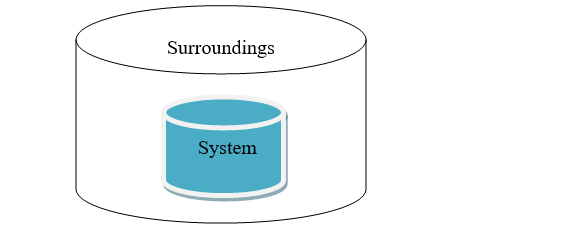
  • System: a part of universe that is starting reactants and finishing products.
  • Surroundings: the rest of the universe
System and surroundings of enthalpy change

(+) energy

(-) energy

W

• Work is done on system

• Work is done by system

Q ( =ΔH)

• Absorbing heat into system

  from surroundings

• Releasing heat from system to

  surroundings

  • Qs/ What is DE when the system does 100J of work and releases 80J of heat?

     ΔE = W + Q

         = (-100J) + (-80J)

         = -180J

B. Work by pressure

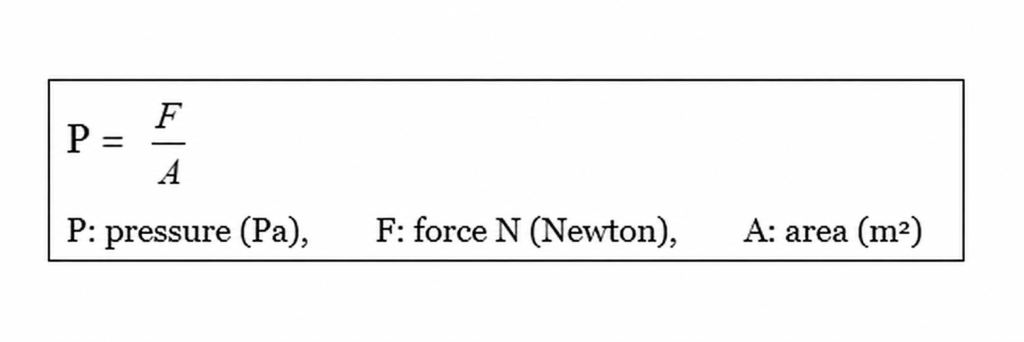
1. Pressure

  • 1 atm = 760 mmHg (torr)

2. Work (W)

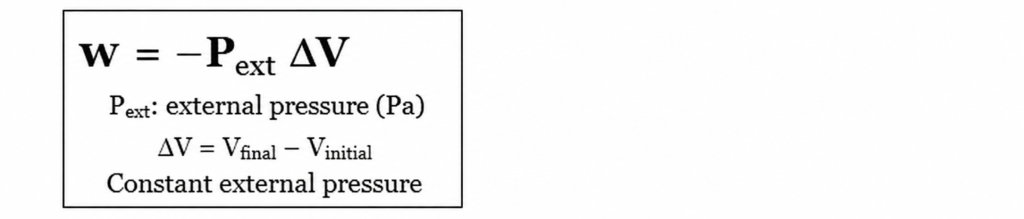
: pressure (or force) times volume change (or distance moved)

+W

• Work is done on system

• - ΔV (contraction of volume)

• Same direction of volume

 change with pressure

- W

• Work is done by system

• + ΔV (expansion of volume)

• Reverse direction of volume

 change against pressure

  • Qs/ What is the work when the volume is expanded from 8.0 L to 10.0 L against an external pressure of 3.0atm?

     W = – PΔV (work is done by system)

         = – 3 atm × (10.0 – 8.0 ) L

         = – 6 L•atm

C. Heat energy, Q

  • Calorie: required energy to raise 1g of water by 1oC

     ** 1 cal = 4.184 J

  • Specific heat, C: heat required to raise the temperature of the substance.

     ** Specific heat of water is 4.18J/g•oC

  •  Qs/ Calculate the heat energy to raise the temperature of 100g of water from 50oC to 80oC.

     Q = C•m•DT

        = 4.18J/g•oC × 100g × (80-50) oC

        = 12,540 J

  • Qs/ Calculate the specific heat of gold when 650J of heat is used to increase the temperature of 50g of gold from 25 oC to 125 oC.

D. Laws of thermodynamics

First law of thermodynamics

• Law of conservation of energy: the total energy of a system and its surroundings is neither created nor destroyed.

Second law of thermodynamics

• Law of disorder: the total entropy (ΔS) of a system and its surroundings is increased during a spontaneous reaction.

E. Enthalpy change, ΔH

: ΔH = Hfinal – Hinitial

Exothermic processes, -DH

Endothermic processes, +DH

Diagrams

Graph and equation

System

• Giving off heat to surroundings

• Decreasing heat by losing energy

• Bond formation processes

• State change: gas → liquid → solid

• Getting heat from surroundings

• Increasing heat by gaining energy

• Bond breaking processes

• State change: solid → liquid → gas

Surroundings

• Increasing heat

• Decreasing heat

Examples

• Combustion of fuel, acid and base neutralization, catabolism of glucose in a cell, mixing water with strong acids

• Melting solid salts, producing glucose by photosynthesis, cold pack by mixing water with ammonium nitrate

** The total energy in both exothermic and endothermic reactions is not changed.

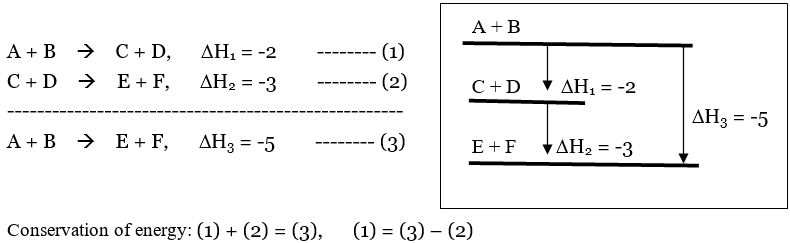
F. Hess’s Law

  • The ΔH of an overall reaction is equal to the sum of the ΔH of the individual steps.
  • During a chemical reaction, energy is conserved (neither created nor destroyed – 1st law of thermodynamics) from initial to final steps with independent path ways.
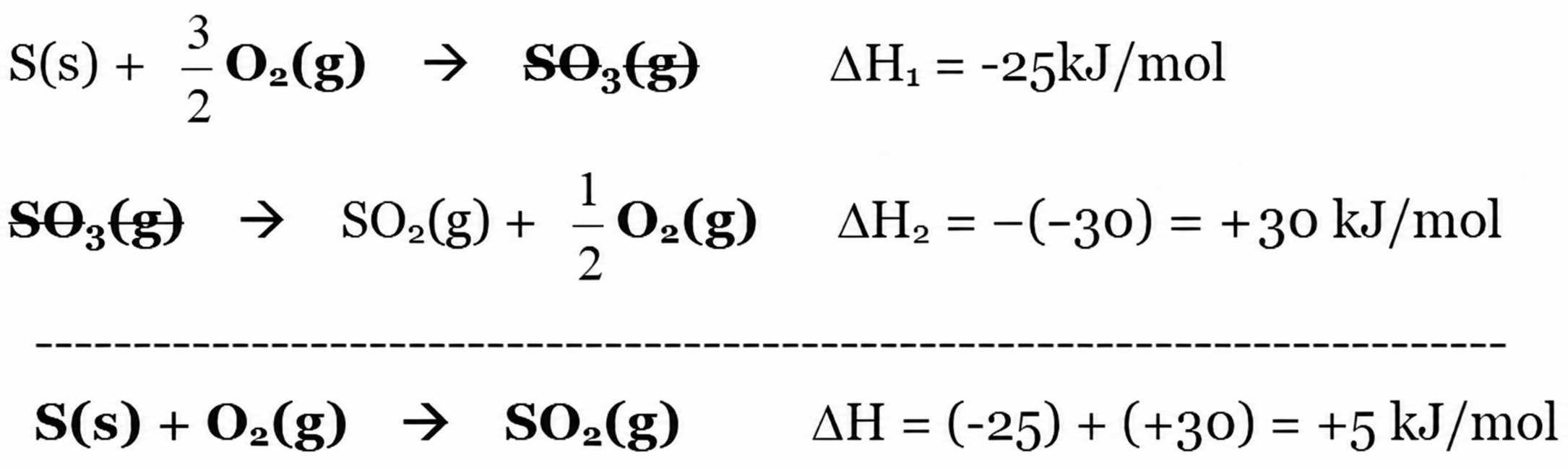
  • Qs/ Calculate the energy change, ΔH, for the reaction S(s) + O2(g) → SO2(g) from the following information.

Table A

     Sol/

Table A

1/2 × 1st reaction

Reverse direction of 2nd reaction

1st reaction +

 2nd reaction

Therefore, the energy change of the reaction S(s) + O2(g) → SO2(g) is +5 kJ/mol.

G. Measuring enthalpy change, ΔHof

: ways to determine DHo from the chemical reactions.

Qs/ Calculate ΔHo for the reaction.

     CH4(g) + 2O2(g)   →  CO2(g) + 2H2O(l)

Molecules

-75

-390

-290

Sol) ΔHo = Σ products of ΔHof  – Σ reactants of ΔHof

     = [CO2 + 2H2O] – [CH4]         ** ΔHof of O2 = 0 kJ/mol

     =[(-390) + 2(-290)] – (-75

     = -895 kJ

Qs/ Calculate ΔH for the reaction by using the bond dissociation energy in Table B.

         2C2H6(g) + 7O2(g)  →  4CO2(g)  + 6H2O(l)

Table B

Bonds

Dissociation bond energies (kJ/mol)

C-H

410

C-C

350

O=O

500

C=O

730

O-H

460

Sol) Σ (Bond energies of reactants) – Σ (Bond energies of products)

     = [(C-H)×12 + (C-C)×2 + (O=O)×7] – [(C=O)×8+(O-H)×12]

     = [410×12 + 350×2 + 500×7] –[730×8+460×12]

     = -2,240kJ

H. Entropy change, ΔS

ΔS > 0

ΔS < 0

  • ΔS = ∑ (entropy of products) – ∑ (entropy of reactants)

     Qs/ Calculate ΔS.

   W + X  →  Y + Z

S

W

3

X

2

Y

5

Z

4

  ΔS = (Y + Z) – (W+X)

     = (5+4) – (3 +2)

     = 4

  • Entropy of surrounding, ΔSsurr

Increasing entropy of surroundings

Decreasing entropy of surroundings

I. Gibbs free energy change, ΔG

: determining spontaneous or non-spontaneous reaction by measuring chemical or physical process.

  • ΔH < 0 and ΔS >0 at T > 0 is always a spontaneous reaction.

Qs/ Which of the following represents a spontaneous reaction if T =1?

     A. ΔH = -1, ΔS = -2

     B. ΔH = +1, ΔS = -2

     C. ΔH = +1, ΔS = +2

     D. ΔH = -1, ΔS = +2

     E. C and D

     ANS: E

     Sol/ For ΔG = ΔH – TΔS

     A. -1 – (-2) = +1

     B. +1 – (-2) = +3

     C. +1 – (+2) = -1

     D. -1 – (+2) = -3

Qs/ ΔH = 6 and ΔS = 3 at equilibrium state. Calculate T.