

I. Atom and Ion theory

Key focus of this chapter: atomic structure

This chapter reviews atomic structure, ions, atomic mass, and nuclear reactions.

A. Atomic history

Historic scientists

Features

Dalton

• Modeled atoms as indivisible, solid spheres.

• Elements are composed of atoms.

Thomson

• Discovered electrons through cathode-ray tube experiments.

• Proposed electrons embedded in a diffuse sphere of positive charge.

Millikan

• Measured the electron’s charge using the oil-drop experiment.

Rutherford

• Discovered the nucleus through alpha (α) particle scattering experiments.

• Proposed a small, positively charged nucleus at the center of the atom.

• Electrons occupy the space surrounding the nucleus.

Bohr

• Modeled electrons in fixed orbits with quantized energies.

• Developed a model for the hydrogen (H) atom.

B. Atomic structure

1. Atom

  • Elements consist of atoms, which contain subatomic particles; atoms are conserved and rearranged in ordinary chemical reactions.
  • Chemical reactions involve the rearrangement of atoms.
  • An atom consists of a nucleus containing protons and usually neutrons, surrounded by electrons.

Fig. 1 Structure of atom

2. Subatomic particles

Classification

Features

Proton

• Positive charge.

• Number of protons determines atomic number.

• Distinguishes one element from another.

Electron

• Negative charge.

• Monatomic ions form when atoms gain or lose electrons.

Neutron

• No charge.

• Isotopes of an element differ in neutron number and mass.

C. Ion

: an atom or group of atoms with a net electric charge.

1. Cation and anion

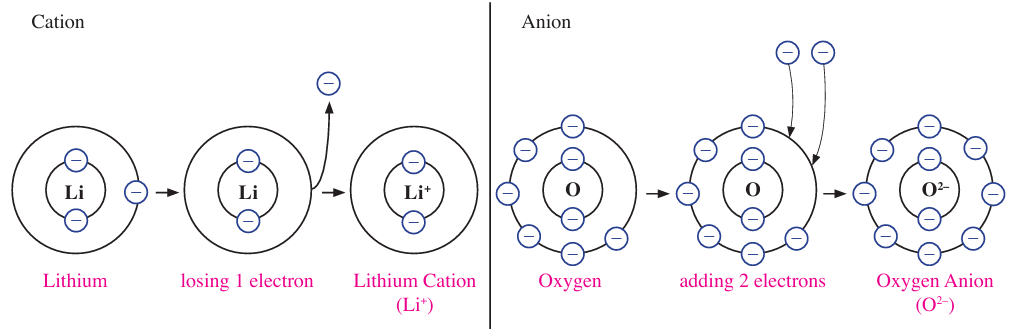
  • Cation (positive ion): a monatomic cation forms when an atom loses one or more electrons.
  • Anion (negative ion): a monatomic anion forms when an atom gains one or more electrons.

Fig. 2 Cation and anion

2. Isoelectronic

  • Atoms or ions with the same number of electrons
  • e.g., K+ and Ar, F– and Mg2+

** Isotope

  • Atoms of the same element with the same number of protons but different numbers of neutrons and therefore different mass numbers.
  • Similar chemical properties but different masses and some different physical properties.
  • Certain radioactive isotopes are used to date archaeological and geological materials.

D. Atomic mass

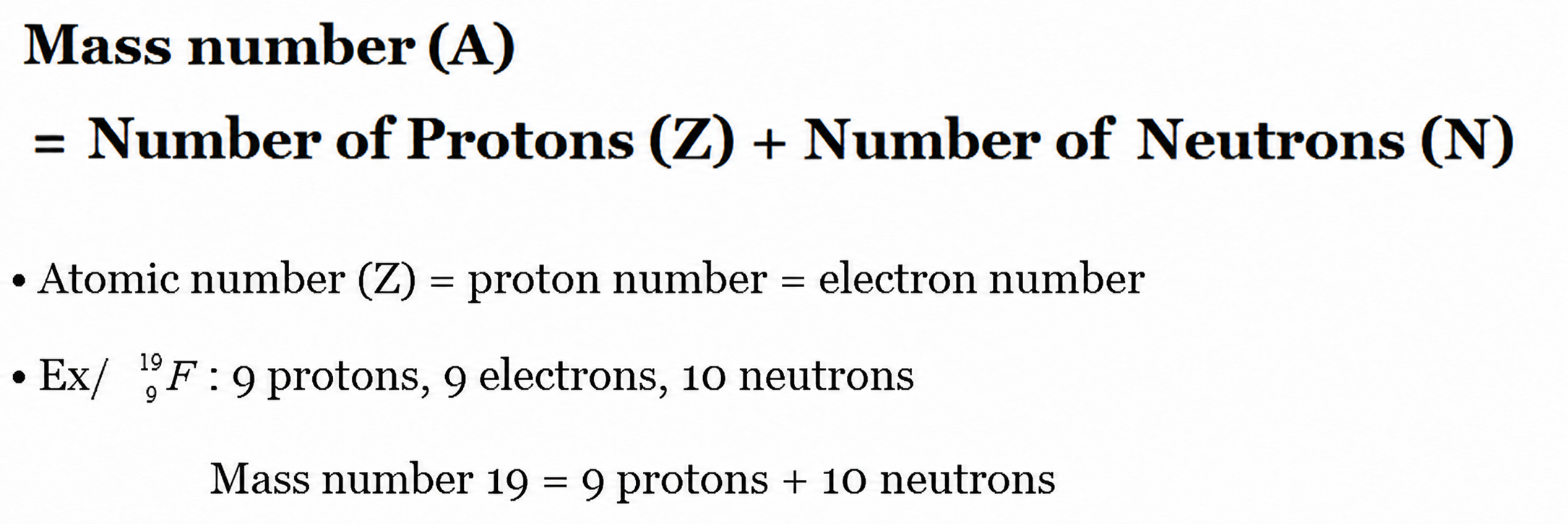
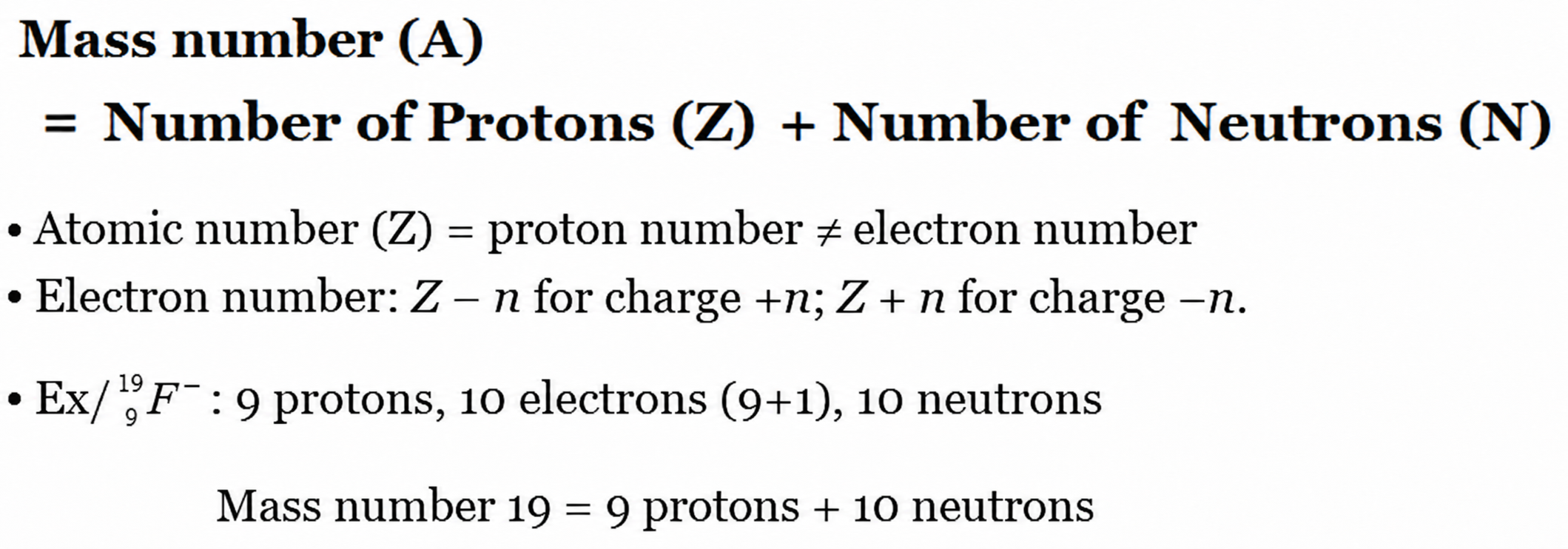
Mass number (A) is the total number of protons and neutrons in a nucleus; it is a whole-number count. Atomic mass is the mass of an atom, usually expressed in atomic mass units (amu). The average atomic mass listed on a periodic table is the abundance-weighted average of an element’s isotopic masses.

Classification

Equations and features

Neutral atom

Ionic atom

E. Nuclear reactions

  • Many nuclides are radioactive.
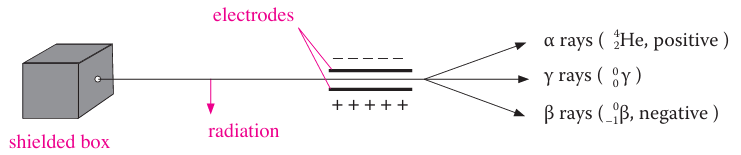
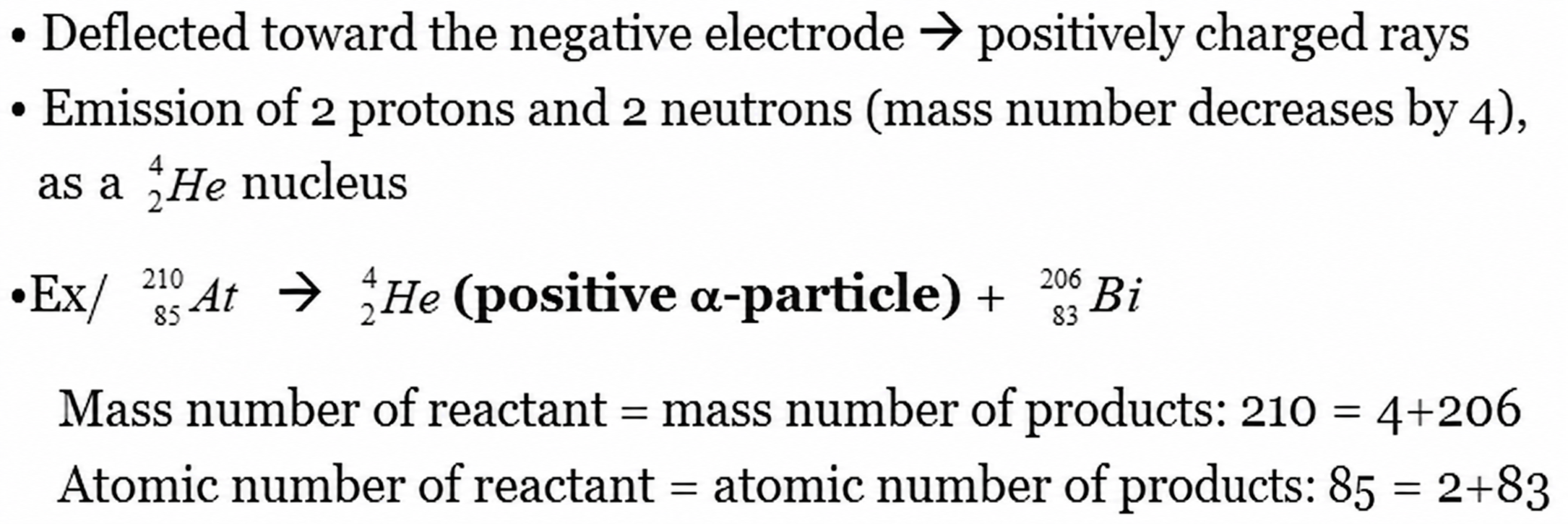
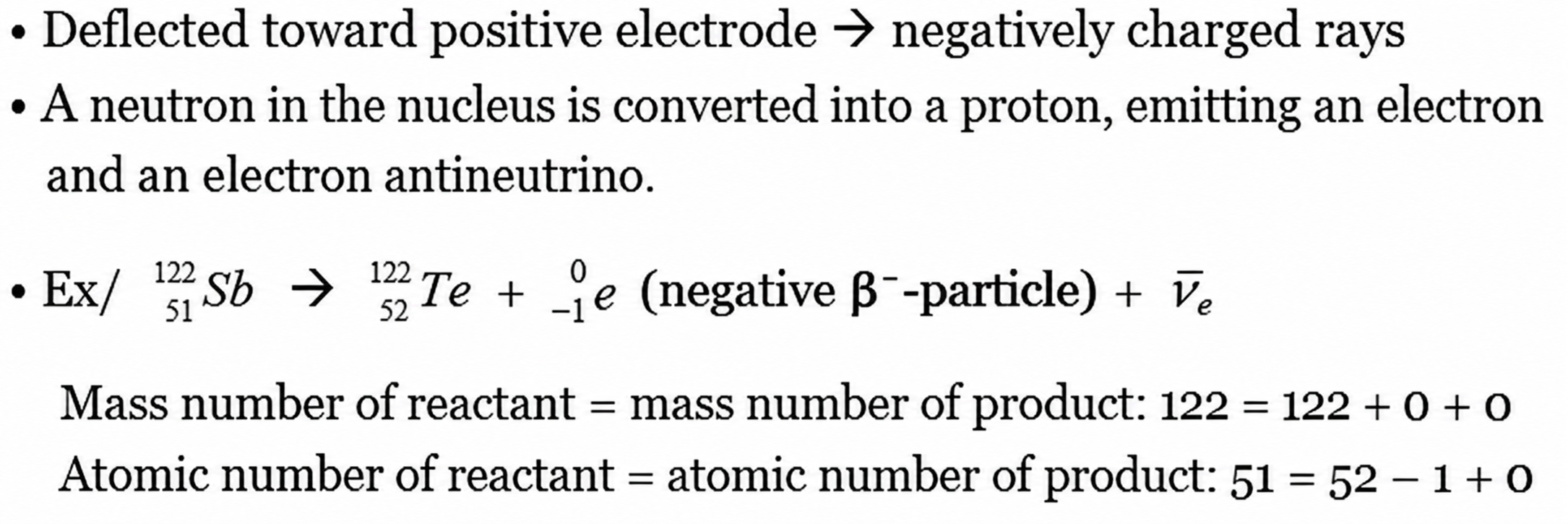
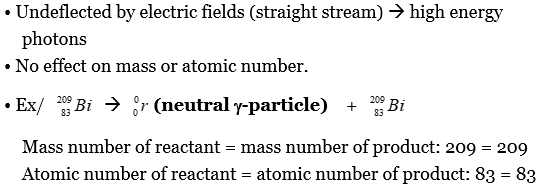
  • In an electric field, alpha (α) particles deflect toward the negative electrode, beta-minus (β−) particles deflect toward the positive electrode, and gamma (γ) rays are not deflected.
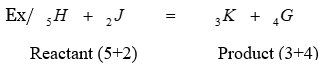
  • The sum of the reactant mass numbers is equal to the sum of the product mass numbers.
  • The sums of the atomic-number subscripts on both sides of a nuclear equation are equal; include the signed subscripts of emitted particles.


Fig. 3 Radiation emitted from the shielded box

Radioactive decay

Features

Alpha(α) decay

Beta(β) decay

Gamma(γ) decay

Mass Defect and Nuclear Binding Energy

The mass of a bound nucleus is less than the combined masses of its free protons and neutrons. The difference is the mass defect. For a nucleus with atomic number Z and mass number A, use nuclear masses and calculate the mass defect using the equation below.

Δm = Zmp + (A − Z)mn − mnucleus.

Binding energy is the energy required to separate the nucleus into its free nucleons. Calculate the positive value EB = Δmc². When Δm is in atomic mass units (u), multiply the mass defect by 931.5 MeV/u to obtain the binding energy in MeV. Divide by A for binding energy per nucleon. Keep the input mass digits through the subtraction because the difference can be much smaller than the masses being compared. Use nuclear masses consistently in this form of the equation.

Scientific reference