VII. Gases

Key focus of this chapter: ideal gas law

This chapter reviews the ideal gas law, molecular speeds, diffusion and effusion, Dalton’s law of partial pressures, and gas stoichiometry.

A. Temperature

1. Fahrenheit and Celsius

2. Kelvin and Celsius

The exact conversion is T(K) = t(°C) + 273.15. The figure uses the rounded offset 273 for approximate calculations.

B. Kinetic theory of gases

1. Kinetic molecular theory (ideal gases)

  • No attraction or repulsion between gas molecules
  • Particles move randomly in straight lines between collisions
  • The volume occupied by the particles is negligible compared with the container volume
  • Collisions are elastic: total kinetic energy is conserved, although colliding particles can exchange kinetic energy
  • Absolute temperature (kelvin) is directly proportional to the average translational kinetic energy of ideal-gas particles.

2. Real gases

  • Real gases do not always behave as predicted by the ideal-gas model.
  • Deviations from ideal behavior become more important at high pressure or low temperature because particle volume and intermolecular attractions cannot be neglected.
  • The van der Waals equation improves on the ideal-gas model by accounting for attractions and finite particle volume. Real gases approach ideal behavior at low pressure and high temperature.

C. Gas Laws

1. Symbols of gas laws

     P: Pressure (Pi = initial pressure, Pf = final pressure)

     V: Volume  (Vi = initial volume, Vf = final volume)

     n: Number of moles (ni = initial amount in moles, nf = final amount in moles)

     R: Gas constant

     T: Absolute temperature (kelvin, K) (Ti = initial temperature, Tf = final temperature)

2. STP (Standard Temperature and Pressure for gases)

T = 273.15 K (0 °C; approximately 273 K)

P= 1 atm (760 mmHg)

R = 0.08206 L·atm/(mol·K)

This chapter uses the common introductory-chemistry STP convention of 0 °C and 1 atm. IUPAC defines standard gas conditions using 0 °C and 1 bar (100 kPa); always use the pressure specified in a problem.

3. Ideal gas laws

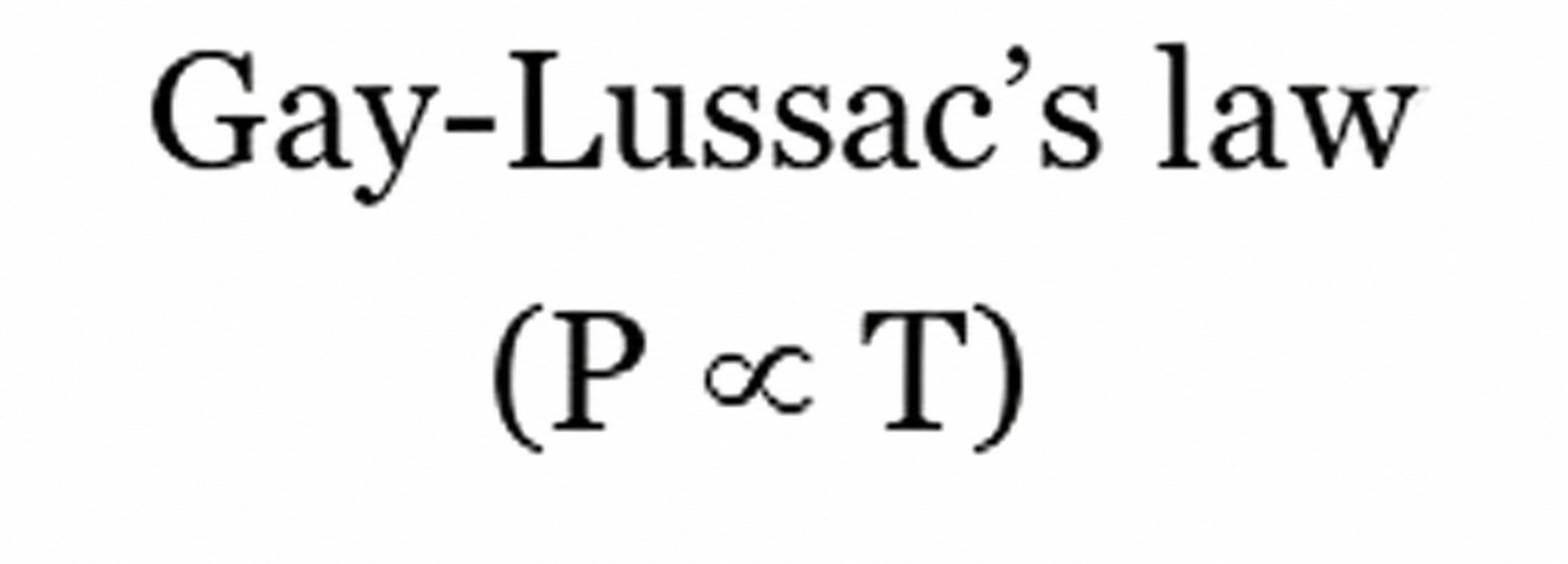
Use absolute pressure and temperature in kelvin. Boyle’s law holds at fixed n and T; Charles’s law at fixed n and P; Gay-Lussac’s law at fixed n and V; and Avogadro’s law at fixed P and T. The usual combined gas law assumes fixed n. The generalized relation shown also allows n to change.

Category


Features and equations

Gay-Lussac’s law: P proportional to T at fixed amount and volume.

4. Relationships described by ideal gas law

Relationships described by ideal gas law

D. Molecular speeds

At the same temperature, gases have the same average translational kinetic energy, while lighter particles have higher characteristic speeds. Graham’s law compares effusion rates at the same temperature and pressure under identical aperture conditions: r1/r2 = √(M2/M1), where M is molar mass. Effusion occurs through a hole smaller than the mean free path; diffusion is mixing by random molecular motion.

The root-mean-square speed is urms = √(3RT/M). Use R = 8.314 J/(mol·K), T in kelvin, and M in kg/mol to obtain speed in m/s.

E. Dalton’s law of partial pressures

1. Dalton’s Law

: the total pressure of an ideal gas mixture equals the sum of its components’ partial pressures in the same container at the same temperature.

Ptotal  = PA + PB

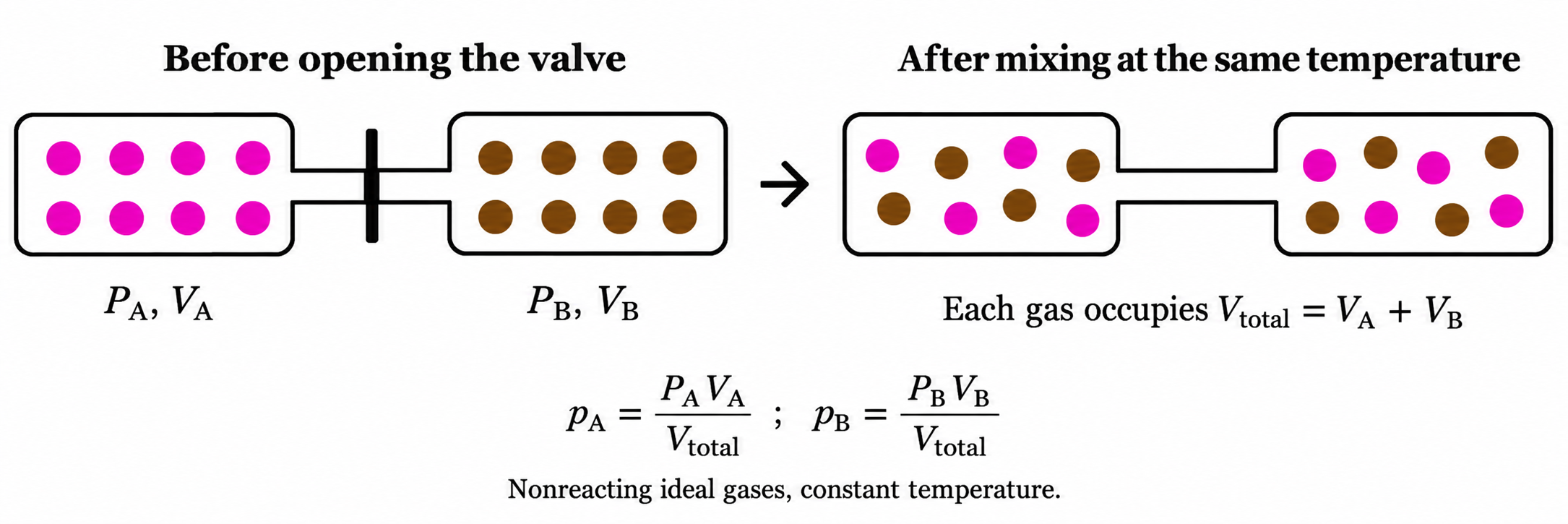
Dalton’s law at equal volume and temperature: eight particles of each gas are intermixed throughout the mixture.

2. Partial pressure and volume

: when a valve connects rigid flasks containing nonreacting ideal gases at the same temperature, each gas expands into the combined volume. Its final partial pressure is PiVi/Vtotal, and the total pressure is the sum of the final partial pressures.

Before opening, each flask contains eight particles of one gas. After mixing, both gases occupy both flasks, with eight particles of each gas conserved.

3. Mole fraction, X

  • The dimensionless fraction of the total amount contributed by one gas
  • Divide the moles of the individual gas by the total moles in the mixture: XA = nA/ntotal. The mole fractions sum to 1.

4. Partial pressure and mole fraction

: the partial pressure of gas A equals its mole fraction multiplied by the total pressure of an ideal-gas mixture.

F. Gas stoichiometry

: ideal gas law (PV = nRT) is applied to stoichiometry.

  • Question: In this hypothetical reaction, 5 mol of A reacts completely with excess B in a 6 L container at 27 °C. Calculate the partial pressure of D, assuming ideal-gas behavior.

2A(g) + B(g)  →   3C(g) + 4D(g)