IV. Bacteriology
Key focus of this chapter: bacteria vs virus.
This chapter focuses on bacteria vs virus and gives concise summaries of the important things about viral types, animal virus, and bacteriophage.
A. Prions
- Composed of infectious proteins.
- Affection degeneration of brain or neural tissues of mammal by mis-folded protein (PrPSC).
- Scrapie disease in sheep, Mad cow disease (BSE), and Creutzfeldt-Jakob disease (CJD) in humans.
B. Viroids
- Composed of circular and single stranded RNA molecules without protein capsid.
- Plant pathogens.
C. Virus
: infection agent that needs a host cell to reproduce.
- Composed of DNA or RNA molecules and protected by protein coat.
- Lacks organelles and cell wall.
- Infection only of their type’s hosts by “lock and key” fit.
- Impossible to reproduce without host cell.
- Not living organism.
1. Viral types
Classification | Shapes | Features |
Adenoviruses | ![]() | • Naked virus • Double stranded DNA • Capsomere of polyhedral capsid with glycoprotein spike • Infects respiratory tracts |
Tobacco mosaic virus | ![]() | • Naked helical virus • Single stranded RNA Virus • Capsomere of helical capsid with rod shape • Infects tobacco plant |
Influenza viruses | ![]() | • Enveloped virus • Single stranded RNA Virus • Membranous envelope with glycoprotein • RNA molecules wrapped in helical capsid |
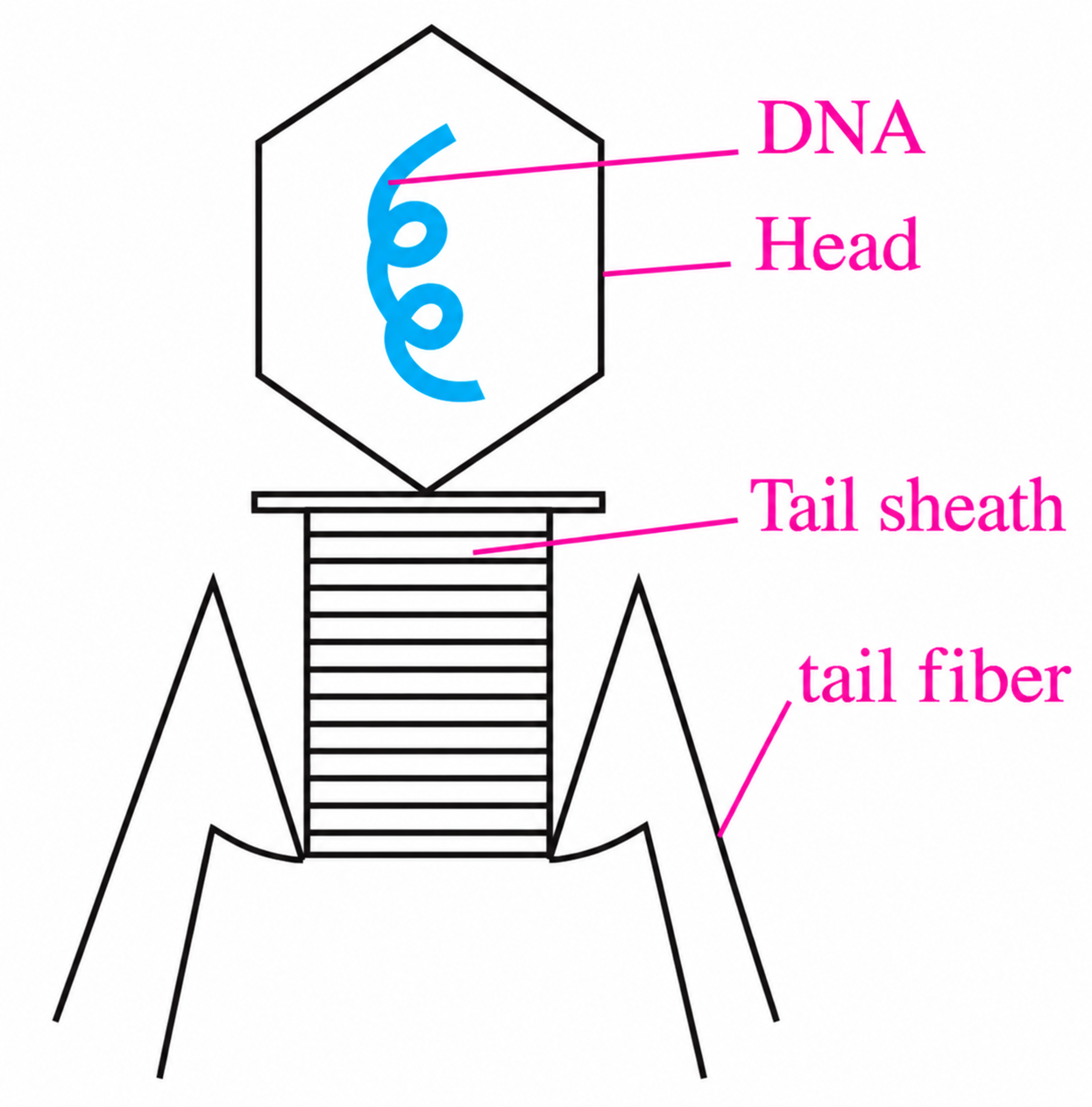
Bacteriophage T4 | ![]() | • DNA virus • Polyhedral head, tail sheath, and tail fiber • Infection E. coli bacteria • Only lytic phase |
2. Reproductive cycle of virus
a. Animal virus
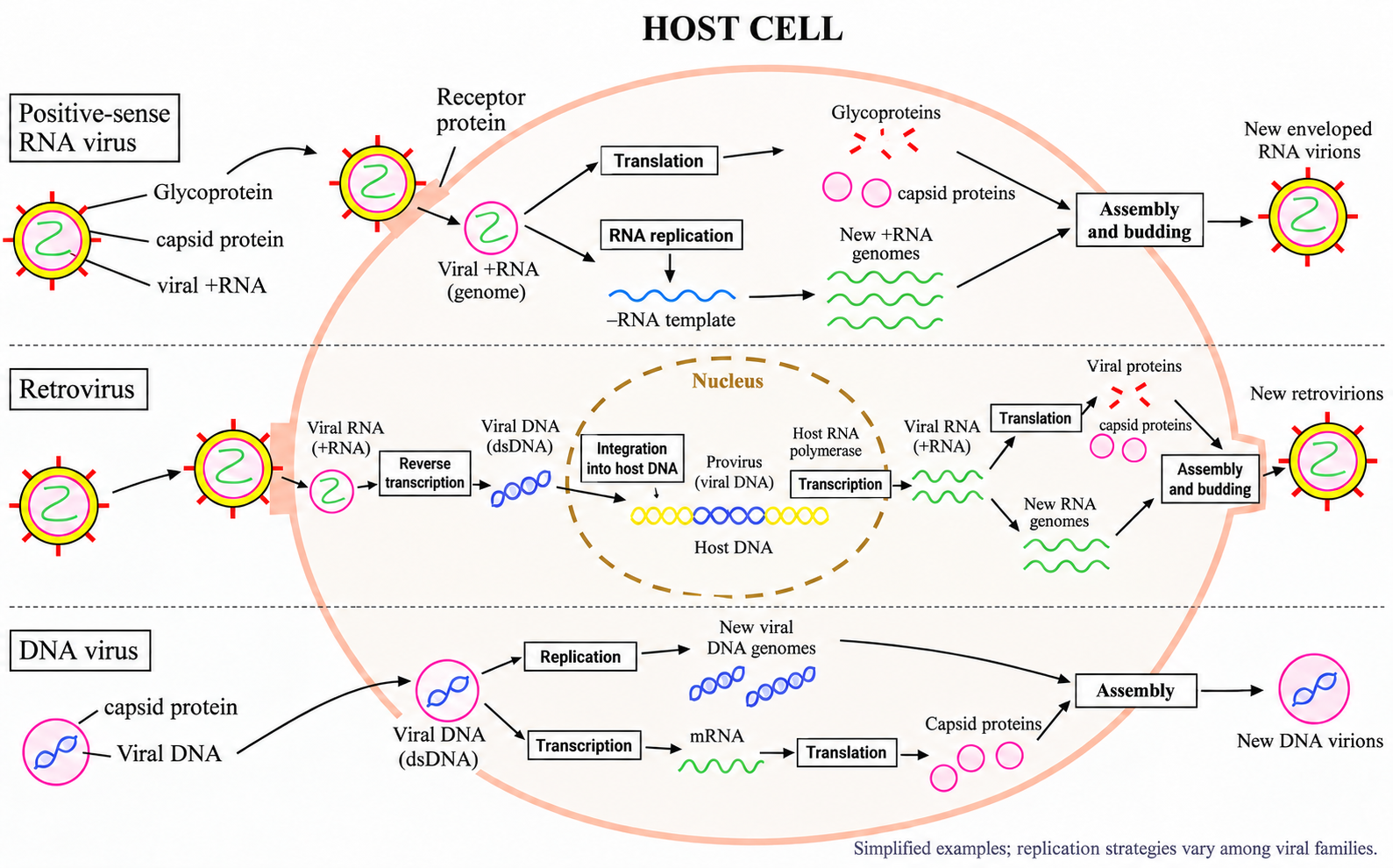
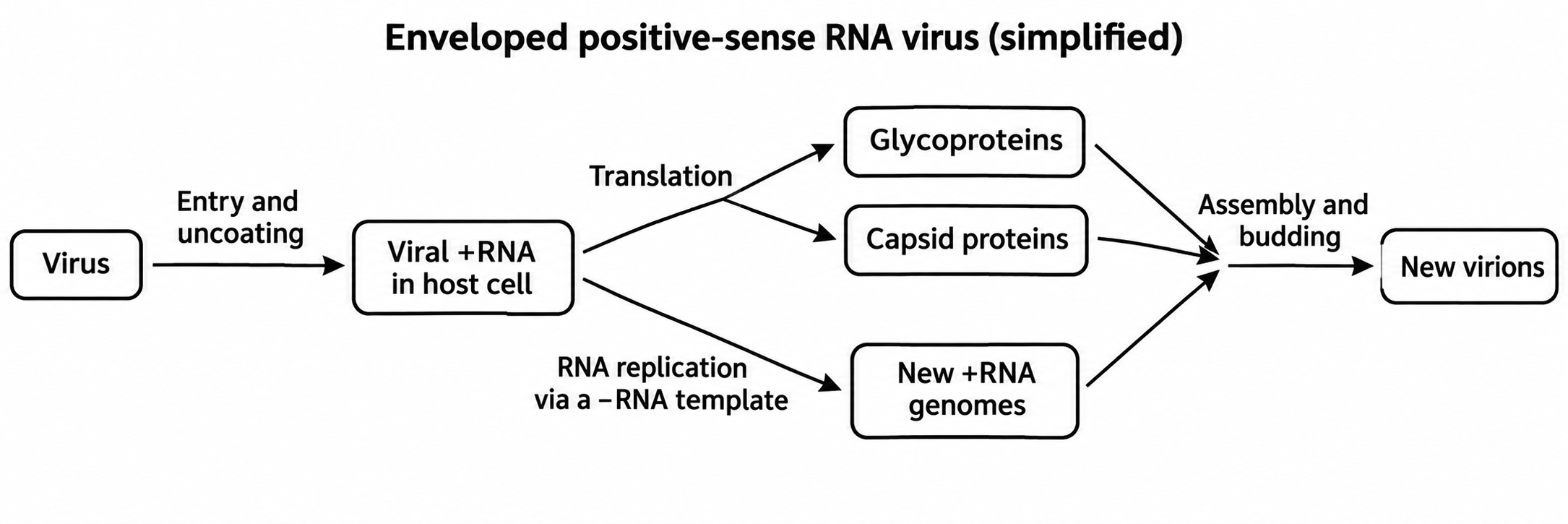
- RNA virus
– synthesizes new genomes from viral RNA.
– eg/ Influenza virus, hepatitis C, SARS
- Retrovirus
– reverse transcriptase (synthesizing DNA from RNA).
– synthesizes new genomes from incorporation of viral DNA with host DNA.
– most complicated reproductive cycles.
– eg/ HIV AIDS, RNA tumor virus
- DNA virus
– synthesizes new genomes from viral DNA.
– eg/ Adenovirus, herpesvirus, papovavirus
b. Bacteriophage
- Only infection bacteria
- Most complex capsids
- Transduction
- Bacteriophage T4
– composed of polyhedral head, tail sheath, and tail fiber
– virulent phage
– only lytic cycle
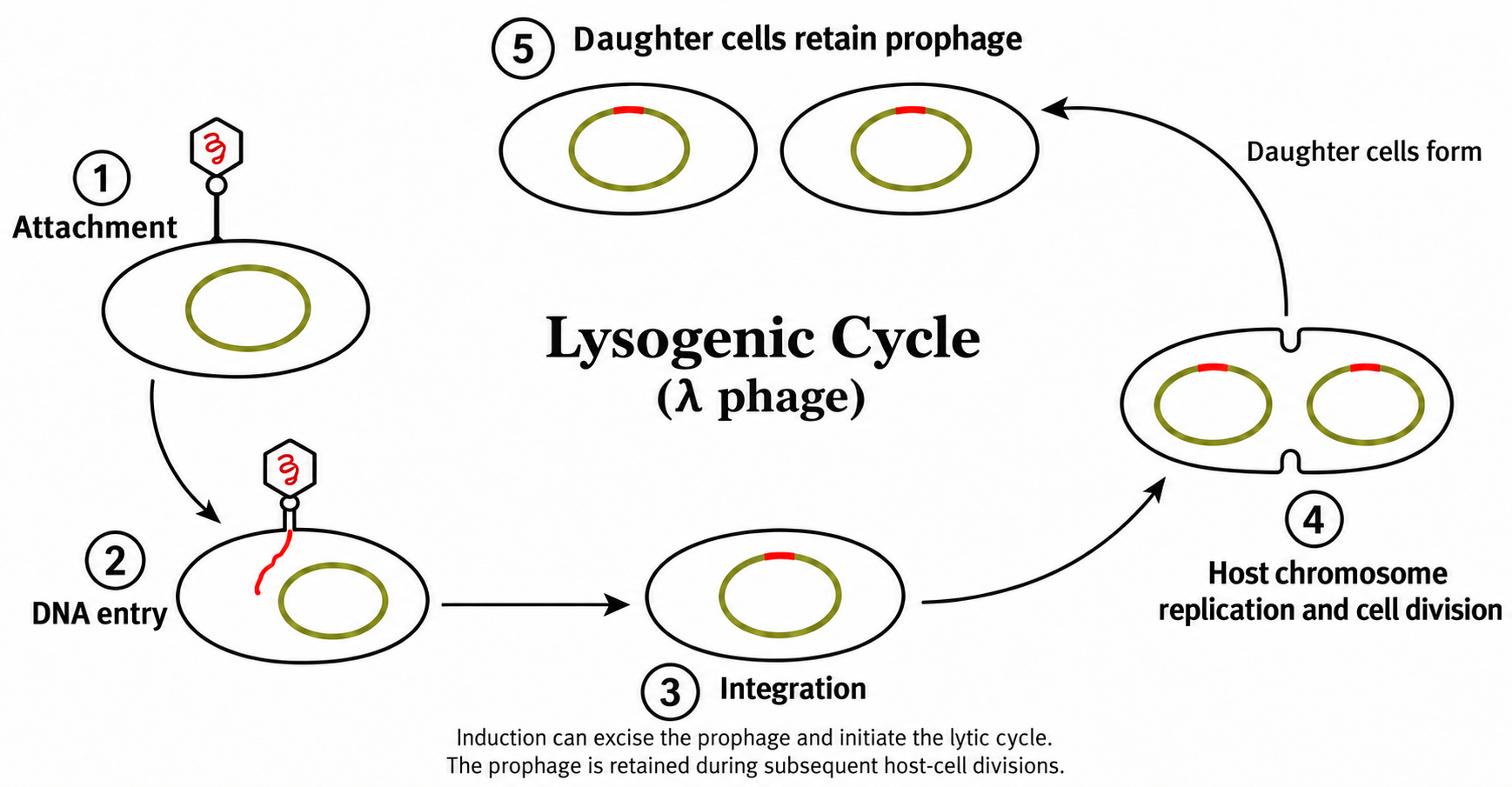
- Bacteriophage lambda (λ)
– temperate phage (both lytic cycle and lysogenic cycle)
– infection Escherichia coli bacteria
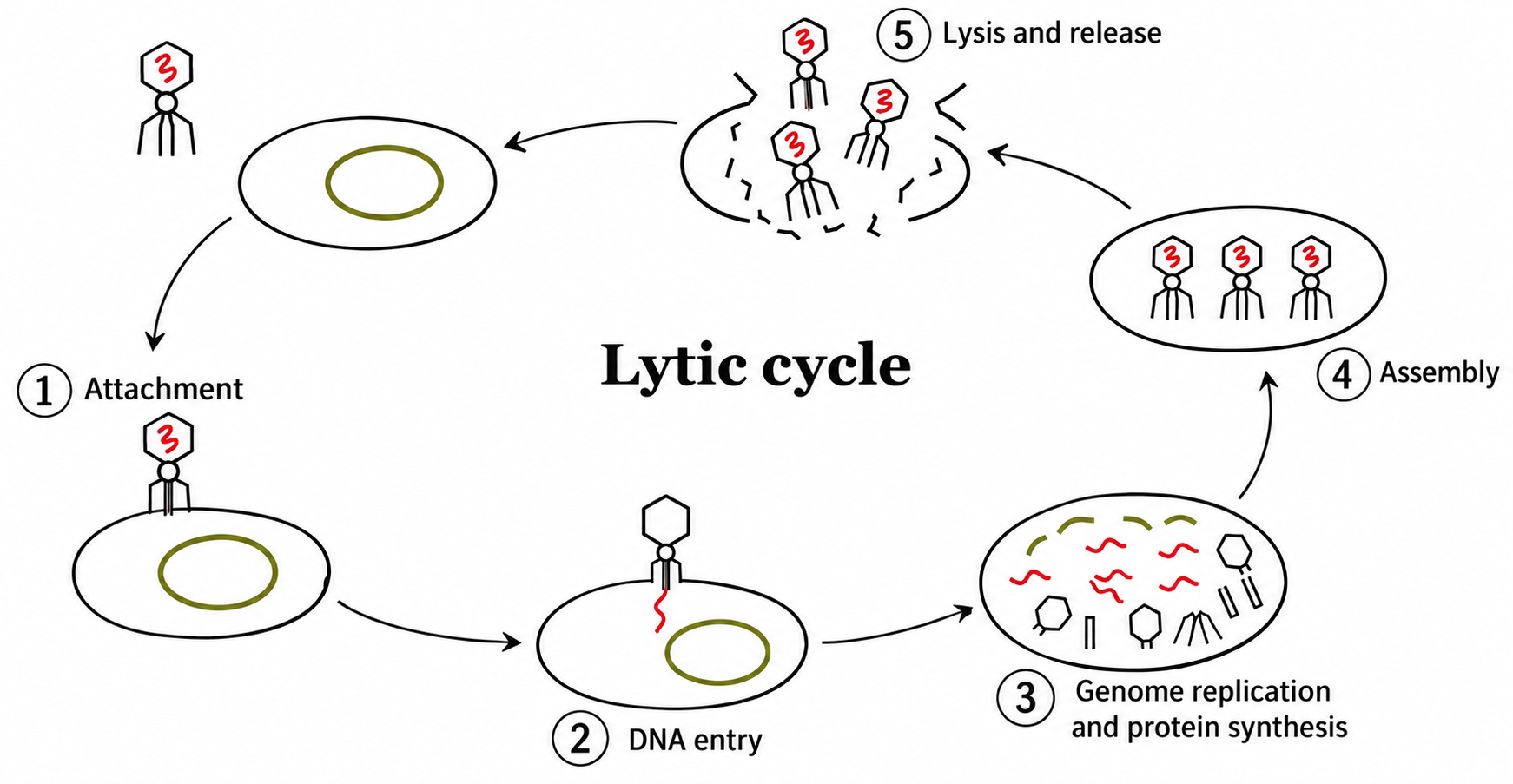
- Lytic cycle
: virulent phage – reproduction phage with killing host bacteria cells.
– ① approaching and attachment.
– ② entry of phage DNA.
– ③ prophage reaction (incorporation phage DNA with bacterial DNA chromosome).
– ④ hydrolyzed DNA and phage assembly.
– ⑤ releasing phages and killing host bacteria cell.
- Lysogenic cycle
: remain dormant indefinitely and reproduce phage without killing host cells called alternate cycle.
– ① approaching and attachment
– ② entry of phage DNA
– ③ prophage reaction
– ④ copying prophage
– ⑤ dividing bacterial
** Comparison of animal virus and bacteriophage multiplication
Stage of reproduction | Animal Virus | Bacteriophage |
Attachment | • Envelope or capsid to host cell surface | • Tail fibers to cell wall |
Penetration | • Enveloped virus into host cell • Capsid virus into host cell | • Nucleic acid into host cell |
Synthesis and Assembly | • At cytoplasm and nucleus | • At cytoplasm only |
D. Bacteria
1. Shapes
- Bacilli – rod shaped
- Cocci – spherical
- Spiral – helical
** Arrangement of prefixes
- Diplo (pair), staphylo (clusters), strepto (chains)
- Eg/ Staphylococci (spherical clusters)
2. Cell-surface Structures
- Gram-positive
– cell wall with thick sheet of peptidoglycan (network composed of modified sugar and amino acids).
- Gram-negative
– cell wall with outer membrane and thin sheet of peptidoglycan.
– outer membrane containing lipopolysaccharide.
3. Motility
- Flagellum movement by ATP-driven pump.
- Flagellum made of basal apparatus, hook, and filament.
- Prokaryotic flagella has no extension of plasma membrane.
- Taxis – Prokaryotic innate locomotion pattern toward or away from a stimulus.
4. Genetic recombination
: bacterial genetic diversity by asexual process.
- Transduction
– transferring DNA process from one bacterium to another by bacteriophages.
- Transformation
– genotypic and phenotypic alteration by uptaking foreign naked DNA.
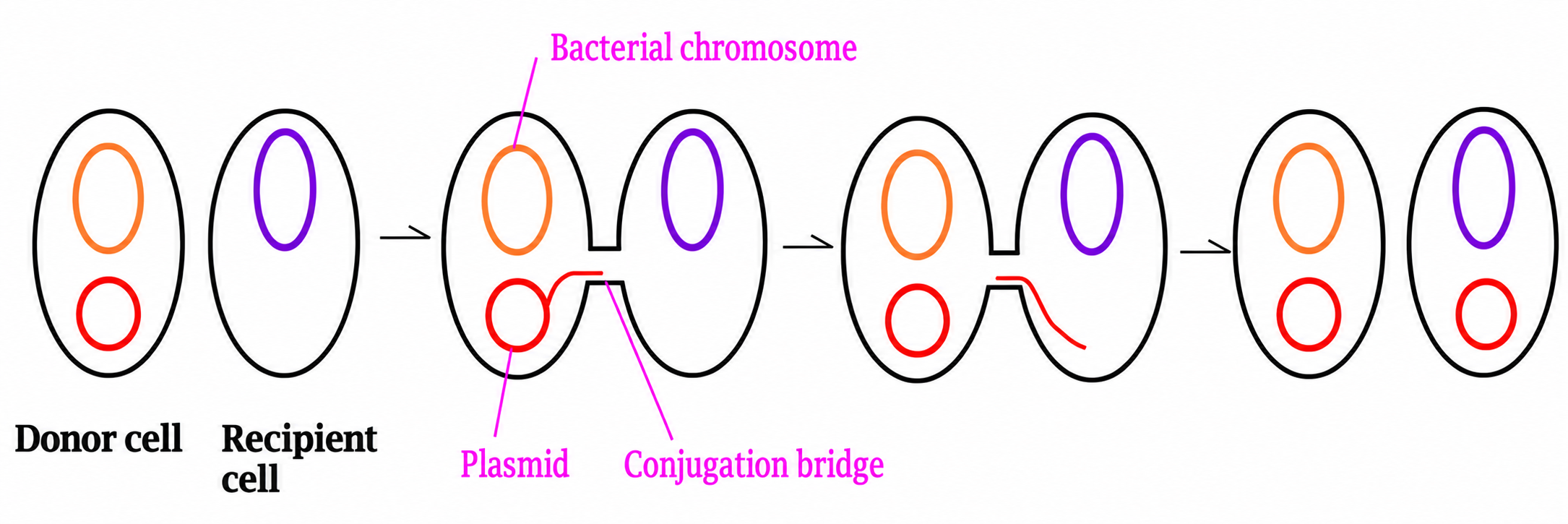
- Conjugation
– directly transferring genetic material from one bacterium to another by conjugation bridge (pilus).
– bacterial sex.
– plasmid: Circular, self- replicable, and separated DNA molecules from bacterial chromosome to be used in horizontal gene transfer.
5. Binary fission
: prokaryotic cell division form by asexual reproduction.
- Chromosome replication
– starting point of replication in both directions.
– bi-directional progress
6. Gene expression
- Lac operon (inducible system)
– controlling enzyme synthesis for metabolizing lactose to glucose in E. coli.
– operon off: Active repressor is bounded at operator and then RNA polymerase stops working.
– operon on: Repressor binding allolactose (inducer) is inactivated and then RNA polymerase makes three enzyme (β-Galactosidase, permease, transacetylase).
Enzymes | Functions |
β-Galactosidase | • Made from lac Z • Hydrolyzing lactose to glucose and galactose |
Permease | • Made from lac Y • Moving lactose into cell |
- Trp operon (repressible system)
– controlling repressible enzyme synthesis for making tryptophan in E. coli.
– operon on: Repressor is inactive and then RNA polymerase works to synthesize enzyme for making tryptophan (corepressor).
– operon off: Active repressor binding tryptophan is bounded at operator and then RNA polymerase stops working.
7. Metabolic adaptation
- Oxygen relationship
Classification | Features |
Obligate aerobes | • Aerobic organisms that need O2 for cellular respiration • Without O2 aerobic organisms cannot grow |
Obligate anaerobes | • Anaerobic organisms that cannot grow with O2 |
Facultative anaerobes | • Making ATP in aerobic environment and fermentation in anaerobic environment. • Eg/ E.coli |
- Biofilms
– community of microorganisms that cling to a living or non-living surface and have living layer to capture moisture and nutrients.
8. Bacterial pathogens and diseases
Bacterial pathogens | Diseases |
Borrelia | • Lyme disease |
Salmonella | • Typhoid fever |
E coli | • Diarrhea, sepsis, urinary tract infection |
Neisseria | • Gonorrhea and meningitis |
Corynebacterium | • Diphtheria |
Clostridium | • Tetanus, gas gangrene |
Streptococcus | • Pneumonia |
E. Benefits of microbe
- Supporting life of organisms (humans obtain vitamin K by harbor bacteria at large intestine).
- Breakdown of organic materials and recycling of nutrients.