VI. Phases of matter: Solid, Liquid, and Gas

Key focus of this chapter: phase change for water

This chapter focuses on the phase change for water and gives concise summaries of the important things about the phase diagram of H2O and CO2, heating curve of H2O, colligative properties, Raoult’s law, osmotic pressure, and Hery’s law in more detail.

A. Solid, liquid, and gas

Classification

Features

Solid

• Particles are rigid structures due to very strong attraction.

• Regularly positioned particles – crystalline solid (ionic, metallic, covalent network, molecular solids).

• Irregularly positioned particles – amorphous solid (any glass).

Liquid

• Particles can flow and have strong attraction.

• Cohesion: attraction force between liquid molecules

  - causing surface tension (resistance of increasing surface area)

  - causing viscosity (resistance of fluidity)

• Adhesion: attraction force between liquid molecule and other substance

Gas

B. Phase change

: phase of solid, liquid, and gas is changed by temperature and pressure.

Fig. 1 Phase change

Phage change for water

Phase changes

Features

Phase changes

Features

Condensation

• Phase change

 from gas to

 liquid by bond

 formation

Decreasing

enthalpy (ΔH)

and

entropy (ΔS)

change

Vaporization

• Phase change

 from liquid to

 gas by breaking

 bond

Increasing

enthalpy (ΔH)

and

entropy (ΔS)

change

Freezing

• Phase change

 from liquid to

 solid by bond

 formation

Fusion

(melting)

• Phase change

 from solid to

 liquid by

 breaking bond

Deposition

• Phase change

 from gas to

 solid by bond

 formation

Sublimation

• Phase change

 from solid to

 gas by breaking bond

• Ex/ iodine, dry ice

C. Phase diagram of H2O and CO2

Fig. 2 Phase diagram of H2O and CO2

• Negative slope between solid and

liquid boundary  →  decreasing

melting point with higher pressure

• Positive slope between liquid and

  gas boundary

• Positive slope between solid and

liquid boundary  →  increasing

melting point with higher pressure

• Positive slope between liquid and

  gas boundary

  • Triple point

– coexisting point of solid, liquid, and gas in equilibrium

  • Critical point

– indistinguishable line between liquid and gas

– impossible to be liquefied or vaporized by changing pressure or temperature

D. Heating curve of H2O

Fig. 3 Heating curve of H2O

Ice

2.0

36.6

Ice → water

6.0

Water

4.2

75.4

Water → vapor

40.7

Qs/ How much energy is required to convert 2mol of ice at -10oC to water at 50 oC?

Sol/Q1 = molar heat capacity of ice: 36.6 J/(mol•oC)

    = 36.6 J/(mol•oC) × 2 mol × 10oC

    = 732 J

Q2 = ΔHfusion (ice → water): 6.0 kJ/mol

    = 6,000 J/mol × 2 mol

    = 12,000 J

Q3 = molar heat capacity of water: 75.4 J/(mol•oC)

    = 75.4 J/(mol•oC) × 2 mol × 50oC

    = 7,540 J

Therefore, Q1 + Q2 + Q3 = 732 J + 12,000 J + 7,540 J

     = 20,272 J

E. Colligative properties

: impure solution mixed as a solute in a pure solvent has a higher boiling and lower freezing point than the pure solvent.  

1. Features of colligative properties

  • Higher boiling point than the pure solvent → lower vapor pressure than the pure solvent
  • Lower freezing point than the pure solvent
  • Osmotic pressure is present

**Freezing point of solution (mixing solute and pure solvent) is lower than freezing point of the pure solvent → melting point of impure solid is lower than the melting point of pure solid (see fig.4)

2. The changing of boiling and freezing point of colligative solution

Fig. 4 The graph of colligative properties for ΔTb, ΔTf, Psol

Classification

Features

** van ’t Hoff factor (mole number of solute ions), i

  • Ex/ CH3OH: non-electrolyte (CH3OH) → i = 1

     LiCl: 2 moles of ions (Li+ + Cl) → i = 2

     CaCl2: 3 moles of ions (Ca+ + 2Cl) → i = 3       

Qs/ Calculate the freezing point of 21g of LiCl in 1000g of water. (Kf of water = 1.86oC•kg/mol)

F. Raoult’s law

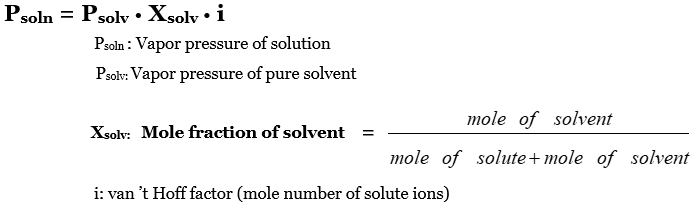
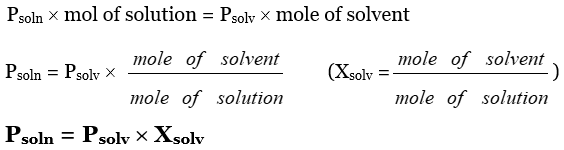
: Psoln (vapor pressure of a solution that is a nonvolatile solute mixed with a pure solvent) is equal to Psolv (vapor pressure of pure solvent) times Xsolv (mole fraction of solvent).

** Induced Raoult’s law

  • The vapor pressure of the solution is lower than the vapor pressure of the pure solvent because the surface area of a vaporizable solvent mixed with a non-volatile solute is decreased. 

Fig. 5 Vapor pressure of pure solvent and solution

Qs/ Calculate the vapor pressure of the solution when 4 moles of K2SO4 is dissolved in 12 moles of H2O at 45oC. (The vapor pressure of water at 45 oC = 70 mmHg.)

G. Osmotic pressure (P)

: the pressure required to keep the same heights between the different heights of the solution and pure solvent.

Fig 6. Osmotic pressure between solvent and solution

** Osmosis: the movement of the solvent molecules from high solvent concentration area to low solvent concentration area through a porous membrane.

Qs/ 116g of NaCl is dissolved in 4L of the solution at 27 oC. Calculate the osmotic pressure. M.W. of NaCl: 23+ 35 = 58g/mol

H. Henry’s law

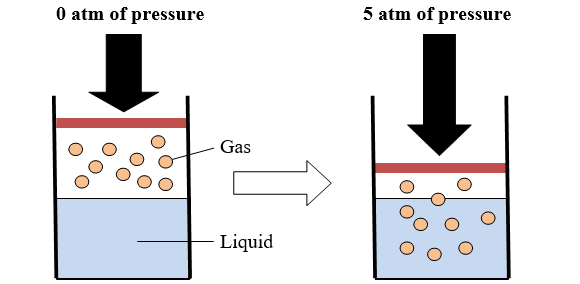
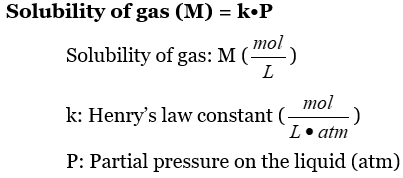
: the solubility of gas into liquid is proportional to the partial pressure on a liquid.

Fig. 7 Solubility of gas into liquid by the partial pressure

Qs/ Calculate the solubility of an unknown gas in water when the partial pressure on the water is 3 atm at 23oC and the Henry’s-law constant of the unknown gas, k, is 5.0 × 10⁻² mol/L•atm.

 Sol/  Solubility of gas = k•P                

     = (5.0 × 10⁻² mol/L•atm) • (3 atm)

     = 0.15 mol/L