VI. Phases of matter: Solid, Liquid, and Gas

Key focus of this chapter: phase change for water

This chapter reviews phase changes, phase diagrams and heating curves of water and carbon dioxide, colligative properties, Raoult’s law, osmotic pressure, and Henry’s law.

A. Solid, liquid, and gas

Category


Features

Solid

• Particles vibrate about relatively fixed positions; interparticle attractions hold the solid together.

• Crystalline solids have long-range order and may be ionic, metallic, covalent network, or molecular.

• Amorphous solids, such as glass, lack long-range order.

Liquid

• Particles remain close together but can move past one another, allowing a liquid to flow.

• Cohesion is attraction between particles of the same substance and contributes to surface tension.

• Viscosity is resistance to flow; it depends on intermolecular attractions, particle size and shape, and temperature.

• Adhesion is attraction between the liquid and another material.

Gas

B. Phase change

: the physical state of a substance depends on temperature and pressure. Phase transitions change the arrangement and motion of particles without changing the substance’s chemical identity.

Fig. 1 Phase change

Phase changes

Features

Phase changes

Features

Condensation

• Gas → liquid:

interparticle attractions are established or strengthened.

ΔH < 0

ΔS < 0

Vaporization

• Liquid → gas:

particles separate by overcoming interparticle attractions.

ΔH > 0

ΔS > 0

Freezing

• Liquid → solid:

particles become more ordered and interparticle attractions stabilize the solid.

Fusion

(melting)

• Solid → liquid:

particles gain mobility as some interparticle constraints are overcome.

Deposition

• Gas → solid:

interparticle attractions stabilize the solid.

Sublimation

• Solid → gas:

particles separate by overcoming interparticle attractions.

• Examples: iodine, dry ice

C. Phase diagram of H2O and CO2

Fig. 2 Phase diagram of H2O and CO2

• Negative slope between solid and

liquid boundary  →  decreasing

melting point with higher pressure

• Positive slope between liquid and

  gas boundary

• Positive slope between solid and

liquid boundary  →  increasing

melting point with higher pressure

• Positive slope between liquid and

  gas boundary

  • Triple point

– the temperature and pressure at which solid, liquid, and gas coexist in equilibrium

  • Critical point

– the endpoint of the liquid–gas coexistence curve, where liquid and gas become indistinguishable

– above the critical temperature, a gas cannot be liquefied by pressure alone; above both the critical temperature and critical pressure, the substance is a supercritical fluid

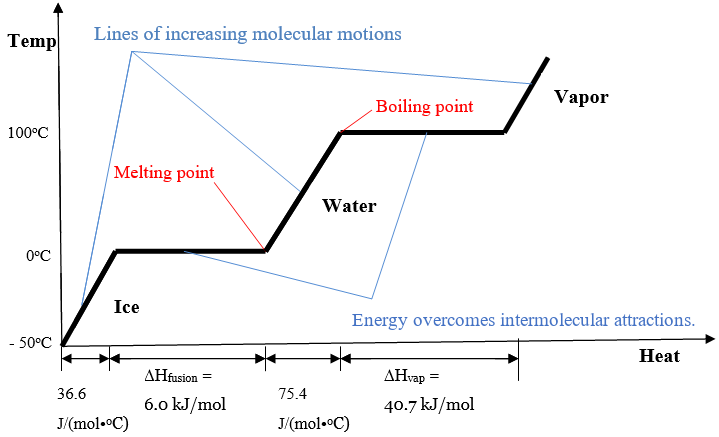
D. Heating curve of H2O

Fig. 3 Heating curve of H2O

Ice

2.0

36.6

Ice → water

6.0

Water

4.2

75.4

Water → vapor

40.7

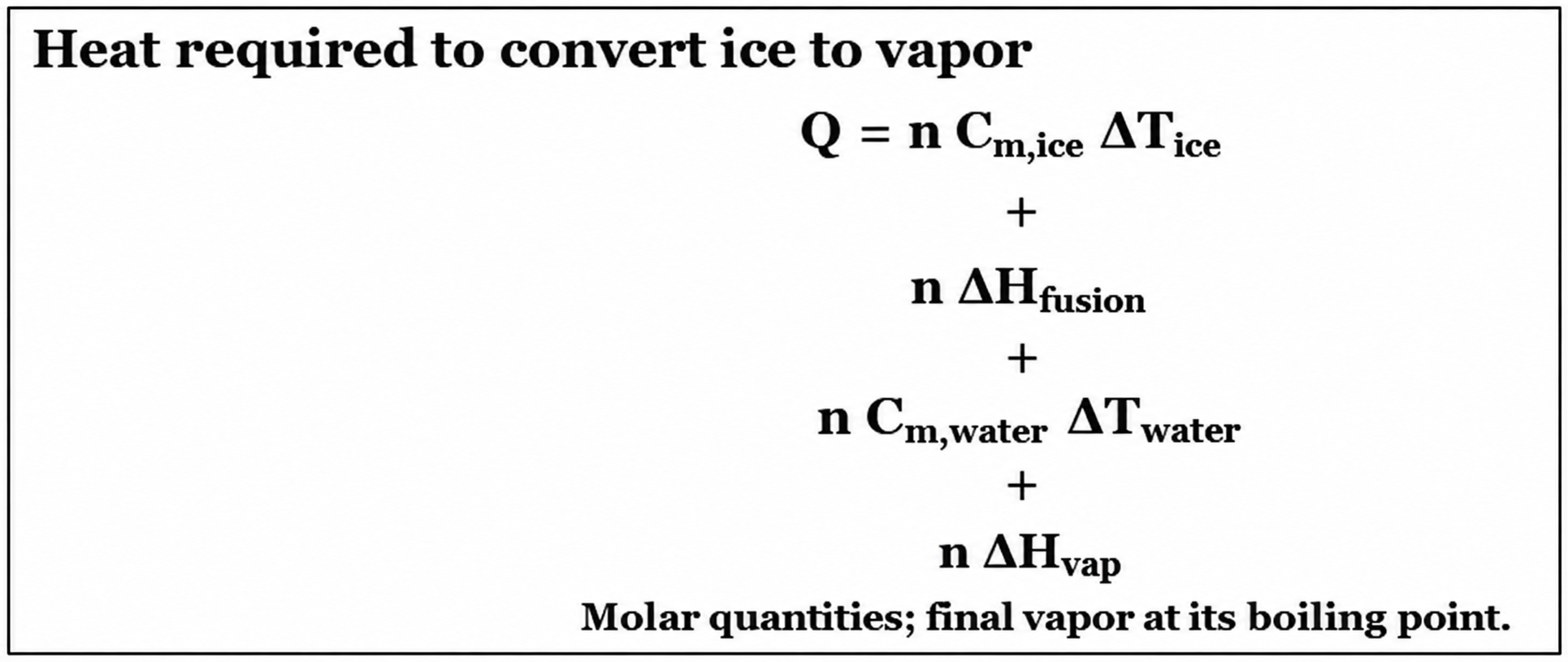
Question: How much energy is required to convert 2mol of ice at -10°C to water at 50°C?

Solution: Q1 (warming ice to 0 °C): use the molar heat capacity of ice, 36.6 J/(mol•°C)

= 36.6 J/(mol•°C) × 2 mol × 10°C

= 732 J

Q2 (melting ice at 0 °C): use ΔHfusion = 6.0 kJ/mol

= 6,000 J/mol × 2 mol

= 12,000 J

Q3 (warming water to 50 °C): use the molar heat capacity of water, 75.4 J/(mol•°C)

= 75.4 J/(mol•°C) × 2 mol × 50°C

= 7,540 J

Therefore, Q1 + Q2 + Q3 = 732 J + 12,000 J + 7,540 J

= 20,272 J (unrounded total using the supplied approximate data)

E. Colligative properties

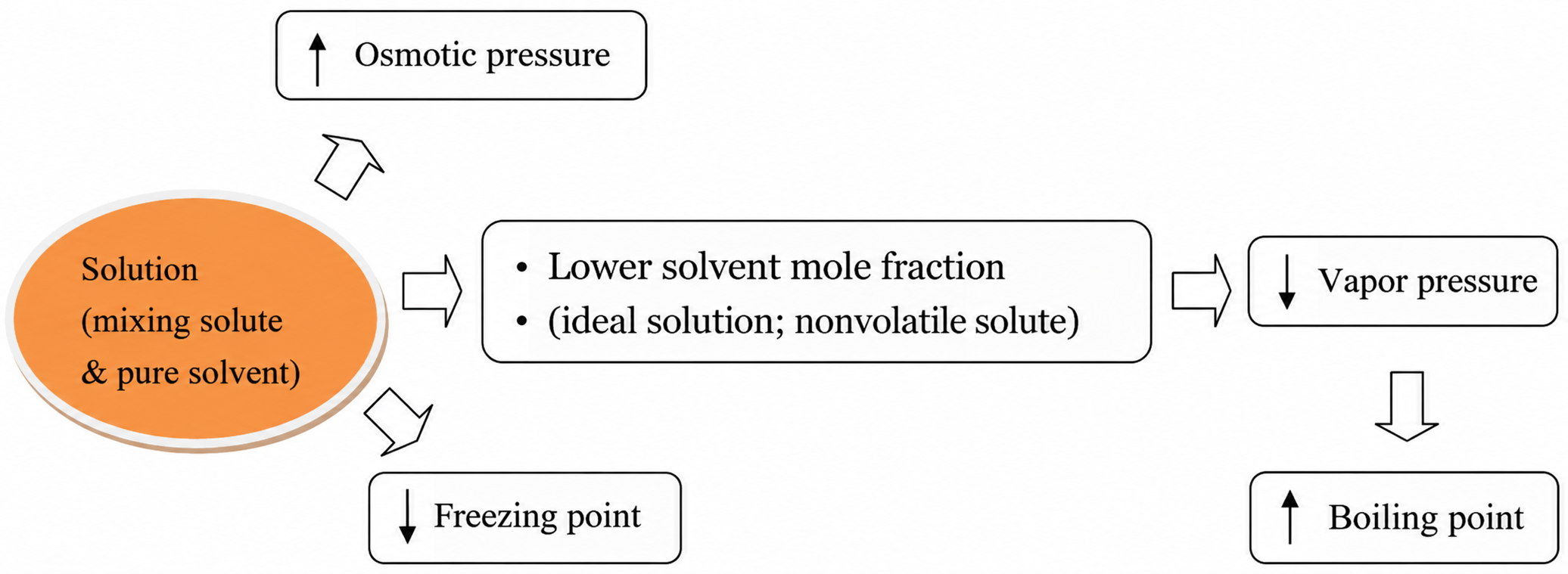
: solution properties that depend on the concentration of dissolved solute particles. For a dilute solution with a nonvolatile solute, the boiling point is higher and the freezing point is lower than for the pure solvent.

1. Features of colligative properties

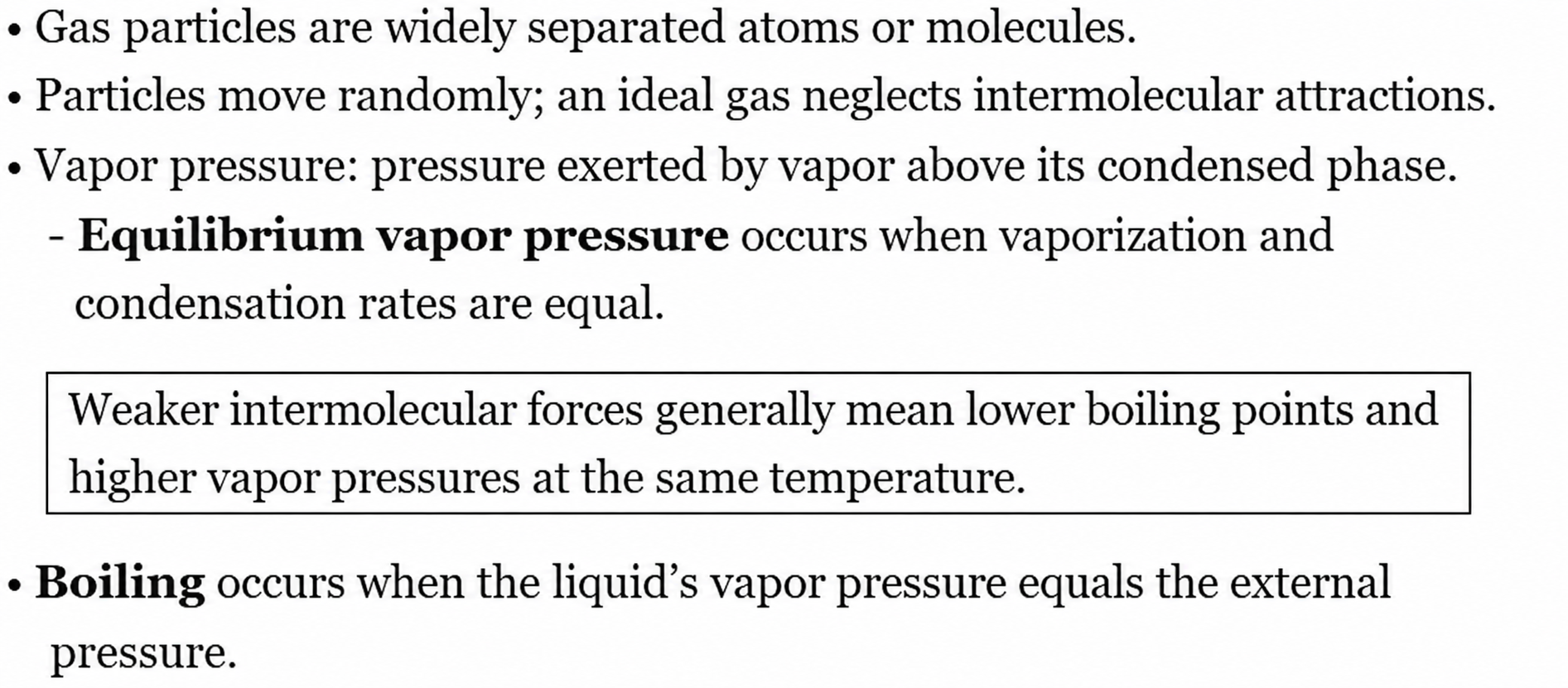
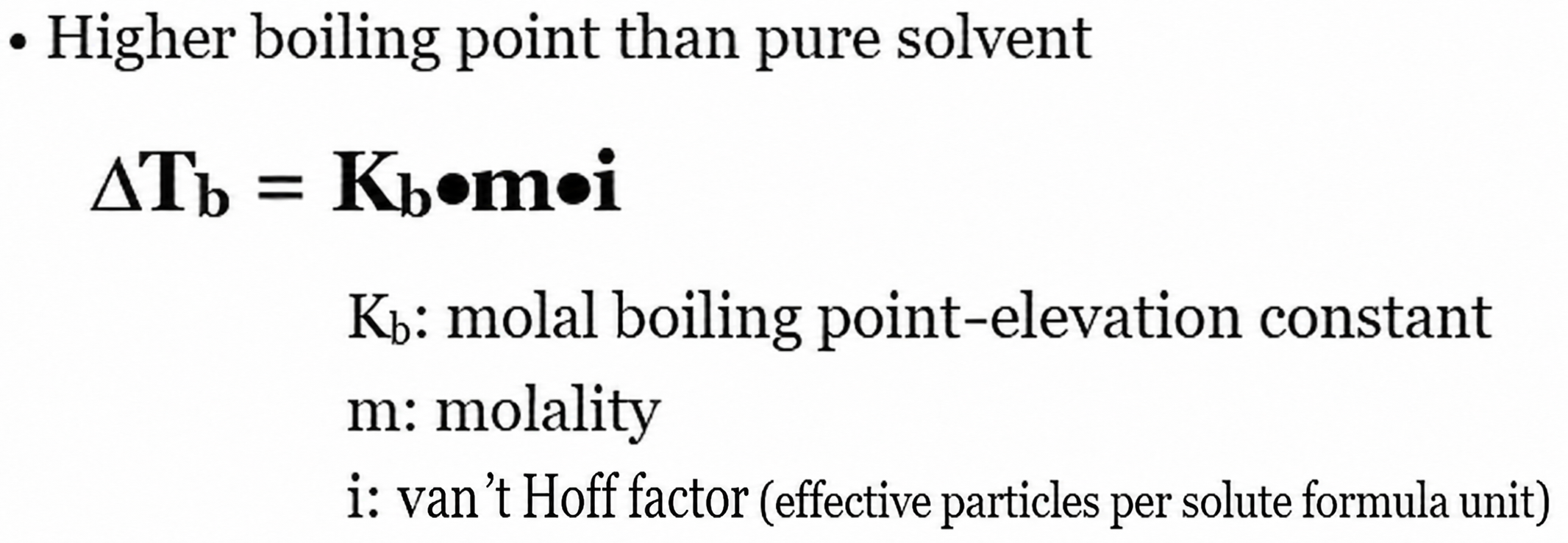
  • Higher boiling point than the pure solvent → lower vapor pressure than the pure solvent
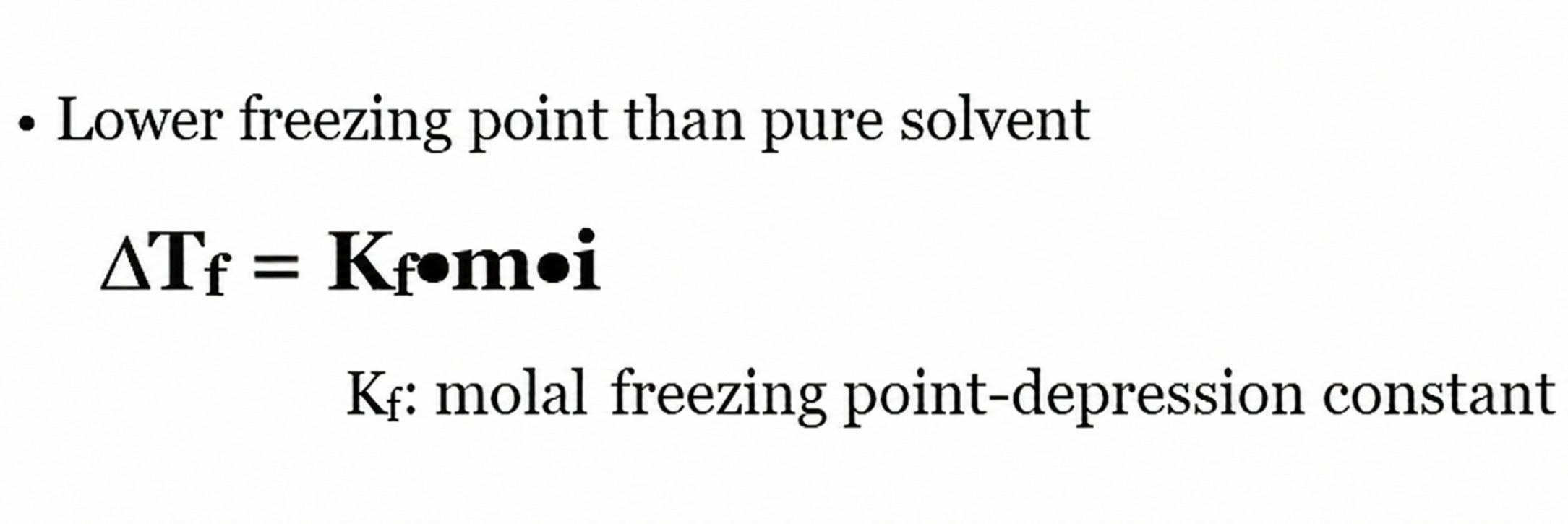
  • Lower freezing point than the pure solvent
  • Osmotic pressure is present
A nonvolatile solute lowers solvent mole fraction and vapor pressure, which raises the boiling point; colligative effects also include freezing-point depression and osmotic pressure.

**For dilute solutions in which the solute is excluded from the solid solvent, the freezing point is lower than that of the pure solvent. A typical impurity also lowers and broadens a solid’s melting range. At a given pressure, a pure substance melts and freezes at the same equilibrium temperature (see Fig. 4).

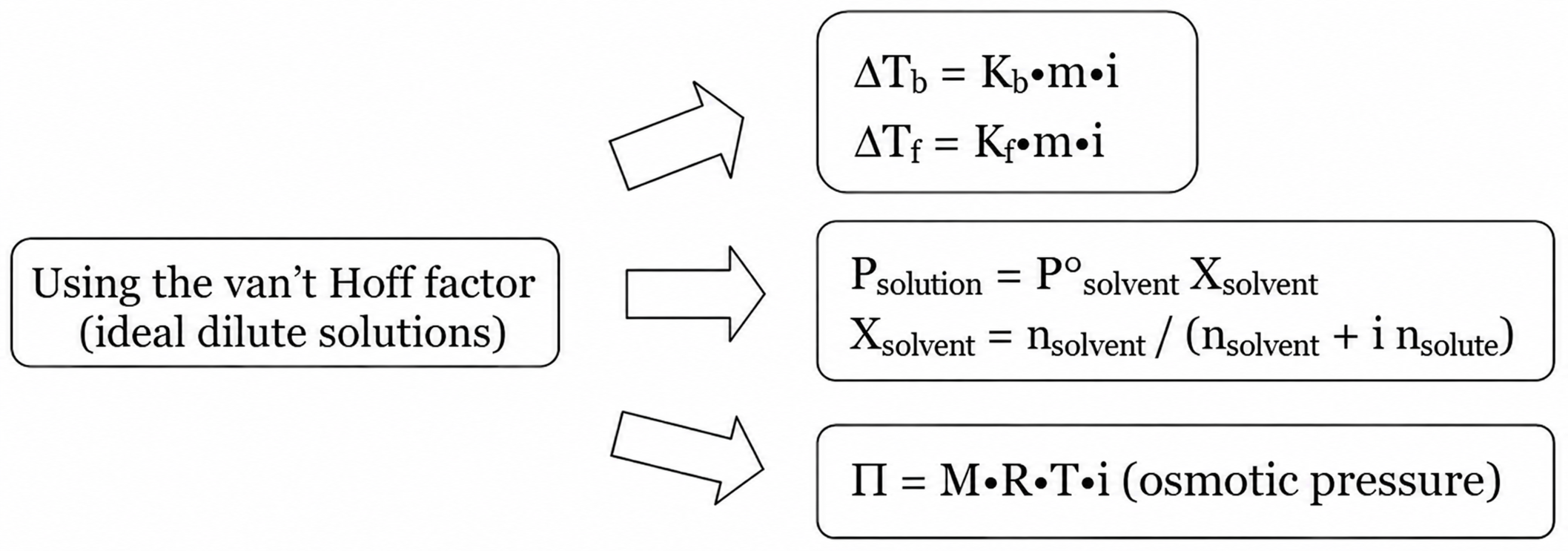
2. Boiling-point elevation and freezing-point depression

Fig. 4 The graph of colligative properties for ΔTb, ΔTf, Psol

Classification

Features

** van’t Hoff factor (effective solute particles per dissolved formula unit), i

  • Example: CH3OH: non-electrolyte (CH3OH) → i = 1

LiCl: 2 moles of ions per mole of LiCl (Li+ + Cl–) → i = 2

CaCl2: 3 moles of ions per mole of CaCl2 (Ca2+ + 2Cl–) → i = 3. These ideal values assume complete dissociation; measured values can differ because of interactions such as ion pairing.

Question: Calculate the freezing point of 21g of LiCl in 1000g of water. (Kf of water = 1.86°C•kg/mol)

For this idealized calculation, assume complete dissociation and ideal solution behavior. Use the rounded atomic masses and other data supplied in the example.

F. Raoult’s law

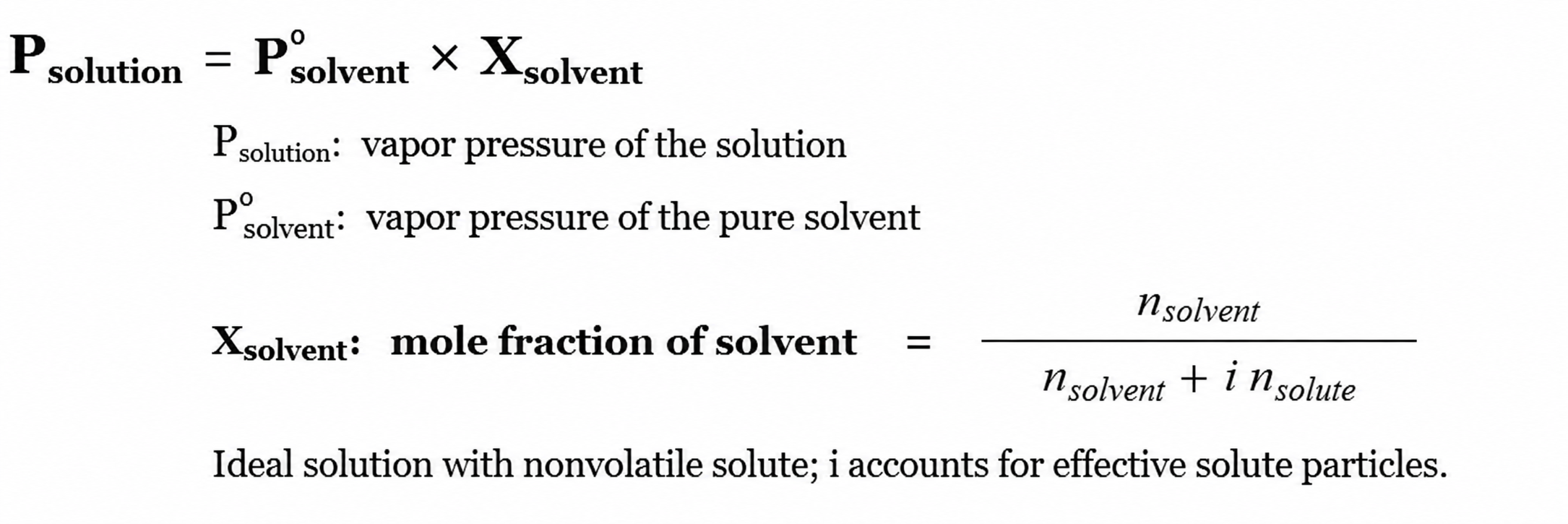
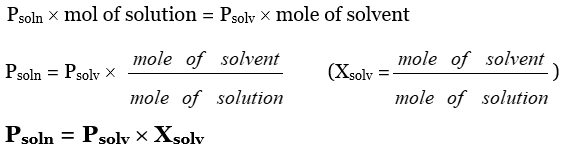
: for an ideal solution containing a nonvolatile solute, Psoln (the solvent vapor pressure above the solution) equals Psolv (vapor pressure of pure solvent) times Xsolv (mole fraction of solvent).

** Rearranged Raoult’s law

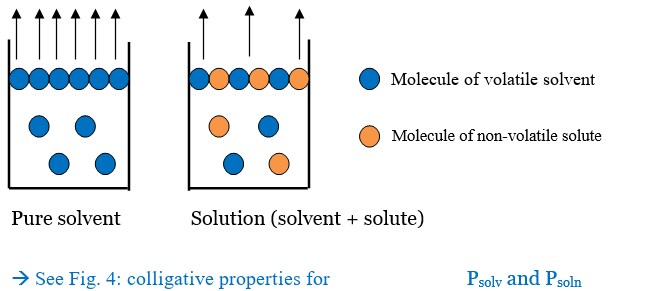
  • For an ideal solution, adding a nonvolatile solute lowers the solvent mole fraction and its equilibrium vapor pressure: Psolvent = XsolventP°solvent. This does not require a decrease in the liquid surface area.

Fig. 5 Vapor pressure of pure solvent and solution

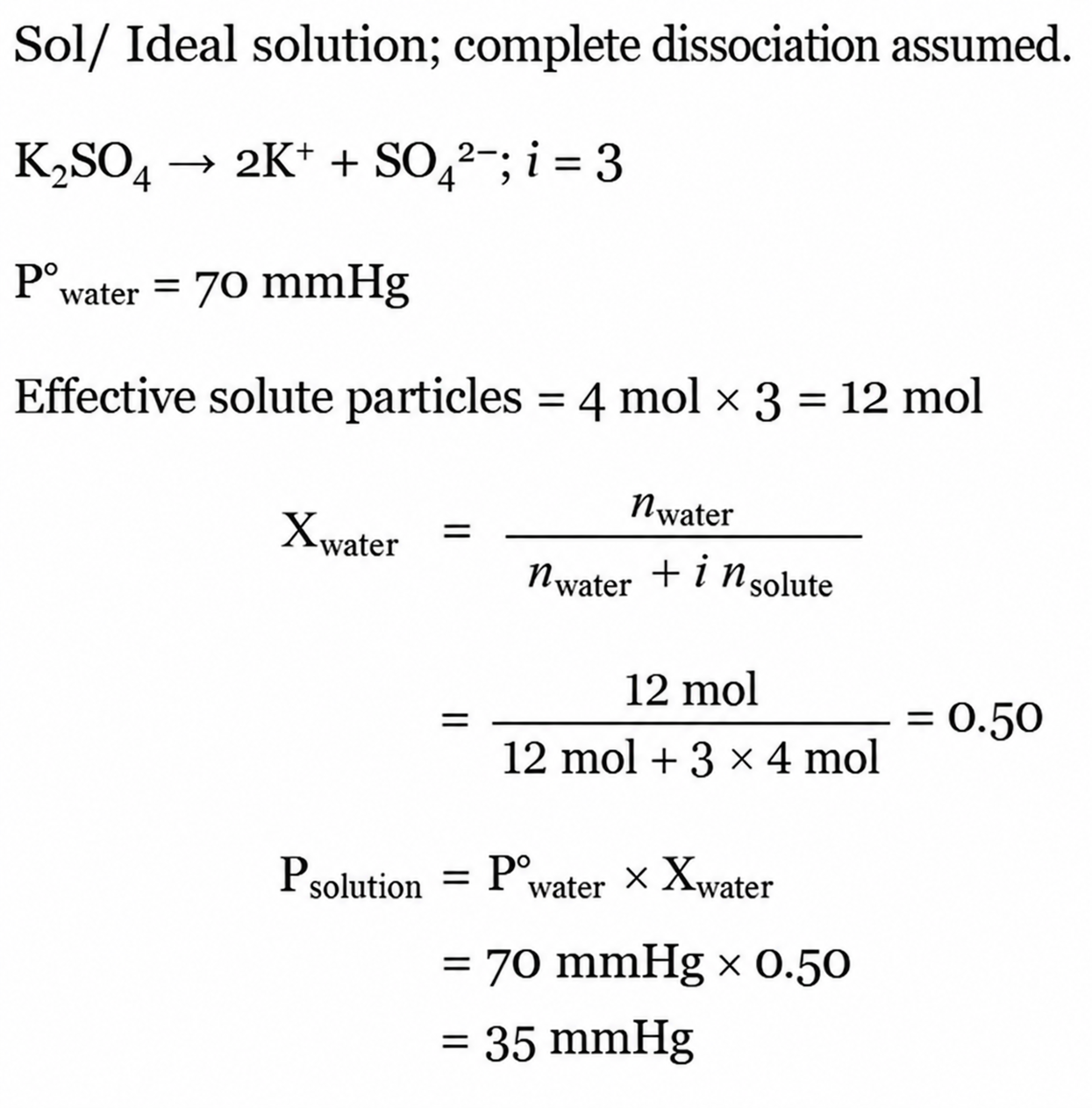
Question: Calculate the vapor pressure of the solution when 4 moles of K2SO4 is dissolved in 12 moles of H2O at 45°C. (The vapor pressure of water at 45°C = 70 mmHg.)

For this idealized calculation, assume complete dissociation and ideal solution behavior. Use the rounded atomic masses and other data supplied in the example.

G. Osmotic pressure (Π)

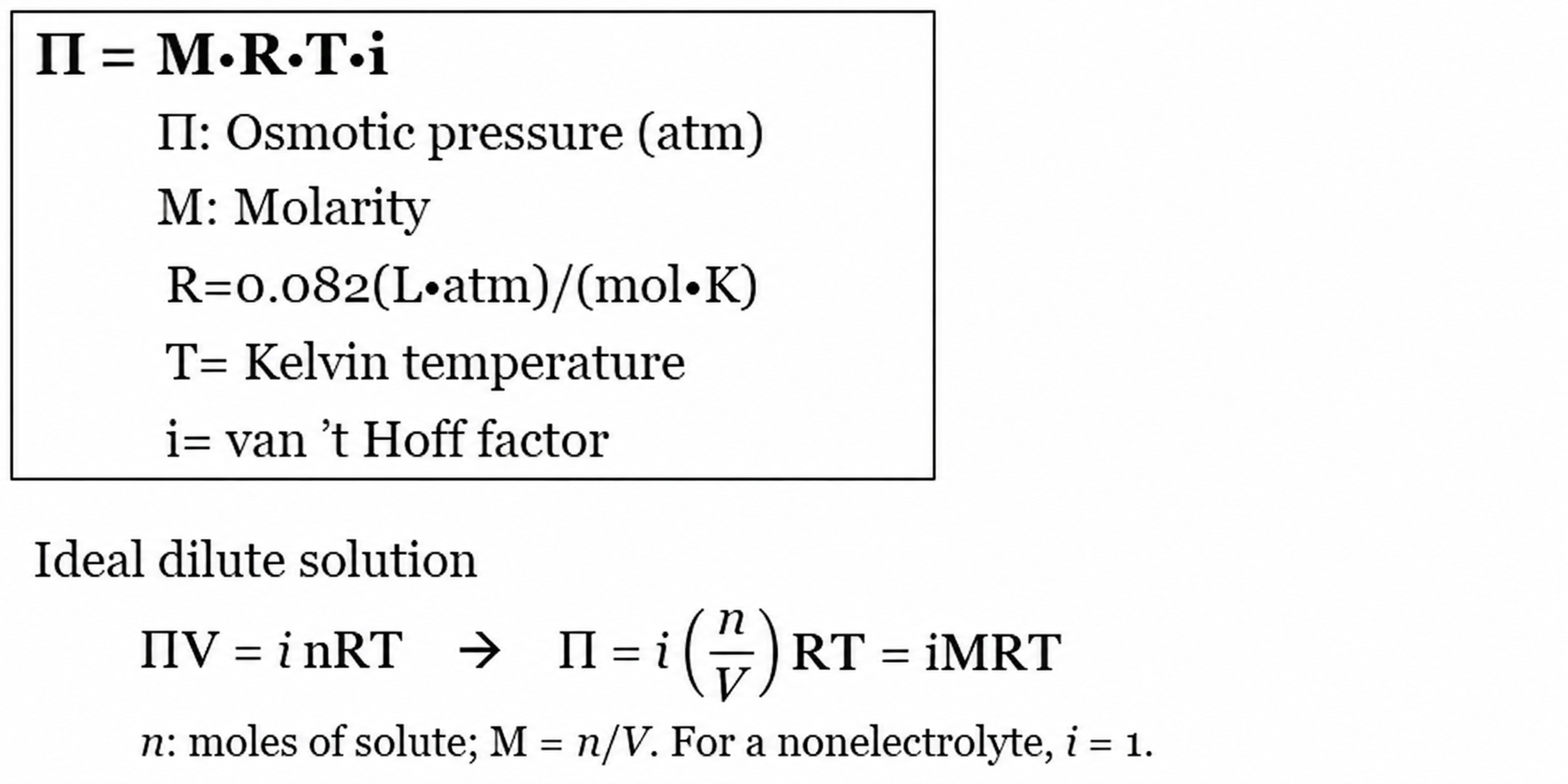
: the pressure that must be applied to a solution to stop net solvent flow into it across a semipermeable membrane.

Fig 6. Osmotic pressure between solvent and solution

** Osmosis: the net movement of solvent through a semipermeable membrane that allows solvent, but not the relevant solute, to pass. Without an opposing pressure difference, solvent flows from the pure solvent or a more dilute solution toward the more concentrated solution.

Ideal dilute solution: PiV equals i nRT and Pi equals iMRT; no extra volume factor.

Question: 116g of NaCl is dissolved in 4L of the solution at 27°C. Calculate the osmotic pressure. M.W. of NaCl: 23+ 35 = 58g/mol

For this idealized calculation, assume complete dissociation and ideal solution behavior. Use the rounded atomic masses and other data supplied in the example.

H. Henry’s law

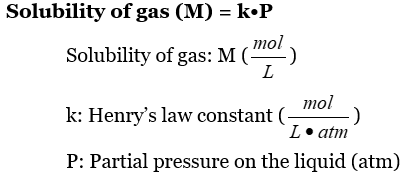
: at constant temperature, the equilibrium concentration of a dissolved gas is proportional to that gas’s partial pressure above the liquid: c = kP. This form applies in the dilute range for a gas that does not react significantly with the solvent; the value and units of k depend on the convention used.

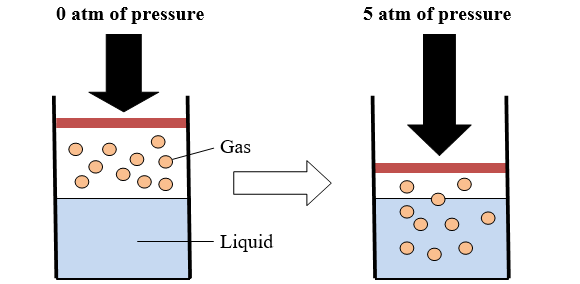
Fig. 7 Gas solubility as a function of gas partial pressure

For this schematic, read “0 atm” and “5 atm” as additional applied pressures relative to ambient pressure, not as absolute gas partial pressures. The left vessel does not represent a vacuum, and the particle counts are qualitative. Henry’s law uses the gas’s equilibrium absolute partial pressure; when that partial pressure is zero, c = 0.

Question: Calculate the solubility of an unknown gas in water when the gas’s partial pressure above the water is 3 atm at 23°C and the Henry’s-law constant of the unknown gas, k, is 5.0 × 10⁻² mol/(L·atm).

Solution:  Solubility of gas = k•P

= (5.0 × 10⁻² mol/(L·atm)) • (3 atm)

= 0.15 mol/L