
III. Ecology
Key focus of this chapter: population and communities.
This chapter reviews populations, communities, ecosystems, and the biosphere, with concise summaries of key ecological concepts.
A. Hierarchical levels of organization
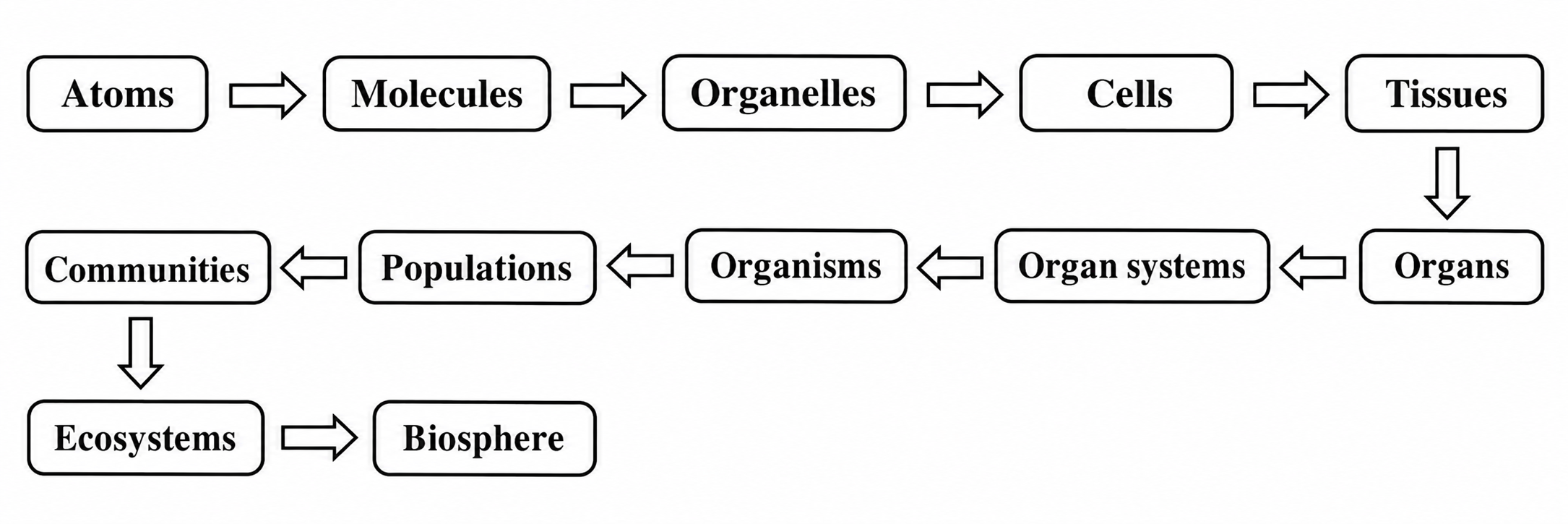
Biological categories and levels | Main features |
Organism | • Individual living thing |
Species | • Under the biological species concept, members can interbreed naturally and produce viable, fertile offspring • Reproductively isolated from other such groups; this concept does not directly apply to asexual organisms |
Population | • Individuals of one species living in the same area at the same time |
Community | • Populations of different species living and interacting in the same area |
Ecosystem | • A biological community and its abiotic environment, including their interactions |
Biosphere | • Sum of all global ecosystems • Includes regions of land, water, and atmosphere where life exists |
B. Species
1. Historical contributors
a. Aristotle (384 – 322 B.C.)
- Scale of nature – life forms ranked on a ladder by complexity from the simplest at the bottom to the most complex at the top in a fixed hierarchy.
- In this historical view, species were regarded as fixed.
b. Carolus Linnaeus (1707 – 1778)
- Binomial nomenclature system of taxonomy.
- Linnaeus initially treated species as fixed and classified organisms by shared characteristics.
c. Georges Cuvier (1769 – 1832)
- Paleontology – the study of fossils.
- Catastrophism – the historical view that major catastrophes caused extinctions and changes observed in the fossil record.
d. James Hutton (1726 – 1797)
- Gradualism – large geological changes can result from the slow accumulation of small, continuous processes.
e. Charles Lyell (1797 – 1875)
- Uniformitarianism – geological processes operating today also operated in the past.
f. Jean Lamarck (1744 – 1829)
- Inheritance of acquired characteristics.
- Lamarck proposed that use strengthens a body part, disuse weakens it, and acquired changes are inherited.
g. Charles Darwin (1809 – 1882)
- Voyage of HMS Beagle, including visits to the Galápagos Islands.
– island observations helped shape Darwin’s ideas about common ancestry and adaptation.
- Origin of species
– descent with modification from common ancestors.
– species evolve through natural selection.
- Natural selection
– individuals with heritable traits that improve reproductive success leave proportionally more offspring.
- Artificial selection
– humans select and breed individuals with desired heritable traits.
2. Evolution and structure
- Evolution: a change in the genetic composition of a population across generations.
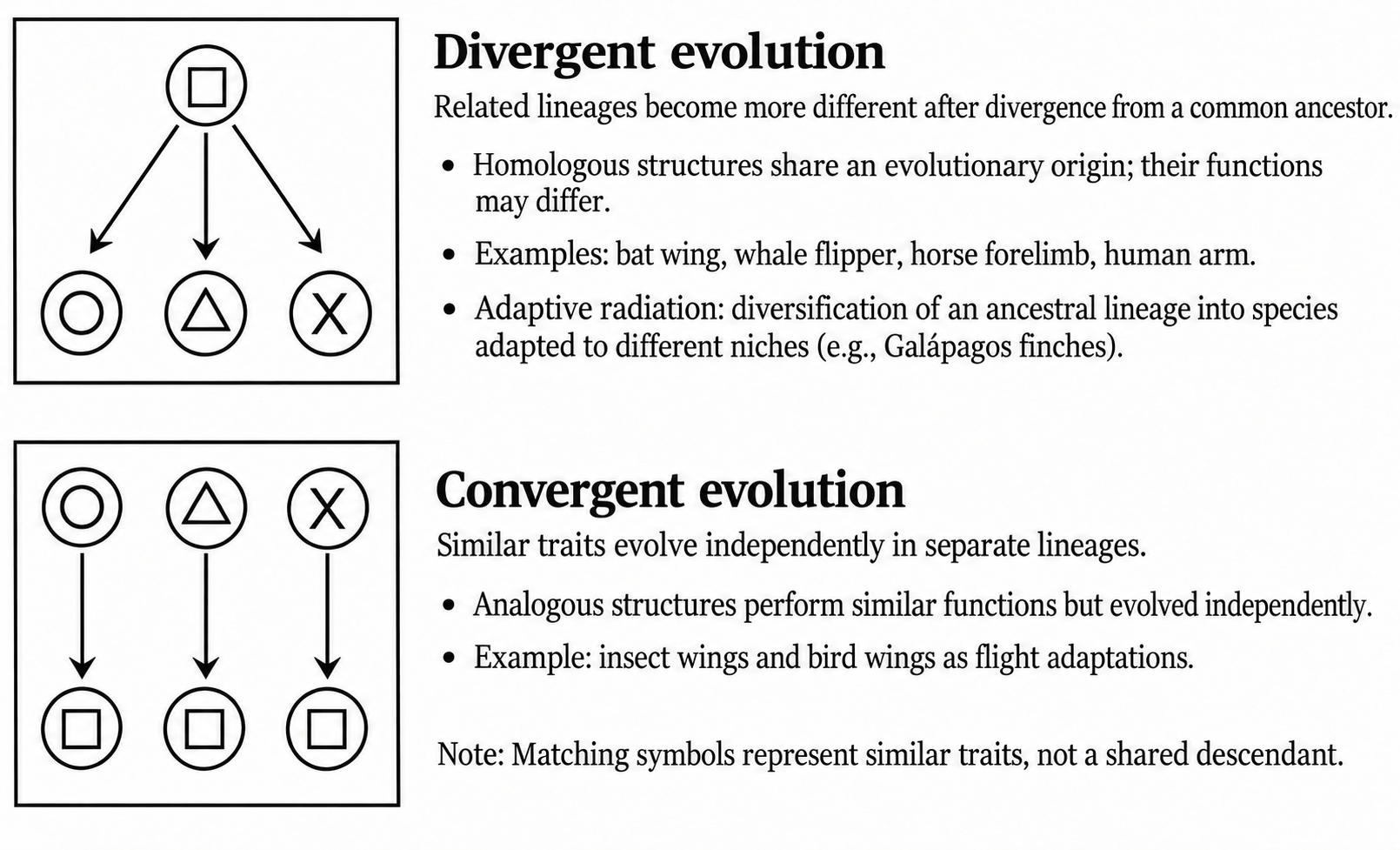
- Divergent and convergent evolution.
3. Geographic separation
- Allopatric speciation
– new species arise when geographically isolated populations evolve reproductive isolation
- Sympatric speciation
– new species arise through reproductive isolation without geographic separation
– the diverging populations occupy the same geographic region
C. Population
1. Sources of genetic variation
a. Mutation – changes in DNA that generate new alleles; gene duplication and divergence can produce new genes
b. Sexual recombination – reshuffling existing alleles into new combinations
2. Alteration of genetic composition
a. Genetic drift
: random changes in allele frequencies due to chance, especially in small populations; genetic variation may be lost.
- Bottleneck effect
– sudden disasters reduce the size of population.
- Founder effect
– a small group establishes a new population whose allele frequencies may differ by chance from those of the source population.
b. Gene flow
- Transfer of alleles between populations through migration of individuals or gametes.
c. Natural selection
: main source of adaptive evolution
- Geographic variation
– a cline is a gradual geographic change in a trait or allele frequency; environmental effects can also contribute to phenotypic variation.
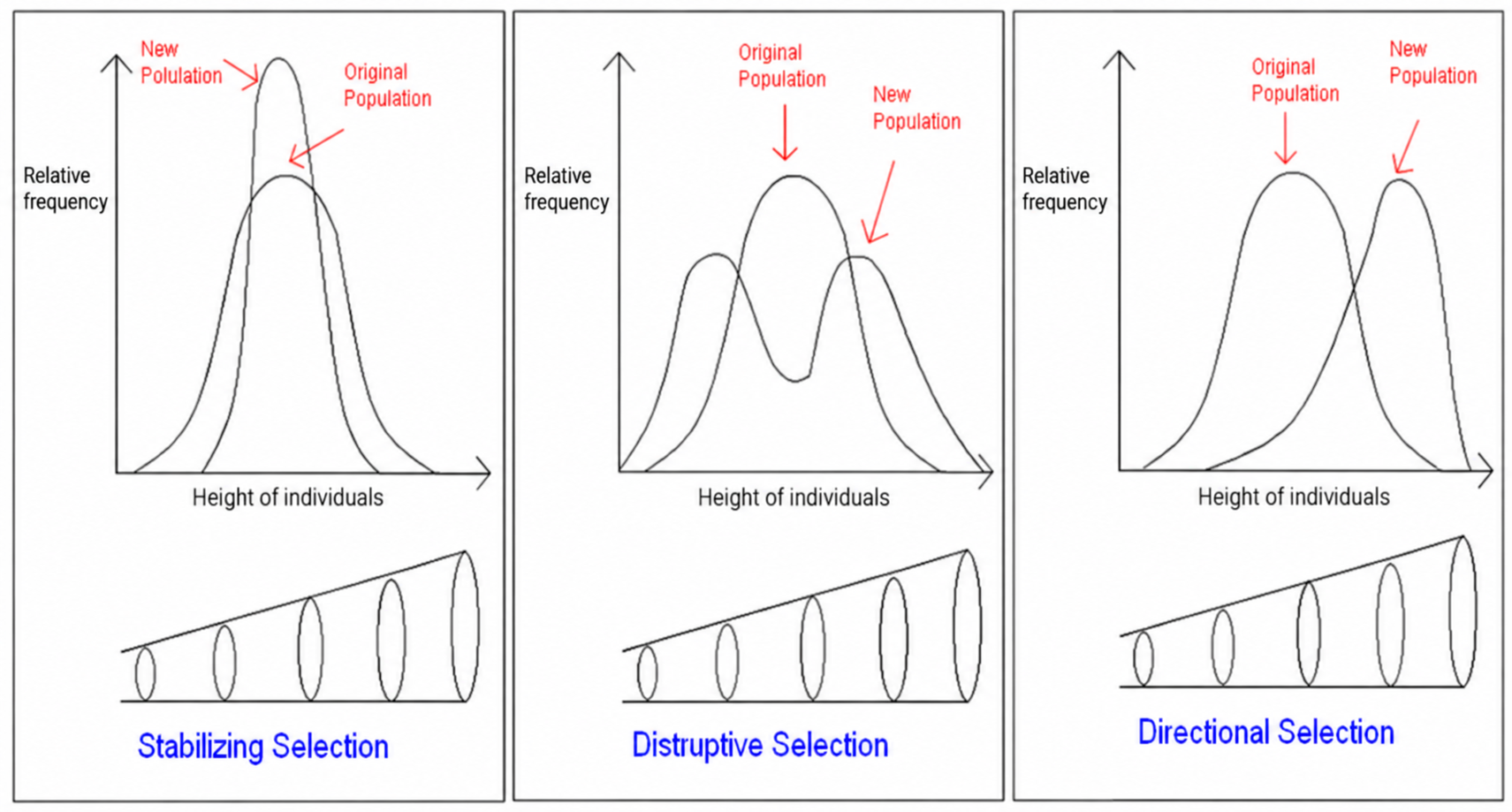
- Patterns of natural selection
– stabilizing selection: favoring intermediate phenotypes and selecting against extreme phenotypes.
– disruptive selection: favoring phenotypes at both extremes over intermediate phenotypes.
– directional selection: favoring one extreme phenotype and shifting the population mean in that direction.
3. Population dynamics
a. Exponential growth
- Population size increases exponentially when the per-capita rate of increase remains constant and positive.
- Births exceed deaths in a closed population with positive growth.
b. Logistic Growth
- Sigmoid curve or S-curve.
- When population size is far below carrying capacity, growth is approximately exponential; net growth slows as the population approaches carrying capacity.
- Carrying capacity: Maximum population size that the environment can sustain over time.
- Life histories.
Life histories | Features |
K-selection | • Traditional category emphasizing competition at high population density, often near carrying capacity (K) • Stable environments • Low reproductive rate • Slow growth • Small number of offspring • Populations often fluctuate near carrying capacity • Long life span • e.g., humans These traits describe a broad pattern, not universal rules. |
r-selection | • High potential intrinsic rate of increase (r) • Unstable environments • High reproductive rate • Rapid growth • Numerous offspring • Short life span • e.g., many rapidly reproducing microbes These traits describe a broad pattern, not universal rules. |
D. Communities
1. Niche and habitat
- Niche: the ecological role of a species, including its resource use, environmental requirements, and interactions with other organisms.
- Habitat: the physical environment where an organism lives.
2. Interspecific interactions
Interaction | Classification | Main characteristics |
- / - | Competition | • Two organisms in the same environment compete to get the same resource • Both species negatively affected |
+/- | Herbivory | • Herbivore is positively affected and plant or alga is negatively affected |
Parasitism | • Parasite is positively affected and host is negatively affected • e.g., tapeworms in the human digestive tract or fungi that cause athlete’s foot | |
Predation | • Predator is positively affected and prey is negatively affected | |
+ / 0 | Commensalism | • One species is positively affected and another species is not affected • e.g., cattle egrets feeding on insects disturbed by grazing water buffalo |
+ / + | Mutualism | • Both species are positively affected • Some mutualisms involve endosymbiosis • e.g., acacia trees and protective ants, lichens (a fungus with a green alga and/or cyanobacterium), nitrogen-fixing bacteria in legume root nodules |
3. Defensive adaptation
: defenses against predators.
Defensive adaptation | Classification | Features |
Coloration | Aposematic coloration | • Warning coloration signals defenses to predators, such as toxicity or stings • e.g., poison-dart frogs |
Cryptic coloration | • Camouflage (Morphological defense) | |
Mimicry | Batesian mimicry | • Palatable species mimics an unpalatable species • Harmless species mimics a harmful species |
Mullerian mimicry | • Two or more unpalatable species are similar to each other and have aposematic signals. |
4. Innate and learned behaviors
a. Fixed action pattern (FAP)
- A stereotyped, innate sequence of behaviors triggered by a sign stimulus, often carried through to completion.
- e.g., egg-rolling behavior in greylag geese when an egg is outside the nest.
b. Imprinting
- Learning during a sensitive period early in life.
- Learning guided by innate predispositions.
- Recognition or attachment learned during this sensitive period can influence later behavior.
- e.g., young geese following their mother, or imprinted cranes following an ultralight aircraft.
c. Habituation
- A decreased response to a repeated, harmless stimulus.
- e.g., a baby becomes less startled by a harmless, repeated sound.
d. Spatial learning
- Learning and remembering the locations of objects and resources in the environment.
e. Associative learning
: learning an association between two stimuli, or between a behavior and its consequences.
Associative learning | Summary |
Classical conditioning | • Learning an association between two stimuli • After pairing with an unconditioned stimulus, a formerly neutral stimulus can elicit a conditioned response • e.g., a tone paired with food later elicits salivation in a dog |
Operant conditioning | • Behavior is modified by its consequences • Reinforcement increases a behavior; punishment decreases it • e.g., a rat learns to press a lever to obtain food |
f. Extinction
- A learned response decreases when the conditioned stimulus repeatedly occurs without the unconditioned stimulus (classical conditioning), or when reinforcement stops (operant conditioning).
5. Ecological succession
: changes in community composition over time, often after new substrate forms or a disturbance occurs
a. Primary succession
- Succession on newly exposed substrate where soil has not yet formed
- New substrate exposed by lava flows or retreating glaciers
- Pioneer species may include microbes, algae, lichens, and mosses
- Communities
Communities | Features |
Pioneering community | • Early colonizers of newly exposed or disturbed habitats • Depending on conditions, pioneers may include microbes, lichens, mosses, or plants |
Climax community | • A relatively persistent late-successional community in the traditional climax model • Species composition and populations can still change with disturbance or climate • e.g., shade-tolerant trees in some mature forests |
b. Secondary succession
- Succession in an area where soil remains after a disturbance.
- e.g., recovery after a forest fire that leaves the soil intact.
E. Ecosystem
1. Biotic and Abiotic factors
- Biotic factors: all living organisms in an ecosystem
- Abiotic factors
– nonliving physical and chemical factors.
– e.g., water, temperature, sunlight, wind, nutrients.
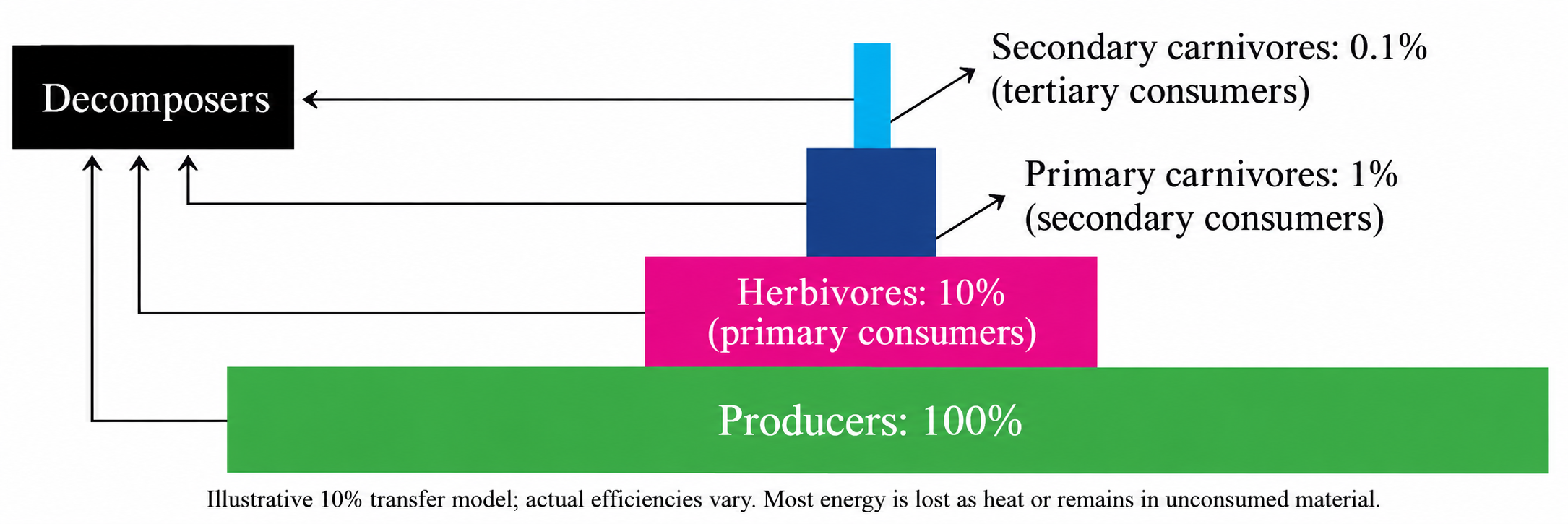
2. Energy flow in ecosystem
a. Food chain
- A food chain shows a linear transfer of energy and matter from producers to consumers. Biomagnification occurs when concentrations of certain persistent contaminants, such as DDT or methylmercury, increase at successive trophic levels.
Trophic structures | Features and examples |
Producer | • Autotrophs that produce organic matter by photosynthesis or chemosynthesis • e.g., plants, algae, cyanobacteria, and chemoautotrophic microbes |
Herbivores | • Primary consumers • Animals that eat producers, including herbivorous zooplankton |
Primary carnivores | • Secondary consumers • Animals that eat primary consumers, including herbivorous zooplankton |
Secondary carnivores | • Tertiary consumers • Animals that eat primary carnivores |
Tertiary carnivores | • Quaternary consumers • Animals that eat secondary carnivores |
Decomposers | • Organisms that break down nonliving organic materials • e.g., many bacteria and fungi |
Detritivores | • Organisms that ingest nonliving organic materials • e.g., earthworms and woodlice |
3. Nutrient cycles
: movement of chemical elements through biotic and abiotic components of ecosystems.
a. Water cycle
- Essential to all living organisms.
- Evaporation of water by solar energy → condensation of water vapor into clouds → precipitation
b. Phosphorus cycle
- Phosphorus is a component of ATP, nucleic acids, and phospholipids.
- Weathering releases phosphate from rocks into soil and water → uptake by producers → consumers → decomposers return phosphate. Sedimentation forms phosphate deposits; there is no major atmospheric gas phase.
c. Carbon cycle
- Carbon forms the backbone of organic molecules in living organisms.
- Photosynthesis fixes CO2 into organic compounds; cellular respiration by plants, animals, and microbes returns CO2 to the environment.
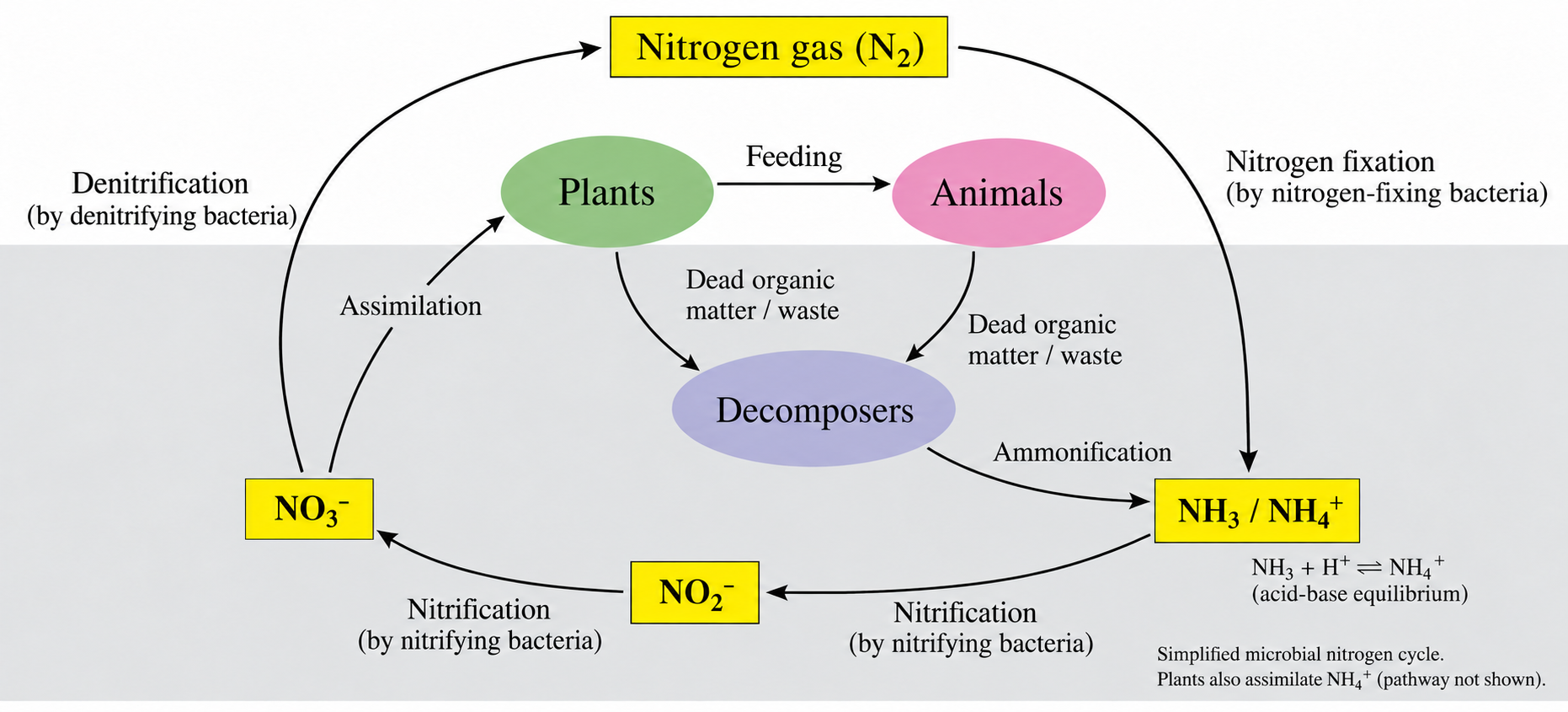
d. Nitrogen cycle
- Nitrogen is a component of amino acids and nucleic acids.
- Nitrogen fixation: N2 → NH3/NH4+.
- Nitrification: NH4+ → NO2− → NO3−.
- Assimilation: inorganic nitrogen is incorporated into organic molecules.
- Ammonification: organic nitrogen → NH3/NH4+.
- Denitrification: NO3− → N2.
Nitrogen-cycle processes | Functions |
Nitrogen fixation | • Reduction of atmospheric N₂ to ammonia (NH₃) • In most soils, ammonia is largely present as ammonium (NH₄⁺) |
Ammonification | • Microbial mineralization of organic nitrogen into ammonia/ammonium (NH₃/NH₄⁺) |
Nitrification | • Oxidation of ammonium (NH₄⁺) to nitrite (NO₂⁻), then to nitrate (NO₃⁻) • Usually occurs under oxygenated conditions |
Denitrification | • Reduction of nitrate (NO₃⁻) to gaseous nitrogen, usually N₂ • Typically occurs under low-oxygen conditions |
- Nitrogen cycle
4. Temperature relation
a. Climate
- Microclimate
– climatic conditions in a small, specific area, such as beneath a tree canopy or near the soil surface.
– important to individuals of a species.
- Macroclimate
– global or broad regional climate.
– important to distribution patterns of species.
b. Thermoregulation
- Homeothermic animals
– maintaining a relatively stable body temperature.
– e.g., many mammals and birds
- Poikilothermic animals
– body temperature varies substantially with environmental conditions.
– e.g., many reptiles and amphibians
Homeothermy and poikilothermy describe temperature stability; endothermy and ectothermy describe the primary source of body heat.
5. Water and salt regulation
a. Freshwater fish
- Freshwater fish gain water by osmosis, excrete large amounts of dilute urine, and actively absorb ions through the gills.
b. Saltwater fish
- Marine bony fish lose water by osmosis, drink seawater, and excrete excess salt mainly through the gills while producing small amounts of urine.
F. Biosphere
1. Aquatic environments
a. Lake zones
Lake zones | Features |
Littoral zone | • Shoreline areas |
Limnetic zone | • Open surface area away from littoral zone |
Photic zone | • Water receiving enough light for net photosynthesis • Includes phytoplankton production • The depth of this zone decreases as turbidity increases |
Aphotic zone | • Too little light for net photosynthesis • In deep lakes, the open-water region below the limnetic zone is the profundal zone |
Benthic zone | • The bottom surface and sediments of a water body • Occurs in shallow as well as deep water |
b. Marine zones
Marine Zones | Features | |
Littoral zone | Intertidal zone | • Between the high- and low-tide marks; alternately exposed to air and submerged by tides • Many different types of organisms • An important area for ecological study |
Neritic zone | • Water over the continental shelf, from the low-tide mark to the shelf edge • The shelf edge is commonly near 200 m depth; its horizontal distance from shore varies • Typically well-lit, productive waters with substantial nutrient inputs | |
Euphotic (sunlit) zone | Epipelagic zone | • Approximately the upper 200 m; depth varies with water clarity • Enough sunlight for photosynthesis |
Twilight and aphotic waters | Mesopelagic zone | • About 200–1,000 m deep • Twilight zone: dim sunlight, insufficient for net photosynthesis |
Bathypelagic zone | • About 1,000–4,000 m deep • No sunlight | |
Abyssal zone | • About 4,000–6,000 m deep | |
Hadal zone | • Deep ocean trenches • Deeper than 6,000 m | |
2. Water relations
a. Rain shadow
- As moist air rises on the windward side of a mountain, it expands and cools; water vapor condenses and precipitation occurs.
- As air descends on the leeward side, it compresses and warms, lowering relative humidity and creating drier conditions.
- e.g., Death Valley (Sierra Nevada)

b. Seasonal turnover
: in many temperate lakes, seasonal mixing redistributes oxygen and nutrients between surface and deep water during spring and fall.
- Mixing occurs when seasonal temperature changes weaken density stratification; wind helps circulate the water.
- Spring turnover
– surface water warming toward 4°C becomes denser, helping the water column mix.
- Fall turnover
– surface water cooling toward 4°C becomes denser, helping the water column mix.
3. Terrestrial biomes

Terrestrial biomes | Main features |
Tropical rain forest | • Very high species richness of terrestrial plants and animals • Found near the equator |
Savanna | • Tropical grassland with scattered trees and distinct wet and dry seasons • Often occurs between wetter tropical forests and drier regions |
Desert | • Dry places with low precipitation • Water conservation for plants and animals • Some plants are succulents, such as cacti |
Chaparral | • Hot, dry summers and mild, wet winters • Evergreen plants, including many shrubs and small trees |
Temperate grassland | • Seasonal temperatures with moderate precipitation, drought, and frequent fires • Grasses and forbs dominate • Many areas have been converted to farmland |
Temperate deciduous forest | • Hardwood and broad-leaved deciduous forests • Precipitation occurs throughout the year; winter precipitation may include snow |
Coniferous forest (Taiga) | • Coniferous trees with needlelike leaves • Short, cool, relatively wet summers • Long, cold winters • Many large mammals |
Tundra | • Found in far north with low precipitation • Small shrubs or vegetation • Long and cold winter and short and cool summer • Permafrost |
Polar ice | • Polar regions around the North and South Poles • Low precipitation • Limited terrestrial life |