VIII. Chemical Kinetics questions
Chemistry kinetics practice problems
There are a total of 20 chemistry kinetics practice problems, which are important content-oriented in the summary part of this chapter. Click the ‘Answer’ button to see the corresponding answers and explanations, and click the ‘Go back’ button to slove the next questions.
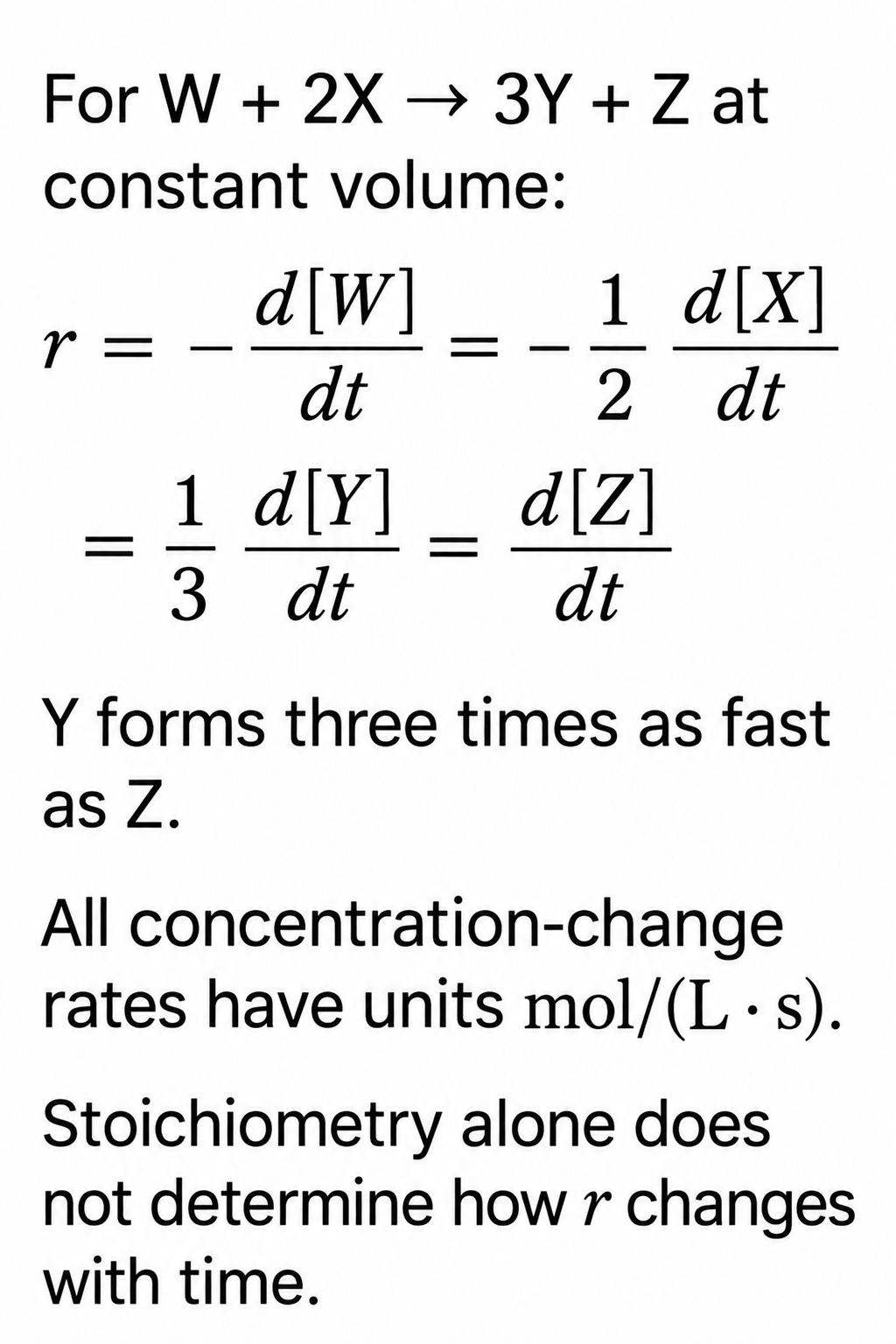
2. Which of the following is the correct statement about the reaction rate of the following reaction?
W + 2X → 3Y + Z
A. The reaction rate is not changed over time.
B. The concentration of W is increased over time.
C. The rate sign of Y is negative.
D. The composing rate of Y is 3 times faster than Z.
E. W, X, Y, and Z have different rate units.
3. Which of the following does NOT affect the reaction rate?
A. Types of reactant
B. Temperature
C. Catalyst
D. Surface area of reactant
E. Concentration of product
4. Increasing temperature influences all of the following functions EXCEPT ____________________ .
A. Increasing high energy particles
B. Increasing activation energy
C. Increasing colliding particles
D. Increasing reaction rate 2 times per increasing temperature 10 oC
E. All are true.
5. Which of the following cause the reaction rate to slow down?
A. Low activation energy
B. Increasing pressure
C. Reaction of covalent bonded molecules
D. No rearrangement of molecules
E. Increasing colliding particles
6. From an experiment, the general rate law is k[A]2[B]. If both concentrations of the reactants are increased by a factor of 2, the rate will be ____________________ .
A. Increased by a factor of 2
B. Decreased by a factor of 4
C. Increased by a factor of 4
D. Decreased by a factor of 8
E. Increased by a factor of 8
11. In an experiment, a certain compound is found to have a half-life of 7 minutes. When the initial mass of the compound was 40g, how much time is required for decay to be 5g?
A. 21 min
B. 32 min
C. 35 min
D. 40 min
E. 42 min
12. A certain sample of radioisotope is decayed over 200 years. When the half life is 50 years, what percent of the original sample would be left?
A. 3.12%
B. 6.25%
C. 12.5%
D. 25.0%
E. 50.0%
13. The half-life for the first reaction is 3 min. What is the value for the rate constant k (min-1)?
A. 4.33
B. 0.23
C. 2.08
D. 0.69
E. 1.38
14. Which of the following does NOT apply to the first order from the simple types of the reaction, A → B + C ?
A. Rate = k[A]1.
B. Linear slope between ln [A] and time on the graph.
C. The rate raw is dependent of the concentration of the reactant.
D. Positive slope between ln [A] and time on the graph.
E. Inverse proportion between half-life and constant k.
16. In a forward reaction, the reactant energy is 100kJ and the activation energy is 50kJ. When the activation energy for the reverse reaction is 90kJ, what is the product energy?
A. +30kJ
B. -60kJ
C. +60kJ
D. -240kJ
E. +240kJ
17. When a catalyst is added to a chemical reaction, which of the following is an INCORRECT statement?
A. The activation energy becomes lower.
B. Equilibrium state is reached more quickly.
C. Colliding particles are increased.
D. The reaction rate is increased.
E. Gibbs free energy is decreased.
18. Which of the following is an INCORRECT statement?
A. Catalysis is dependent on temperature.
B. Catalysis is dependent on reactant concentration.
C. Rate constant is dependent on temperature.
D. Rate constant is independent of reactant concentration.
E. All are correct.
Answers
3. E
Factors that affect the reaction rate: concentration of reactant, pressure, surface area, catalysis, temperature, types of reactant.
4. B
Increasing temperature → increasing high energy particles → increasing colliding particles → increasing reaction rate. Reaction rate is increased 2 times as temperature increases 10 oC.
5. C
During the reaction of covalent bonded molecules, the rearrangements of molecules occurs. This causes the reaction rate to slow down.
14. D
The first order from the simple types of the reaction has a negative slope between ln [A] and time on the graph.
15. C
The second order of the graph is C. Graph A is for the zeroth order and graph E is for the first order. The graph B and D are nonsense.
17. E
Adding the catalyst to a chemical reaction does not influence the Gibbs free energy of the reaction.