X. Immunology
Key focus of this chapter: immunity system
This chapter focuses immunity system and gives concise summaries of the important things about lymphatic system, defense systme, nonspecific immunity, specific immunity, and immune responses.
A. Lymphatic system
- Blood fluids leave blood capillaries and enter the lymphatic capillaries.
- Lymph nodes filter bacteria or foreign matters by macrophages.
- Filtered lymphatic veins return to circulatory system.
Lymphoid tissues | Functions | |
Central lymphoid tissues | Thymus | • Maturates and regulates T lymphocyte (T cells) • Secretes thymosin hormone |
Bone marrow | • Makes new blood cells | |
Peripheral lymphoid tissues | Adenoids | • Trap inhaled viruses and make antibodies during childhood |
Tonsils | • Protect against infection | |
Lymph nodes | • Filter bacteria or foreign matters in the lymph | |
Spleen | • Filters and destroys red blood cells | |
Peyer’s patch | • Collects macrophages, B cells, and T cells | |
Lymphatic vessels | • Capillaries of lymph | |
B. Defense system
Immunity | Responses to invading pathogens | |
Nonspecific Immunity (innate Immunity) | External Defenses | • Skin • Secretions • Mucous membranes |
Internal Defenses | • Proteins for antimicrobes • Inflammatory response • Phagocytic white blood cells • Natural killer cells (null cells) | |
Specific Immunity | • Humoral response (B cells) • Cell-mediated response (cytotoxic T cells) | |
C. Nonspecific Immunity
: rapid responses to infectious agents.
1. External defenses
a. Skin – protect against invading bacteria or viruses.
b. Secretions – lysozyme in tears and saliva destroy the bacteria cell walls and secretes outside.
c. Mucous membranes – viscous mucous from mucous membranes protects the respiratory and digestive tracts by trapping microbes.
2. Internal Defenses
a. Proteins for antimicrobes
- Complement system
– composed of protein fragments.
– functions as inflammation, lysis of invading cells, and immune response.
- Interferon
– cell signaling proteins to response immune system from invading virus.
b. Inflammatory Response
- Histamine – secreted by mast cells and triggers an injury response.
- Chemokines – collect phagocytic cells and send them to injury sites.
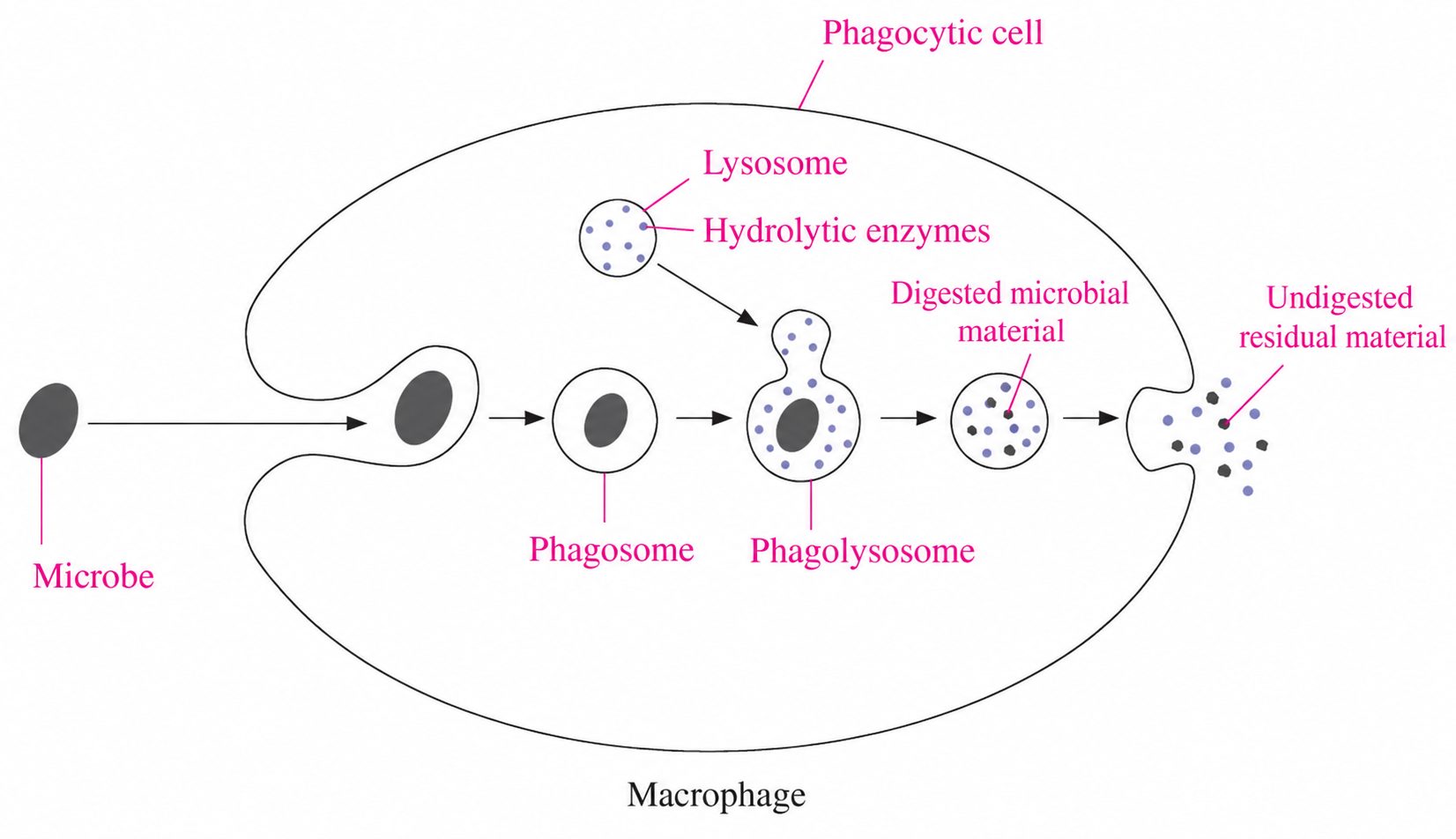
c. Phagocytic cells (macrophage)
Phagocytic white blood cells | Functions and features |
Neutrophils | • Engulf microorganism or foreign particles |
Monocytes | • Become macrophages for phagocytic activity |
Eosinophils | • Minor phagocytic activity • Release enzymes to kill parasites • Discharge toxins from enzyme damage to tissues |
d. Natural killer cells
- Release molecules (perforin) to kill infected or tumor cells.
- Apoptosis – programmed cell death.
D. Specific immunity
– slow responses to infectious agents.
1. Basic theory
a. Terminology
- Antibiotic
– chemotherapeutic agent that kills or interferes with the growth of micro-organisms, including bacteria, protozoans, and fungi.
– usually inhibits the protein synthesis of ribosome in micro-organisms.
– antibiotic does not work as an inhibition agent of viruses.
- Cytokines
– proteins secreted from immune cells.
– function to help activate lymphocytes and coordinate the immune system against infection.
b. Structures of B cell and antigen
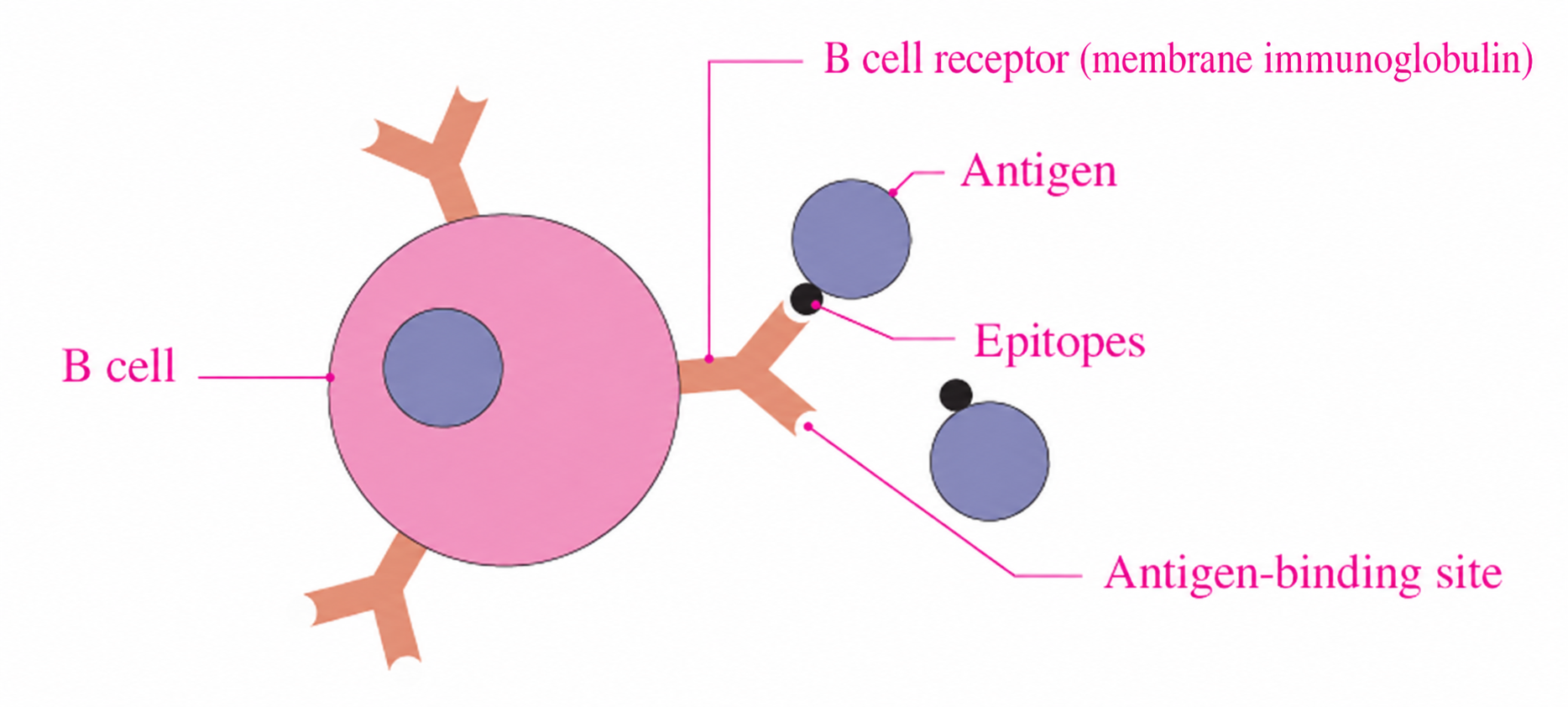
- Antibodies
– immunoglobulins produced by B cells in plasma and interstitial fluid.
– function as identifying and binding foreign microbes for destruction.
- Antigen
– foreign molecules or microbes detected by lymphocytes.
- Epitope
– antigenic determinants.
– recognition of site of antigens.
c. Lymphocytes
- Produce three main types: B lymphocytes (B cells), T lymphocytes (T cells), and natural killer cells (NK cells)
- Major function as body’s defenses
d. Structure of B cell and T cell receptors
Receptors | Features |
B cell receptor | • Y shape with four polypeptide chains (two heavy chains and two light chains) • Four disulfide bridges link the four chains |
T cell receptor | • Two lines shape with two different polypeptide chains (α and β chains) • Disulfide bridge links α and β chains |
e. Lymphocyte development
: lymphocyte developed from stem cell in bone marrow maturates the B cell in the bone marrow and the T cell in thymus.
f. Clonal selection of lymphocyte
- Clonal selection – antigen driven activation of lymphocytes
- Effector cells (plasma cells)
– short-lived cells.
– combat the same antigen.
- Memory cells
– long-lived cells.
– bearing receptors specific for the same antigen.
- Primary immune response
– B cells proliferate antibodies and cytotoxic T cells become active.
– person becomes sick.
- Secondary immune response
– much faster immune response from same antigen, more prolonged, and greater magnitude than primary immune response.
2. Humoral and cell-mediated immunities
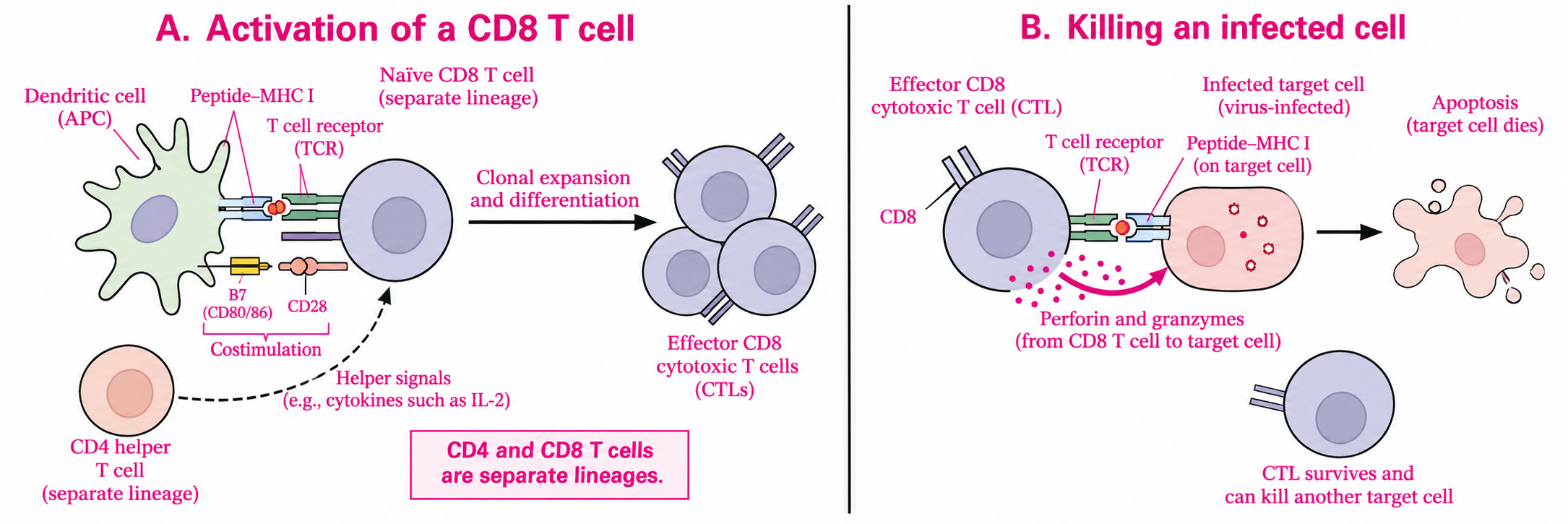
- Macrophage
– engulfs microorganisms and presents antigens.
- Helper T cell
– responds to antigens, which are displayed from macrophages.
– stimulates the activation of B cells and cytotoxic T cells.
a. Humoral immunity
: activates B cells to proliferate antibodies, which defend against pathogens in the blood and lymph.
- B Cells
– important role in the humoral immune response.
– respond to pathogens and are activated by helper T cell.
– make the clone of memory B cells.
– proliferate plasma cells to make antibodies in the blood and lymph.
- Memory B cells
- Plasma cells – produce antibodies
- Classes of antibodies
Classes | Shapes | Features |
IgA | ![]() | • Important role in newborn immunity • Present in breast milk, mucosal surfaces, tears, and saliva • Serve localized defense of mucous membranes |
IgD | ![]() | • Important antigen receptor on B cells • Antigen receptor and differentiation of B cells |
IgE | ![]() | • Involved in allergic reaction |
IgG | ![]() | • Most common antibody in blood • Serve for neutralization, agglutination of antigens, and opsonization • Important role in fetus and newborn immunity • Cross the placenta |
IgM | ![]() | • Produced in the primary response • Serve for neutralization and agglutination of antigens |
b. Cell-mediated immunity
: activates the clone of cytotoxic T cells, which destroy cancer cells or infected cells.
- Cytotoxic T cell
– important role in the cell-mediated immune response.
– developed from helper T cells in the thymus.
– uses the protein perforin to destroy cancer cells or infected cells.
- Class II HMC molecules
– identifies molecules on the surface of macrophages, activates B cells, and dendritic cells.
- Class I HMC molecules
– identifies molecules on the surface of almost every cell in the body.
- T cell receptor
– detects and binds foreign antigens.
E. Immune responses
1. Generating immunity
- Active immunity
– immunity conferred by natural or artificial infectious agents.
– eg/ Vaccination
- Passive immunity
– immunity conferred by introducing antibodies from other persons.
– eg/ Transferring antibodies (IgG and IgA) to fetus from the mother, erythroblastosis fatalis with Rh– mother and Rh+ fetus
2. Blood group
Blood type | Antibodies | Reaction to other blood type | Possible transfusion blood type from others |
A | Anti-B | B, AB | A, O |
B | Anti-A | A, AB | B, O |
AB | None | None | A, B, AB, O |
O | Anti-A, Anti-B | A, B, AB | O |