IV. Bacteriology

Key focus of this chapter: Bacteria vs. Viruses.

This chapter compares bacteria and viruses and summarizes prions, viroids, viral types, animal viruses, bacteriophages, and key concepts in bacterial biology.

A. Prions

  • Composed of infectious proteins.
  • Misfolded prion protein (PrPSc) can induce misfolding of normal PrP and cause neurodegeneration in mammals.
  • Scrapie disease in sheep, Mad cow disease (BSE), and Creutzfeldt-Jakob disease (CJD) in humans.

B. Viroids

  • Composed of circular and single stranded RNA molecules without protein capsid.
  • Plant pathogens.

C. Virus

: an infectious agent that requires a host cell to replicate.

  • Composed of DNA or RNA molecules and protected by protein coat.
  • Lacks organelles and cell wall.
  • Host range depends in part on specific interactions between viral attachment proteins and host-cell receptors.
  • Cannot reproduce without a host cell.
  • Viruses are not classified as living organisms.

1. Viral types

Classification

Shapes

Features

Adenoviruses

• Naked virus

• Double stranded DNA

• Icosahedral capsid with fiber proteins projecting from its vertices.

• Infects respiratory tracts

Tobacco mosaic virus

• Naked helical virus

• Single stranded RNA Virus

• Capsomere of helical capsid with rod shape

• Infects tobacco plant

Influenza viruses

• Enveloped virus

• Single stranded RNA Virus

• Membranous envelope with glycoprotein

• RNA molecules wrapped in helical capsid

Bacteriophage T4

• DNA virus

• Polyhedral head, tail sheath, and tail fiber

• Infects E. coli.

• Only lytic phase

2. Reproductive cycle of virus

a. Animal virus

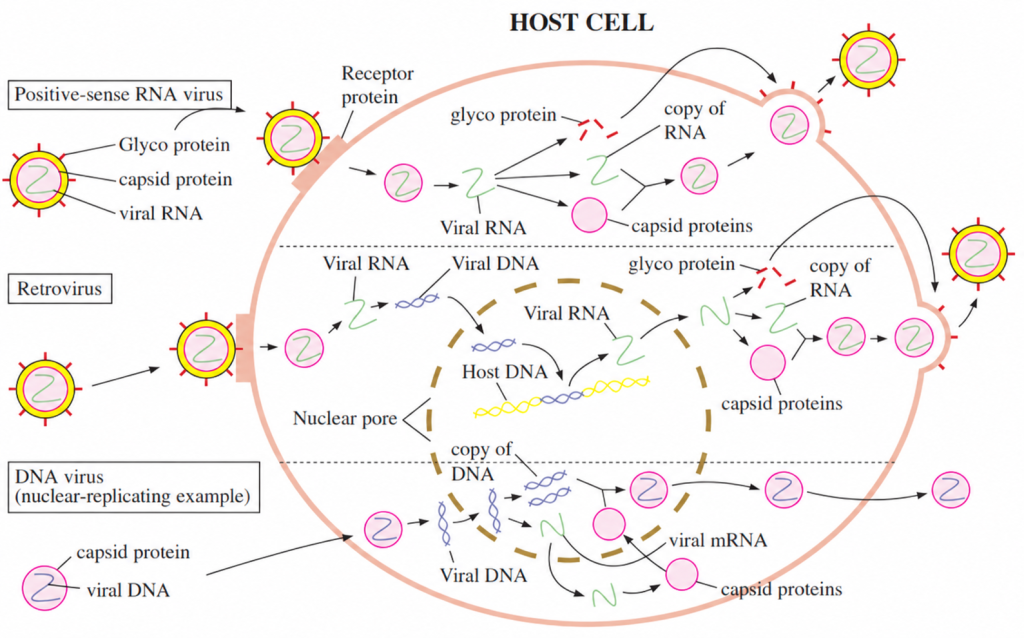
Examples of positive-sense RNA virus, retrovirus, and nuclear-replicating DNA virus pathways; DNA virions contain viral DNA, and transcription produces viral mRNA.
  • RNA virus

– Most non-retroviral RNA viruses replicate their RNA genomes using an RNA-dependent RNA polymerase. Positive-sense RNA can act as mRNA; negative-sense RNA must first be transcribed into mRNA.

– e.g., Influenza virus (negative-sense RNA), hepatitis C virus, and SARS-CoV (positive-sense RNA).

  • Retrovirus

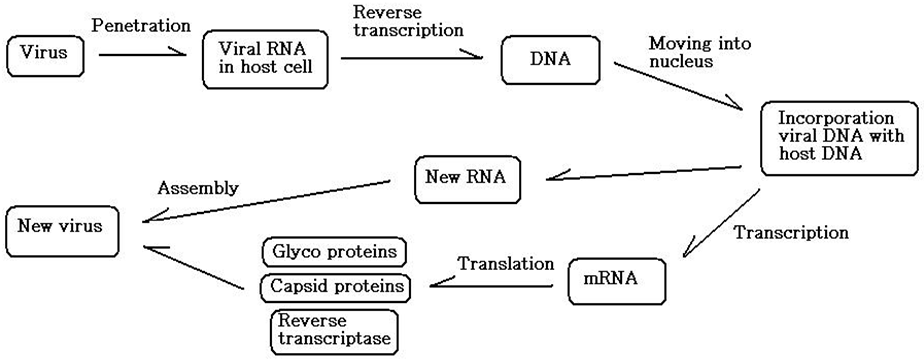
– reverse transcriptase (synthesizing DNA from RNA).

– Host RNA polymerase II transcribes the integrated proviral DNA to produce viral genomic RNA and mRNA.

– Retroviral replication involves reverse transcription, integration into host DNA, transcription, translation, assembly, and budding.

– e.g., HIV (which can cause AIDS) and oncogenic retroviruses.

  • DNA virus

– synthesizes new genomes from viral DNA.

– replication and assembly sites vary by virus; many DNA viruses replicate in the nucleus, while poxviruses replicate in the cytoplasm.

– e.g., Adenovirus, herpesvirus, papillomaviruses (Papillomaviridae), and polyomaviruses (Polyomaviridae).

b. Bacteriophage

  • Infects bacteria
  • Some bacteriophages have complex head-tail structures.
  • Transduction
  • Bacteriophage T4

– composed of polyhedral head, tail sheath, and tail fiber

– virulent phage

– only lytic cycle

– infection E. coli bacteria

  • Bacteriophage lambda (λ)

– temperate phage (both lytic cycle and lysogenic cycle)

– infection Escherichia coli bacteria

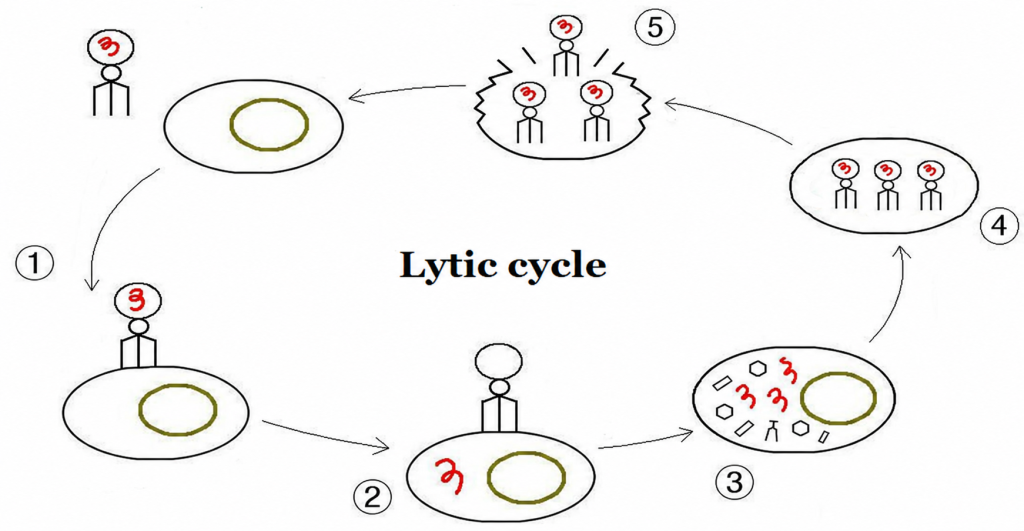
  • Lytic cycle

: phage replication that ends with host-cell lysis; virulent phages use only this cycle.

– ① approaching and attachment.

– ② entry of phage DNA.

– ③ phage DNA replication and viral protein synthesis.

– ④ phage assembly.

– ⑤ host-cell lysis and release of new phages.

Bacteriophage lytic cycle: attachment, DNA entry, phage DNA replication and protein synthesis, assembly, and host-cell lysis and release.
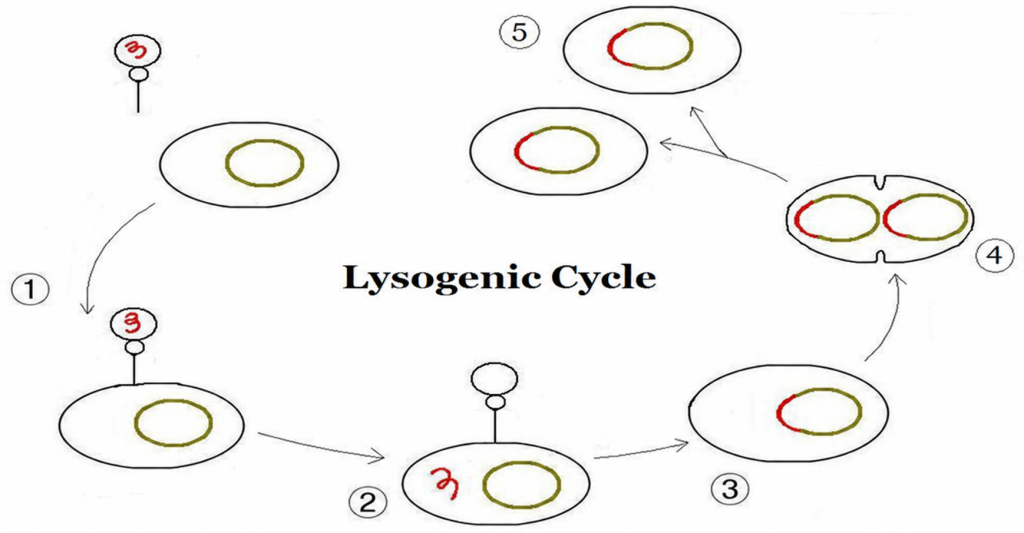
  • Lysogenic cycle

: in temperate phages such as λ, phage DNA integrates into the host chromosome as a prophage and replicates with the host without immediate lysis. Induction can switch it to the lytic cycle.

– ① approaching and attachment

– ② entry of phage DNA

– ③ integration into the host chromosome (prophage formation)

– ④ replication of the prophage with host DNA

– ⑤ bacterial division passes the prophage to daughter cells

Lysogenic cycle: phage DNA integrates as a prophage, replicates with the host chromosome, and is inherited by both daughter cells.


** Comparison of animal virus and bacteriophage multiplication

Stage of reproduction

Animal Virus

Bacteriophage

Attachment

• Envelope or capsid to host cell surface

• Phage attachment proteins bind specific bacterial surface receptors; tail fibers mediate attachment in phages such as T4.

Penetration

• Enveloped viruses may enter by membrane fusion or endocytosis.

• Non-enveloped viruses commonly use receptor-mediated entry to deliver their genomes; entry mechanisms vary among viruses.

• Nucleic acid into host cell

Synthesis and Assembly

• In the cytoplasm and/or nucleus, depending on the virus

• At cytoplasm only

D. Bacteria

1. Shapes

  • Bacilli – rod shaped
  • Cocci – spherical
  • Spiral – helical

   ** Arrangement of prefixes

  • Diplo (pair), staphylo (clusters), strepto (chains)
  • E.g., Staphylococci (spherical clusters)

2. Cell-surface Structures

  • Gram-positive

– cell wall with thick sheet of peptidoglycan (network composed of modified sugar and amino acids).

  • Gram-negative

– cell wall with outer membrane and thin sheet of peptidoglycan.

– outer membrane containing lipopolysaccharide.

 3. Motility

  • Bacterial flagellar rotation is powered by a proton-motive force (H⁺ gradient), or in some species a sodium-motive force (Na⁺ gradient).
  • Flagellum made of basal apparatus, hook, and filament.
  • Prokaryotic flagella are not extensions of the plasma membrane.
  • Taxis – directed movement of a motile cell toward or away from an environmental stimulus.

4. Genetic recombination

: horizontal gene transfer can increase bacterial genetic diversity; it is distinct from asexual reproduction by binary fission.

  • Transduction

– transfer of bacterial DNA from one bacterium to another by bacteriophages.

  • Transformation

– uptake of extracellular naked DNA by a competent bacterium; the DNA may recombine with the genome or be maintained as a plasmid.

  • Conjugation

– direct DNA transfer from a donor to a recipient through cell-to-cell contact; in many Gram-negative bacteria a sex pilus helps establish contact.

– genetic exchange without production of new cells.

– Plasmids are usually extrachromosomal, independently replicating DNA molecules, commonly circular. They may carry antibiotic-resistance genes, and some can be transferred between bacteria.

5. Binary fission

: a form of asexual reproduction by cell division in bacteria.

  • Chromosome replication

– starting point of replication in both directions.

– bi-directional progress

6. Gene expression

  • Lac operon (inducible system)

– controlling enzyme synthesis for metabolizing lactose to glucose and galactose in E. coli.

– operon off: Active repressor is bound to the operator and inhibits transcription of the lac genes.

– operon on: Allolactose (inducer) binds and inactivates the repressor. RNA polymerase transcribes lacZ, lacY, and lacA into mRNA; ribosomes translate β-galactosidase, permease, and transacetylase.

– strongest expression occurs when lactose is present and glucose is low: increased cAMP binds CAP, and the cAMP–CAP complex promotes transcription.

Enzymes

Functions

β-Galactosidase

• Made from lac Z

• Hydrolyzing lactose to glucose and galactose

Permease

• Made from lac Y

• Moving lactose into cell

Transacetylase

• Made from lac A

• Transfers an acetyl group from acetyl-CoA to certain β-galactosides; not required for lactose hydrolysis.

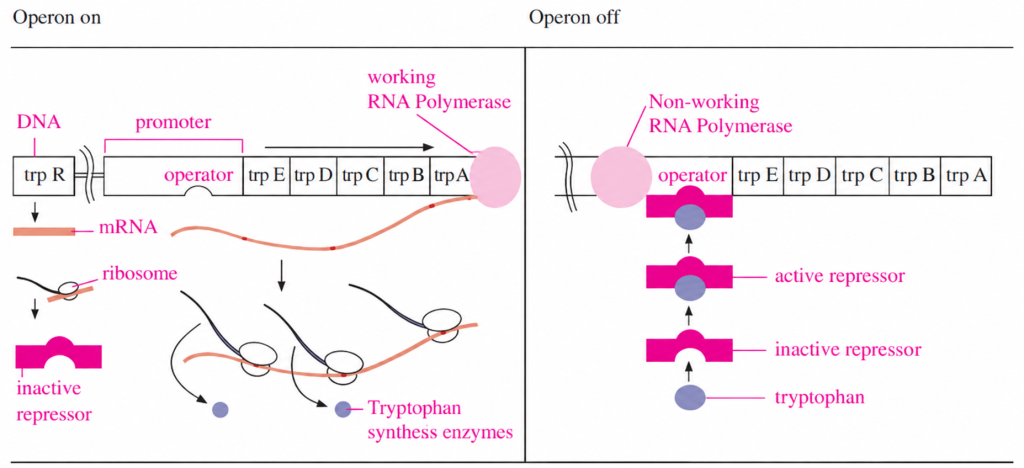
  • Trp operon (repressible system)

– controlling repressible enzyme synthesis for making tryptophan in E. coli.

– operon on: When tryptophan is scarce, the repressor is inactive. RNA polymerase transcribes the trp genes into mRNA; ribosomes translate enzymes for tryptophan synthesis.

– operon off: Tryptophan acts as a corepressor: binding activates the repressor, which binds the operator and inhibits transcription.

Trp operon: transcription and translation produce tryptophan synthesis enzymes when tryptophan is scarce; tryptophan activates the repressor as a corepressor when abundant.

7. Metabolic adaptation

  • Oxygen relationship

Classification

Features

Obligate aerobes

• Aerobic organisms that need O2 for cellular respiration

• Without O2 aerobic organisms cannot grow

Obligate anaerobes

• Anaerobic organisms that cannot grow with O2

Facultative anaerobes

• Use aerobic respiration when O₂ is available; without O₂, use fermentation or, when the organism and electron acceptor permit, anaerobic respiration.

• E.g., E. coli

  • Biofilms

– communities of microorganisms attached to surfaces and embedded in a self-produced extracellular polymeric substance (EPS) matrix, which promotes adhesion, protection, and retention of water and nutrients.

8. Bacterial pathogens and diseases

Bacterial pathogens

Diseases

Borrelia burgdorferi

• Lyme disease

Salmonella enterica serovar Typhi

• Typhoid fever

Escherichia coli (pathogenic strains)

• Diarrhea, sepsis, urinary tract infection

Neisseria gonorrhoeae / N. meningitidis

• Gonorrhea (N. gonorrhoeae); meningitis (N. meningitidis)

Corynebacterium diphtheriae (toxigenic strains)

• Diphtheria

Clostridium tetani / C. perfringens

• Tetanus (C. tetani); gas gangrene (commonly C. perfringens)

Streptococcus pneumoniae

• Pneumonia

E. Benefits of Microbes

  • Gut bacteria can synthesize vitamin K₂ (menaquinones), although the amount absorbed and its contribution to human vitamin K requirements remain uncertain.
  • Breakdown of organic materials and recycling of nutrients.