
III. Ecology
Key focus of this chapter: population and communities.
This chapter focuses on population and communities and gives concise summaries of the important things about ecosystem and biosphere.
A. Hierarchical levels of organization

|
Hierarchical levels |
Main features |
|
Organism |
• Individual living thing |
|
Population |
• A group of individuals of the same species living in the same area at the same time. |
|
Community |
• Populations of different species living and interacting in the same area |
|
Ecosystem |
• A community and its interacting abiotic environment |
|
Biosphere |
• Sum of all global ecosystems • The regions of Earth where life exists |
B. Species
Species (biological species concept): A group of organisms whose members can interbreed naturally to produce viable, fertile offspring and are reproductively isolated from other such groups. This concept has limitations for asexual organisms. Species is a taxonomic category, not a structural ecological level.
1. Historic biologists
a. Aristotle (384 – 322 B.C.)
- Scale of nature – Aristotle arranged living forms by increasing complexity; this was a historical view, not modern evolutionary theory.
- Aristotle regarded species as fixed rather than evolving.
b. Carolus Linnaeus (1707 – 1778)
- Binomial nomenclature: each species has a two-part name (genus and specific epithet).
- Linnaeus grouped organisms by shared characteristics; his classification was not originally based on evolutionary ancestry.
c. Georges Cuvier (1769 – 1832)
- Paleontology – the study of fossils.
- Catastrophism – sudden geological events can cause extinctions and help explain changes seen among fossil-bearing rock strata.
d. James Hutton (1726 – 1797)
- Gradualism – substantial geological change can accumulate through slow, continuous processes.
e. Charles Lyell (1797 – 1875)
- Uniformitarianism – geological processes operating today also operated in the past.
f. Jean Lamarck (1744 – 1829)
- Lamarck proposed inheritance of acquired characteristics; this is not the general mechanism of adaptive evolution.
- Lamarck proposed that use and disuse altered traits and that these acquired changes were inherited.
g. Charles Darwin (1809 – 1882)
- Voyage of HMS Beagle, including observations in the Galápagos Islands.
– Observations from the Galápagos Islands contributed to Darwin’s ideas about evolution.
- Origin of species
– descent with modification from ancestral populations.
– species evolve through natural selection.
- Natural selection
– Individuals with heritable traits that increase reproductive success tend to contribute more offspring to the next generation.
- Artificial selection
– Selective breeding by humans increases the frequency of chosen heritable traits.
2. Evolution and structure
- Evolution: change in heritable characteristics, including allele frequencies, in a population across generations.
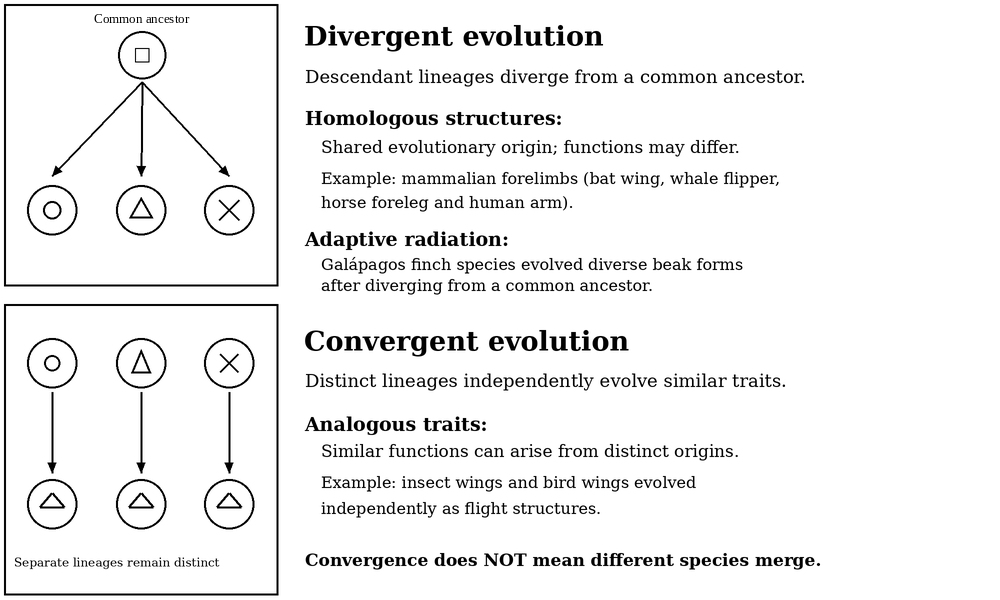
- Divergent and convergent evolution.
3. Geographic separation
- Allopatric speciation
– Speciation following geographic isolation and the evolution of reproductive isolation.
- Sympatric speciation
– Speciation through reproductive isolation without geographic separation.
– The diverging populations occupy the same geographic region.
C. Population
1. Sources of genetic variation
a. Mutation – the ultimate source of new alleles and new genetic variation.
b. Sexual recombination – reshuffles existing alleles into new genotype combinations.
2. Alteration of genetic composition
a. Genetic drift
: Random changes in allele frequencies, especially strong in small populations; drift can reduce genetic variation.
- Bottleneck effect
– A sudden reduction in population size may leave an unrepresentative sample of alleles.
- Founder effect
– A new population founded by a few individuals may have allele frequencies different from the source population.
b. Gene flow
- Movement of alleles into or out of a population through migration of individuals or gametes.
c. Natural selection
: main source of adaptive evolution
- Geographic variation
– A cline is a gradual geographic change in phenotype or allele frequency across an environmental gradient.
- Evolutionary fitness: relative reproductive success
– stabilizing selection: favors intermediate phenotypes and selects against extremes.
– disruptive selection: favors both extreme phenotypes over intermediate phenotypes.
– directional selection: favors one extreme phenotype, shifting the trait distribution toward it.

3. Population dynamics
a. Exponential growth
- Population size increases exponentially.
- Under ideal conditions, constant positive per capita growth produces a J-shaped curve.
b. Logistic Growth
- Sigmoid curve or S-curve.
- As population size approaches carrying capacity (K), net growth decreases toward zero in the logistic model; real populations can fluctuate as conditions change.
- Carrying capacity: Maximum population size that environment can sustain.
- Life histories.
Life histories | Features |
K-selection | • Traits favor survival and competitive success near carrying capacity (K) • Traditionally associated with relatively stable environments • Low reproductive rate • Slow growth • Small number of offspring • Population size may fluctuate around carrying capacity • Long life span • e.g., Human |
r-selection | • Traits favor a high intrinsic rate of population increase (r) • Traditionally associated with variable or disturbed environments • High reproductive rate • Rapid growth • Numerous offspring • Short life span • e.g., Bacteria |
D. Communities
1. Niche and habitat
- Niche: the resources, conditions, and ecological interactions that characterize how a species lives.
- Habitat: the place where an organism lives.
2. Species interactions
Interaction | Classification | Main characteristics |
- / - | Competition | • Two organisms in the same environment compete to get the same resource • Both species negatively affected |
+/- | Herbivory | • Herbivore is positively affected and plant or alga is negatively affected |
Parasitism | • Parasite is positively affected and host is negatively affected • e.g., Tapeworm living in the digestive tract and human, fungal agent (athlete’s foot) and human | |
Predation | • Predator is positively affected and prey is negatively affected | |
+ / 0 | Commensalism | • One species is positively affected and another species is not affected • e.g., Cattle egrets and water buffalo, remora and shark |
+ / + | Mutualism | • Both species benefit • Some endosymbiotic relationships are mutualistic • e.g., Acacia trees and protective ants; lichens (fungus with an alga or cyanobacterium); nitrogen-fixing bacteria in legume root nodules |
3. Defensive adaptation
: defensive methods from predation.
Defensive adaptation | Classification | Features |
Coloration | Aposematic coloration | • Conspicuous warning coloration signals defenses to predators; the coloration itself is not a chemical defense. • e.g., Poison arrow frog |
Cryptic coloration | • Camouflage (Morphological defense) | |
Mimicry | Batesian mimicry | • Palatable species mimics an unpalatable species • Harmless species mimics a harmful species |
Müllerian mimicry | • Two or more unpalatable species are similar to each other and have aposematic signals. |
4. Innate and learned behaviors
a. Fixed action pattern (FAP)
- An innate, stereotyped behavioral sequence triggered by a sign stimulus; once initiated, it usually continues to completion.
- E.g., a greylag goose rolls a displaced egg back toward its nest.
b. Imprinting
- Learning during a sensitive period.
- Combines an innate predisposition with experience during the sensitive period.
- In filial imprinting, young birds learn to recognize and follow a parent or another moving object.
- e.g., Young geese following their mother, flying imprinted cranes with an ultralight plane.
c. Habituation
- Decreased response to a repeated, harmless stimulus.
- e.g., Baby is no longer startled by sound of a car horn after repeated exposure.
d. Spatial learning
- Learning and remembering spatial relationships, landmarks, routes, or locations.
e. Associative learning
: Learning that forms an association between two stimuli or between a behavior and its consequence.
|
Associative learning |
Summary |
|
Classical conditioning |
• Learning by associating a previously neutral stimulus with an unconditioned stimulus, producing a conditioned response. • Conditioned stimulus → conditioned response after repeated or strong association. • e.g., A dog salivates in response to a conditioned bell sound |
|
Operant conditioning |
• Behavior changes because of its consequences: reinforcement increases a behavior, while punishment decreases it. • Voluntary behaviors → experience errors → learning • Trial and error learning • E.g., a rat learns to press a lever because pressing it delivers food. |
f. Extinction
- Extinction: a conditioned response weakens when the conditioned stimulus is repeatedly presented without the unconditioned stimulus; operant behavior can also weaken when reinforcement stops.
5. Ecological succession
: community composition changes over time as organisms colonize and modify an area, including after disturbance.
a. Primary succession
- Succession begins on a substrate where soil has not formed.
- Examples: fresh lava or land exposed by a retreating glacier.
- Pioneers on bare substrates may include microbes, lichens, and mosses; the sequence depends on local conditions.
- Communities
|
Communities |
Features |
|
Pioneering community |
• Early colonizing organisms; composition varies by substrate • E.g., lichens and mosses on some bare substrates; herbs and grasses where soil remains |
|
Climax community |
• Late successional community • Many ecosystems remain dynamic because disturbance and climate prevent a single permanently stable “climax” state. • E.g., shade-tolerant trees in some forest successions |
b. Secondary succession
- Succession after disturbance where soil remains.
- Disturbed area formed by forest fire.
E. Ecosystem
1. Biotic and Abiotic factors
- Biotic factors: all living organisms in ecosystem
- Abiotic factors
– nonliving physical and chemical factors.
– e.g., water, temperature, sunlight, wind, nutrients.
2. Energy flow in ecosystem
a. Food chain
- Biomagnification: persistent toxins can become more concentrated at successively higher trophic levels.
Trophic structures | Features and examples |
Producer | • Autotrophs make organic matter using light or chemical energy • Green plants, algae, phytoplankton |
Herbivores | • Primary consumers • Animals that eat producers; herbivorous zooplankton |
Primary carnivores | • Secondary consumers • Animals that eat primary consumers, including herbivorous zooplankton |
Secondary carnivores | • Tertiary consumers • Animals that eat primary carnivores |
Tertiary carnivores | • Quaternary consumers • Animals that eat secondary carnivores |
Decomposers | • Organisms that break down nonliving organic materials • e.g., Bacteria, fungi |
Detritivores | • Organisms that eat nonliving organic materials • e.g., worms, arthropods |

3. Nutrient cycles
: pathway of biogeochemical elements through both abiotic and biotic factors.
a. Water cycle
- Essential to all living organisms.
- Evaporation and transpiration → condensation → precipitation → runoff, infiltration, and return to surface waters.
b. Phosphorus cycle
- Components of ATP, nucleic acids, and phospholipids in living organisms.
- Plants absorb phosphate from soil or water → consumers obtain it by feeding → decomposition returns phosphate.
c. Carbon cycle
- Essential to all living organisms as organic structures.
- Photosynthesis removes CO2 from air or water; respiration, decomposition, and combustion return CO2 to the environment.
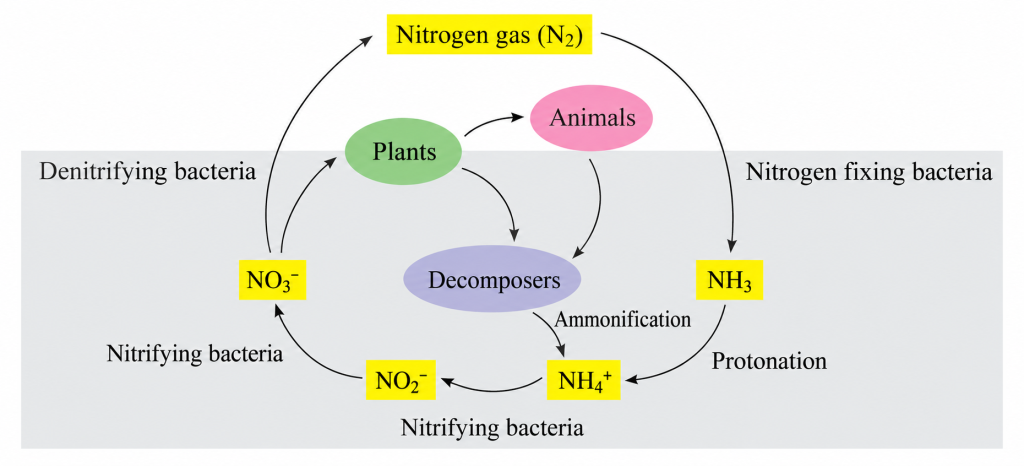
d. Nitrogen cycle
- Components of amino acids, nucleic acids in living organisms.
- Nitrogen fixation: N2 → NH3/NH4+; assimilation: inorganic nitrogen → organic nitrogen in biomass; ammonification: organic nitrogen → NH3/NH4+; nitrification: NH4+ → NO2− → NO3−; denitrification: NO3− → N2.
|
Process and microorganisms |
Functions |
|
Nitrogen fixation (bacteria and archaea) |
• Reduction of N₂ by nitrogen-fixing microbes • N₂ → NH₃, which can form NH₄⁺ in water |
|
Ammonification (decomposer bacteria and fungi) |
• Decomposers convert organic nitrogen from wastes and dead organisms into ammonia (NH3) and ammonium (NH4+). |
|
Nitrification (bacteria and archaea) |
• Oxidation of reduced inorganic nitrogen • NH₄⁺ → NO₂⁻ → NO₃⁻ |
|
Denitrification (mainly bacteria) |
• Reduction of nitrate under low-oxygen conditions • NO₃⁻ → N₂ (through intermediates) |
- Nitrogen cycle
4. Temperature relation
a. Climate
- Microclimate
– Local atmospheric conditions near the ground or around organisms that can differ from the broader regional climate.
– important to individuals of a species.
- Macroclimate
– global or broad regional climate.
– important to distribution patterns of species.
b. Thermoregulation
- Homeothermic animals
– maintaining a relatively stable body temperature.
– e.g., most mammals and birds. Endothermy refers to internal heat production; homeothermy refers to temperature stability.
- Poikilothermic animals
– having a body temperature that varies substantially; this differs from ectothermy (reliance mainly on environmental heat).
– e.g., many reptiles and amphibians, whose temperatures often vary with their surroundings.
5. Water and salt regulation
a. Freshwater fish
- Freshwater fish are hyperosmotic to their surroundings: water enters by osmosis. They excrete abundant dilute urine and actively absorb ions through their gills.
b. Saltwater fish
- Marine bony fish are hypoosmotic to seawater: they lose water by osmosis, drink seawater, excrete excess salts through the gills, and produce relatively little urine.
F. Biosphere
1. Water structure
a. Lake zones
|
Lake zones |
Features |
|
Littoral zone |
• Shoreline areas |
|
Limnetic zone |
• Open surface area away from littoral zone |
|
Photic zone |
• Area exposed to sunlight for photosynthesis • The euphotic zone has sufficient light for net photosynthesis; greater turbidity reduces light penetration and makes this zone shallower. |
|
Aphotic zone |
• Insufficient light for net photosynthesis |
|
Benthic zone |
• Bottom substrate of a lake or other body of water |
b. Marine zones
|
Marine Zones |
Features |
|
|
Littoral zone |
Intertidal zone |
• Alternately exposed to air and submerged by tides • Many different types of organisms • Important area for study of ecology |
|
Neritic zone |
• Coastal ocean waters over the continental shelf, generally extending to depths of about 200 m. • Extends seaward from the low-tide line to the continental shelf edge • Often productive; oxygen and salinity vary with local conditions |
|
|
Photic zone |
Epipelagic zone |
• Approximately 0–200 m; the light boundary varies with water clarity • Most photosynthesis takes place |
|
Aphotic zone |
Mesopelagic zone |
• About 200–1,000 m; dim twilight, generally insufficient light for net photosynthesis |
|
Bathypelagic zone |
• 1000-4000m depth |
|
|
Abyssopelagic zone |
• 4000-6000m depth |
|
|
Hadalpelagic zone |
• Deepest area of marine environment • Below 6000m depth |
|
2. Water relations
a. Rain shadow
- Moist air rises on the windward side of a mountain, expands and cools, causing condensation and precipitation.
- Drier air descends on the leeward side, compresses and warms, lowering relative humidity and creating a rain-shadow region.
- e.g., Death Valley (Sierra Nevada)

b. Seasonal turnover
: in many temperate lakes, spring and autumn mixing redistributes oxygen and nutrients through the water column.
- Seasonal temperature changes weaken stratification, allowing wind-driven mixing.
- Spring turnover
– Surface water warms toward about 4°C, approaches the density of deeper water, and the lake mixes.
- Fall turnover
– Surface water cools toward about 4°C, becomes denser, and wind-driven mixing circulates the lake.
3. Terrestrial biomes
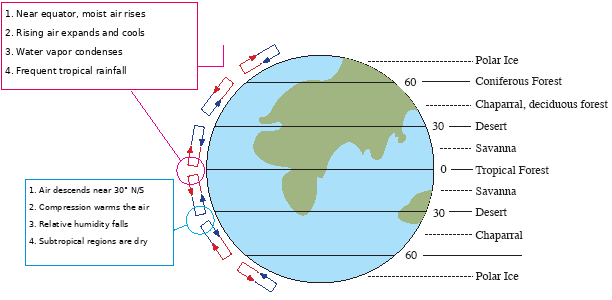
Terrestrial biomes | Main features |
Tropical rain forest | • Very high terrestrial biodiversity; warm temperatures and abundant rainfall • Around region of equator |
Savanna | • Tropical grassland with scattered trees and distinct wet and dry seasons • Seasonal drought and fire help maintain grass-dominated vegetation |
Desert | • Dry places with low precipitation • Water conservation for plants and animals • Succulent plants of shrubs and cacti |
Chaparral | • Hot, dry summers and mild, wet winters • Drought-tolerant evergreen shrubs and small trees |
Temperate grassland | • Seasonal climate; typically cold winters and warm or hot summers • Grasses and herbaceous flowering plants; drought and fire limit trees • Many farmlands |
Temperate deciduous forest | • Hardwood and broad-leaved deciduous forests • Precipitation throughout the year; cold winters and warm summers |
Coniferous forest (Taiga) | • Coniferous trees with needle-like or scale-like leaves • Moderate precipitation, with snow common and summer rainfall in many regions • Long and cold winter • Many large mammals |
Tundra | • Found in far north with low precipitation • Small shrubs or vegetation • Long and cold winter and short and cool summer • Permafrost |
Polar ice | • North and south pole • Generally low precipitation; polar regions are often cold deserts • Limited life of organisms |