

This chapter focuses on atomic structure and gives concise summaries of the important things about ion, atomic mass, and nuclear reactions in more detail.
A. Atomic history
Historic scientists
Features
Dalton
• Atom is the smallest particle and is in the shape of a sphere.
• Elements are composed of atoms.
Thomson
• Discovery of electrons by the experiment of cathode-ray tubes.
• Atom is shaped by distributed positive and negative charges.
Millikan
• Measuring the mass of electron by oil-drop experiment.
Rutherford
• Discovery of nucleus by the experiment of scattering alpha (α) particles.
• Positive charged nucleus is positioned at the center of atom and negative
charged electrons are circling around the nucleus like planets around the sun.
Bohr
• Electrons circling around a nucleus have fixed paths.
• Model for hydrogen (H) atom.
B. Atomic structure
1. Atom
Elements made up of indivisible particles.
Chemical reaction are caused by rearrangement of atoms.
Nucleus (proton +neutron) + Electron.
Fig. 1 Structure of atom
2. Classification of atom
Classification
Features
Proton
• Positive charge.
• Number of protons determines atomic number.
• Distinguishes one element from another.
Electron
• Negative charge.
• Ionic atoms are formed by gaining or losing electron(s).
Neutron
• No charge.
• Affects atomic mass or isotopes.
C. Ion
: atom that has gained or lost electron(s).
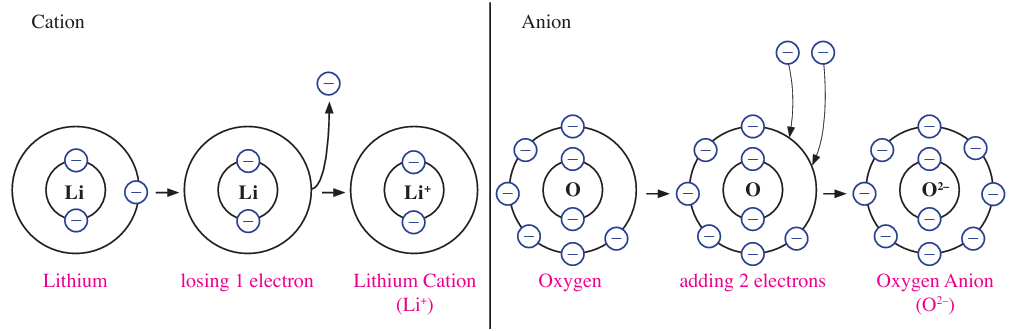
1. Cation and anion
Cation (+ion): an atom that has lost electron(s).
Anion (- ion): an atom that has gained electron(s).
Fig. 2 Cation and anion
2. Isoelectronic
Different atoms but same number of electrons
Ex/ K+ and Ar, F– and Mg2+
** Isotope
Same number of protons but different numbers of mass (neutrons).
Similar chemical character but different physical character.
Used for dating ancient relics or fossil remains.
D. Atomic mass
Classification
Equations and features
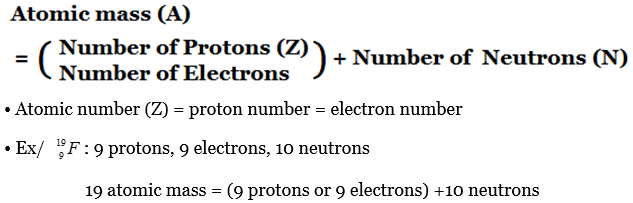
Neutral atom
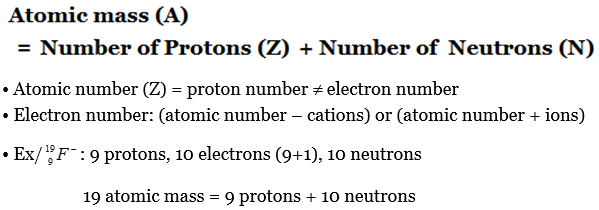
Ionic atom
E. Nuclear reactions
Many nuclides have radioactivity.
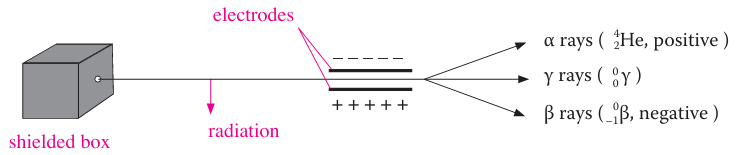
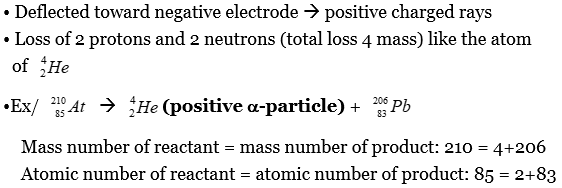
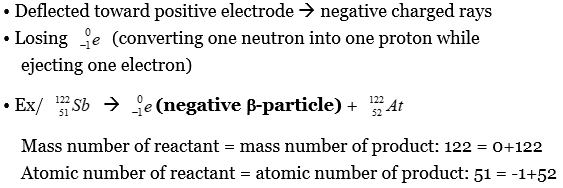
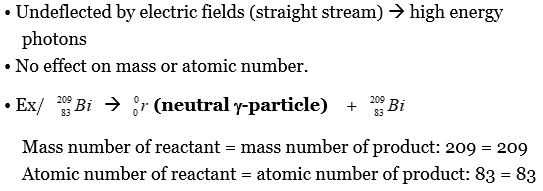
When the radiation emitted from the shielded box passes along with electrodes, the radiation is deflected toward negative electrode (α rays), positive electrode (β rays), or straight direction (γ rays).
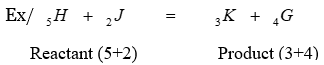
The sum of the reactant mass numbers is equal to the sum of the product mass numbers.
The sum of the reactant proton numbers is equal to the sum of the product proton numbers.