VII. Gases

Key focus of this chapter: ideal gas law

This chapter focuses on the ideal gas law and gives concise summaries of the important things about speed of gases, Dalton’s law of partial pressures, and gas stoichiometry in more detail.

A. Temperature

1. Fahrenheit and Celsius

2. Kelvin and Celsius

B. Gases theory

1. Kinetic molecular theory (ideal gases)

  • No attraction or repulsion between gas molecules
  • Random and straight movement of gas molecules
  • Gas molecules are of negligible size
  • No change of energy from collision of gas molecules (elastic collisions)
  • Temperature is directly proportional to kinetic energy

2. Real gases

  • Do not always behave as predicted by kinetic molecular theory.
  • When P is high and T is low, ideal theory does not apply (because attractive force is occurs between closed gas molecules).
  • Van der Waals equation (interaction of molecules) is a good predictor of behavior of real gases.

C. Gas Laws

1. Symbols of gas laws

     P: Pressure (Pi = initial pressure, Pf = finial pressure)

     V: Volume  (Vi = initial volume, Vf = finial volume)

     n: Number of moles (ni = initial mole, nf = finial mole)

     R: Gas constant

     T: Temperature (Kelvin, K) (Ti = initial temp, Tf = finial temp)

2. STP (Standard Temperature and Pressure for gas)

     T = 273K (0oC)

     P= 1 atm (760 mmHg)

     R = 0.082 (L•atm/mol•K)

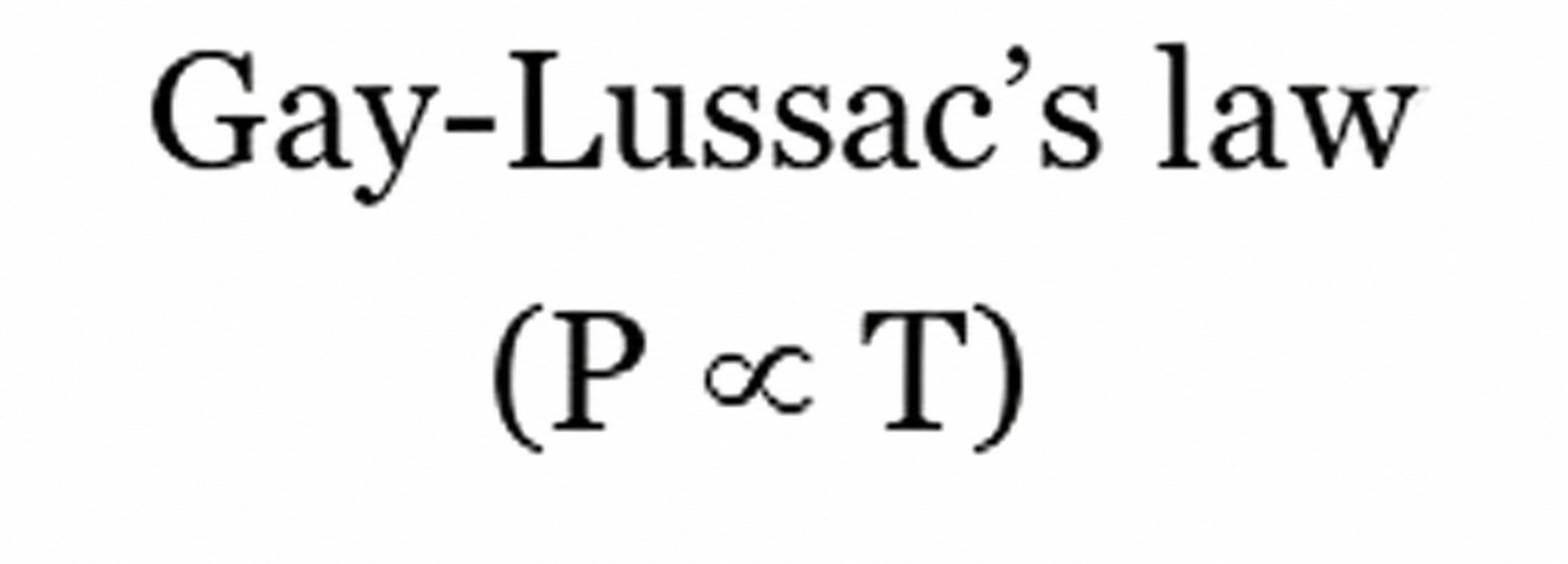
3. Ideal gas laws

Classification

Features and equations

4. Relationships described by ideal gas law

Relationships described by ideal gas law

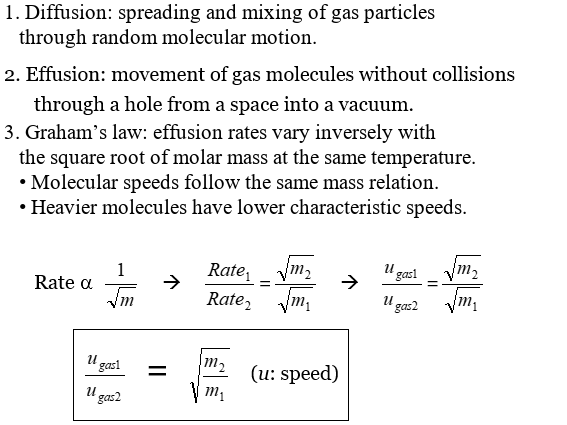
D. Speed of gases

E. Dalton’s law of partial pressures

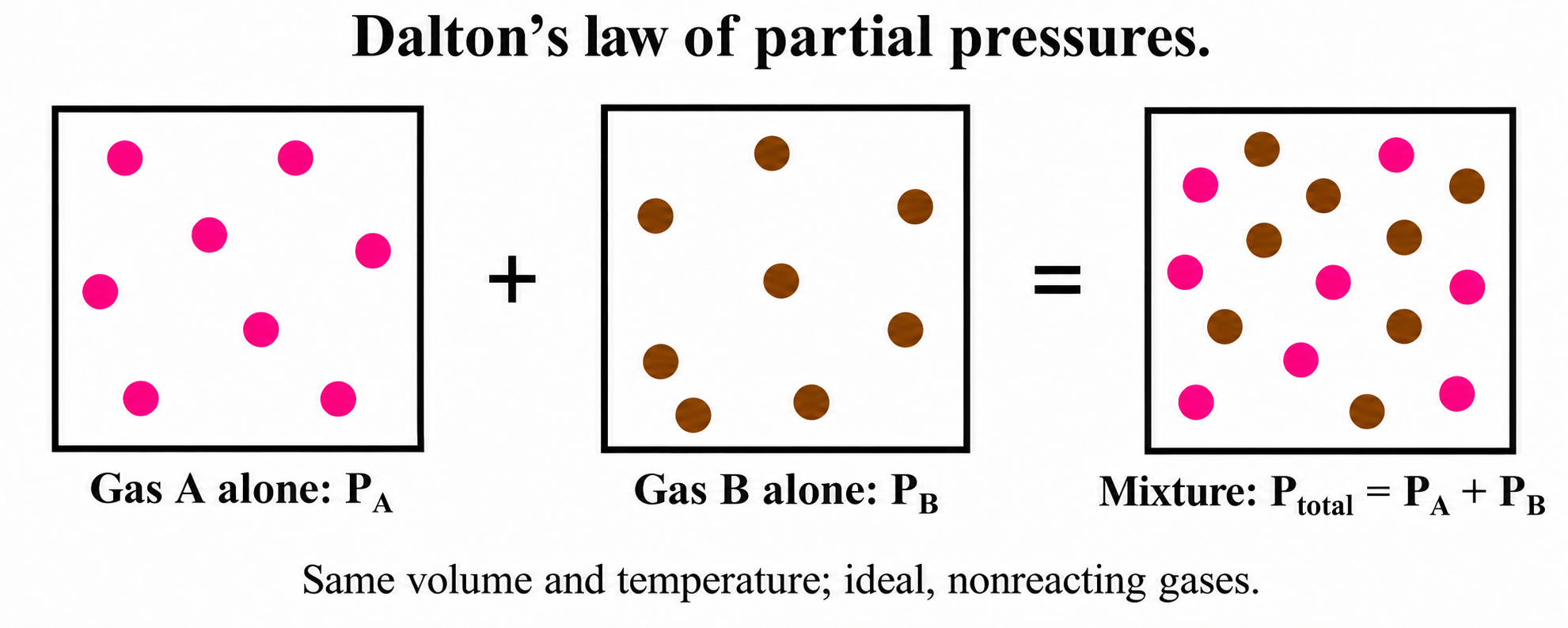
1. Dalton’s Law

: the sum of the pressure of individual gases in separate flasks is equal to the total pressure of the combined gases in a flask.

Ptotal  = PA + PB

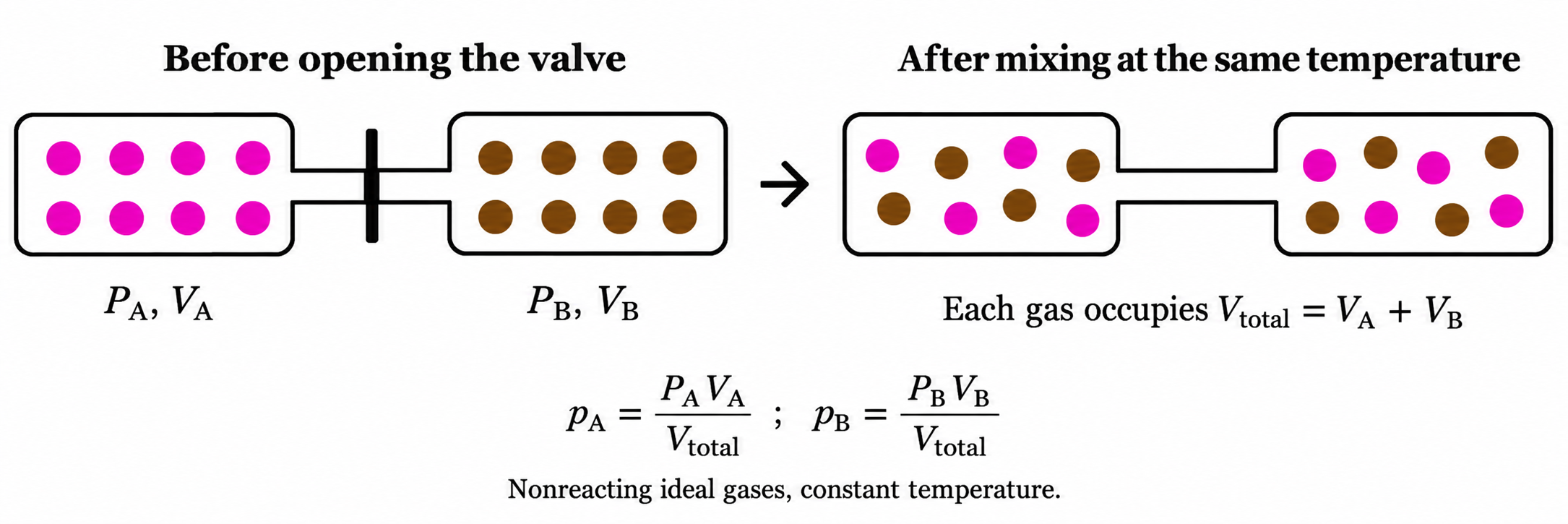
2. Partial pressure and volume

: the sum of the partial pressure of individual gases at opened valve is equal to the total pressure of the mixture of different gases.

3. Mole fraction, X

  • Concentration of an individual gas in a mixture of gases
  • Expression of the mole of the individual gas divided by the total mole of the gas mixture

4. Partial pressure and mole

: partial pressure A in a gas mixture is expressed by mole fraction (XA) multiplied by the total pressure of the gas mixture.

F. Gas stoichiometry

: ideal gas law (PV = nRT) is applied to stoichiometry.

  • Qs/ When 5 mole of A is reacted with an excess of B, the volume of 6L of D is produced at 27 oC. Calculate the pressure of D.

     2A(g) + B(g)  →   3C(g) + 4D(g)