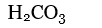
III. Compound theory
Key focus of this chapter: naming chemical compounds
This chapter reviews compound naming and the key principles of bonding, molecular geometry, intermolecular forces, magnetism, and crystal structures.
A. Naming chemical compounds
1. Naming oxoanions (atom + oxygen(s))
The hypo-/per- and -ite/-ate naming patterns apply to related oxoanions of the same central element, such as the chlorine oxyanion series. The number of oxygen atoms alone does not universally determine the name of an oxoanion.
Number of oxygen atom(s) | Prefix | Suffix | Examples |
One | Hypo - | - ite | |
Two | - ite | ||
Three | - ate | ||
Four | Per - | - ate |
2. Naming acids
a. Oxoacids (hydrogen + oxoanion)The corresponding hypo-/per- and -ous/-ic acid patterns apply within an oxoacid series of the same central element, such as the chlorine oxoacids shown below. Oxygen count alone does not universally determine an oxoacid name.
Number of oxygen atom(s) | Prefix | Suffix | Examples |
One | Hypo - | - ous acid | |
Two | - ous acid | ||

Three | - ic acid | ||
Four | Per - | - ic acid |
** H2SO3 : Sulfurous acid
H2SO4 : Sulfuric acid
H3PO4 : Phosphoric acid
b. Hydrogen + anion
Prefix | Suffix | Examples |
Hydro - | - ic acid | HCl(aq): hydrochloric acid HBr(aq): hydrobromic acid HI(aq): hydroiodic acid HCN(aq): hydrocyanic acid |
3. Table of naming polyatomic anions and acids
The acid formulas correspond to complete protonation of the listed anions. H2O2 is hydrogen peroxide, not an ordinary oxoacid named by changing -ate to -ic or -ite to -ous.
Poly atomic anions | Acids | |||
Single charged anions | Hydrogen carbonate (bicarbonate) | Carbonic acid | ||
Hydrogen sulfate (bisulfate) | Sulfuric acid | |||
Dihydrogen phosphate | Phosphoric acid | |||
Acetate | Acetic acid | |||
Cyanide | Hydrocyanic acid | |||
Nitrite | Nitrous acid | |||
Nitrate | Nitric acid | |||
Hydroxide | ||||
Hypochlorite | Hypochlorous acid | |||
Chlorite | Chlorous acid | |||
Chlorate | Chloric acid | |||
Perchlorate | Perchloric acid | |||
Permanganate | Permanganic acid | |||
Hypobromite | Hypobromous acid | |||
Bromite | Bromous acid | |||
Bromate | Bromic acid | |||
Perbromate | Perbromic acid | |||
Double charged anions | Hydrogen phosphate | Phosphoric acid | ||
Carbonate | Carbonic acid | |||
Chromate | Chromic acid | |||
Dichromate | Dichromic acid | |||
Peroxide | Hydrogen peroxide | |||
Sulfite | Sulfurous acid | |||
Sulfate | Sulfuric acid | |||
Thiosulfate | Thiosulfuric acid | |||
Triple charged anions | Phosphate | Phosphoric acid | ||
** NH4+: Ammonium
4. Naming compounds
Fig. 1 Classification of groups
Combinations | Naming compounds | |
![]() | ||
![]() | ![]() | |
![]() | ||
![]() | ![]() | |
![]() | ![]() | |
B. Chemical bonds
Chemical Bonds | Features |
Ionic bonds | ![]() |
Metallic bonds | ![]() |
Covalent bonds (molecules) | ![]() |
C. Covalent bond
1. Electronegativity (EN)
- Electronegativity is the tendency of an atom in a chemical bond to attract the shared electrons toward itself.
- Atoms with high electronegativity strongly attract bonding electrons. Electronegativity is related to, but distinct from, electron affinity.
- A greater electronegativity difference generally produces a more polar bond. Molecular polarity also depends on molecular geometry.
- In the same period, electronegativity generally increases as the atomic number increases.
- In the same group, electronegativity generally decreases as the atomic number increases.
2. Polar and nonpolar covalent bond
Classification | Features |
Polar covalent bond | • Bond polarity depends primarily on the electronegativity difference between bonded atoms. • Molecular polarity depends on both bond dipoles and molecular geometry. Polar bonds do not necessarily produce a polar molecule. |
Nonpolar covalent bond | • Identical atoms have zero electronegativity difference: H₂, F₂, and Cl₂ have nonpolar covalent bonds. • C–H bonds are often treated as nearly nonpolar. |
- Ex/ The order of polarity between two atoms:
![]() |
HF has a polar covalent bond, C–H bonds are often treated as nearly nonpolar, and F2 has a nonpolar covalent bond. NaF and LiF are ionic compounds. Bond polarity depends primarily on electronegativity difference; molecular polarity depends on both bond dipoles and molecular geometry. Polar bonds do not necessarily produce a polar molecule.
3. Dipole moments of polar and nonpolar molecules
Classification | Features |
Polar molecules | ![]() |
Nonpolar molecules | ![]() |
4. Molecular forces (van der Waals force)
: attractive forces between molecules
Classification | Features |
London dispersion force | London dispersion forces arise from instantaneous and induced dipoles and occur in all atoms and molecules. Strength depends on polarizability and molecular contact area; it often increases with size within related series. Boiling points reflect all intermolecular forces. |
Dipole-dipole force | Dipole–dipole interactions occur between permanent molecular dipoles. Strength depends on dipole magnitude, orientation and separation. Comparisons of boiling points must also account for dispersion and other interactions. |
Hydrogen bond | Hydrogen bonding occurs when H bonded to N, O or F interacts with a lone pair on a neighboring atom. Its strength depends on geometry and environment; there is no universal N–H / O–H / F–H strength ranking. Examples: H₂O, HF, NH₃. |
Ion-dipole |
For molecules of comparable size and polarizability, dipole–dipole attractions and hydrogen bonding can strengthen intermolecular attraction beyond dispersion alone. The familiar London dispersion < dipole–dipole < hydrogen-bonding comparison is a useful guideline, not a universal ranking of substances.
Boiling-point examples: CH₄ < SiH₄ < GeH₄ < SnH₄: increasing size and polarizability strengthen dispersion. H₂S < H₂Se < H₂Te: increasing dispersion dominates. All are polar; this is not a ranking of dipole–dipole interactions alone. HF < H₂O: combined forces and hydrogen-bond network connectivity determine boiling points; this is not a universal hydrogen-bond strength order. |
Boiling points depend on the combined effects of intermolecular forces, including London dispersion forces, dipole–dipole interactions, and hydrogen bonding when applicable. Molecular size, polarizability, and molecular structure also influence these properties. Melting points additionally depend strongly on crystal packing.
In HCl, HBr, and HI, permanent dipole moments decrease in the order HCl > HBr > HI, while polarizability and dispersion contributions increase in the order HCl < HBr < HI. Their boiling points increase HCl < HBr < HI because the increasing dispersion contribution outweighs the decreasing dipole contribution. Their melting points follow the same order in this series; this does not establish a universal rule for melting points.
** Other covalent bonds
Diatomic molecules | ![]() |
Coordinate covalent | ![]() |
Covalent network solid | ![]() |
5. Octet rule
: atoms in the main group tend to be positioned with 8 electrons in their outmost shell like noble gases.
a. Valence electron:
- Electrons of atoms in the outermost shell
- Forming covalent bonds
- Main factor to distinguish the chemical properties of atoms
- Ex/
Atoms | Number of valence electrons | Forming bonds |
C N O F | 4 5 6 7 | 4 3 2 1 |
b. Lewis structure
- Repulsive and attractive forces make optimum distance between two atoms
– repulsive forces between two different atom’s electrons
– attractive forces between one atom’s electrons and another atom’s nucleus
- Indicating covalent bonds
– double bonds by sharing 4 electrons (2 pairs): CO2, O2
– triple bonds by sharing 6 electrons (3 pairs): HCN, N2
c. Exception to octet rule
- Some atoms (Be, B, Al) have less than 8 electrons in their outermost shell.
- Some atoms (past the second row in the periodic table: Si, P, Ge, Sn,…), have more than 8 electrons in their outermost shell.
Fig. 3 atoms that are exceptions to the octet rule
- Some molecules involving third-period or heavier central atoms are represented by expanded-octet Lewis structures. However, significant participation of low-energy d orbitals is not required to explain their bonding. Modern bonding descriptions use delocalized molecular orbitals and other models.
XeF4 has 36 valence electrons: four Xe–F bonds, two lone pairs on Xe, and three lone pairs on each F. All formal charges are zero. The electron-domain geometry is octahedral and the molecular geometry is square planar; the sketch below omits the terminal F lone pairs.
![]() |
6. VSEPR-Valence shell (valence-shell electron-pair repulsion model)
: electrons will be positioned as far as possible from one another to maintain a stable state of molecular geometry by the repulsive forces.
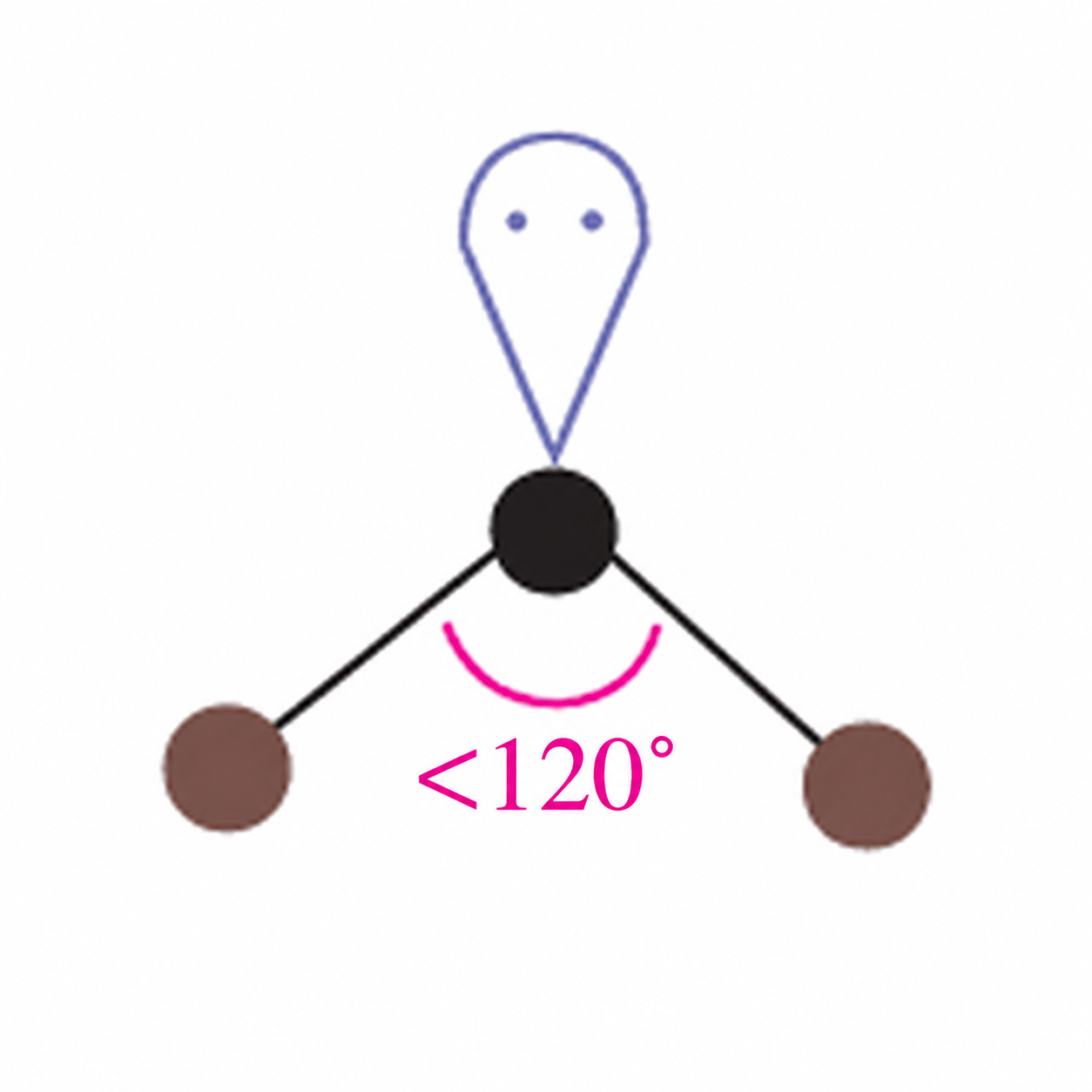
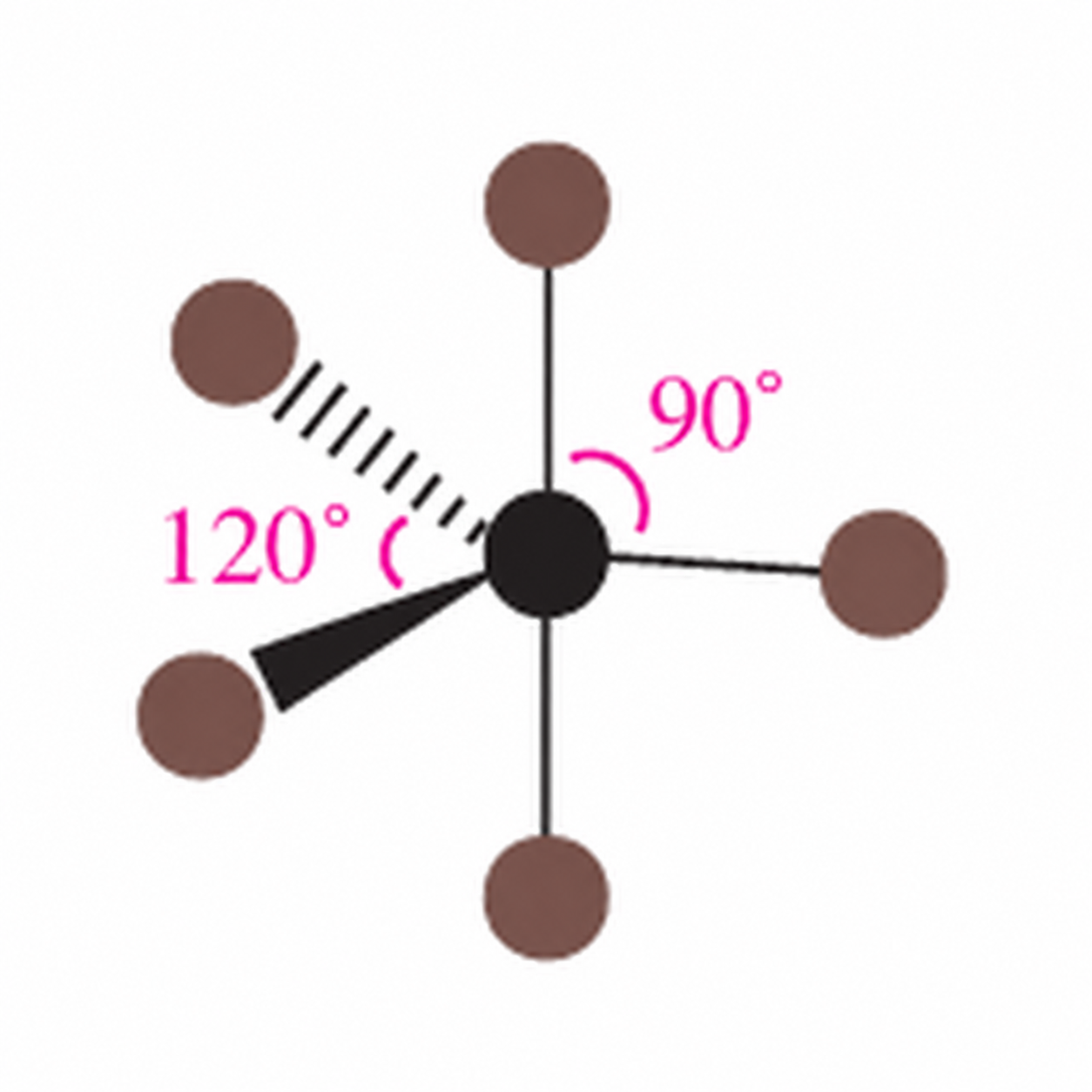
Count electron domains around the central atom: every single, double or triple bond counts as one bonding domain, and each lone pair counts as one domain. The table distinguishes molecular geometry from electron-domain geometry; ideal angles may be distorted by lone pairs and the identities of surrounding atoms.
Molecular shapes | Molecular geometry | Examples | Features |
Linear |
|
|
|
|
|
| |
Trigonal planar |
|
|
|
Bent |
|
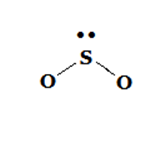
| Bond angle <120° (SO₂: about 119°) 2 bonding domains 1 lone pair Example: SO₂ |
|
| Bond angle <109.5° 2 bonding domains 2 lone pairs H₂O: 104.5°; H₂S and H₂Te are closer to 90°. | |
Tetrahedral |
|
| Ideal bond angle: 109.5° 4 bonding domains 0 lone pairs Examples: SiH₄, CH₄, NH₄⁺, carbon in diamond |
Trigonal pyramidal |
|
|
|
Trigonal bipyramidal |
|
|
|
Seesaw |
|
| Distorted trigonal bipyramidal geometry Angles usually <90° and <120° 4 bonding domains 1 equatorial lone pair Examples: SF₄, IF₄⁺ |
T-shaped |
|
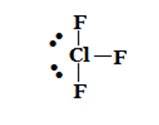
| Angles approximately 90° and 180° (often compressed) 3 bonding domains 2 equatorial lone pairs Example: ClF₃ |
Octahedral |
|
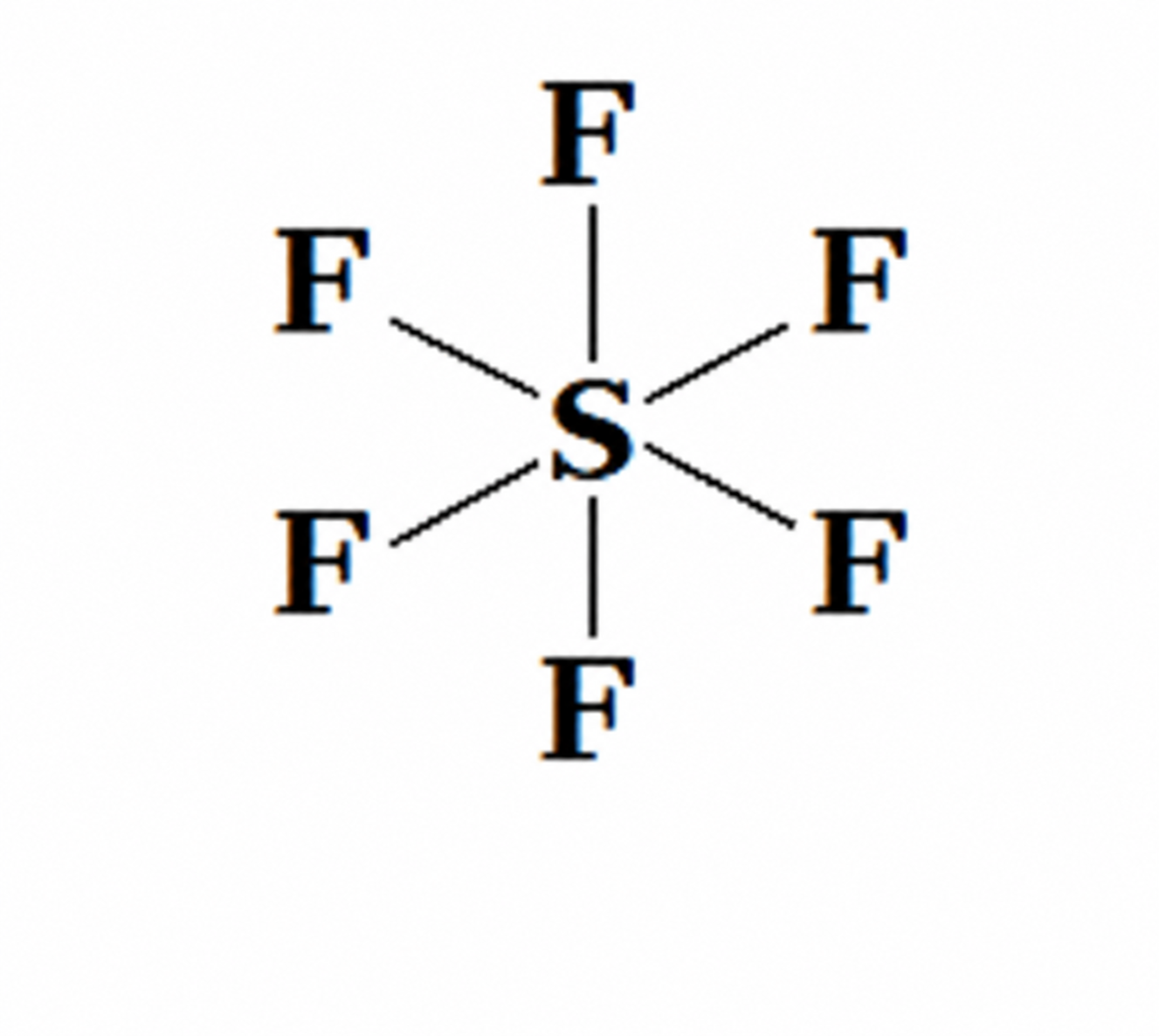
| Ideal angles: 90° and 180° 6 bonding domains 0 lone pairs Example: SF₆ |
Square pyramidal |
|
|
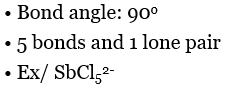
|
Square planar |
|
|
|
7. Formal charges
Formal charge is the charge assigned to an atom when bonding electrons are shared equally.
Formal charge = valence electrons − nonbonding electrons − ½(bonding electrons).
In the examples below, “binding number” means bond-order sum, equal to half the number of bonding electrons.
![]() |
![]() |
Atoms | Number of valence electrons | Binding number | Number of non-bonding electrons |
N | 5 | 3 | 2 |
C | 4 | 4 | 0 |
S | 6 | 1 | 6 |
Formal charge of N: 5 −3 − 2 = 0
Formal charge of C: 4 − 4 − 0 = 0
Formal charge of S: 6 − 1 − 6 = -1
8. Hybridization
Hybridization is a bonding model in which atomic orbitals on the same atom are mathematically combined to form hybrid orbitals with specific spatial orientations.
a. Sigma(σ) bond
- Axis bond by head-on orbital overlap
- Straight orbital overlap
- Round shape by vertical section
- Occupying maximum 2 electrons
b. Pi(π) bond
- Sideways overlap
- Dumbbell-shape by vertical section
- Weaker than sigma(σ) bond
c. Application
- Single bond: 1 sigma bond and 0 pi bond
- Double bond: 1 sigma bond and 1 pi bond
- Triple bond: 1 sigma bond and 2 pi bonds
d. Hybrid orbitals
Count electron domains: each single, double, or triple bond counts as one domain, and each lone pair counts as one. The traditional sp3d and sp3d2 labels describe five- and six-domain geometries; they do not imply that substantial d-orbital hybridization is required for hypervalent bonding.
Classification | Total number of bonds & lone pairs | Shape of molecules | Examples |
• Linear | |||
• Bent • Trigonal planar |
| ||
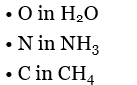
• Bent • Trigonal pyramidal • Tetrahedral |
| ||
• Linear • Seesaw • T-Shaped • Trigonal bipyramidal | Xe in XeF₂ S in SF₄ Cl in ClF₃ P in PCl₅ | ||
• Octahedral • Square Pyramidal • Square Planar | S in SF₆ Sb in SbCl₅²⁻ Xe in XeF₄ |
- Ex/
BF3 : 3 bonds and 0 lone pair → 3+0=3 → sp2 types of orbital
NH3: 3 bonds and 1 lone pair → 3+1=4 → sp3 types of orbital
9. Resonance
Resonance occurs when a single Lewis structure cannot adequately represent the electron distribution in a molecule or ion. Resonance contributors differ in electron placement, not in the positions of atomic nuclei. The actual structure is a resonance hybrid with delocalized electrons.
- Electron delocalization can stabilize a molecule or ion. The importance and relative energies of valid contributors matter; merely drawing more structures does not guarantee greater stabilization.
- Contributors preserve total charge, electron count, and nuclear positions; major contributors generally favor complete octets and reasonable formal charges.
- Examples: O3, OCN−, and NO3−. Ozone has two equivalent major contributors, nitrate has three, and cyanate has nonequivalent contributors with different weights.
D. Magnetism
Magnetism | Features |
Ferromagnetism | Ferromagnetism: cooperative alignment of magnetic moments produces spontaneous magnetization within domains. An applied field can align domains, giving a strong positive response. Magnetization can remain after the field is removed. |
Paramagnetism | Paramagnetism: unpaired electrons give a weak attraction to an applied magnetic field (positive susceptibility), without ferromagnetic long-range alignment. Induced magnetization disappears when the field is removed. Examples: O₂, Al. |
Diamagnetism | Diamagnetism: an applied field induces a weak opposing response (negative susceptibility). Diamagnetic contributions occur in all materials; substances with all electrons paired are usually diamagnetic. Examples: N₂, F₂, Cu. |
E. Unit cells
A unit cell is a repeating region that generates a crystal structure by translation in three dimensions. A crystal structure consists of a lattice and its associated atomic basis.
Diamond has a diamond cubic crystal structure consisting of a face-centered cubic Bravais lattice with a two-atom basis. Its conventional cubic unit cell contains eight carbon atoms.
Unit Cell | Number of atom(s) per unit cell | Features |
Primitive cubic (Simple cubic) | 1 | • 1/8 of each atom in unit cell • Ex/ Polonium |
Body-centered cubic | 2 | • 1 atom at center with 1/8 of each corner atom • Ex/ Tungsten, iron, sodium |
Face-centered cubic | 4 | • 1/2 of each face-centered atom with 1/8 of each corner atom • Ex/ Copper, silver, gold, nickel, lead |