II. Orbital and Periodicity

Key focus of this chapter: periodic table with groups

This chapter focuses on the periodic table and its groups and gives concise summaries of the important things about orbital theory, shapes of orbitals, rules of filling up electrons in orbitals, quantum numbers, electron configuration, atomic radius, ionization, and electron affinity in more detail.

A. Orbital theory

1. Bohr’s atomic model

  • Model for the hydrogen atom.
  • In Bohr’s model of hydrogen, electrons occupy specific quantized circular orbits. In the modern quantum-mechanical model, orbitals describe the probability distribution of electrons rather than fixed paths.
  • Hydrogen energy levels increase with n: K(n=1) < L(n=2) < M(n=3) < N(n=4). The spacing between successive energy levels decreases as n increases.

Fig. 1 Bohr’s atomic model

• Energy changes during transitions between energy levels

Classification

Features

Ground state

electrons

• Lowest-energy state of an atom

• When ground state electrons at a lower shell go to the higher shell, energy is absorbed.

  K (n=1) → L (n=2)

Excited state

electrons

• Higher-energy state of an atom

• When excited state electrons at a higher shell go to the lower shell,

  energy is emitted.

L (n=2) → K (n=1)

Fig2. Ground and excited state electrons

2. Lyman, Balmer, and Paschen series

Classification

Features

Lyman series

• When excited state electrons at a high shell go down to K (n=1) shell,

  energy is emitted.

• Ultraviolet region

Balmer series

• When excited state electrons at a high shell go down to L (n=2) shell,

  energy is emitted.

• Visible region

Paschen series

• When excited state electrons at a high shell go down to M (n=3) shell, energy is emitted.

• Infrared region

3. Modern atomic model

The quantum-mechanical model extends beyond the limitations of Bohr’s model.

a. Orbital theory

  • An orbital describes an electron’s probability distribution around the nucleus, rather than a fixed path.
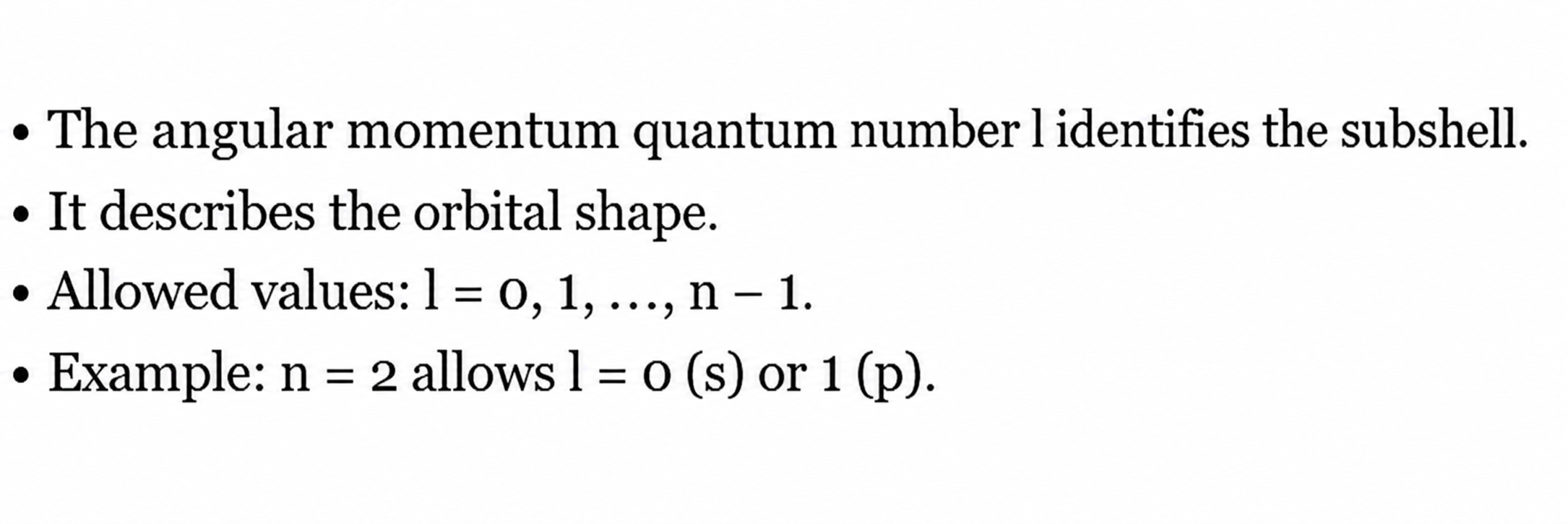
  • Each shell contains subshells (s, p, d, f, …), with allowed values l = 0, 1, …, n − 1. Each subshell contains one or more orbitals.

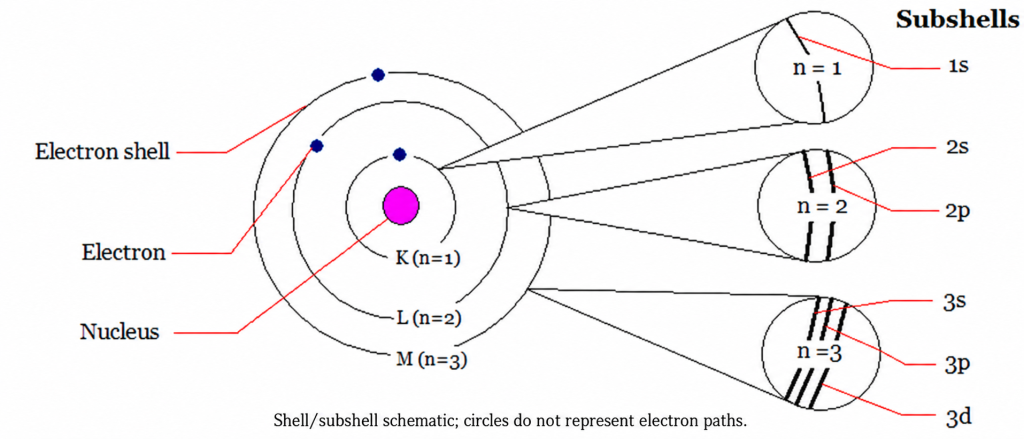
b. Electron shells and orbitals

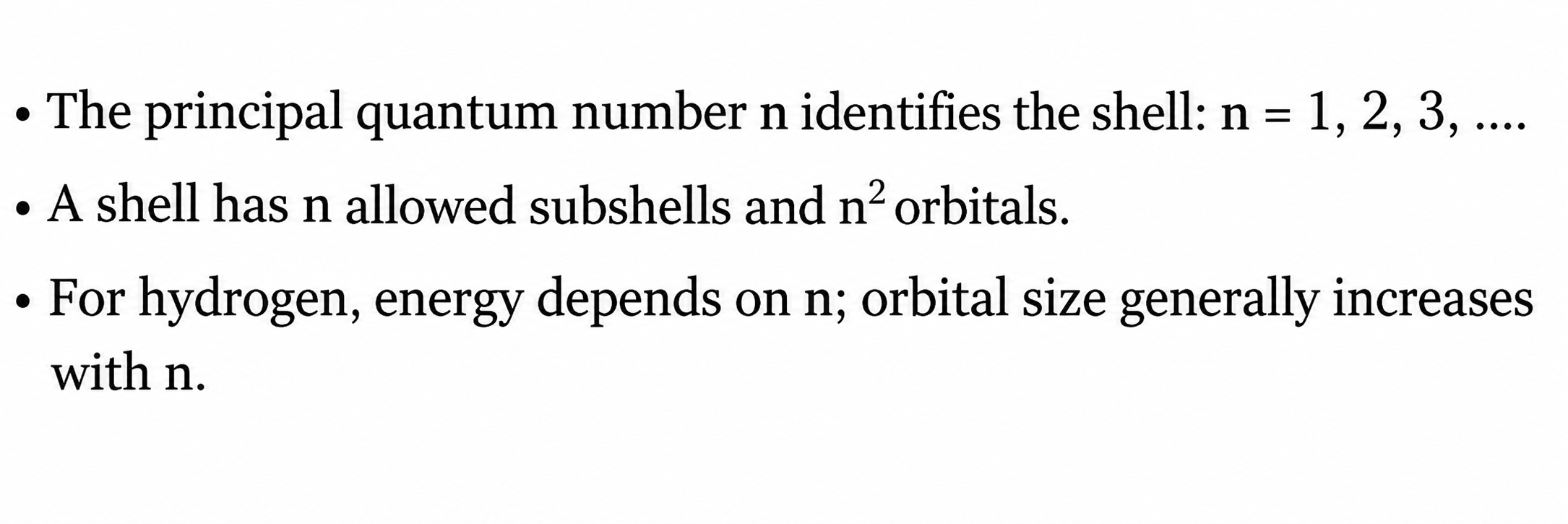
  • A shell with principal quantum number n contains n subshells and n2 orbitals, with a maximum capacity of 2n2 electrons.

Electron shells

Subshells

n= 1

1s

n=2

2s

 2p

n=3

3s

 3p

 3d

Fig. 3 Modern atomic model

B. Shapes of orbitals

Classification

Features

s orbitals

• Spherical shape

• For a given shell, s orbitals penetrate closest to the nucleus

• Spherically symmetric; no preferred spatial orientation

• Magnetic quantum number, ml =0

• Orbital holds 2 electrons → 1×2 = 2 electrons in s orbitals

p orbitals

• Dumbbell shape

• 3 orientations of X, Y, or Z coordinate axes →  px, py, or pz

• Magnetic quantum number, ml = -1, 0, +1

• Each orbital holds 2 electrons → 3×2 = 6 electrons in p orbitals

d orbitals

• Usually have a cloverleaf shape

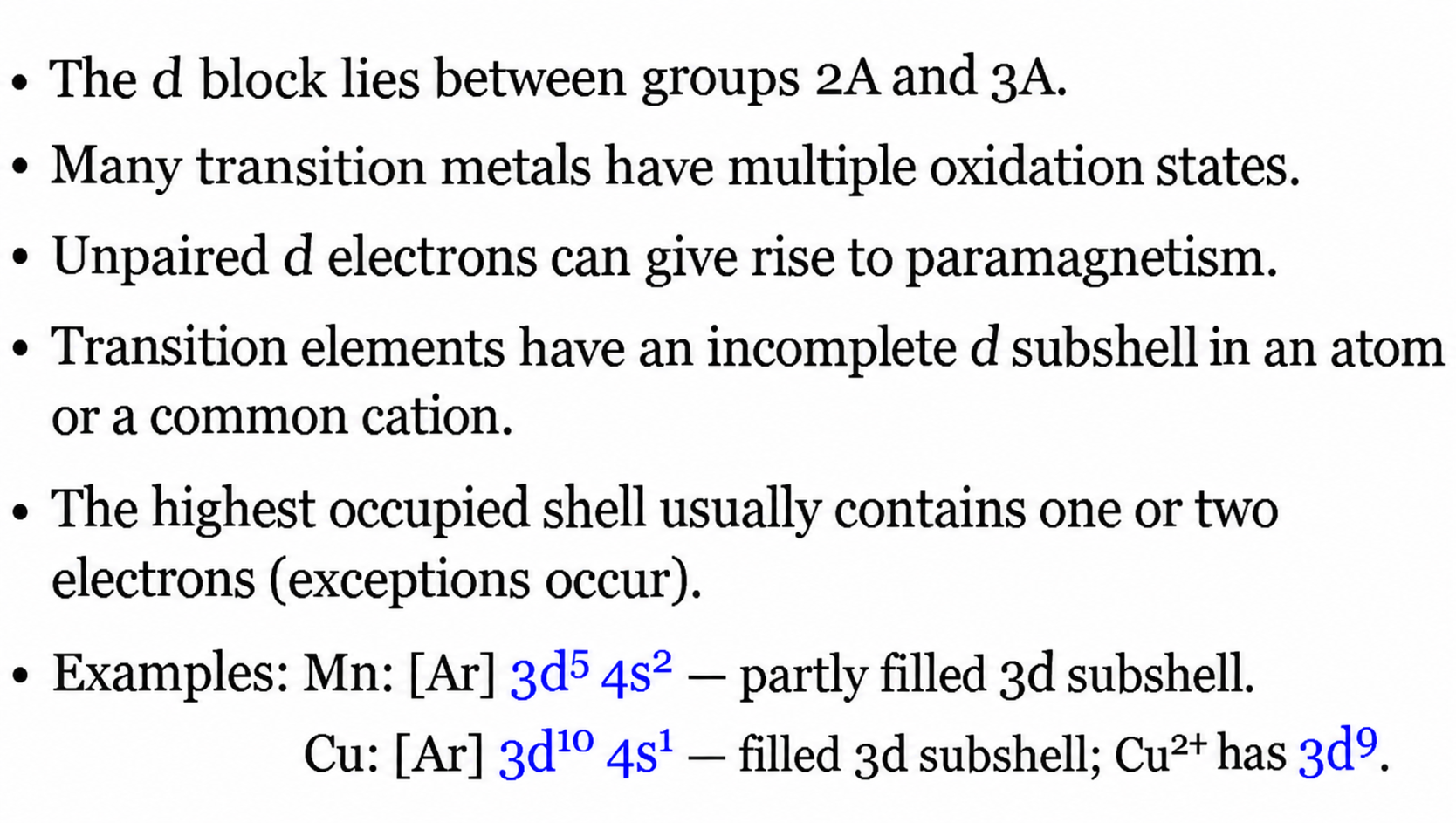
• Five d orbitals: dxy, dxz, dyz, dx2−y2, dz2

• Each orbital holds 2 electrons → 5×2 = 10 electrons in d orbitals

• The d block includes the transition-metal region of the periodic table

f orbitals

• f subshells contain seven orbitals with complex shapes.

• Each orbital can hold two electrons, giving a maximum of 14 electrons.

C. Rules of filling up electrons in orbitals

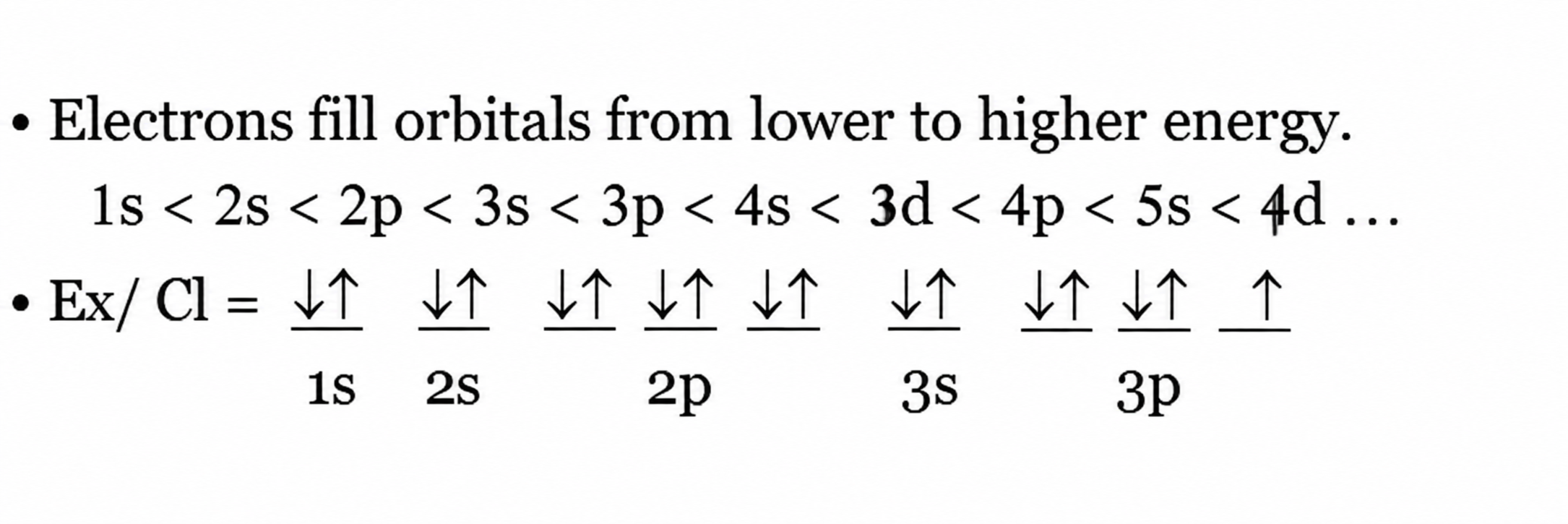
Electrons are represented by arrows (↓, ↑) in orbital filling diagrams.

Classification

Features

Pauli exclusion principle

Hund’s rule

Filling order of different orbitals

D. Quantum numbers

Three quantum numbers (n, l, ml) specify an atomic orbital. A fourth quantum number (ms) specifies the spin projection of an electron.

ms = +½ or −½

Classification

Features

The principal quantum

 number (n), shell

Angular-momentum quantum number, subshell (l)

Magnetic quantum

 number (ml)

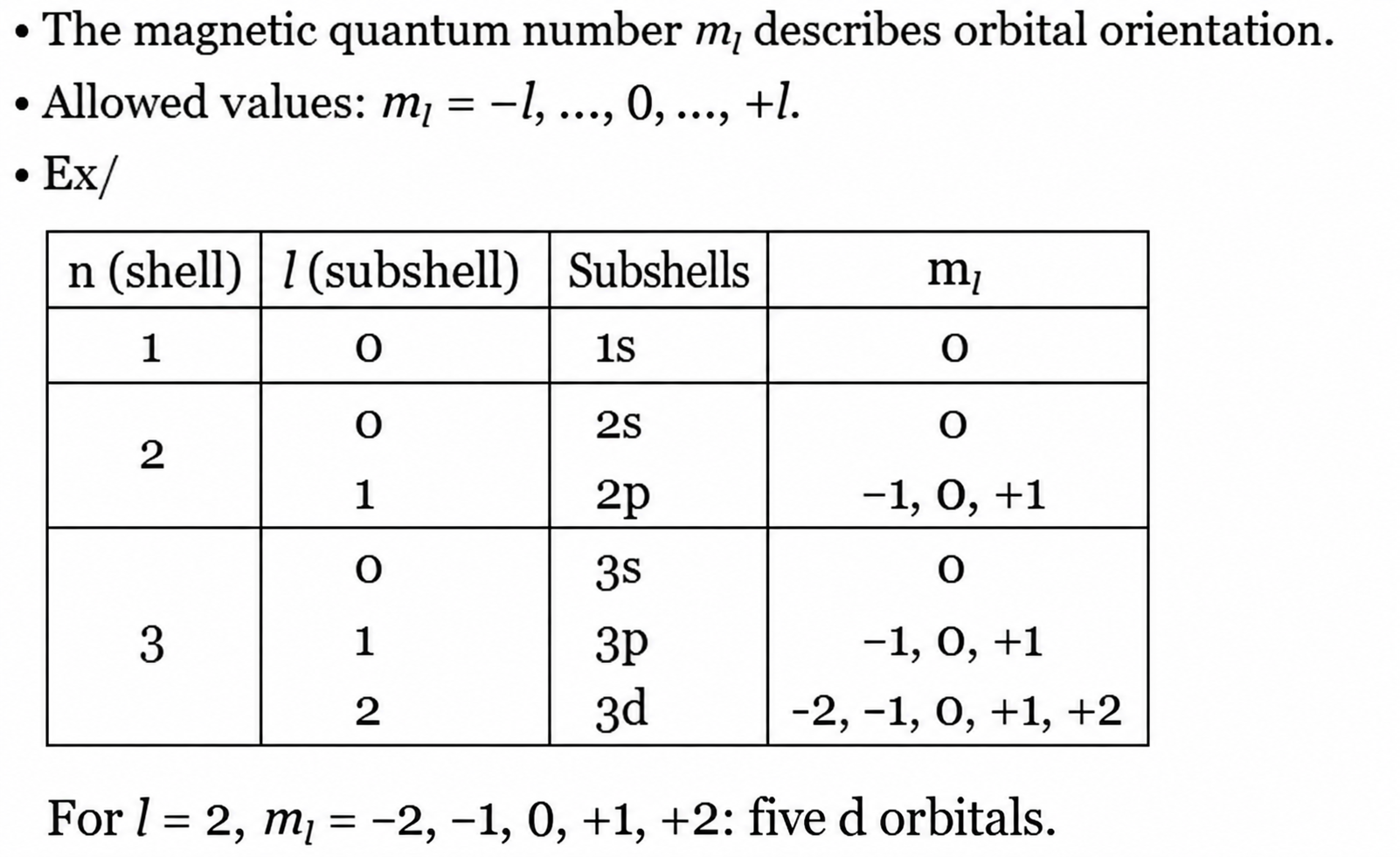
• Combined quantum numbers (n, l, ml)

Principal

quantum number

 n

Angular momentum quantum number

    l

Orbital

notation

Magnetic quantum

number

 ml

Number of

orbital(s) in

subshell

Maximum electrons in shell (2n2)

1

0

1s

0

1

2

 0

  1

2s

 2p

 0

  -1, 0, +1

1

 3

3

0

1

 2

3s

3p

3d

0

 -1, 0, +1

  -2, -1, 0, +1, +2

1

 3

  5

4

0

1

 2

 3

4s

4p

4d

4f

   1

    3

    5

    7

E. Electron configuration

1. Filling order of electrons in orbitals (from low to high energy)

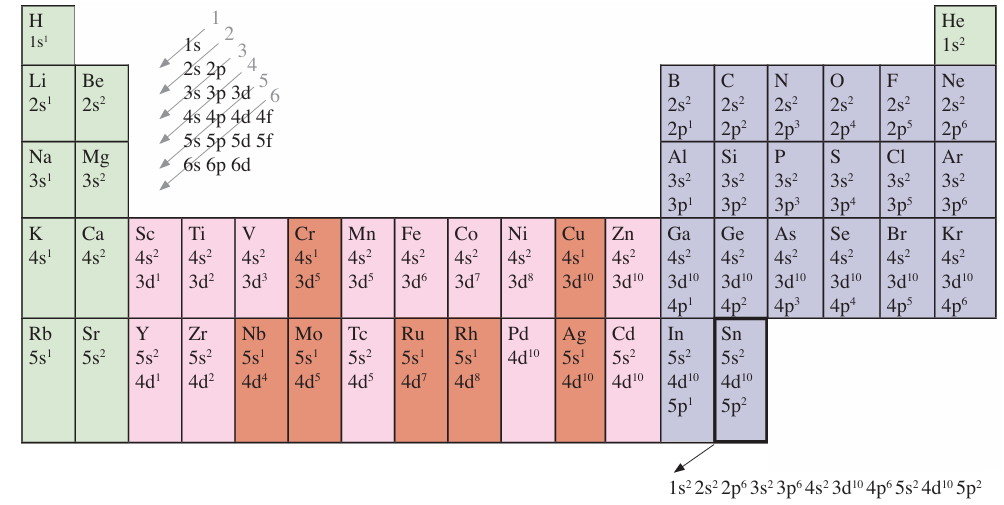
1s → 2s → 2p → 3s → 3p → 4s → 3d → 4p → 5s → 4d → 5p → ….

Fig. 4 Subshell blocks in the periodic table

2. Electron configuration

Electron configuration describes how electrons are distributed among atomic orbitals.

Ground state electron configuration

Shorthand electron configuration

Orbital filling diagrams

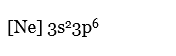
Be

Ar

V

Fig. 5 Ground state electron configuration in the periodic table

** Exceptional atoms of electron configuration

Cr, Cu, Nb, Mo, Ru, Rh, Pd, Ag (dark red color above)

       Ex/ Cr: 1s22s22p63s23p64s23d4 (X)  →  1s22s22p63s23p64s13d5 (O)

           Cu: 1s22s22p63s23p64s23d9 (X)  →  1s22s22p63s23p64s13d10 (O)

F. Application of electron configuration

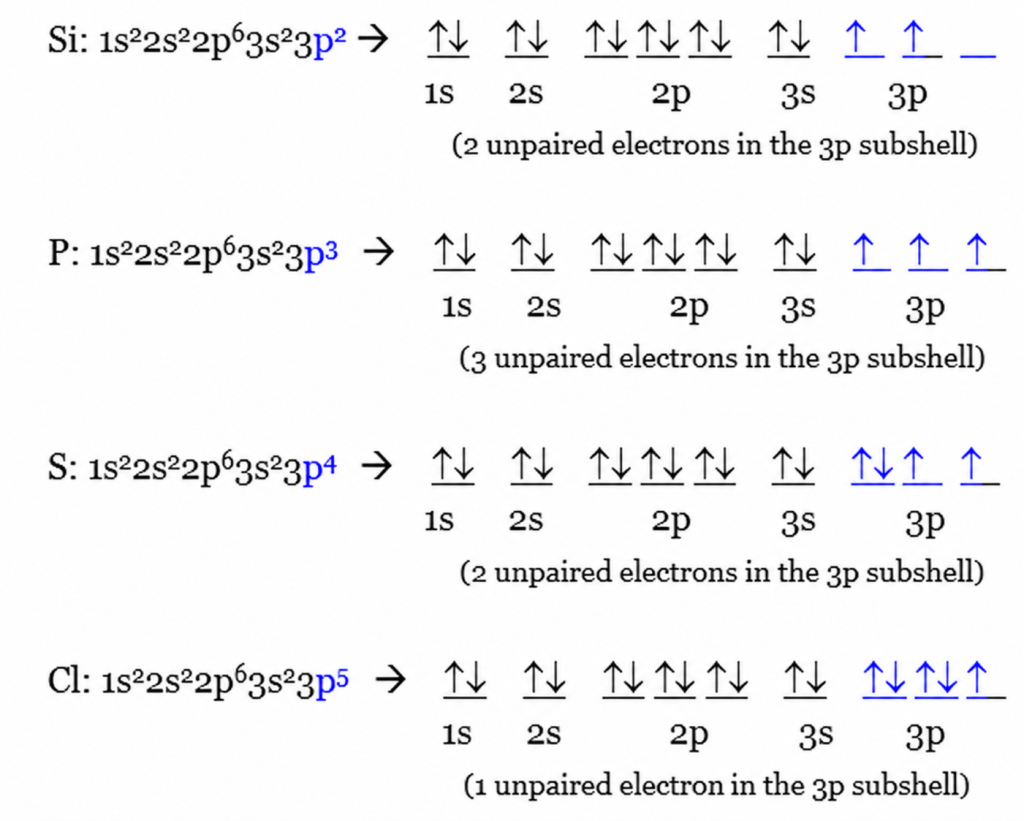
1. Counting unpaired electrons: electrons in singly occupied orbitals

2. Ground state and excited state

  • Ground state: the lowest-energy electron configuration.
  • Excited state: a higher-energy configuration formed by promoting an electron to a higher-energy orbital.

G. Electromagnetic spectrum

1. Light

  • Classified by wavelength (λ)
  • All electromagnetic waves travel at approximately 3.00 × 10⁸ m/s in vacuum. Their speed can differ in other media.
  • Frequency (ν): number of wave peaks per second (hertz, Hz, s-1)

** Photoelectric effect: electrons are emitted from a metal surface when incident photons have sufficient energy.

2. Energy (E)

  • Long wavelength → low frequency → low energy
  • Short wavelength → high frequency → high energy
  • Ex/ Gamma rays → short wavelength → high energy

3. General order of photon energies

Spectral ranges can overlap.

H. Periodicity

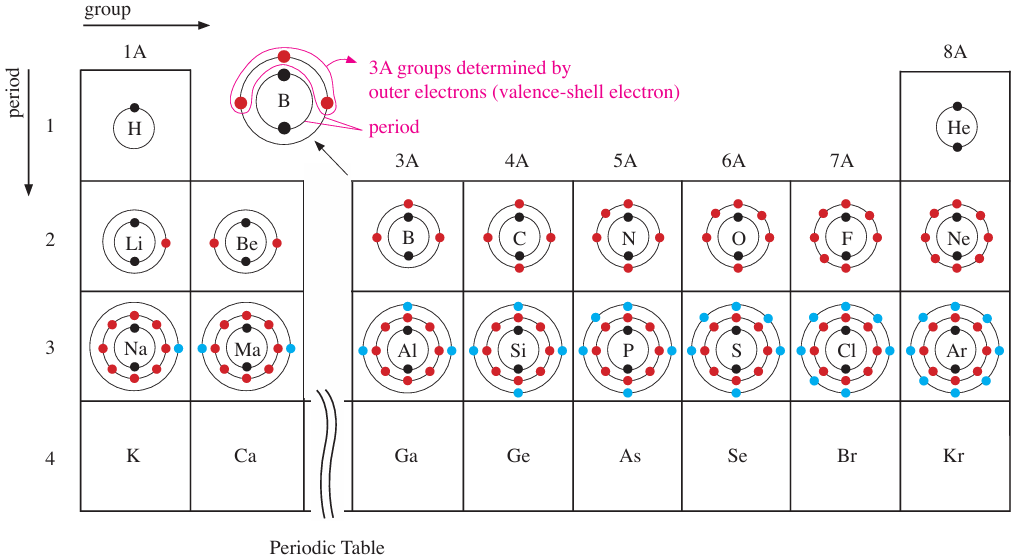
1. Periods

  • Seven horizontal rows (periods 1–7).
  • For main-group elements, the period indicates the principal quantum number of the valence shell.

2. Groups

  • 18 columns (1A – 8A, 1B –8B)
  • For main-group elements, members of the same group generally have the same number of valence electrons and similar chemical properties.

 Ex/ Be, Mg, and Ca (group 2A) have similar chemical characteristics (they have 2 outermost electrons).

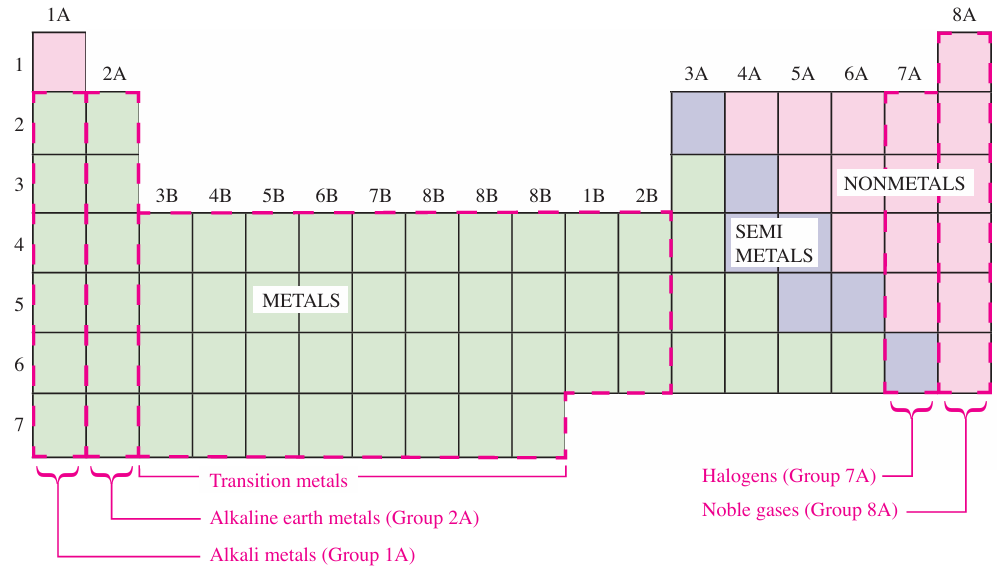
Fig. 6 Periods and groups

periodic table with groups

a. Metal and nonmetal

Classification

Characteristics

Metal

• Many metals lose electrons to form cations and act as reducing agents. Mobile electrons account for good heat and electrical conductivity.

• Malleability

• Ductility

• Shiny luster

• Typically solids

Nonmetal

• Many nonmetals gain electrons to form anions and can act as oxidizing agents. They generally conduct heat and electricity poorly.

• Solid nonmetals are often brittle

b. Classification of groups

Fig. 7 Classification of groups in periodic table

Classification

Sub classification

Features

Metal

groups

Alkali metals

• Group 1A except H (Li, Na, K, Rb, Cs, Fr)

• One valence electron; commonly form +1 cations. Their oxides and hydroxides are generally basic.

• Alkali metals are generally soft, reactive metals with relatively low melting points.

• Found naturally mainly in compounds

Alkaline earth metals

• Group 2A (Be, Mg, Ca, Sr, Ba, Ra)

• Two valence electrons.

• Alkaline earth metals are reactive metals that generally form +2 ions.

• Found naturally mainly in compounds

Transition

metals

Semi metals (metalloid)

• Intermediate characteristics between metals and nonmetals

• B, Si, Ge, As, Sb, Te, At

Nonmetals

Halogen

group

• Group 7A (F, Cl, Br, I, At)

• Seven valence electrons; commonly gain one electron to form −1 anions. Many are strong oxidizing agents.

• Corrosive and colorful nonmetals

• Commonly found in compounds

Noble gas

group

• Group 8A (He, Ne, Ar, Kr, Xe, Rn)

• Very low reactivity because of 8 electrons (except He) in their outermost shells

• Colorless and odorless

I. Atomic radius

A measure of atomic size, often defined as half the distance between the nuclei of two identical bonded atoms.

1. Atomic radius in periodic table

  • Atomic radius generally decreases across a period as effective nuclear charge increases.

Li > Be > B > C > N > O > F

  • Atomic radius generally increases down a group as additional electron shells are occupied.

Li < Na < K < Rb < Cs

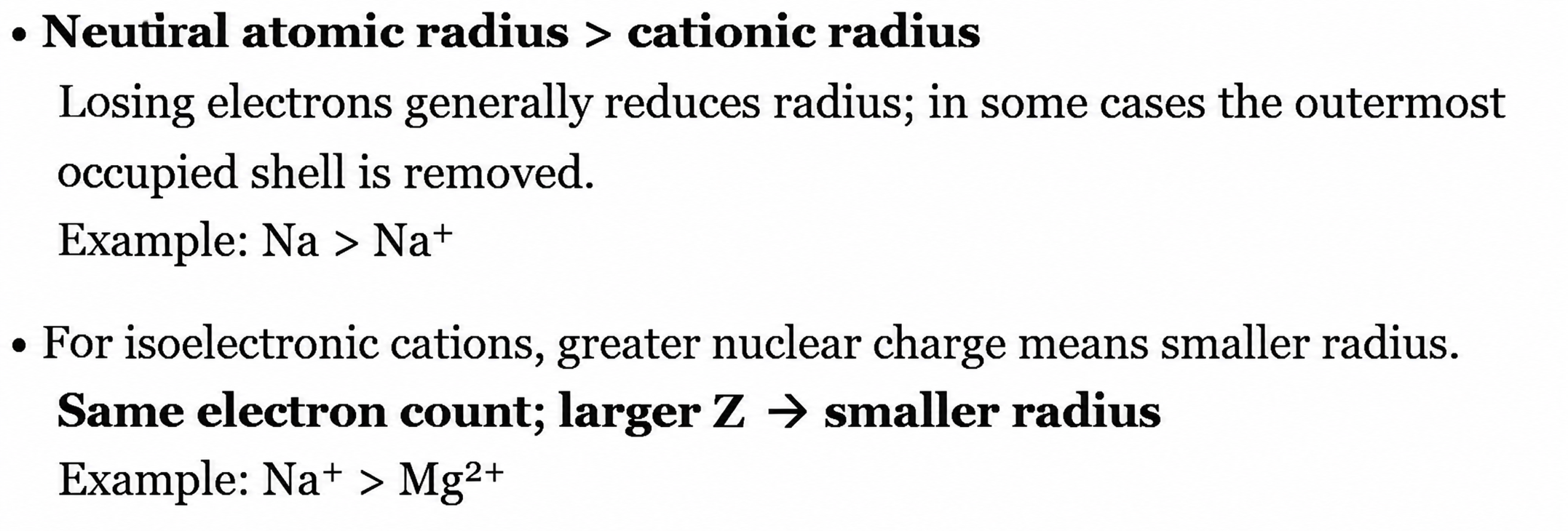
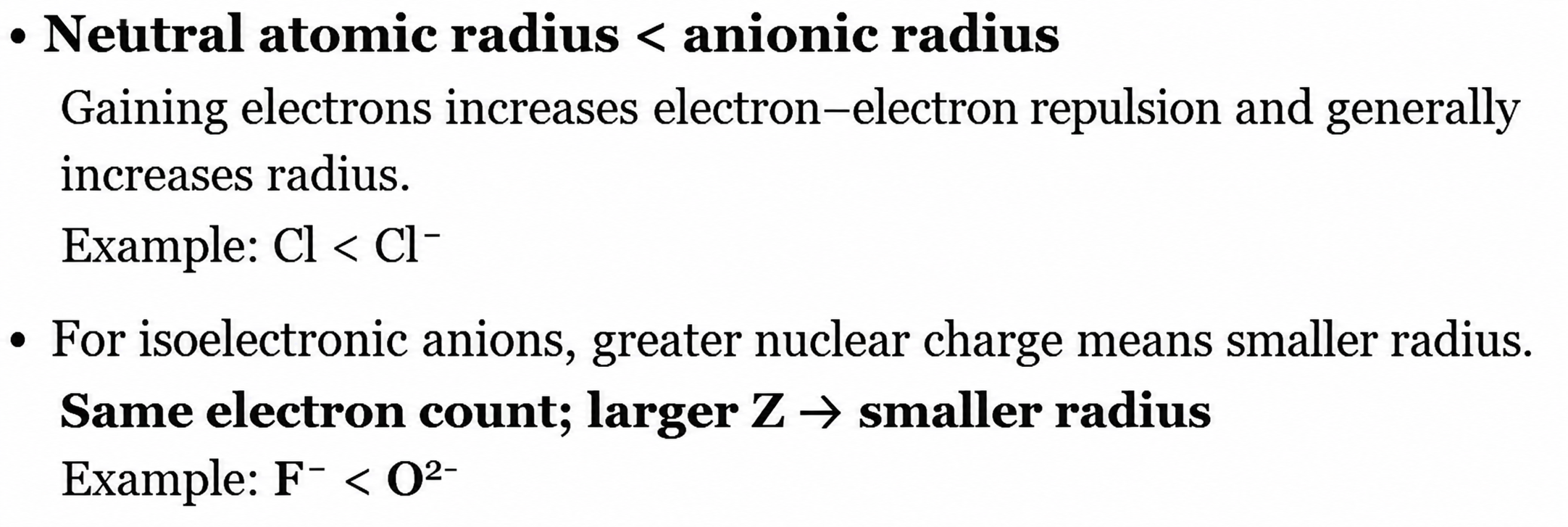
  • Cations are usually smaller than their parent atoms; anions are usually larger.
  • Isoelectronic species have equal electron counts. Within an isoelectronic series, radius decreases as nuclear charge increases.

Ca2+ < K+ < Ar < Cl− < S2−

2. Cationic and anionic radii

Classification

Features

Cations

Anions

J. Ionization energy (Ei)

First ionization energy is the energy required to remove an electron from a gaseous atom in its ground state.

X(g) + energy → X+(g) + e−

Fig. 8 Ionization energy of Li

  • First ionization energy: energy required for X(g) → X+(g) + e−.

Ar > Be > Li

  • Second ionization energy: energy required for X+(g) → X2+(g) + e−. Removing an electron from a filled shell can require substantially more energy.

Li > Ar > Be

Ground state electron configuration

Outermost electron(s)

Ei 1

(kJ/mol)

Ei 2

(kJ/mol)

Ei 3

(kJ/mol)

Li

1

520

7,300

11,820

Be

2

900

1,760

14,850

Ar

8

1,520

2,670

3,930

a. General trend

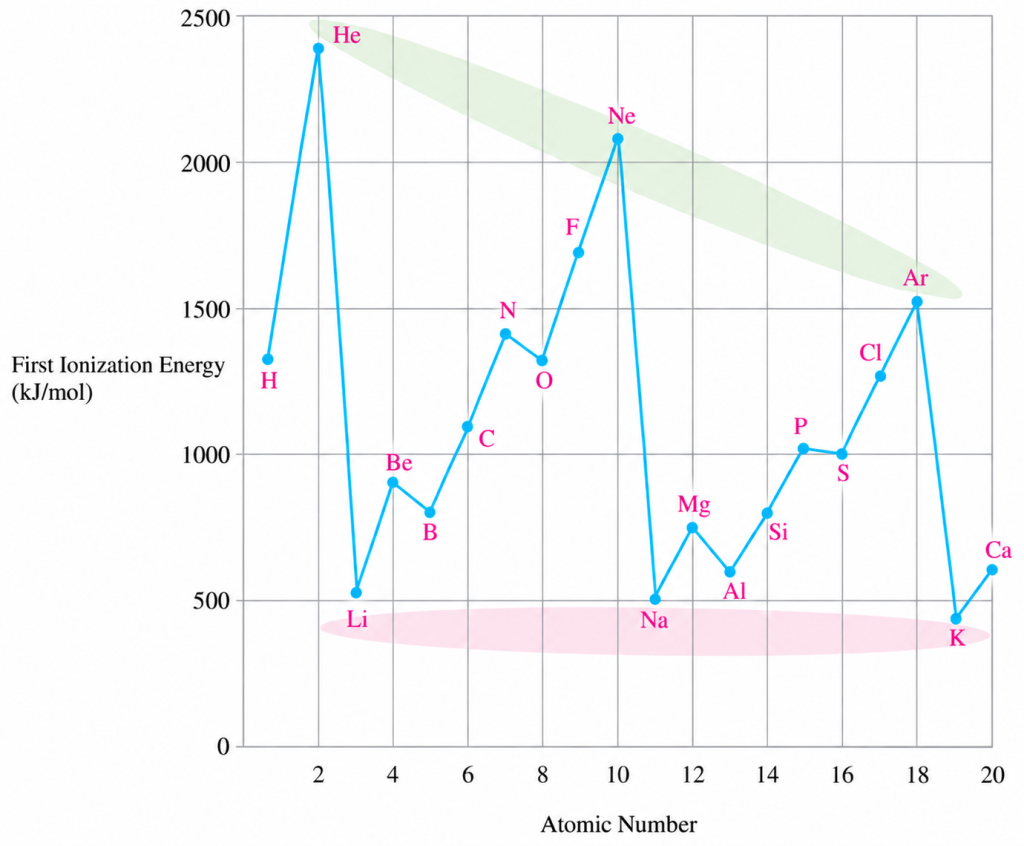
  • First ionization energy generally increases across a period.

O < F < Ne

  • First ionization energy generally decreases down a group.

He > Ne > Ar

  • Exceptions reflect subshell energies and electron pairing: Be > B and N > O. Removing a paired electron from oxygen is easier than removing an electron from nitrogen’s half-filled 2p subshell.

     Therefore, ionization energy: Be > B

     Therefore, ionization energy: N > O > C

Fig. 9 Ionization energy of the atoms

K. Electron affinity (Eea)

Electron affinity describes the energy change when an electron is added to a gaseous atom. The process can release or require energy depending on the element.

X(g) + e− → X−(g)

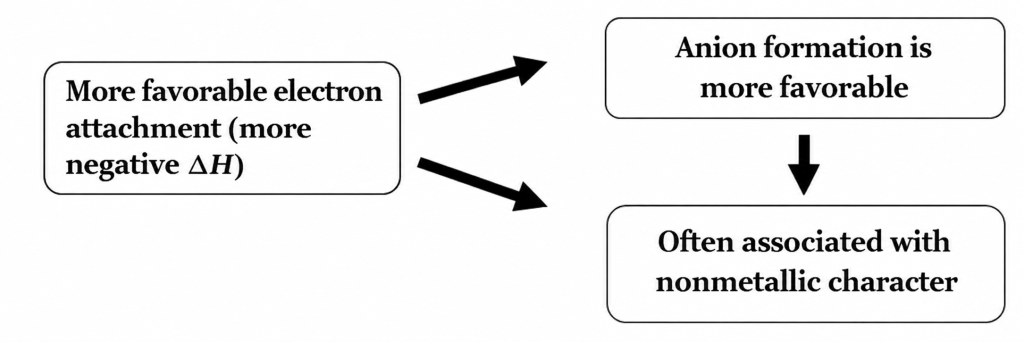
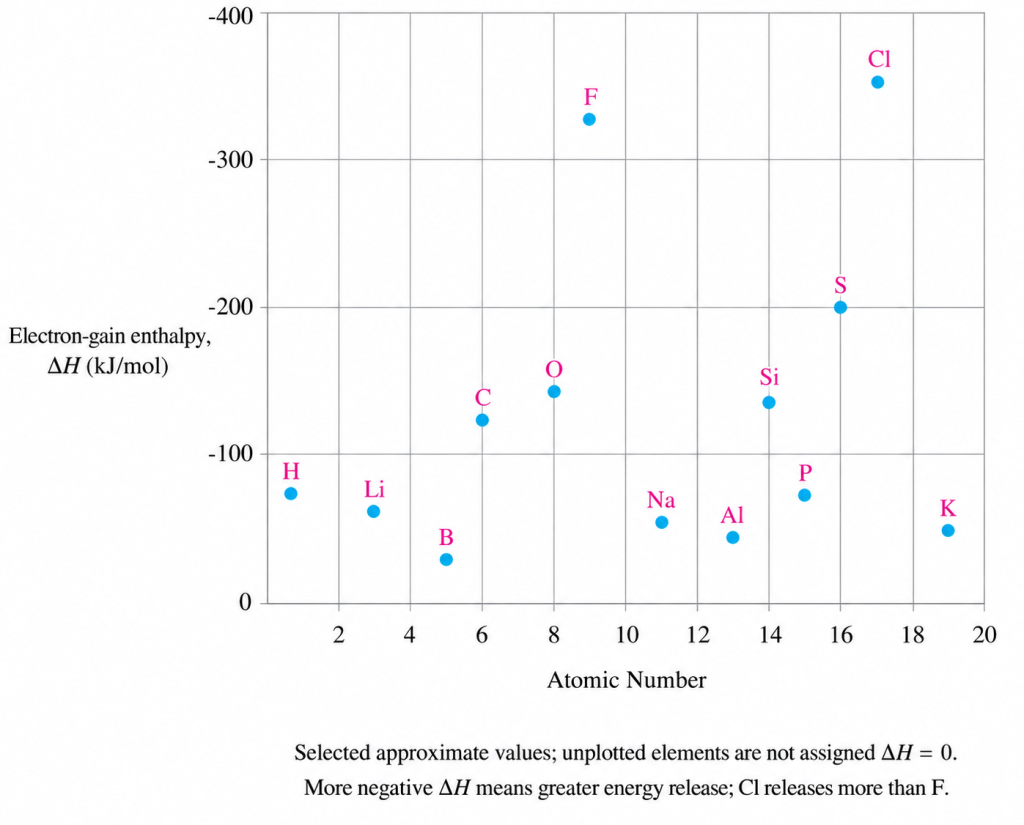
Here, electron-gain enthalpy ΔH is used: ΔH < 0 is exothermic; ΔH > 0 is endothermic. Some references define electron affinity as the energy released, positive for favorable attachment; this is a different sign convention.

Fig. 10 Electron attachment to F (electron-gain enthalpy ΔH)

a. General trends and exceptions

  • Noble gases generally have an unfavorable tendency to accept additional electrons because their valence shells are filled.
  • Electron attachment tends to become more favorable across a period, with many exceptions. Fluorine releases more energy than oxygen; nitrogen attachment is unfavorable.
  • Among Cl, Br and I, the energy released decreases: Cl > Br > I. Chlorine releases more energy than fluorine, because fluorine’s compact 2p subshell produces greater electron–electron repulsion.
  • Pairing an added electron in nitrogen’s half-filled 2p subshell is unfavorable.

Electron attachment releases energy for carbon; it is unfavorable for nitrogen.

  • Adding an electron to fluorine completes its 2p subshell; neon’s filled valence shell makes electron attachment unfavorable.

Electron attachment is favorable for fluorine and unfavorable for neon.

Fig. 11 Electron-gain enthalpies of selected atoms (ΔH)

L. Periodic trends

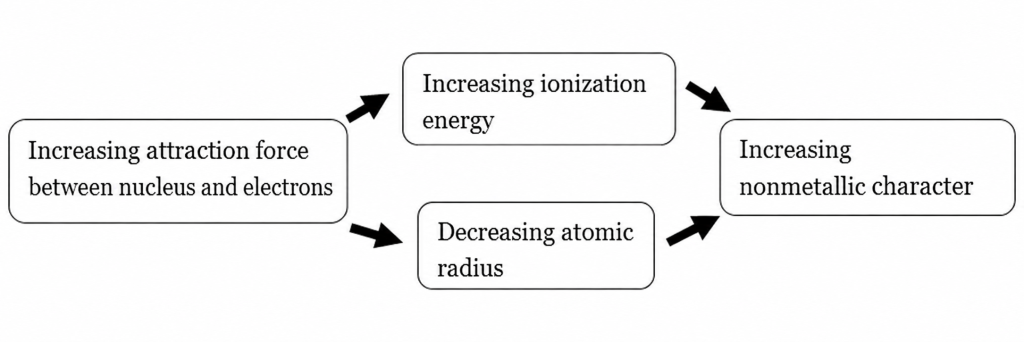
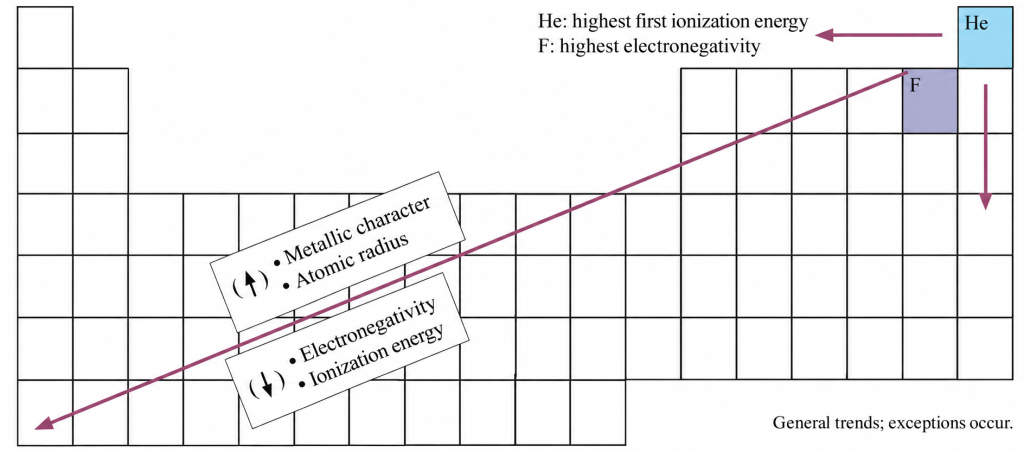
  • Metallic character and atomic radius generally increase toward the lower left of the periodic table.
  • Electronegativity and first ionization energy generally increase toward the upper right.
  • Electron affinity has many exceptions and does not follow a universal monotonic trend.

Increasing

Decreasing

Going left and down (from periodic table)

• Metallic character

• Atomic radius

• Electronegativity

• Ionization energy

Fig. 12 General periodic trends