Atomic number (Z) equals the number of protons in the nucleus. In a neutral atom, the number of electrons also equals Z.
Mass number (A) is the total number of protons and neutrons. Isotopes have identical Z values but different neutron counts.
Valence electrons occupy the outermost relevant shell and largely determine how main-group atoms bond.
b. Atomic orbitals
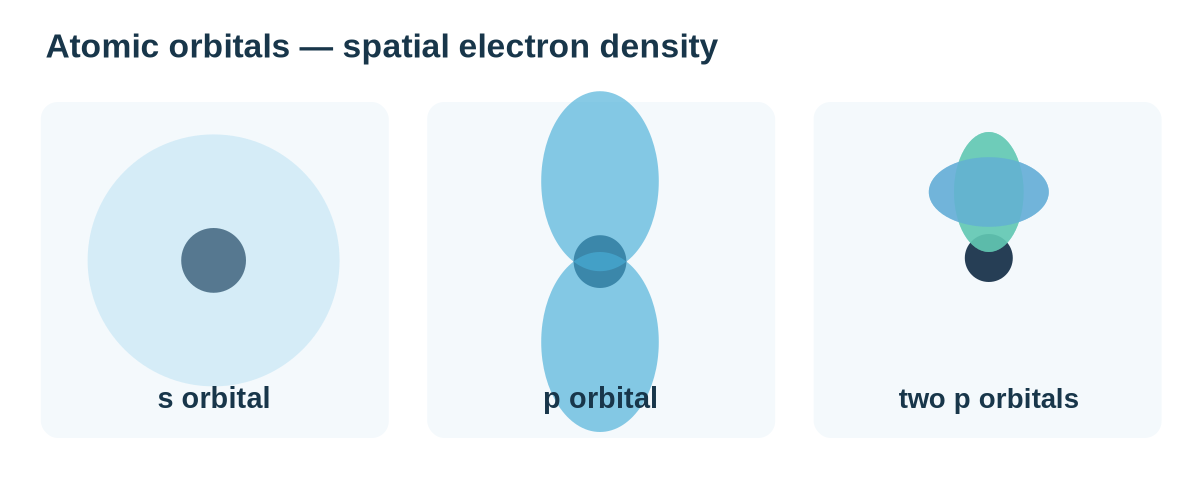
An orbital describes a three-dimensional electron probability distribution rather than a fixed electron path.
An s orbital is spherically symmetric; a p orbital has two principal lobes separated by a nodal plane.
The three p orbitals of a shell have different spatial orientations but equal energy in an isolated atom.
Schematic atomic-orbital shapes, newly illustrated for KENZ.
c. Valence configurations
Element
Valence electrons
Ground-state electron configuration
Carbon (C)
4
1s² 2s² 2p²
Nitrogen (N)
5
1s² 2s² 2p³
Oxygen (O)
6
1s² 2s² 2p⁴
Fluorine (F)
7
1s² 2s² 2p⁵
d. Valence electrons and filling rules
Carbon has four valence electrons. Common neutral patterns are four bonds for carbon, three bonds and one lone pair for nitrogen, two bonds and two lone pairs for oxygen, and one bond and three lone pairs for a halogen. These patterns are guides rather than absolute limits.
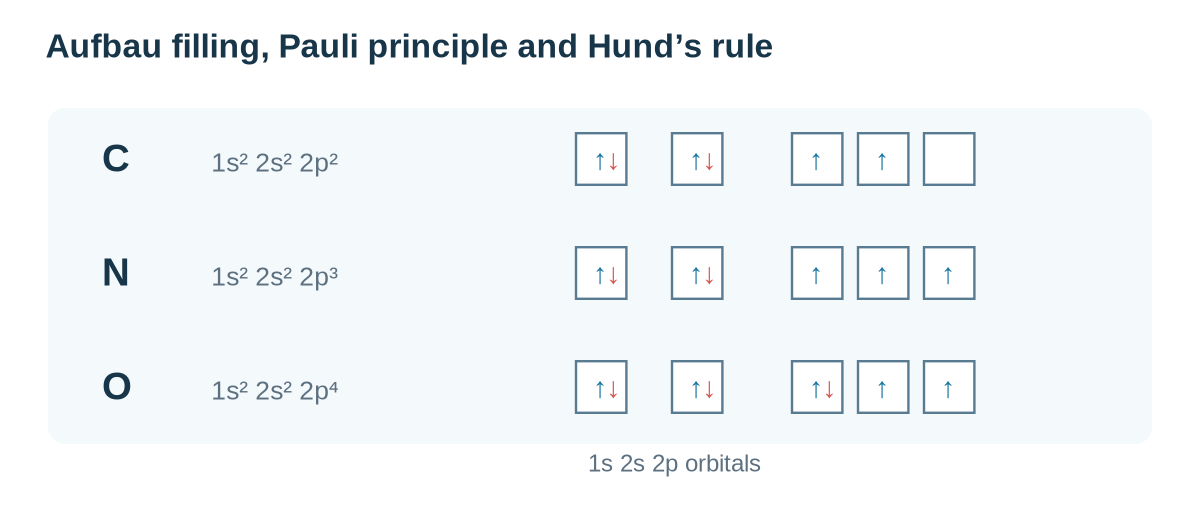
For a typical ground-state configuration, the Aufbau principle fills lower-energy orbitals first. The Pauli exclusion principle permits no more than two electrons of opposite spin in one orbital. Hund’s rule places one electron in each degenerate orbital before pairing.
Valence electrons and Lewis structuresOrbital-box configurations for carbon, nitrogen and oxygen.
B. Lewis Structures
1. Valence, octets and charge
a. Formal charge and Lewis-structure bookkeeping
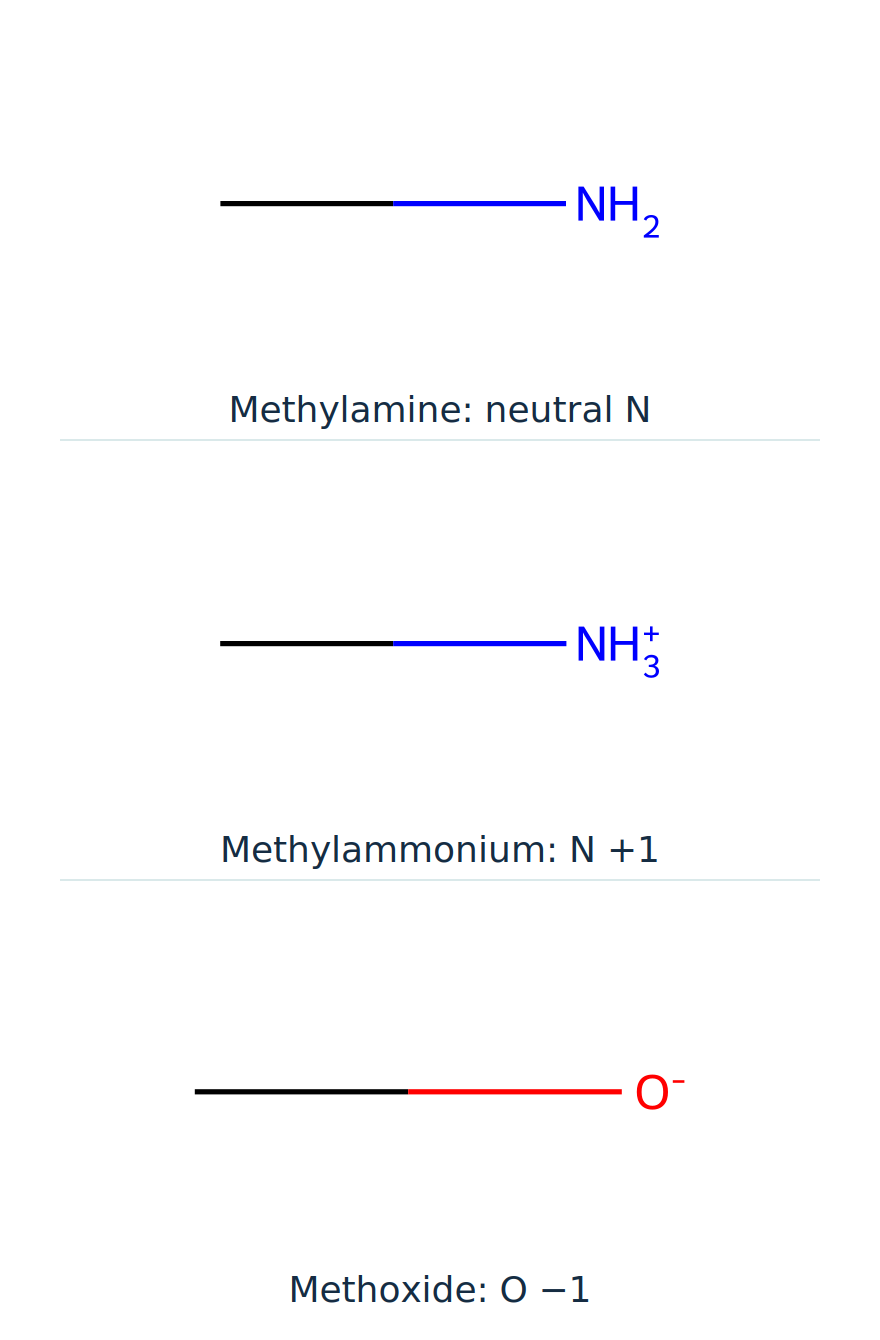
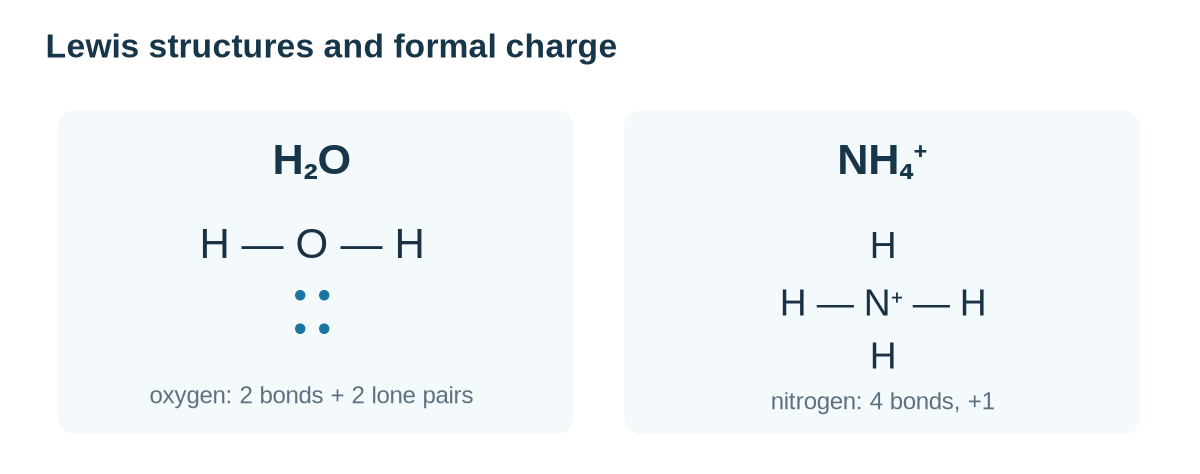
Formal charge = valence electrons − nonbonding electrons − ½(bonding electrons). The sum of formal charges must equal the overall molecular or ionic charge. Formal charge differs from partial charge.
Hydrogen normally forms one bond. Carbon, nitrogen and oxygen are second-row atoms and do not exceed an octet in ordinary Lewis structures; count shared and unshared electrons when evaluating a structure.
Atom
Common neutral pattern
C
4 bonds; no lone pairs
N
3 bonds; 1 lone pair
O
2 bonds; 2 lone pairs
F, Cl, Br, I
1 bond; 3 lone pairs
Lewis representations distinguish lone pairs and formal charge.
C. Bonding and Hybridization
1. Orbital overlap and geometry
a. Sigma and pi overlap
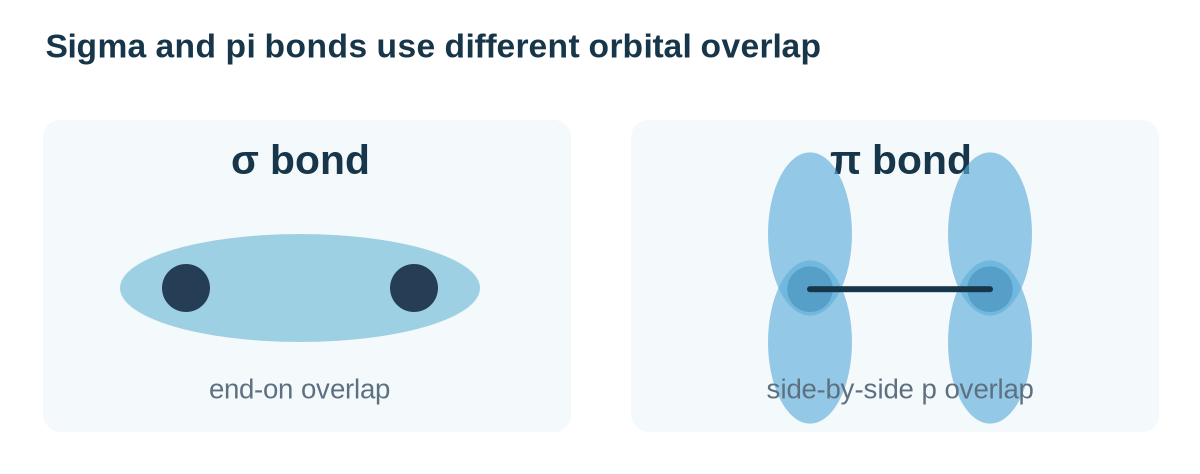
A σ bond concentrates electron density along the internuclear axis through end-on orbital overlap. A π bond comes from sideways overlap of suitably oriented p orbitals.
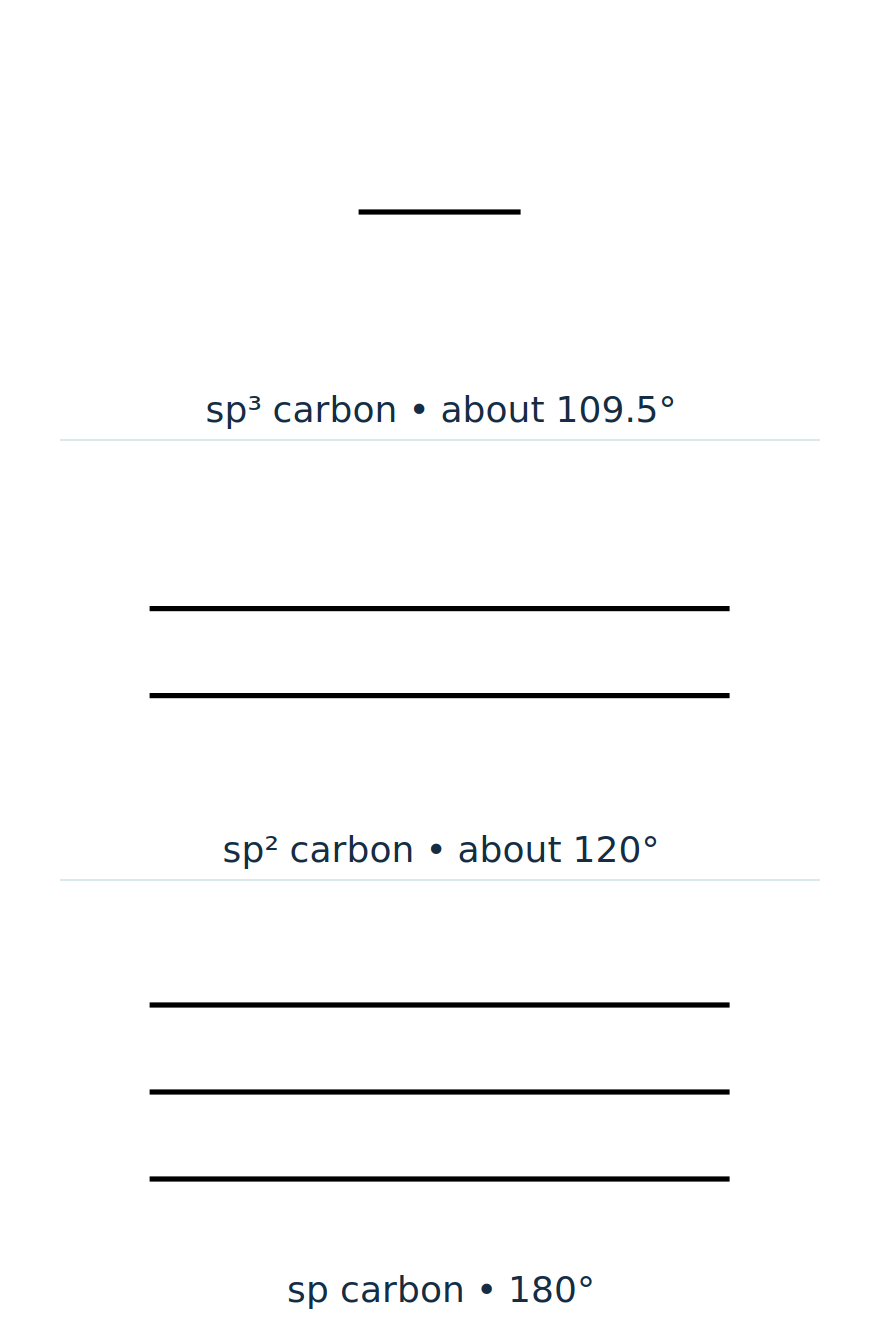
A carbon–carbon single bond contains one σ bond; C=C contains one σ and one π bond; C≡C contains one σ and two π bonds. Each π bond contains two electrons. Rotation about an ordinary C=C disrupts π overlap and requires substantial energy.
Hybridization
s character
Ideal angle
sp³
25%
109.5°
sp²
33%
120°
sp
50%
180°
End-on σ overlap compared with side-on π overlap.
b. Hybridization, domains and molecular shape
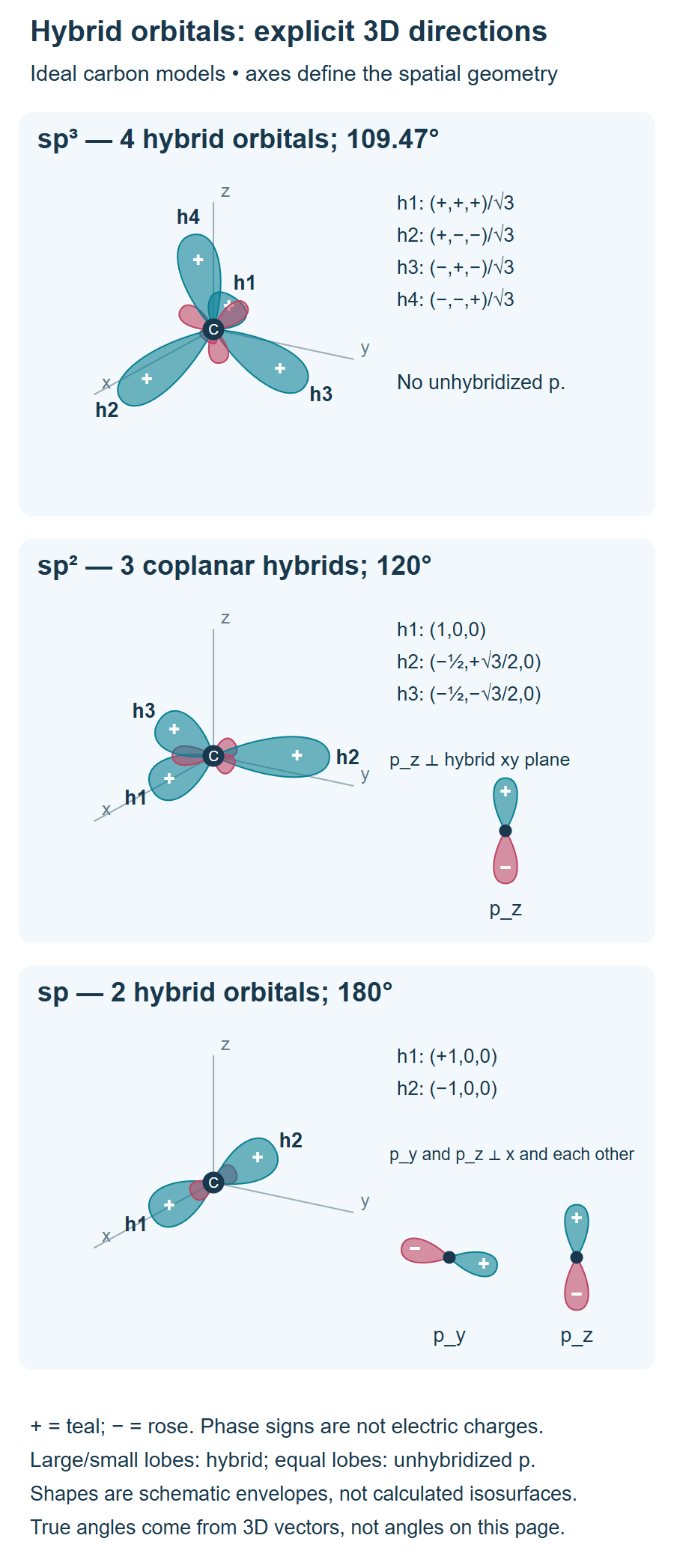
Two electron domains usually correspond to sp hybridization and linear geometry (180°); three correspond to sp² and trigonal-planar geometry (about 120°); four correspond to sp³ and tetrahedral electron-domain geometry (about 109.5°).
A lone pair counts as an electron domain. Molecular shape describes atom positions without the lone-pair positions: water is bent and an ordinary amine is pyramidal. Carbonyl carbon is sp², and alkynyl carbon is sp. An sp² carbon retains one unhybridized p orbital, and an sp carbon retains two.
Hybridization and multiple bondsThree coordinate-defined panels show sp³/sp²/sp directions, true 3D angles, and retained p orbitals. Colors and +/− signs represent orbital phase, not charge. Lobe envelopes are schematic; use the listed vectors to verify directions.
Carbon environment
Hybridization
Geometry
Typical angle
CH₄ / saturated C
sp³
Tetrahedral
109.5°
C=C carbon
sp²
Trigonal planar
120°
C≡C carbon
sp
Linear
180°
c. Bond length and strength
For comparable C–C bonds, triple bonds are generally shorter and stronger than double bonds, and double bonds are shorter and stronger than single bonds.
Bond length, bond dissociation energy and molecular geometry are related but are not interchangeable properties.
D. Formal Charge and Resonance
1. Delocalization and electron flow
a. Electron-pair and single-electron bookkeeping
A full curved arrow moves an electron pair from a lone pair or bond to an atom or bond. A fishhook arrow moves one electron.
Heterolysis sends both bonding electrons to one fragment; homolysis sends one to each fragment.
Begin each electron-pair arrow at its donor and end it at its acceptor; keep resonance bookkeeping distinct from a reaction mechanism.
b. Resonance contributors and the hybrid
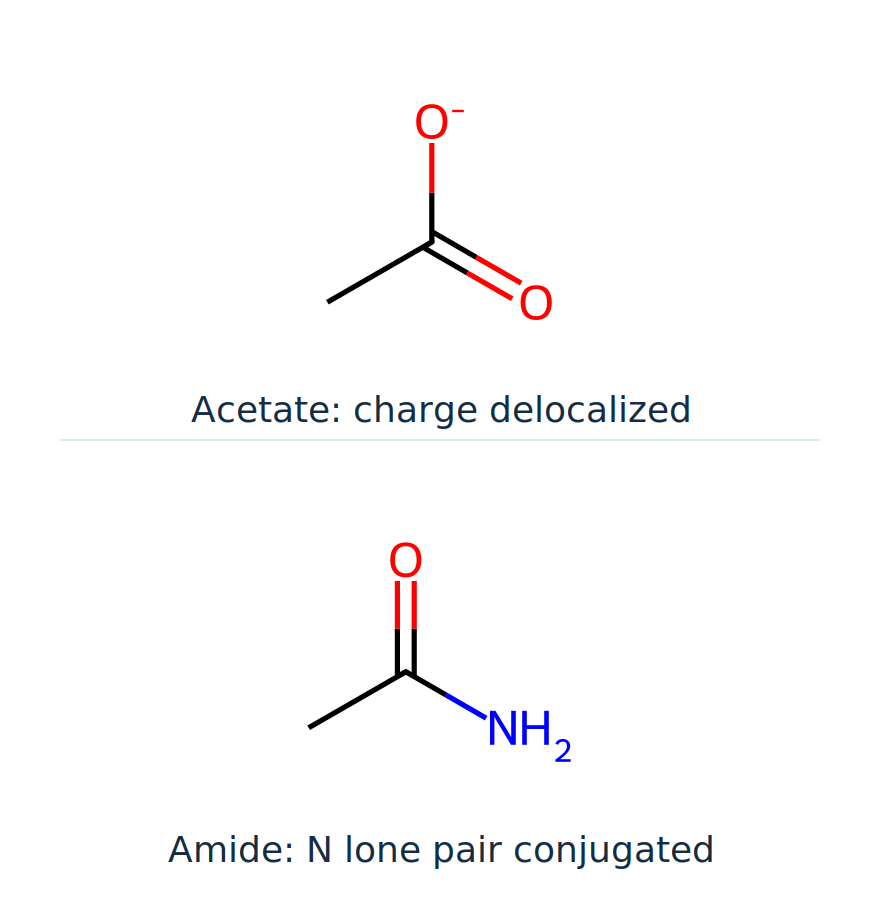
Resonance contributors preserve atom positions, σ-bond connectivity and total charge. Only electron pairs move. Changing σ connectivity describes a different bonding arrangement, not another resonance contributor. The molecule is a resonance hybrid rather than separate contributors switching back and forth.
Major contributors generally satisfy second-row octets, minimize charge separation and place negative charge on more electronegative atoms when other factors are comparable. Resonance and hyperconjugation can stabilize carbocations and radicals.
Contributors and the resonance hybrid
c. Delocalization
Equivalent contributors can give equivalent bonds in the hybrid. Delocalizing a charge usually stabilizes it.
The lone pair on an amide nitrogen is conjugated with the carbonyl; this changes bond geometry, reactivity, and basicity.
d. Carbocation and radical stability
For simple alkyl carbocations, tertiary > secondary > primary > methyl is a useful starting order, but benzylic/allylic conjugation changes the ranking. Radical substitution products depend on relative radical stability and number of available hydrogens.
e. Resonance and substitution effects
Compare resonance first, then substitution, inductive/charge effects
Allylic/benzylic often outrank an otherwise comparable nonconjugated intermediate.
For carbocations and radicals, distinguish resonance, hyperconjugation, substitution and inductive or charge effects. Evaluate whether a rearrangement is structurally possible before using a stability ranking.