
CH 7. Aromatic Compounds
A. Benzene and Aromaticity
1. Aromatic structures, names and electron counting
a. Benzene structure
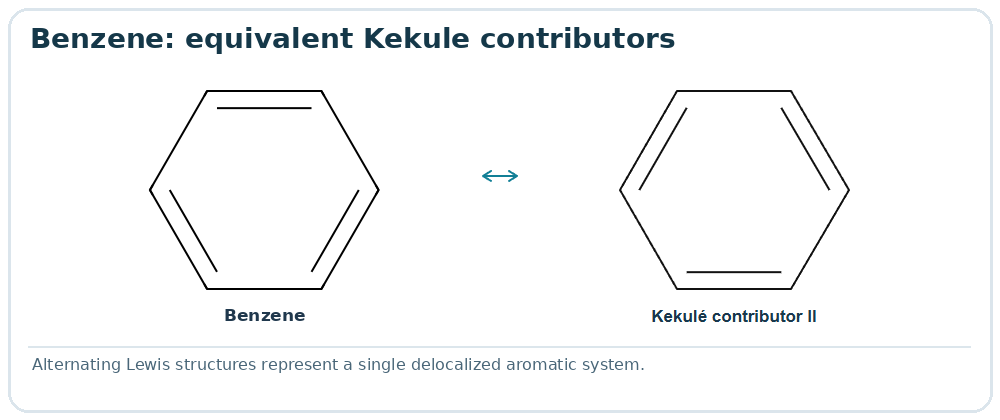
- Benzene (C₆H₆) is a planar six-membered ring in which each carbon is approximately sp²-hybridized.
- All six C–C bonds are equivalent in the resonance hybrid; alternating double-bond drawings do not imply that bonds alternate in length.
- Each carbon contributes one p orbital to a cyclic, delocalized π system.
b. Aromatic, antiaromatic and nonaromatic systems
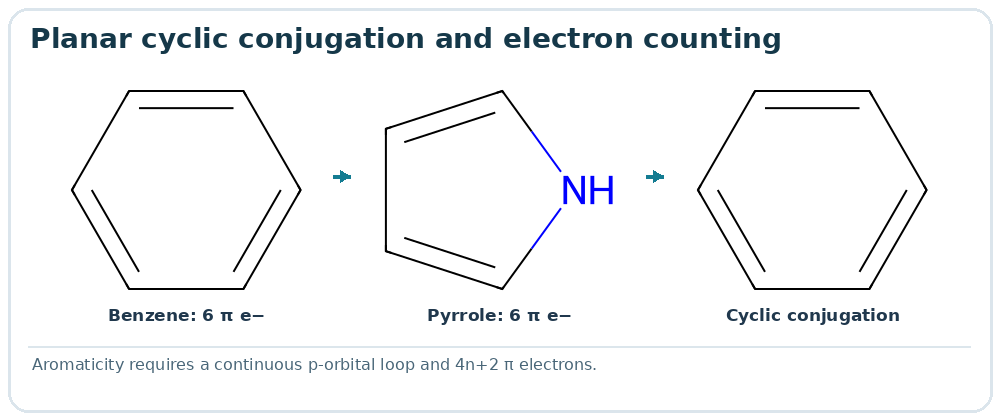
- For a typical monocyclic Hückel system, aromaticity requires a cyclic, approximately planar, continuously conjugated framework with 4n+2 π electrons. Benzene has six π electrons (n = 1). Conjugation alone does not establish aromaticity.
- A planar, continuously conjugated ring with 4n π electrons is antiaromatic. A system without continuous conjugation or the required geometry is nonaromatic; establish the orbital framework before counting electrons.
c. Charged rings and heterocycles
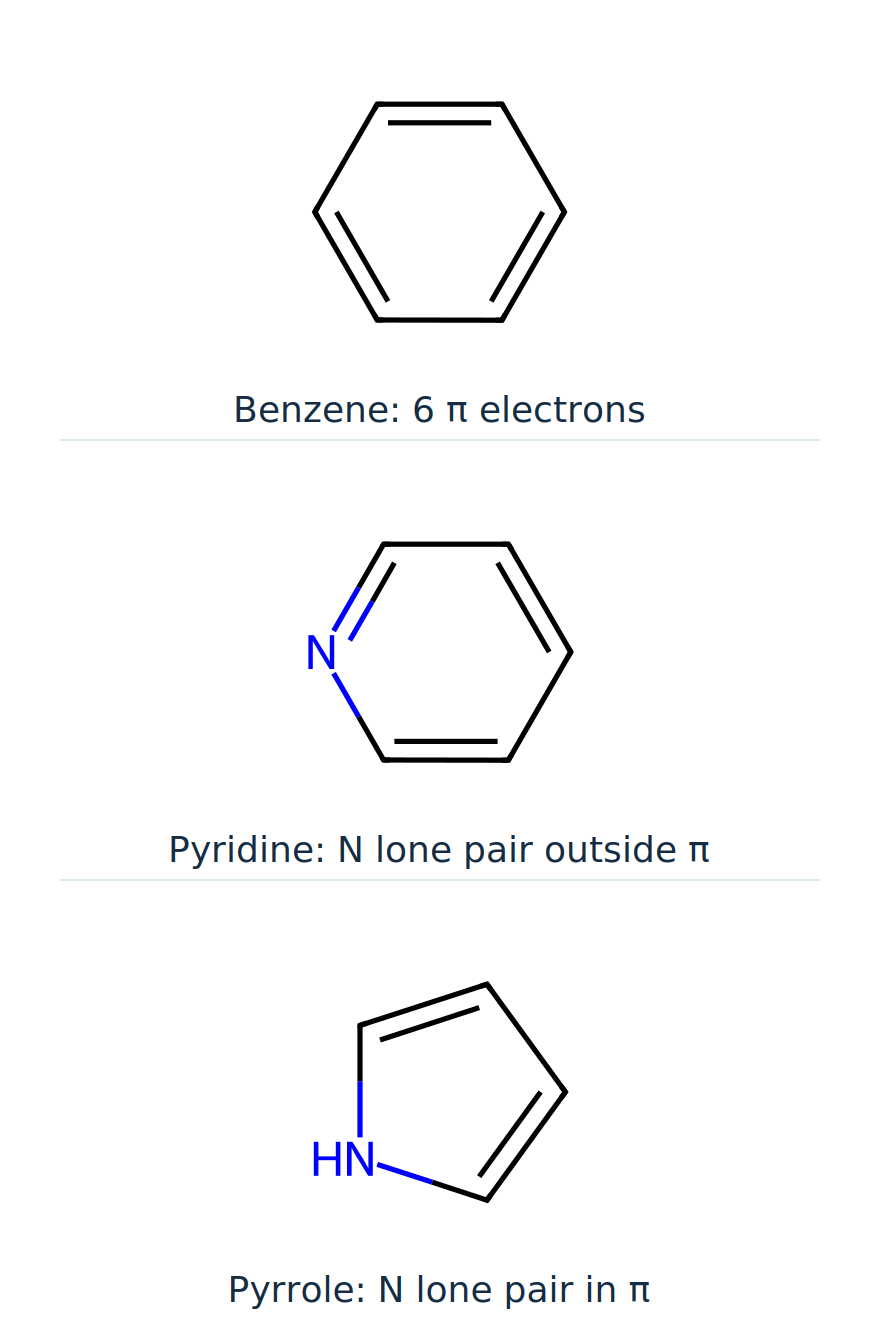
- Cyclopentadienyl anion has six pi electrons; its lone pair occupies a p orbital. Cyclopentadienyl cation has four and is antiaromatic if planar.
- Pyridine’s N lone pair lies outside the aromatic pi system. Pyrrole’s N lone pair contributes two electrons to the aromatic sextet.
| System | Result |
|---|---|
| Cyclic + planar + conjugated; 4n+2 π | Aromatic |
| Cyclic + planar + conjugated; 4n π | Antiaromatic |
| Planarity or conjugation absent | Nonaromatic |
d. Parent structures and substituents
- A benzene ring may serve as the parent, with substituents numbered to give an appropriate set of locants.
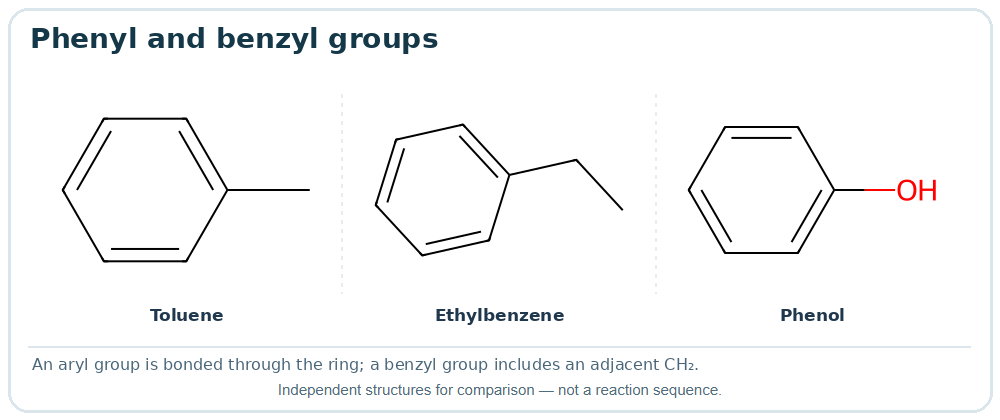
- Common retained names include toluene (methylbenzene), phenol (hydroxybenzene), and aniline (aminobenzene).
- Phenyl (Ph–) represents C₆H₅–, while benzyl (Bn–) represents C₆H₅CH₂–.
e. Two substituents
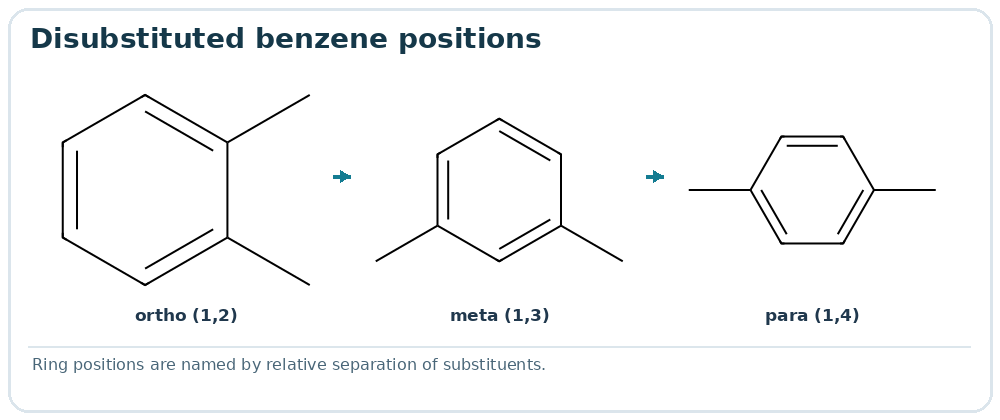
- Ortho (o-) identifies 1,2-disubstitution; meta (m-) identifies 1,3-disubstitution; para (p-) identifies 1,4-disubstitution.
- For more highly substituted rings, use locants and systematic naming rather than relying only on o/m/p prefixes.
f. Structural reasoning
- Benzene resists simple electrophilic addition more strongly than ordinary isolated alkenes because addition forfeits aromatic stabilization.
- Distinguish electrophilic aromatic substitution, benzylic radical substitution, and side-chain oxidation from one another before interpreting reagents and products.
B. Electrophilic Aromatic Substitution
1. Mechanism and electrophile generation
a. Electrophilic aromatic substitution through a sigma complex
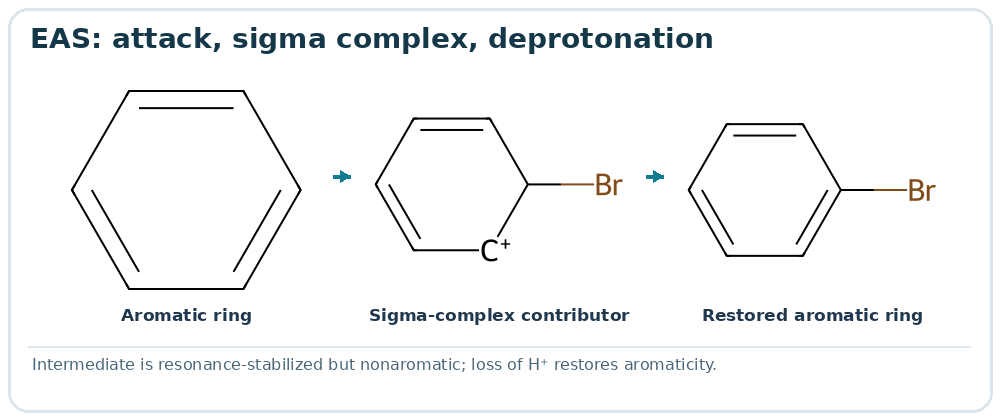
- An aromatic π bond attacks a suitable electrophile to form a nonaromatic cationic sigma complex, also called an arenium ion. Resonance delocalizes the positive charge in this intermediate.
- A base removes the H from the carbon that received the electrophile, restoring the aromatic π system. The net reaction replaces aromatic H with E. Unlike permanent addition across the ring, substitution recovers aromatic stabilization.
b. Electrophile generation
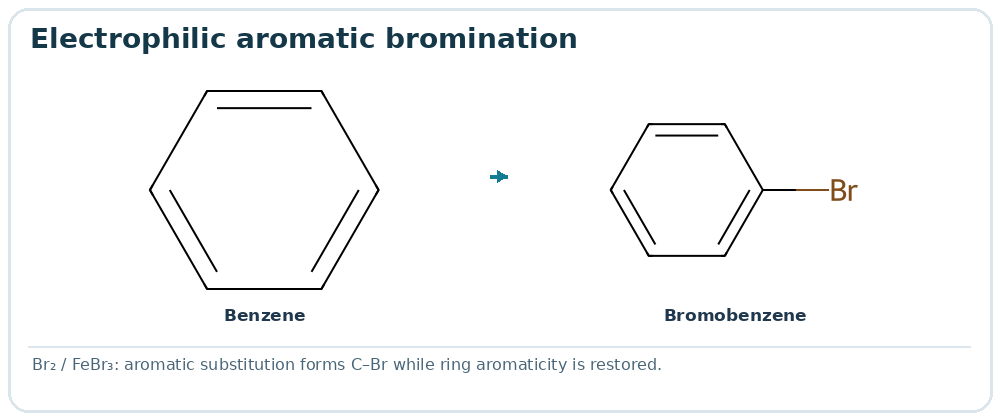
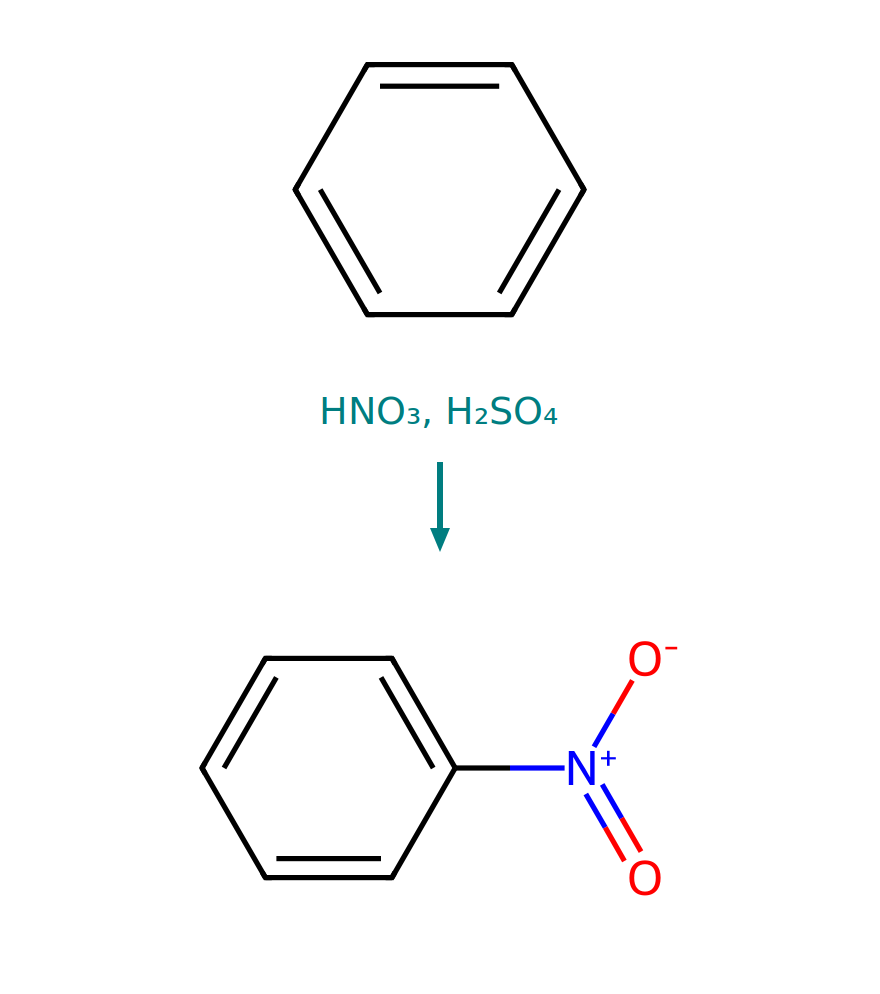
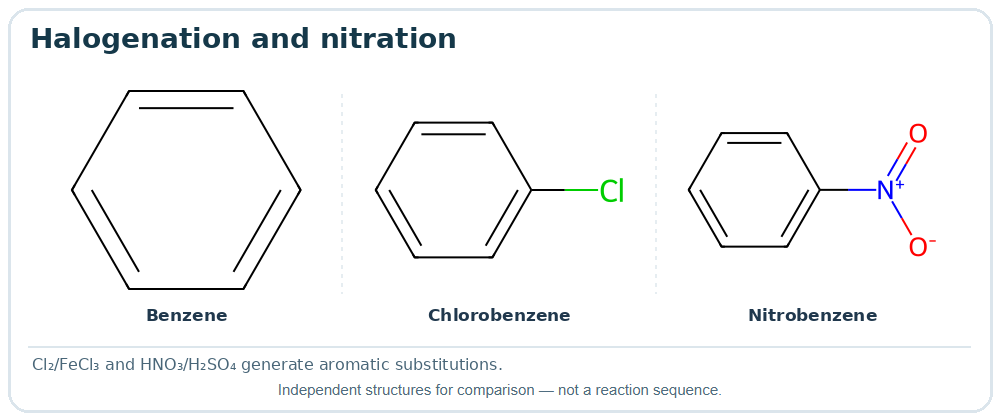
- Halogenation commonly uses Br₂/FeBr₃ or Cl₂/FeCl₃. Nitration uses HNO₃/H₂SO₄ to generate a nitronium electrophile.
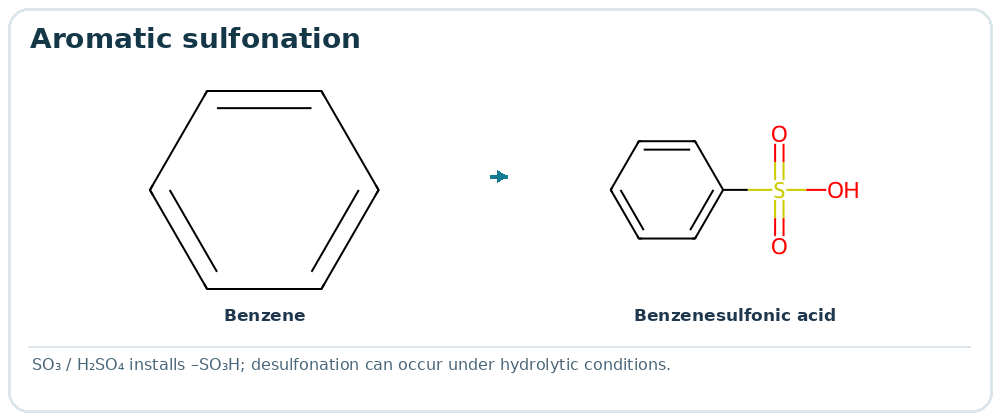
- Sulfonation uses SO₃/H₂SO₄ and is reversible; hot aqueous acidic conditions can remove the sulfonic acid group.
| Transformation | Typical reagents | Major structural change |
|---|---|---|
| Bromination | Br₂ / FeBr₃ | Ar–H → Ar–Br |
| Chlorination | Cl₂ / FeCl₃ | Ar–H → Ar–Cl |
| Nitration | HNO₃ / H₂SO₄ | Ar–H → Ar–NO₂ |
| Sulfonation | SO₃ / H₂SO₄ | Ar–H → Ar–SO₃H |
| Friedel–Crafts acylation | RCOCl / AlCl₃ | Ar–H → Ar–C(O)R |
c. Halogenation
- Bromination commonly uses Br₂ with FeBr₃; chlorination commonly uses Cl₂ with FeCl₃.
- The Lewis acid assists electrophile generation; the aromatic ring ultimately regains aromaticity after loss of H⁺.
d. Nitration
- A mixture of HNO₃ and H₂SO₄ generates the nitronium ion (NO₂⁺), the electrophile for aromatic nitration.
- Aromatic ring attack gives a sigma complex, followed by deprotonation to yield a nitroarene.
e. Sulfonation
- SO₃ in strong sulfuric acid introduces a sulfonic acid substituent (–SO₃H).
- Sulfonation can be reversible; desulfonation may occur with hot aqueous acid.
f. Friedel–Crafts alkylation
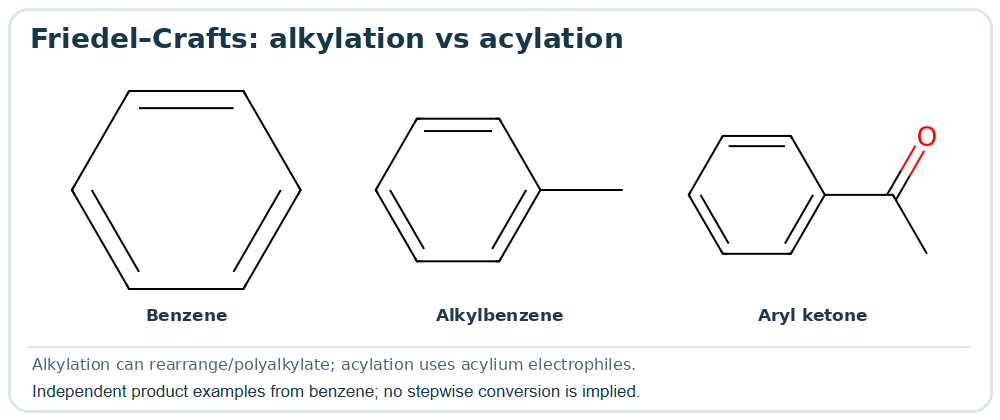
- Alkyl halides with Lewis acids such as AlCl₃ can generate an electrophile that installs an alkyl group on benzene.
- Carbocation rearrangements and multiple alkylations can complicate product distributions.
- Strongly deactivated aromatic rings are generally poor substrates for Friedel–Crafts alkylation.
- Aryl and vinyl halides are not ordinary alkylating partners. Strong binding to the Lewis acid can also prevent straightforward Friedel–Crafts alkylation.
- Friedel–Crafts alkylation may rearrange or polyalkylate; strong deactivators and amine–Lewis-acid complexes can prevent straightforward reaction.
g. Friedel–Crafts acylation
- An acyl halide with a Lewis acid provides an acylium-type electrophile and yields an aryl ketone.
- Acylium ions do not undergo ordinary carbocation rearrangements; the new acyl group deactivates the ring and limits further acylation.
- Acyl chloride/AlCl₃ is followed by workup. Carbonyl deoxygenation can provide an alkylbenzene without the ordinary alkylation rearrangement pathway. Gattermann–Koch conditions use CO/HCl with suitable Lewis-acid catalysis to install CHO on an appropriate aromatic substrate.
- Friedel–Crafts acylation followed by carbonyl reduction can install an alkyl side chain while avoiding the ordinary alkyl-carbocation rearrangement pathway.

C. Directing Effects
1. Activation, orientation and limitations
a. Electronic donation
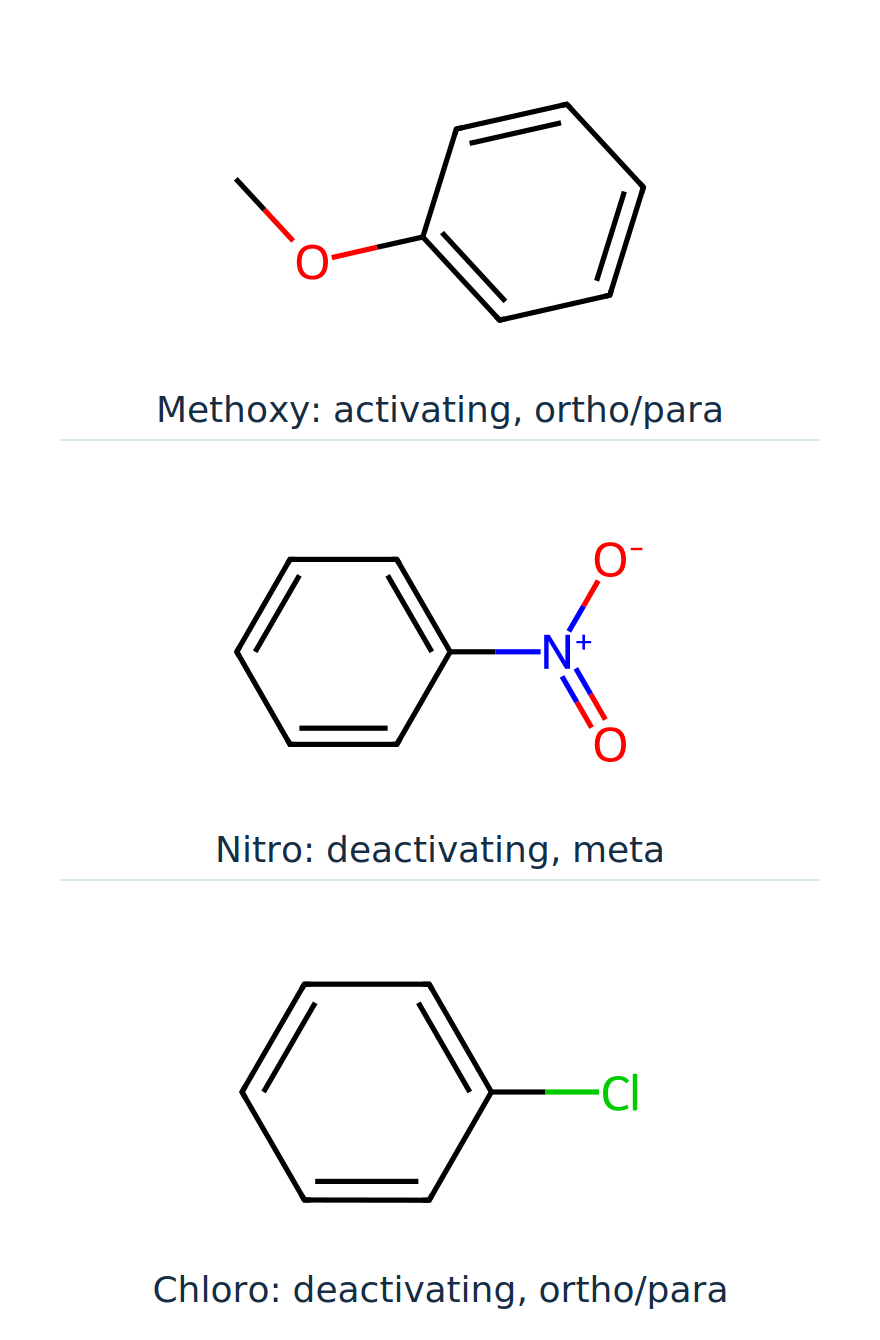
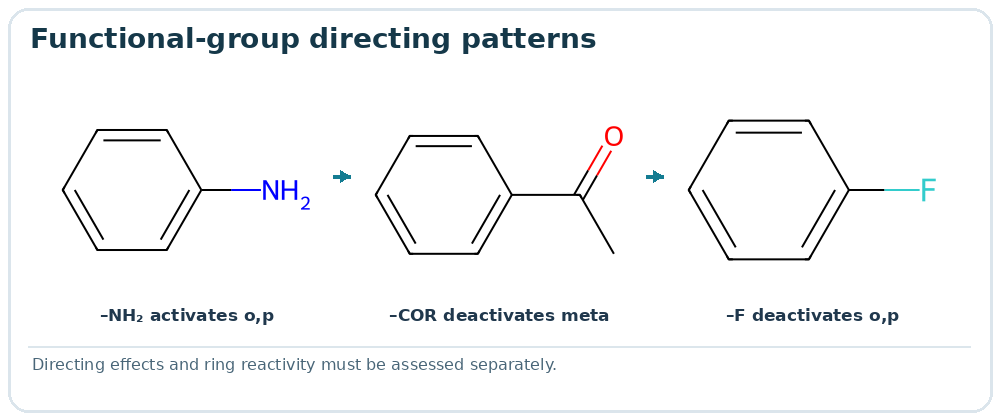
- Groups that donate electron density by resonance, such as –OH and –OR, usually increase EAS reactivity relative to benzene.
- Alkyl groups are weakly activating, partly through hyperconjugation.
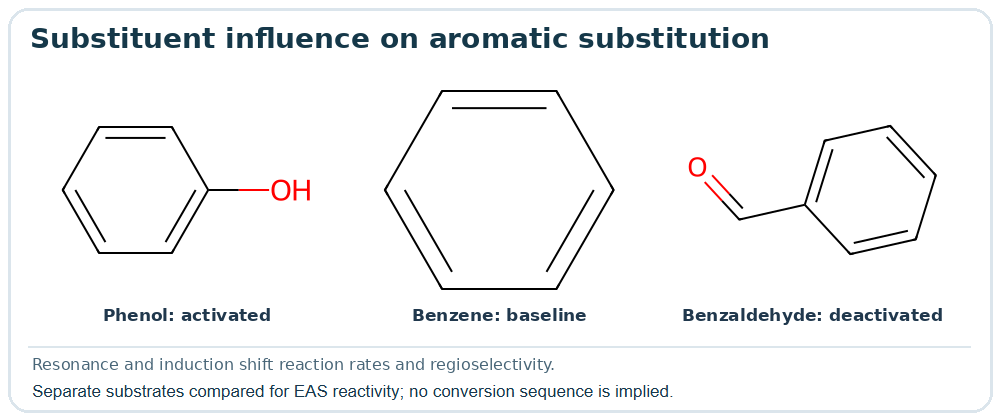
- Common donating substituents include NH₂ as well as OH, OR and alkyl. Strong withdrawing groups commonly deactivate and direct meta; CHO, COR and CO₂R are typical examples when the carbonyl carbon is bonded to the ring.
b. Electronic withdrawal
- Strongly electron-withdrawing groups, including –NO₂, –CN, and carbonyl-containing substituents attached through the carbonyl carbon, usually reduce EAS reactivity.
- Resonance and inductive effects both influence reaction rate and regioselectivity.

- For a strong withdrawing substituent, ortho/para sigma complexes can place positive charge in unfavorable arrangements, favoring meta substitution. A preferred orientation does not by itself imply a fast reaction.
c. Multiple substituents
- With more than one substituent, competing directing effects, steric hindrance, and existing ring substitution determine the likely products.
- A strongly activating group often has substantial influence on orientation, but specific reaction conditions also matter.
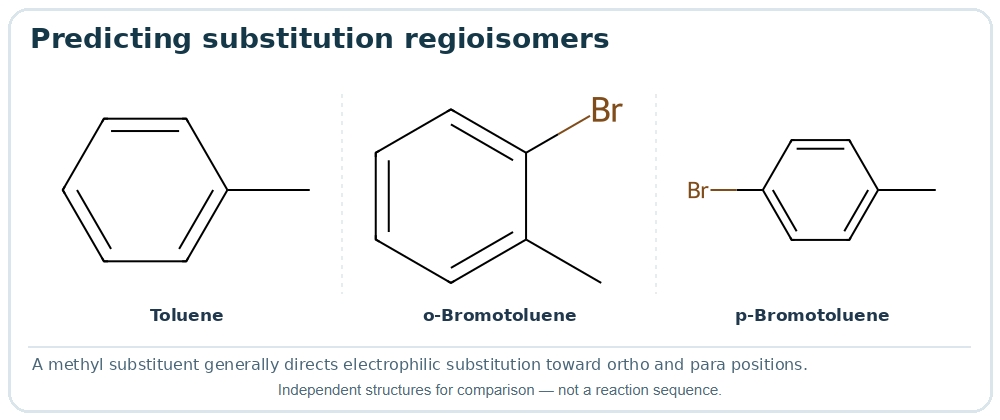
- Choose the substitution sequence so the intended directing effects converge at the desired position.
- Account for changes caused by oxidation of a benzylic side chain when planning the order of ring substitutions.
d. Exceptions and conditions
- Halogens deactivate by induction but direct ortho/para through lone-pair resonance donation.
- Protonation or coordination can change a substituent’s behavior; aniline in strongly acidic media should not be treated as unchanged neutral aniline. With several substituents, consider their combined direction and steric crowding.
| Group attached to ring | Typical direction |
|---|---|
| –OH, –OR, –NH₂, alkyl | ortho/para |
| –NO₂, –CN, –CHO, –COR, –CO₂R | meta |
| F, Cl, Br, I | ortho/para; deactivating |
| Group | Relative effect | Usual orientation |
|---|---|---|
| –OH, –OR, –NH₂ | Strong activating | ortho / para |
| –R (alkyl) | Weak activating | ortho / para |
| –F, –Cl, –Br, –I | Deactivating | ortho / para |
| –NO₂, –CN, –SO₃H | Deactivating | meta |
| –CHO, –COR, –CO₂R, –CO₂H | Deactivating | meta |
- Electron donation can stabilize the ortho/para sigma complexes. Halogen lone-pair donation explains ortho/para direction despite inductive deactivation.
D. Benzylic Reactions
1. Side-chain oxidation and halogenation
a. Oxidation of side chains
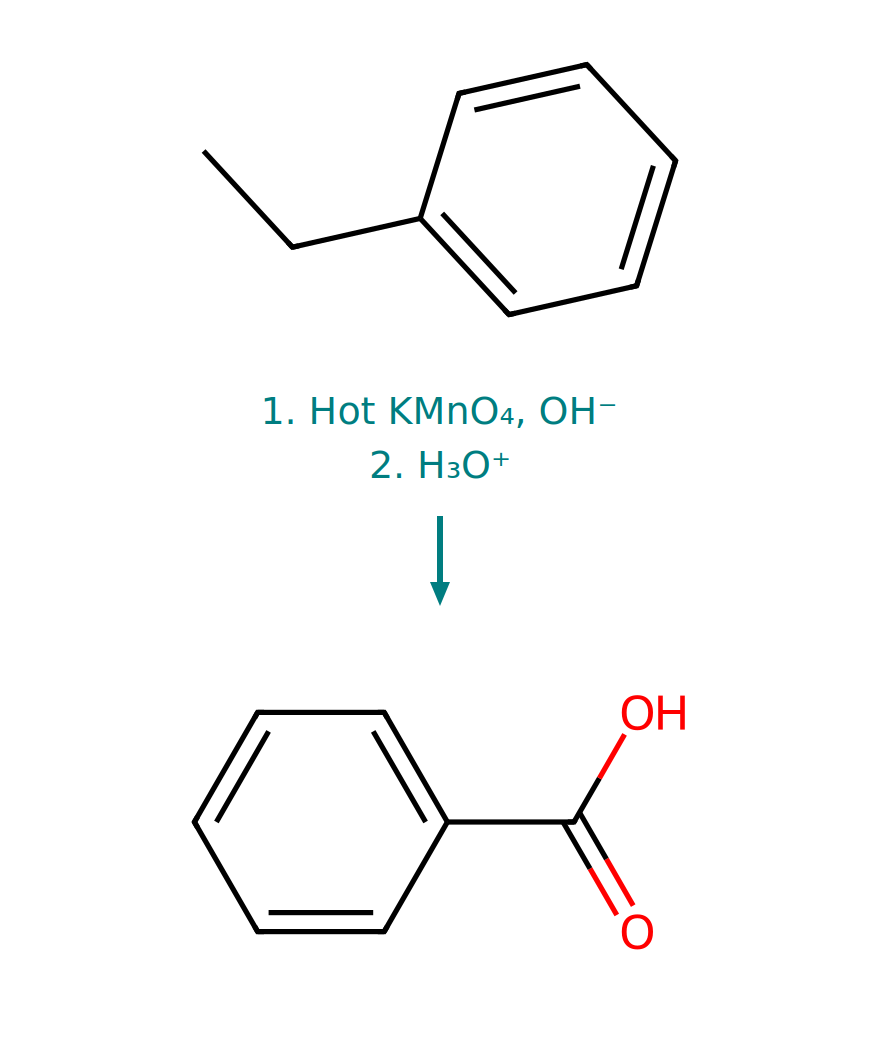
- Alkylbenzene side chains containing at least one benzylic hydrogen can be oxidized under sufficiently strong conditions to carboxylic acids.
- The aromatic ring framework usually survives the oxidation under common preparative conditions.
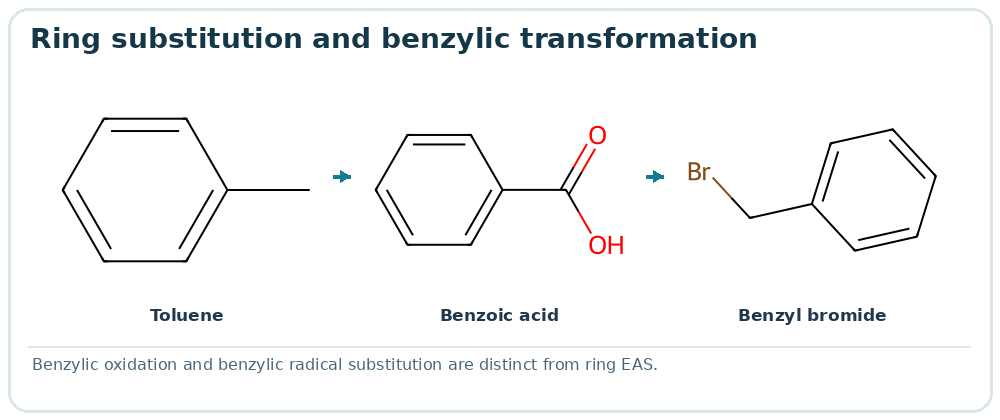
- Strong KMnO₄ oxidation of an alkylbenzene with a benzylic H commonly gives benzoic acid regardless of the remaining side-chain length; the ordinary pattern does not apply without a benzylic H.
b. Benzylic halogenation
- Radical halogenation of an alkylbenzene side chain affects the benzylic C–H position rather than the aromatic ring C–H position.
- This is mechanistically different from electrophilic aromatic halogenation.
- Benzylic radical bromination with NBS/hν or Br₂/hν is distinct from aromatic ring bromination with Br₂/FeBr₃.
- A benzylic carbocation or radical can delocalize into the ring. An aryl carbon and a benzylic carbon are different reaction sites.
E. Nucleophilic Aromatic Substitution
1. Activated aromatic substitution
a. Nucleophilic aromatic substitution
- An aryl halide generally does not undergo ordinary SN1/SN2. Strong electron-withdrawing groups ortho/para to a leaving group can enable addition–elimination substitution.
- Benzyne pathways require different, strongly basic conditions. Keep the activated-ring pathway distinct from substitution at an sp³ benzylic carbon.