
CH 2. Acids, Bases & Molecular Properties
A. Brønsted–Lowry Acids and Bases
1. Proton transfer and conjugate pairs
a. Proton transfer and the broader electron-pair model
- A Brønsted–Lowry acid donates H⁺ and a Brønsted–Lowry base accepts H⁺. Loss of H⁺ gives the conjugate base; acceptance of H⁺ gives the conjugate acid. Each conjugate pair differs by one proton.
- Acid–base behavior depends on the reaction partner: the same compound can play different roles in different reactions. A Lewis acid accepts an electron pair and a Lewis base donates one; proton transfer is one example of this broader interaction.

b. Representative pairs
| Acid | Conjugate base | Acid–base relation |
|---|---|---|
| CH₃COOH | CH₃COO⁻ | Carboxylic acid / carboxylate |
| H₂O | OH⁻ | Water / hydroxide |
| NH₄⁺ | NH₃ | Ammonium / ammonia |
| HC≡CH | HC≡C⁻ | Terminal alkyne / acetylide |
c. Amino-acid charge
- At pH below pI: more positive; above pI: more negative
- Requires ionizable-group pKa values.
d. Amino acids
- Track COOH/COO− and NH3+/NH2 with pH relative to their respective pKa values.
B. Lewis Acids and Bases
1. Electron-pair donors and acceptors
a. Electron-pair transfer
- A Lewis base donates an electron pair; a Lewis acid accepts an electron pair.
- A molecule with a suitable lone pair may act as a Lewis base, whereas an electron-deficient center may act as a Lewis acid.
- Lewis acid–base bonding does not require proton transfer; a coordinate bond can form when one partner initially supplies both bonding electrons.

b. Relationship between acid–base models
- Brønsted–Lowry reactions specifically describe proton transfers.
- Lewis theory describes the broader category of electron-pair donation and acceptance.
- Examples of common Lewis acids include electron-deficient boron compounds and many metal cations; common Lewis bases include amines and suitable oxygen donors.
C. pKa and Equilibrium
1. Acidity, stabilization and equilibrium
a. The pKa scale
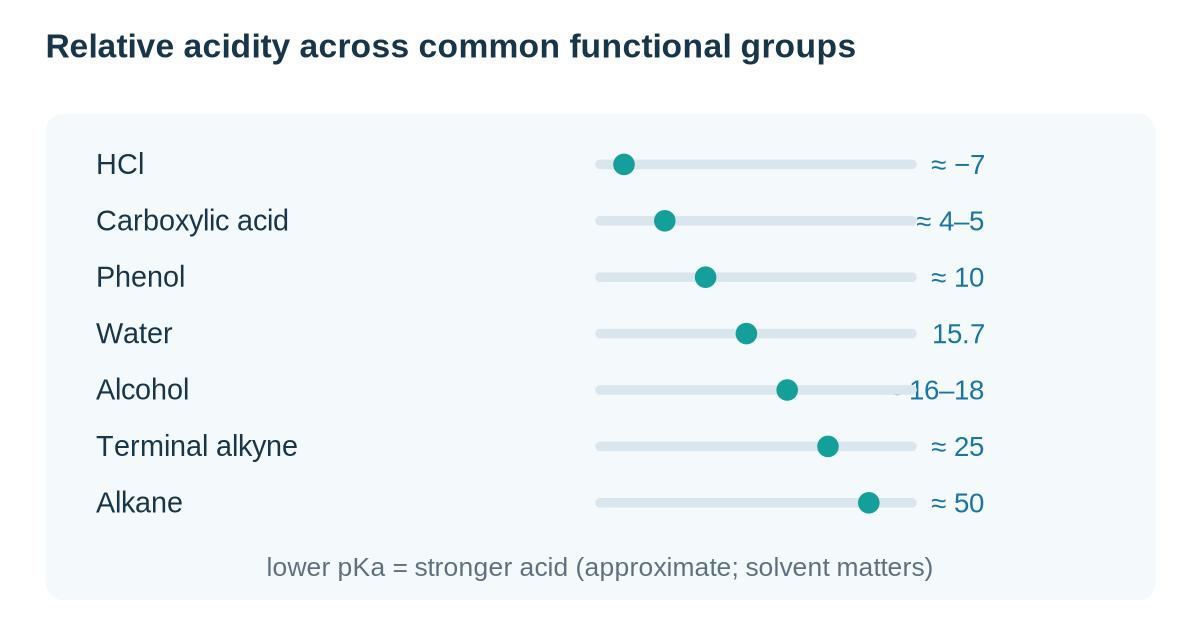
- A lower pKa indicates a stronger acid when values are compared in an appropriate common solvent.
- Stronger acids generally have weaker conjugate bases.
- pKa values depend on solvent and experimental conditions, so typical textbook values are approximations.
b. Estimating equilibrium
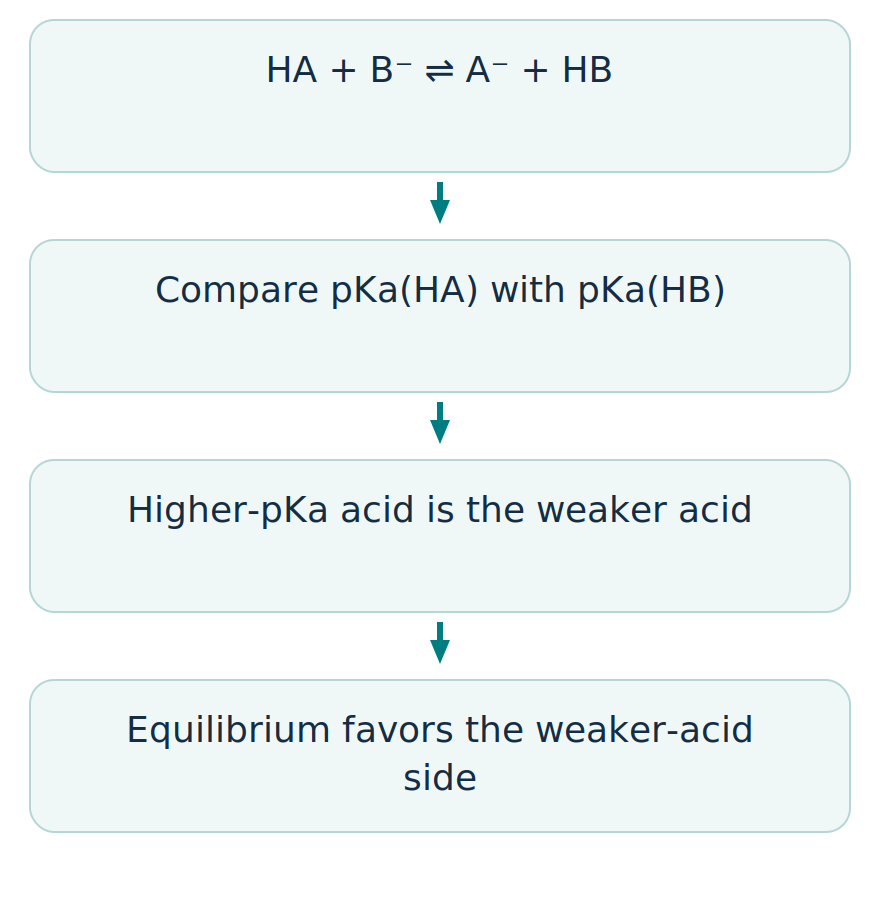
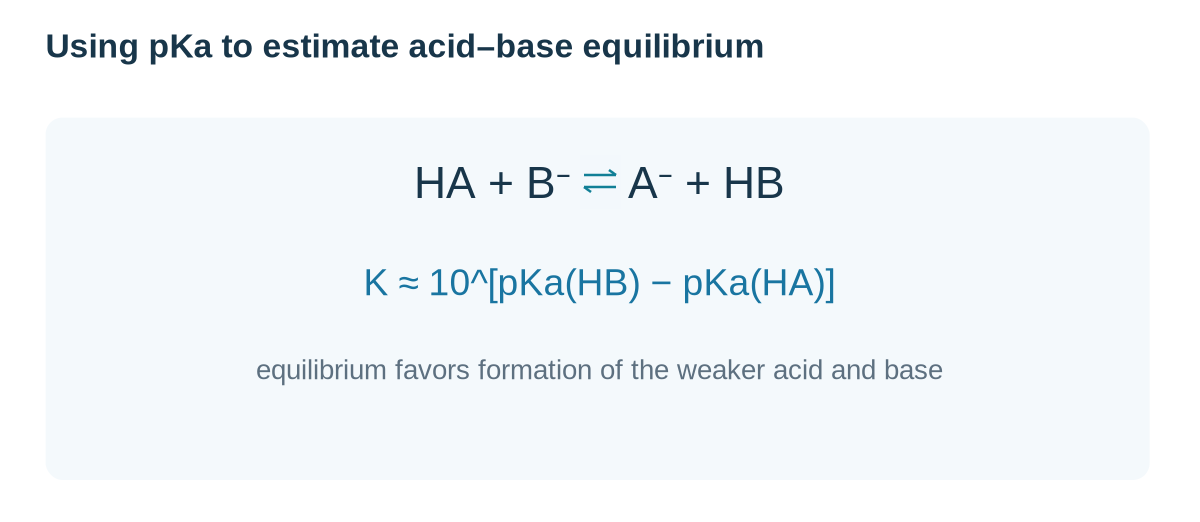
- HA + B⁻ ⇌ A⁻ + HB
- K ≈ 10^[pKa(HB) − pKa(HA)]
- Products are favored when the product-side acid HB has a substantially higher pKa than HA.
- The estimate is most reliable when the pKa values refer to comparable solution conditions.
c. Resonance stabilization
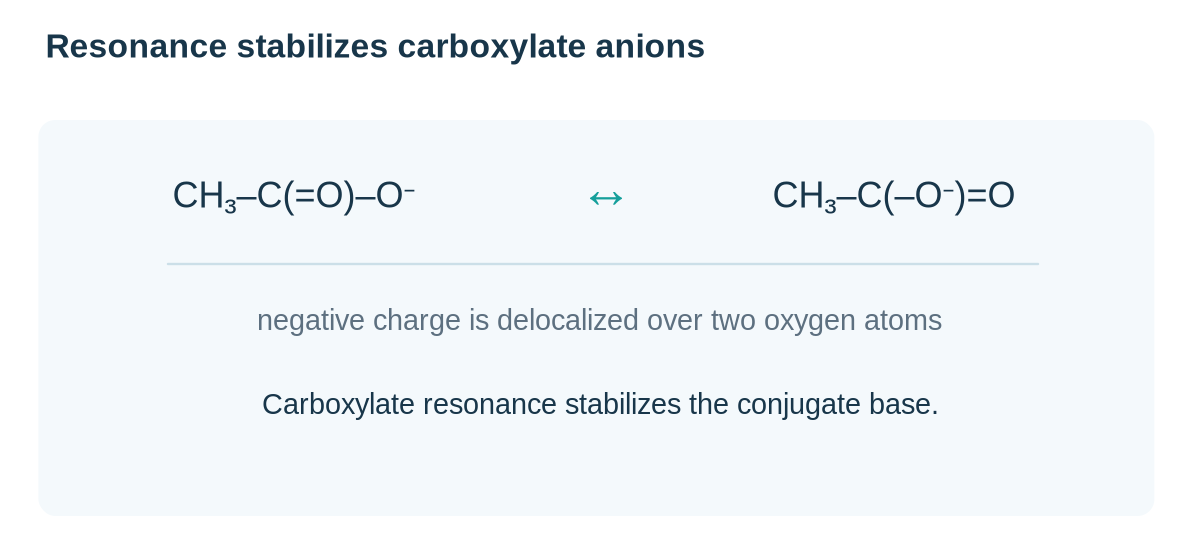
- A carboxylate anion distributes its negative charge over two oxygen atoms through resonance.
- Resonance contributors retain the same atom connectivity; resonance is not a chemical equilibrium between different molecules.
- The increased stability of carboxylate helps explain why carboxylic acids are usually more acidic than comparable alcohols.
d. Equilibrium direction
- For HA + B⁻ ⇌ A⁻ + HB, K is approximately 10^[pKa(HB) − pKa(HA)] when the pKa values refer to compatible conditions.
- Equilibrium favors the side with the weaker acid and weaker base. pKa values depend on solvent and should be compared on a consistent scale.
| Acid family | Approximate pKa |
|---|---|
| Carboxylic acid | 4–5 |
| Phenol | 10 |
| Water / simple alcohol | about 16 |
| Ketone α-H | about 19–21 |
| Terminal alkyne | about 25 |
| Alkane | about 50 |
e. Atom, resonance and induction
- Across a row, a more electronegative atom often stabilizes negative charge better; down a group, size and polarizability can dominate.
- Resonance and nearby electron-withdrawing substituents can stabilize a conjugate base. An inductive effect generally weakens with distance.
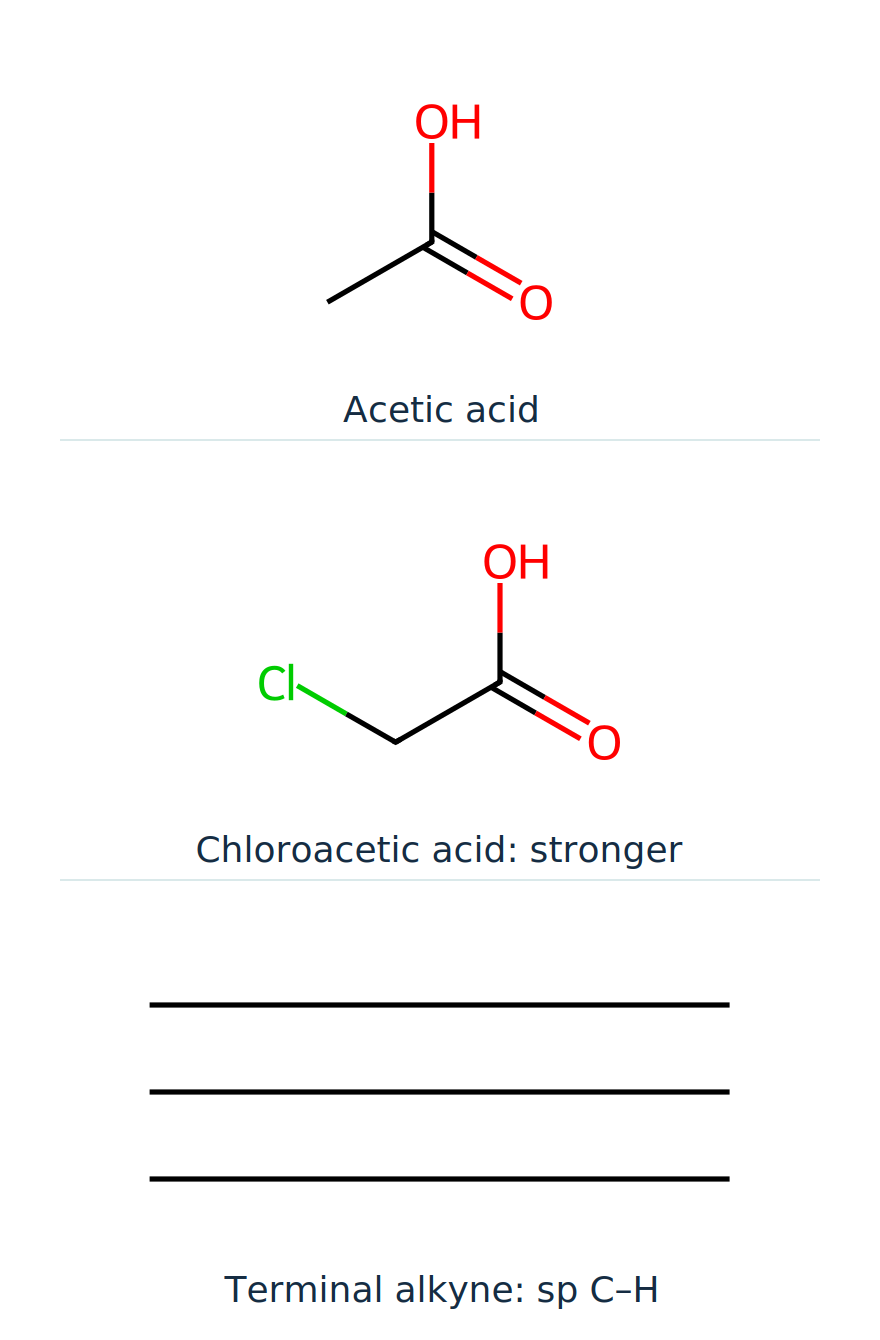
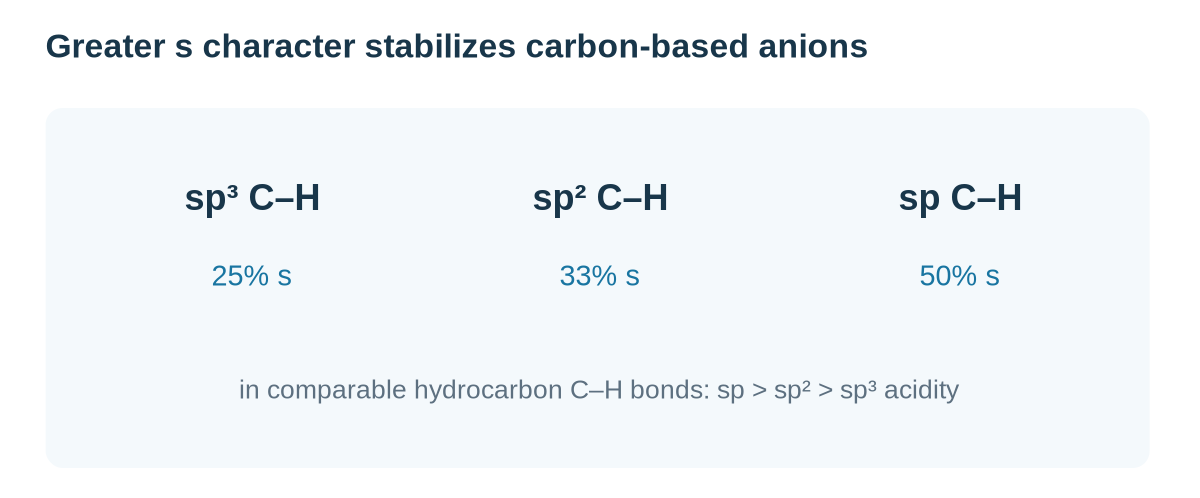
- Greater s character can stabilize a carbon-centered anion. Across a row, identify the atom bearing charge; down a group, size and polarizability can dominate electronegativity. Induction and resonance can act together, so the dominant effect depends on the actual structure.
- Electron withdrawal through σ bonds can stabilize a nearby negative charge and strengthen the parent acid; the inductive effect generally decreases with distance.

- For otherwise comparable carbon acids, conjugate-base stabilization follows sp > sp² > sp³. Terminal alkynes are more acidic than typical alkenes or alkanes, but hydroxide is still too weak for efficient acetylide formation.
| Structural feature | Acidity implication | Representative comparison |
|---|---|---|
| Resonance delocalization | Can stabilize conjugate base | Carboxylic acid vs. alcohol |
| Inductive withdrawal | Often increases acidity | Chloroacetic vs. acetic acid |
| Greater s character at carbon | Stabilizes C-based conjugate base | Terminal alkyne vs. alkene |
| Charge location and atom identity | Changes anion stability | O-centered vs. C-centered anion |
f. Structural effects on acidity
- Assess conjugate-base stabilization using Atom, Resonance, Induction, Orbital (ARIO); solvent and neighboring groups can change outcomes. Carboxylic acids (~4–5) are much stronger acids than phenols (~10), water (15.7), ordinary alcohols (~16–18), and terminal alkynes (~25). Electron-withdrawing substituents can strengthen an aromatic acid or phenol.
- These pKa values are approximate and depend on solvent and experimental conditions.
D. Molecular Polarity and Physical Properties
1. Dipoles, intermolecular forces and ionization
a. Electronegativity, partial charge and molecular dipole
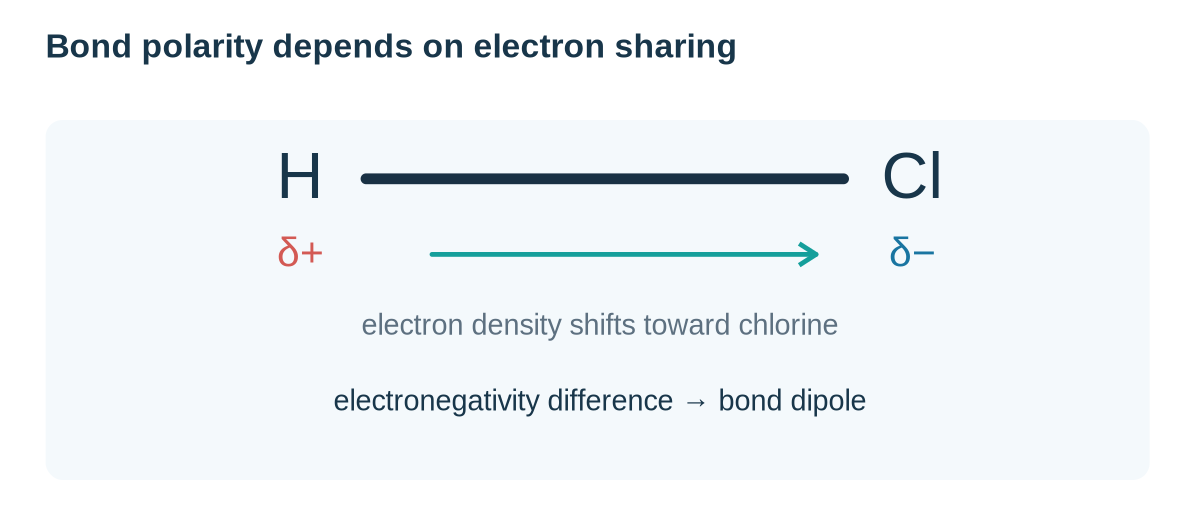
- Electronegativity describes an atom’s attraction for shared bonding electrons. Unequal sharing polarizes a bond toward the more electronegative atom and creates partial charges (δ+ and δ−), without implying complete electron transfer.
- The molecular dipole is the vector sum of the bond dipoles and depends on molecular geometry. Symmetry can cancel the individual dipoles, so polar bonds do not necessarily give a polar molecule.

b. Chemical behavior
- Alkanes are relatively unreactive toward many polar reagents under ordinary conditions.
- They undergo combustion with oxygen and can undergo radical halogenation under suitable conditions.
- Combustion of a hydrocarbon forms CO₂ and H₂O under complete combustion conditions.
c. Attractions between molecules
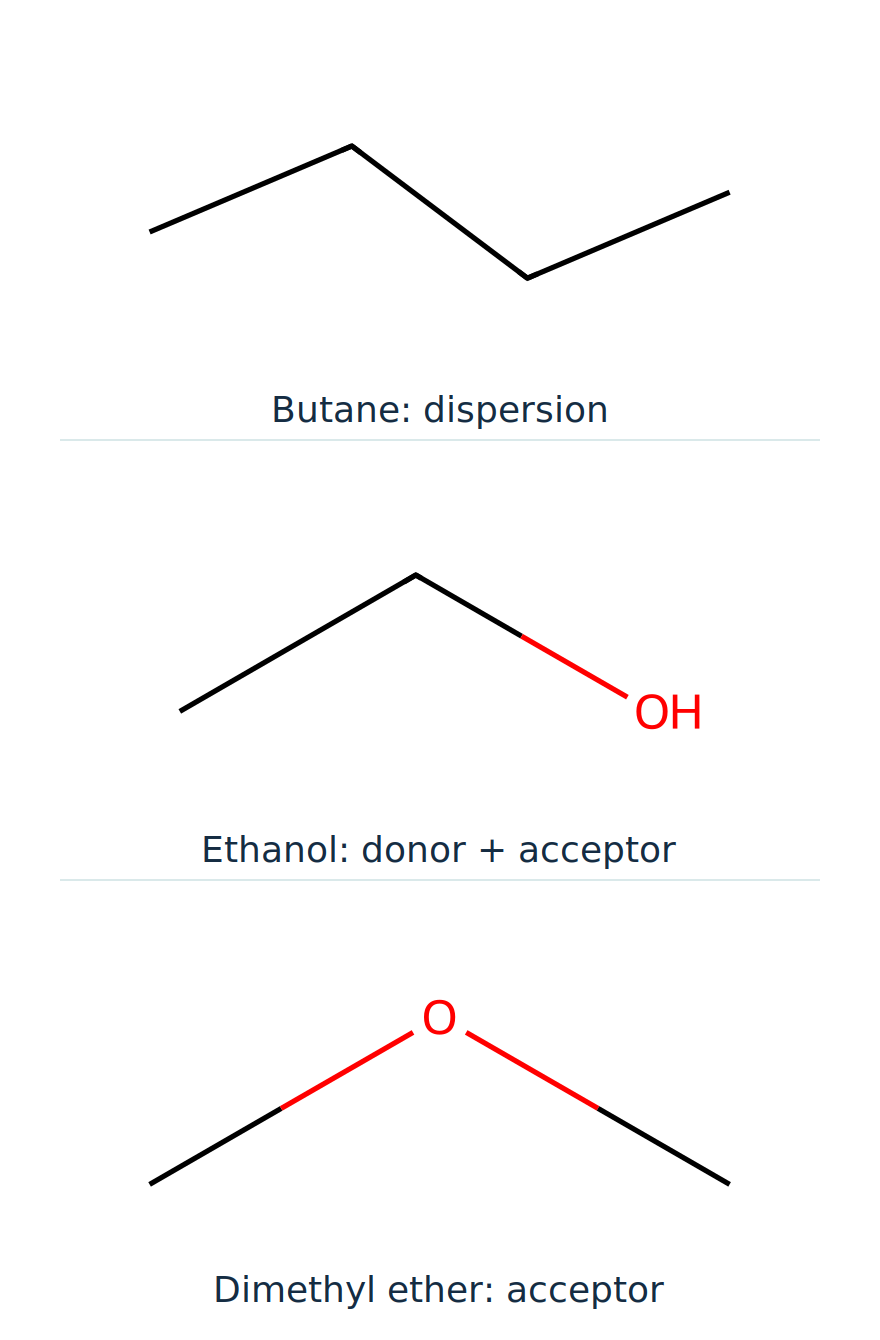
- London dispersion forces occur in all molecules and usually increase with polarizability and contact area. Permanent dipoles add dipole–dipole attractions.
- Hydrogen bonding requires a suitable donor, typically O–H or N–H, and an electron-pair acceptor. An ether accepts hydrogen bonds from water but cannot donate one to another ether.
d. Comparing related structures
- Among isomeric alkanes, branching often lowers boiling point by reducing surface contact. A longer hydrocarbon chain usually raises boiling point.
- A polar functional group helps water solubility, but a growing nonpolar carbon skeleton works against it. Melting points also depend strongly on packing and symmetry.
| Interaction | Structural requirement |
|---|---|
| Dispersion | All molecules |
| Dipole–dipole | Permanent molecular dipole |
| Hydrogen bonding | Donor and acceptor partners |
- Alkanes are largely nonpolar and interact mainly through London dispersion forces. Within a homologous series, molecular size and surface contact influence boiling point.

- Ionization and pH can dominate water solubility. Alcohols and amines can hydrogen-bond, but not every lone pair is an available acceptor; amide nitrogen is an important exception.
e. Extraction
- Aqueous bicarbonate extracts carboxylic acids as carboxylates; strong acid converts an amine to an ammonium salt.
- Acid–base extraction changes protonation and charge to alter partitioning between organic and aqueous layers.