
CH 4. Substitution & Elimination
A. Alkyl Halides
1. Classification and preparation
a. Structure and nomenclature
- An alkyl halide has a halogen attached to an sp³-hybridized carbon: R–X, where X is usually Cl, Br, or I.
- In systematic names, halo substituents receive prefixes such as fluoro-, chloro-, bromo-, and iodo-. Number the parent chain to provide appropriate locants.
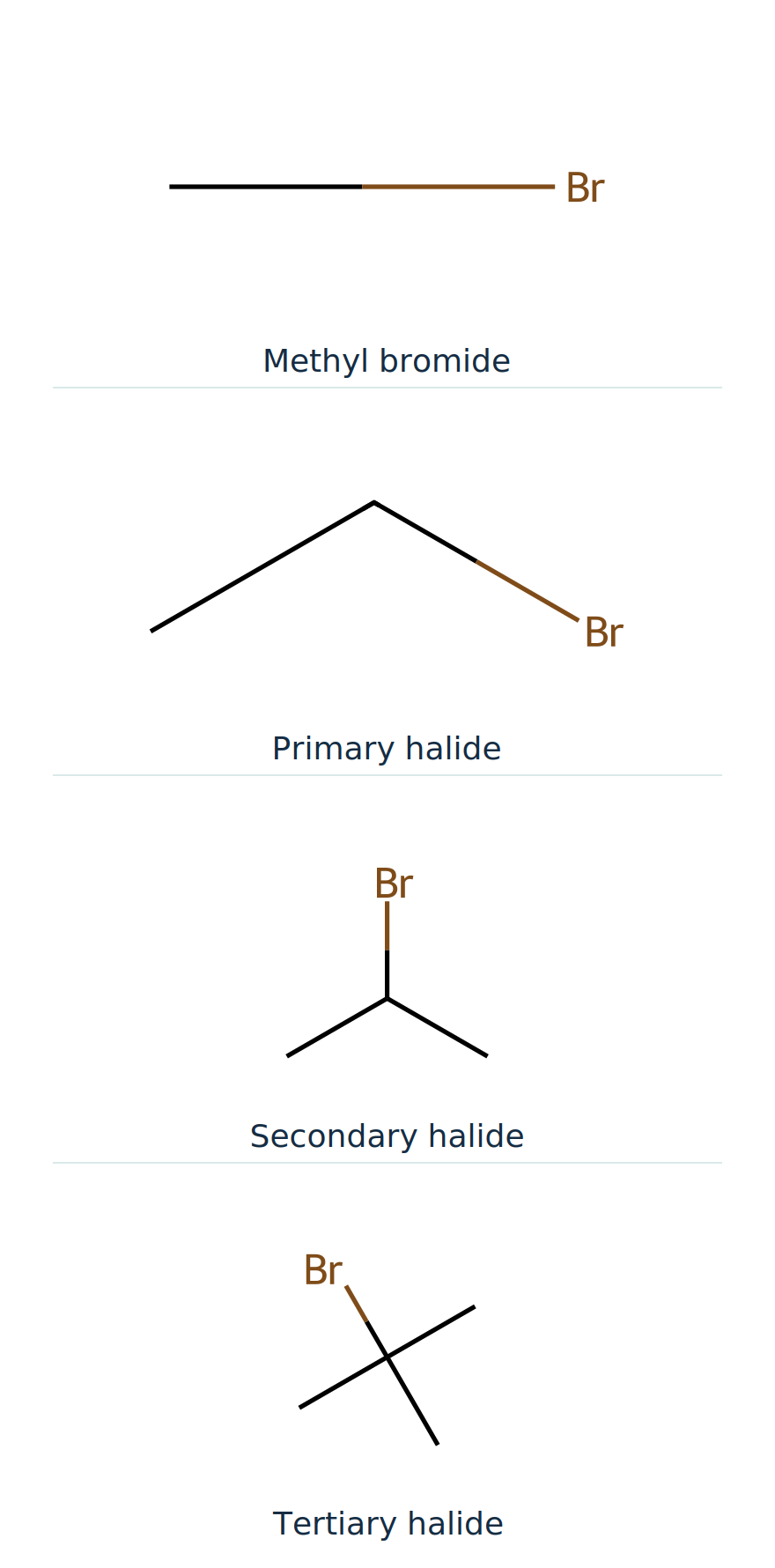
- Methyl, primary, secondary, and tertiary classifications describe the carbon bearing X—not the total number of carbons in the molecule.

b. Common transformations
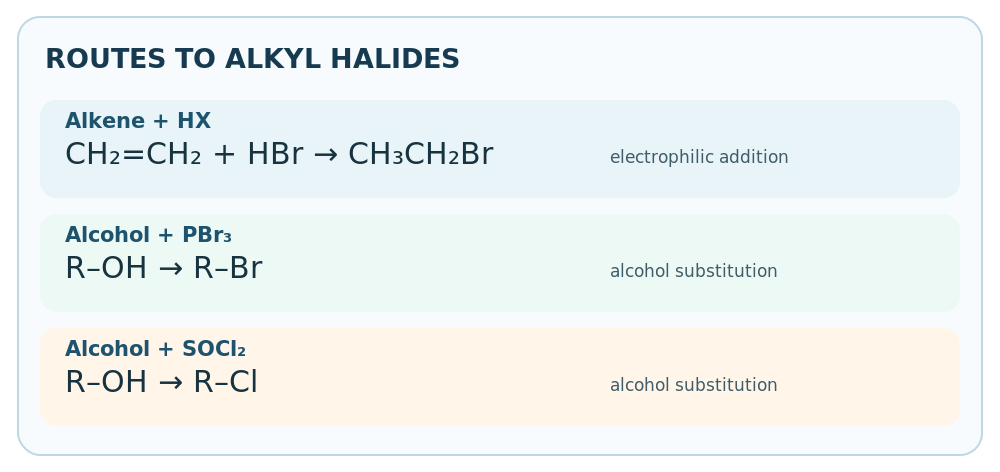
- Addition of HX to an alkene can produce an alkyl halide; substrate and conditions determine regiochemistry and possible rearrangement.
- Free-radical halogenation of alkanes may yield mixtures because different C–H sites can react.
- Alcohols can be converted to alkyl chlorides with SOCl₂ and to alkyl bromides with PBr₃ under suitable conditions.
- Aryl and vinyl halides have the halogen bonded to sp² carbon; their behavior differs markedly from ordinary alkyl halides.
c. Grignard reagent formation
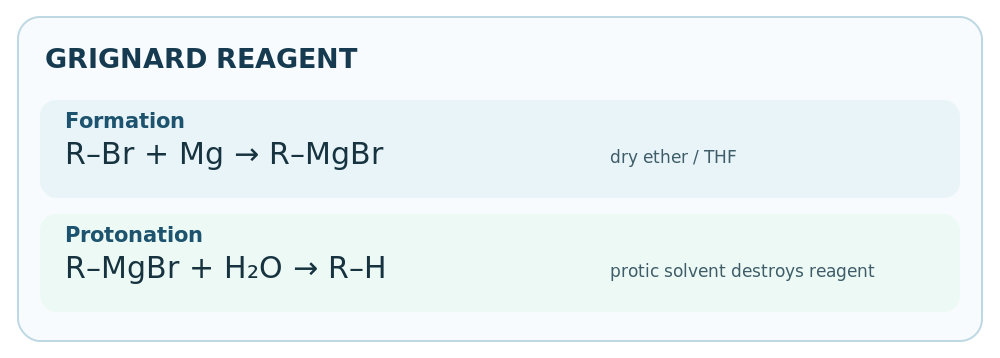
- An alkyl halide can react with Mg in dry ether or THF to form an organomagnesium halide, RMgX.
- The carbon bonded to Mg is strongly nucleophilic and basic in reactions with suitable electrophiles.
- Water, alcohols, and other protic substances destroy Grignard reagents by proton transfer; dry glassware and solvent are therefore important.
d. Electrophilic carbon
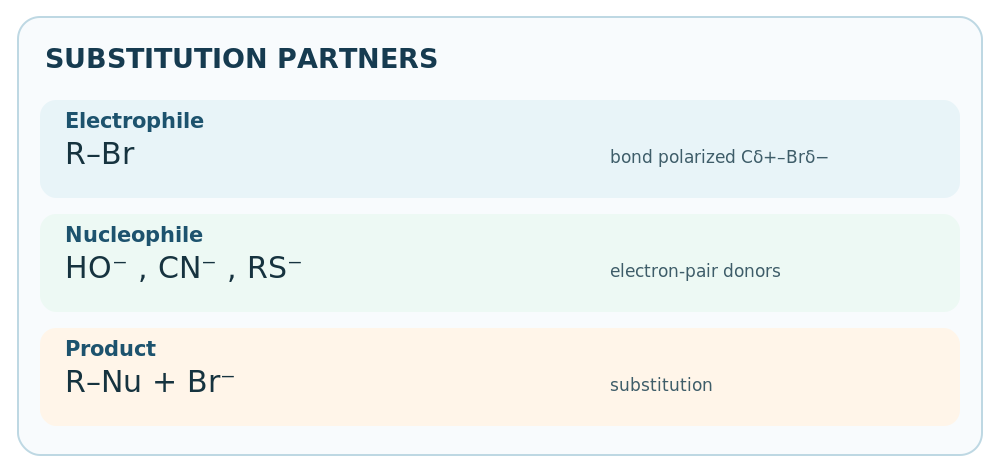
- In an alkyl halide, C–X polarization makes the sp³ carbon susceptible to nucleophilic attack. Methyl, primary, secondary and tertiary describe substitution at that carbon.
- Vinyl and aryl halides have X on an sp² carbon and do not behave like ordinary alkyl halides in SN1/SN2. Allylic and benzylic substrates can be unusually reactive.
B. Nucleophiles and Leaving Groups
1. Competing nucleophilic and basic roles
a. Substitution terminology
- A nucleophile donates an electron pair to an electrophilic carbon; the C–X bond breaks as the leaving group departs.
- Anions such as HO⁻, RO⁻, CN⁻, and RS⁻ are common nucleophiles, while neutral species such as H₂O and NH₃ also react.
- Leaving-group ability generally improves when the departing species is relatively stable: for alkyl halides, I⁻ > Br⁻ > Cl⁻ ≫ F⁻ is a useful qualitative trend.
- Leaving-group ability is not the same property as nucleophilicity; solvent, steric hindrance, and polarizability affect the latter.
b. Nucleophile versus base
- A nucleophile attacks an electrophilic atom; a base removes a proton. One reagent can do both. Steric bulk can hinder carbon attack while still allowing proton removal.
- Good leaving groups are usually weak bases. Halide leaving-group ability in common alkyl substitution follows I⁻ > Br⁻ > Cl⁻ ≫ F⁻; unactivated OH⁻ is poor.
- Sulfonate esters can provide good leaving groups; substrate and solvent still affect practical reaction rates.
C. SN1 / SN2
1. Displacement pathways and stereochemistry
a. SN2: concerted displacement, rate and inversion
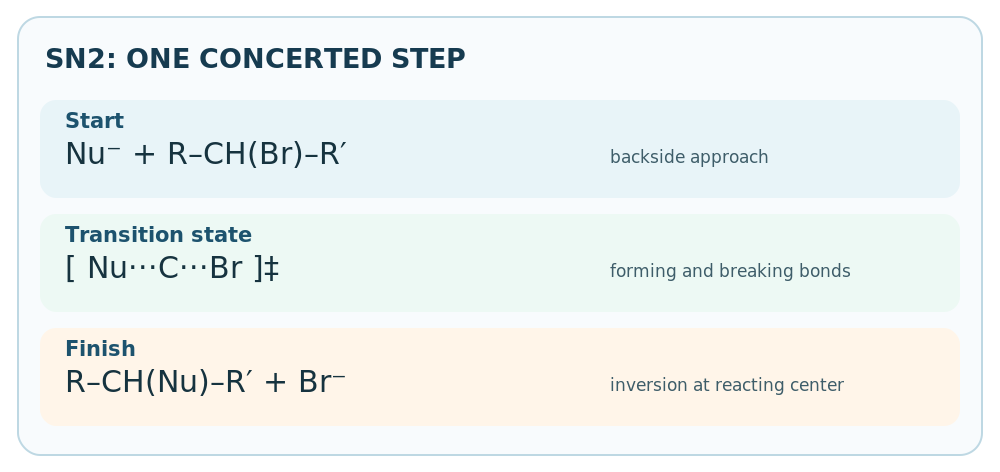
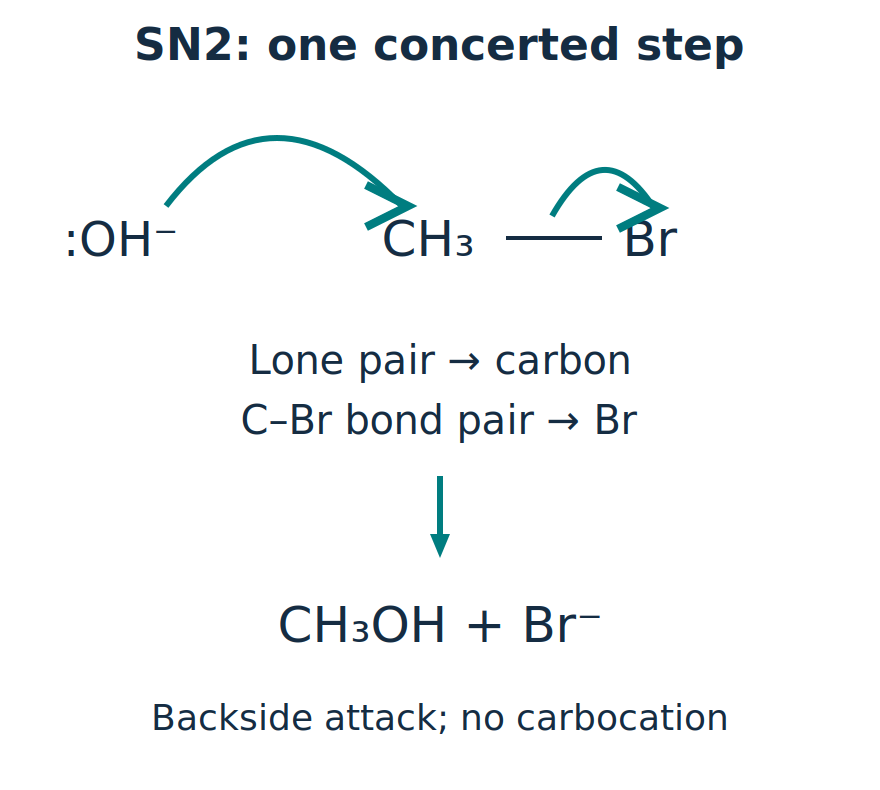
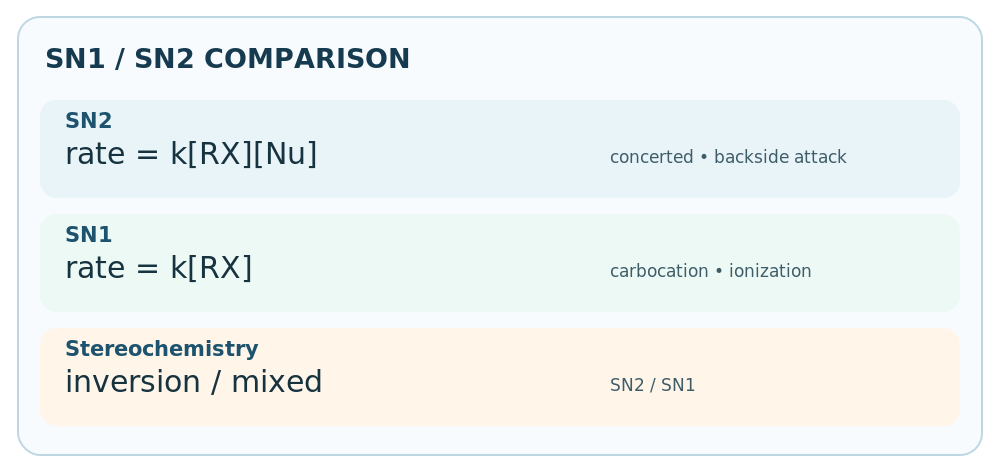
- In SN2, a nucleophile approaches the electrophilic carbon opposite the leaving group. Formation of the new bond and cleavage of C–X occur together through one transition state, without a discrete carbocation.
- The simple rate law is rate = k[RX][Nu]. Steric crowding suppresses attack: accessible methyl and primary substrates generally react more readily than secondary substrates, while tertiary alkyl halides are extremely unfavorable for ordinary SN2.
- Backside displacement inverts a stereogenic reaction center. An R/S descriptor need not change, because replacing a substituent can change the CIP priorities.
- Polar aprotic solvents often increase the reactivity of anionic nucleophiles; ion pairing and the particular reagent system can alter the trend.
| Feature | SN2 |
|---|---|
| Steps | One concerted displacement |
| Rate | k[RX][Nu] |
| Geometry | Backside attack; inversion |
| Rearrangement | No carbocation rearrangement |
b. SN1: ionization, carbocation stability and capture
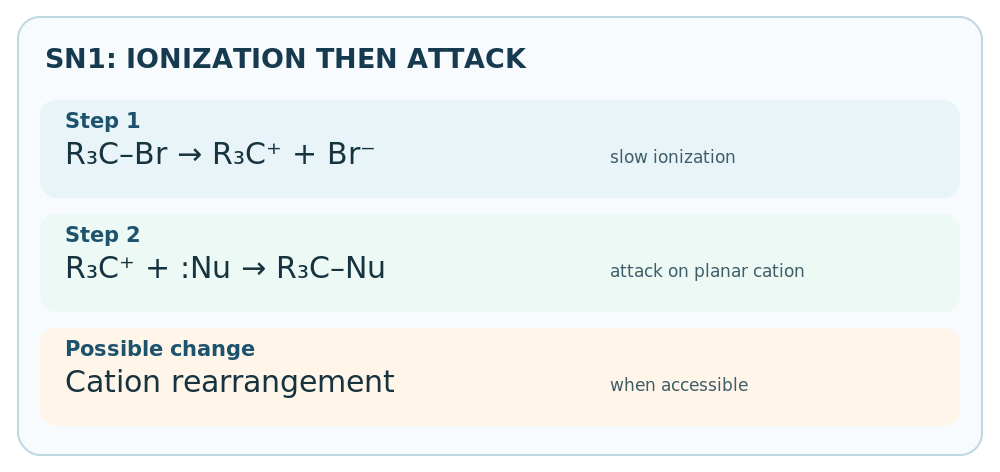
- Leaving-group departure forms a carbocation before nucleophile capture. In the idealized SN1 pathway, ionization is rate determining and rate = k[RX].
- Tertiary, benzylic and allylic substrates can favor SN1 when they form stabilized carbocations; ordinary methyl and primary alkyl carbocations are unfavorable.
- A planar carbocation permits attack from either face, often giving partial racemization rather than an exactly equal mixture. Hydride or alkyl shifts may compete when the rearranged pathway is favorable.
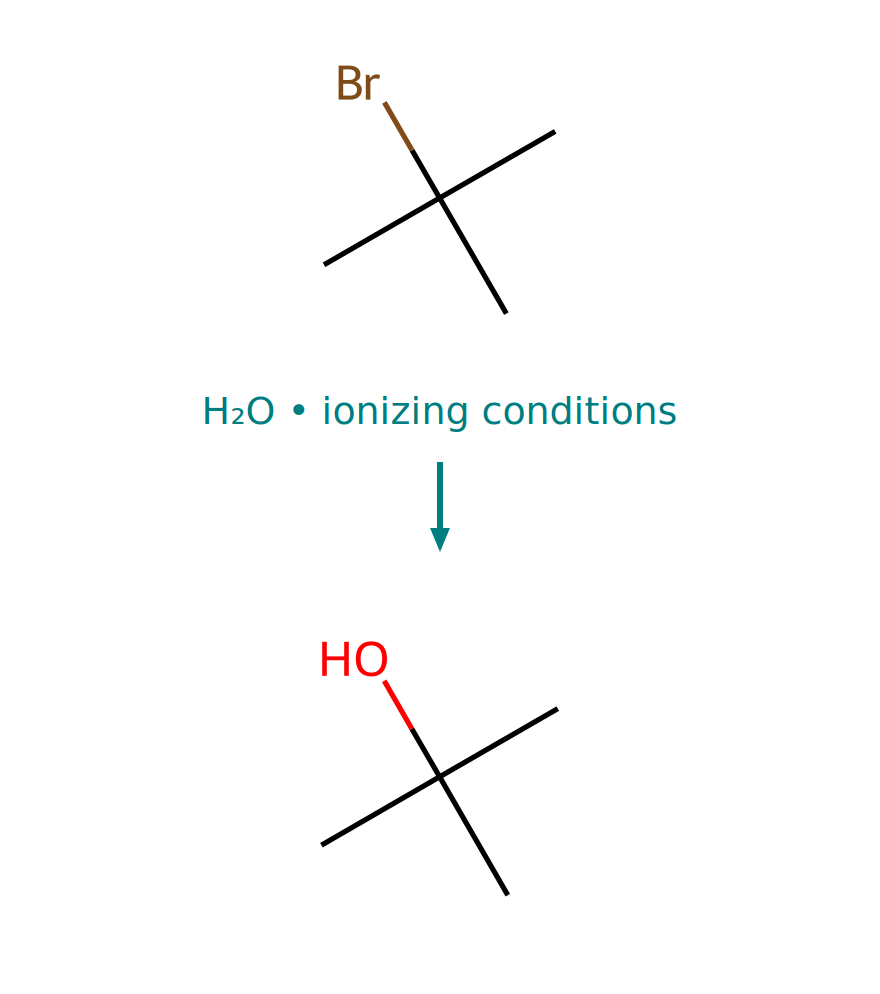
- Ion pairs or solvent cages can bias attack on a carbocation, explaining incomplete racemization. Polar ionizing solvents and good leaving groups assist ionization.
D. E1 / E2
1. Elimination pathways and geometry
a. Beta elimination
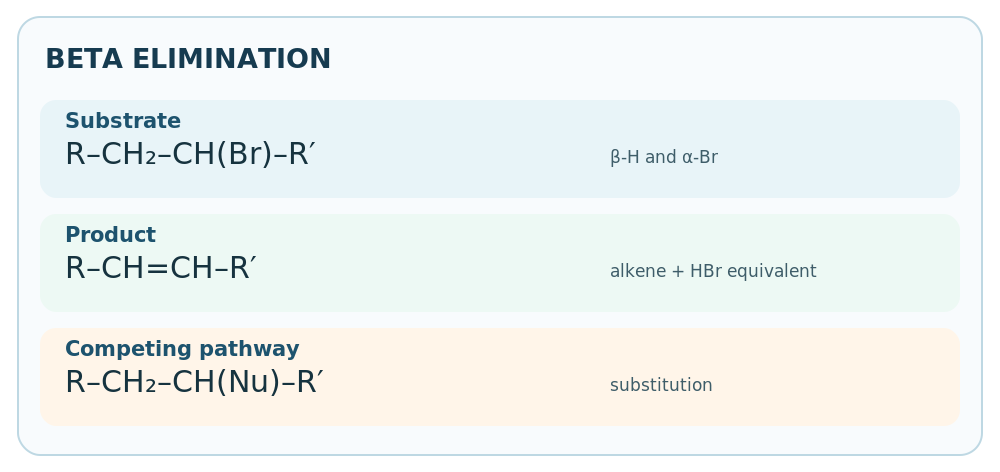
- Elimination removes a hydrogen from a β carbon and a leaving group from the adjacent α carbon, generating a C=C bond.
- Elimination competes with substitution because the same nucleophile may also act as a Brønsted base.
- Orientation and stereochemistry matter: different β hydrogens can lead to different alkene regioisomers.
b. E2: concerted beta elimination and anti geometry
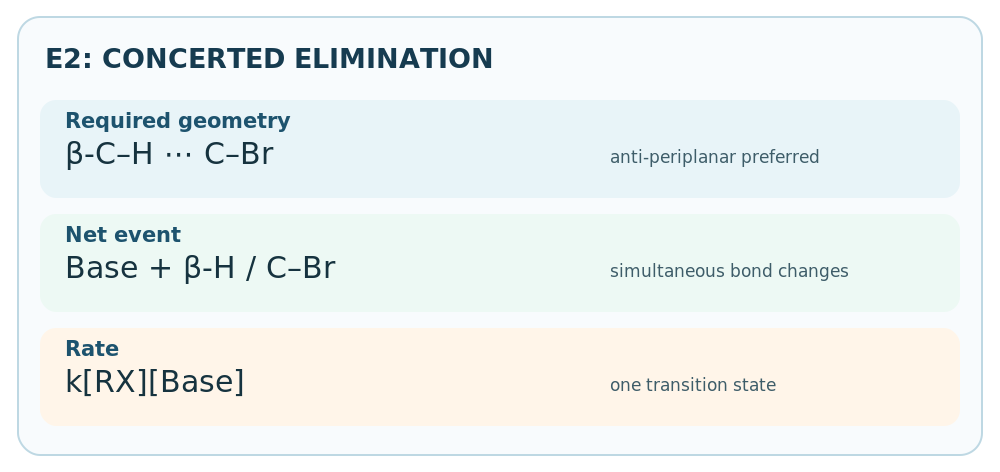
- A base removes a β hydrogen while its C–H electrons form C=C and the C–X bond breaks in the same step. The simple bimolecular rate law is rate = k[RX][Base].
- For an ordinary acyclic substrate, an anti-periplanar H–C–C–X arrangement provides favorable orbital overlap. In cyclohexane, the reactive chair normally requires a trans-diaxial β-H and leaving group.
- A small base often favors the more substituted Zaitsev alkene; a bulky base can favor the less substituted Hofmann alkene. Accessible geometry and the presence of an appropriate β-H must be checked.

c. Carbocation-mediated pathway
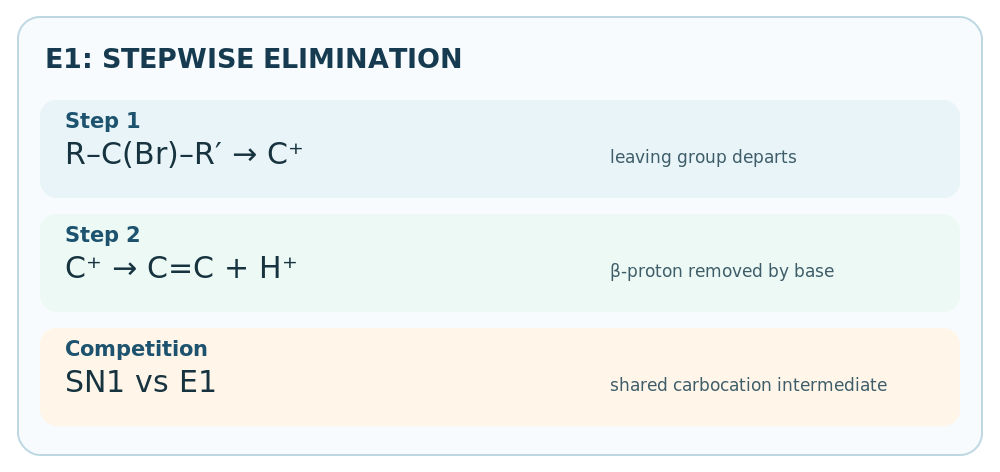
- Leaving-group departure creates a carbocation, after which a base removes a β proton to form the alkene.
- The observed idealized rate is rate = k[RX], because ionization is rate-limiting.
- E1 commonly competes with SN1 under ionizing conditions and can undergo carbocation rearrangements.
- Heat often increases the proportion of elimination relative to substitution on a suitable substrate, but does not guarantee a single mechanism.
- Substrate and solvent still affect the balance between E1 and competing substitution, even when heating increases the importance of elimination.

- E1 can compete with SN1 under heated ionizing conditions with a weak nucleophile or base when the substrate can form a carbocation.
d. Regioselectivity
- A small base often favors the more substituted Zaitsev alkene when geometry permits. A bulky base can favor the less substituted Hofmann product.
- Conjugation and the accessible anti geometry can outweigh a simple substitution rule. A substrate with no suitable β-H cannot follow ordinary E2.
| Factor | Consequence |
|---|---|
| Strong base | Promotes E2 |
| Bulky base | Often favors less substituted alkene |
| Anti-periplanar H/LG | Required accessible geometry |
| Cyclohexane chair | Usually trans-diaxial elimination |
e. Rearrangement and selectivity
- The carbocation can rearrange before deprotonation. More stable alkenes commonly predominate if accessible.
- E1 lacks the concerted anti-periplanar requirement of E2. The pathway nevertheless needs an appropriate β-H for alkene formation.
E. Solvent, Substrate and Stereochemical Effects
1. Competition between reaction pathways
a. Reaction variables
- Strong nucleophiles and relatively unhindered substrates commonly favor SN2.
- Polar protic solvents can stabilize ions and often favor ionization pathways on suitable substrates; polar aprotic solvents frequently enhance anionic nucleophile reactivity in SN2.
- Substrate structure, nucleophile strength, leaving group, solvent, and temperature must be considered together; the labels SN1/SN2 are limiting models, not universal predictions.
b. Competitive pathways
- Primary substrates with unhindered nucleophiles generally favor SN2; strong bulky bases can instead favor E2.
- Secondary substrates show the greatest competition among SN2, E2, and sometimes SN1/E1, depending on conditions.
- Tertiary alkyl halides cannot undergo ordinary backside SN2; strong bases tend to promote E2, while ionizing conditions can promote SN1/E1.
- Use an actual β-hydrogen check before predicting elimination: without a suitable β hydrogen, an elimination pathway may be unavailable.

- A methyl substrate can undergo SN2 with a competent nucleophile but cannot undergo ordinary β-elimination.
c. Product patterns
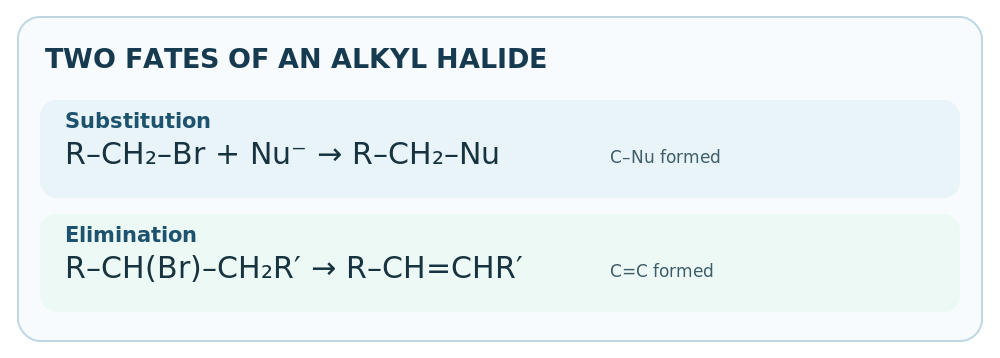
- With a nucleophile, C–X replacement forms a new carbon–heteroatom or carbon–carbon bond depending on the nucleophile.
- With a base, removal of β-H along with X leads to the alkene framework.
- Elimination forms a π bond; substitution preserves the original carbon skeleton unless rearrangement is part of an ionization pathway.
d. Three-dimensional constraints
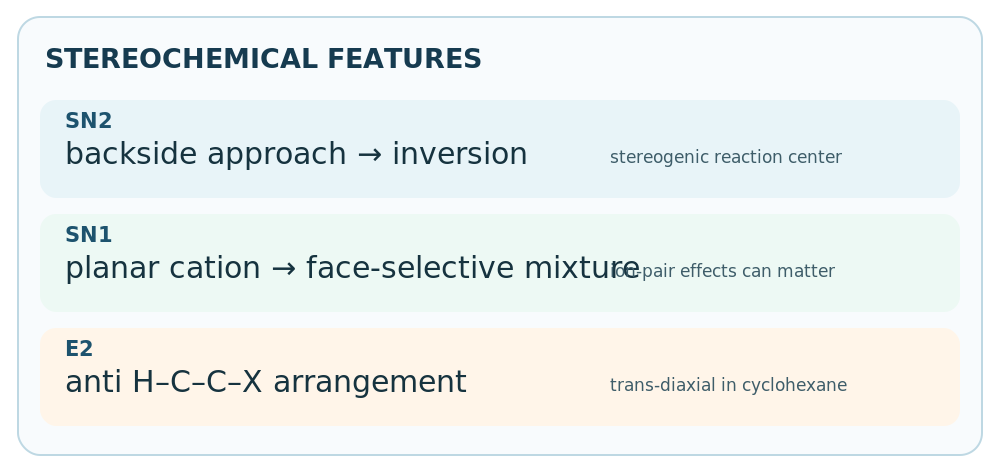
- SN2 reactions involve backside attack and inversion at the carbon being attacked.
- SN1 reactions proceed through a planar carbocation and may show mixed stereochemical outcomes.
- E2 elimination requires a suitable geometry between the β-C–H bond and the departing C–X bond; in a cyclohexane chair this is commonly trans-diaxial.
- The geometry of the starting material can control the specific E/Z alkene or cycloalkene substitution pattern formed.
e. Mechanistic distinctions
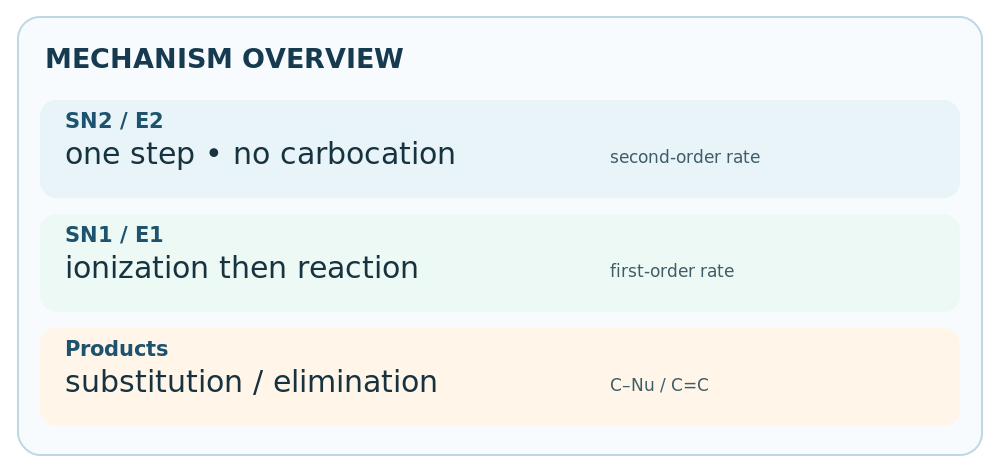
- SN2 and E2 are concerted, bimolecular pathways; SN1 and E1 are stepwise, unimolecular pathways.
- Carbocations appear in SN1 and E1, but not as discrete intermediates in ordinary SN2 or E2.
- SN1/E1 generally tolerate weaker nucleophiles or bases on substrates capable of ionizing; SN2/E2 depend strongly on the incoming nucleophile or base.
f. General distinctions
| Mechanism | Rate | Core event | Stereochemical note |
|---|---|---|---|
| SN2 | k[RX][Nu] | Concerted substitution | Inversion at reactive center |
| SN1 | k[RX] | Carbocation formation | Often mixed stereochemical outcome |
| E2 | k[RX][Base] | Concerted beta elimination | Anti-periplanar requirement |
| E1 | k[RX] | Carbocation followed by proton loss | May rearrange |
g. Reagent dependence
- A strong, unhindered nucleophile that is a weak base can favor substitution; a bulky strong base favors elimination.
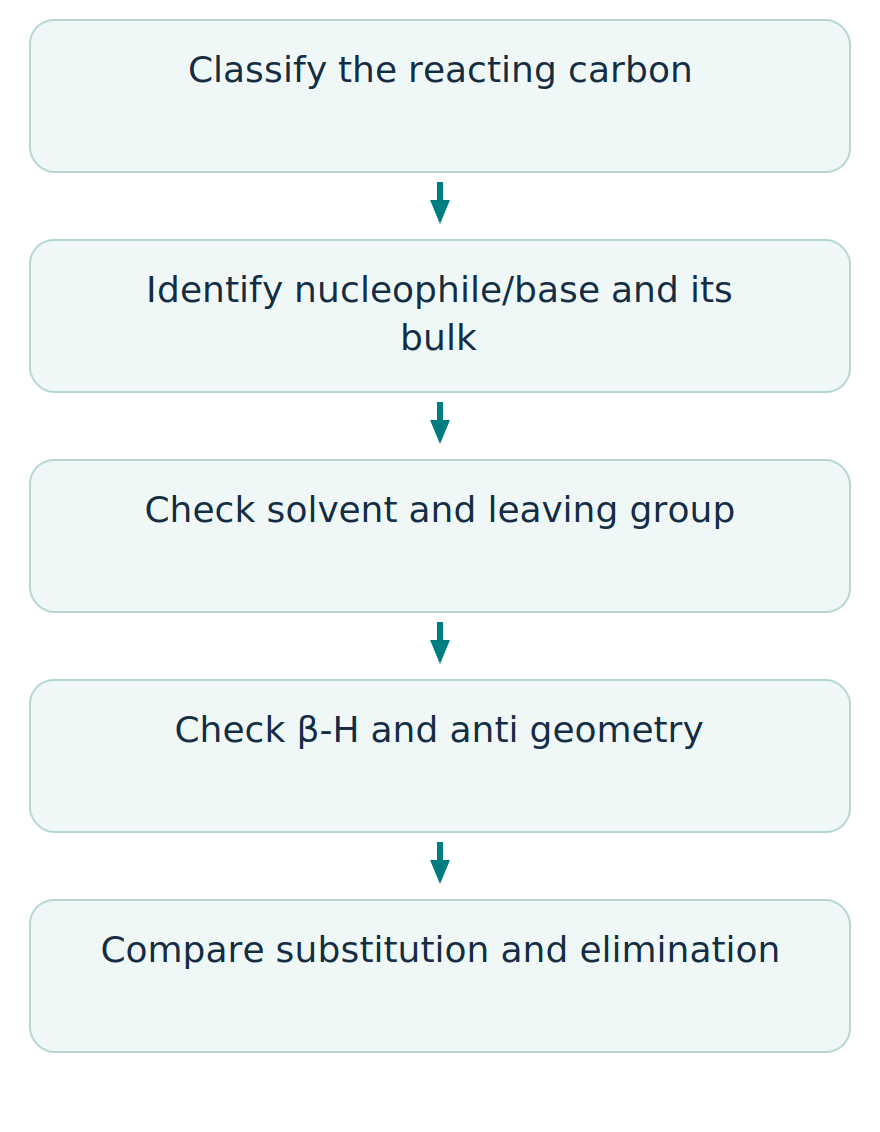
- Assess leaving group, resonance stabilization, β-H geometry, solvent and temperature together. A single primary/secondary/tertiary label is insufficient.
| Mechanism | Intermediate | Simple rate law |
|---|---|---|
| SN2 | None | k[RX][Nu] |
| SN1 | Carbocation | k[RX] |
| E2 | None | k[RX][Base] |
| E1 | Carbocation | k[RX] |
- Heating with strong base can shift competition toward elimination.