
CH 6. Alcohols, Phenols, Ethers & Epoxides
A. Alcohol Properties and Preparation
1. Functional groups, acidity and alcohol synthesis
a. Functional groups
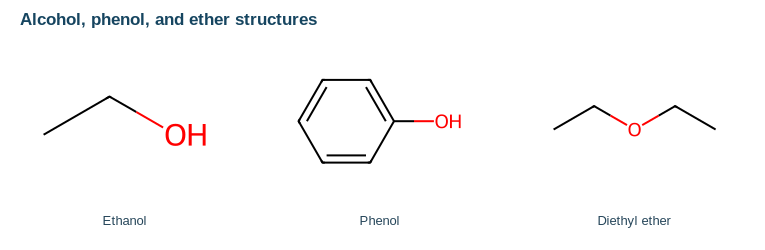
- An alcohol contains a hydroxyl group bonded to a saturated carbon: R–OH.
- In phenols, the O–H group is attached directly to an aromatic ring; a phenol is not simply an ordinary alcohol.
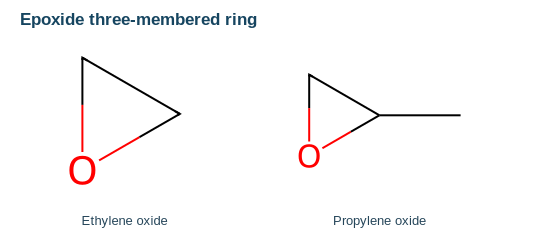
- An ether has an oxygen atom bonded to two carbon groups: R–O–R′. A cyclic ether places that oxygen in a ring.

b. Alcohol classes
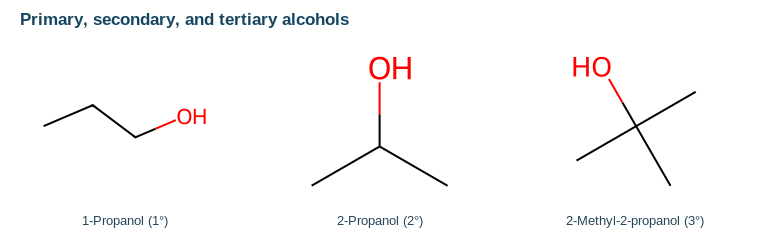
- A primary (1°) alcohol has the OH-bearing carbon attached to one other carbon (methanol is conventionally considered separately).
- A secondary (2°) alcohol has two carbon substituents at its OH-bearing carbon; a tertiary (3°) alcohol has three.
- These labels describe the carbon bearing OH, not the total number of hydroxyl groups.
c. Names and suffixes
- For a simple alcohol, select a carbon parent containing the OH-bearing carbon and use the suffix -ol; number from the end that gives OH the lower locant.
- A molecule with two hydroxyl groups uses the suffix -diol; for example, ethane-1,2-diol.
- Phenol is a retained parent name. Ethers may be named as alkoxy substituents on the longer carbon parent, such as methoxyethane.
d. Intermolecular attraction
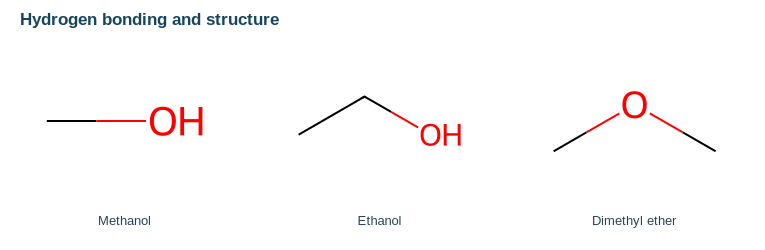
- O–H groups act as both hydrogen-bond donors and acceptors; alcohols and phenols can associate by hydrogen bonding.
- Ethers accept hydrogen bonds from water but lack an O–H bond, so pure ethers cannot donate conventional O–H hydrogen bonds to one another.
- For compounds of similar molar mass, hydrogen bonding often raises alcohol boiling points relative to ethers or hydrocarbons.
e. Solubility in water
- Small alcohols dissolve readily in water, but solubility generally falls as the hydrophobic carbon portion grows.
- Additional hydroxyl groups increase opportunities for hydrogen bonding with water.
f. Acid-base reactions
- Strong bases such as sodium hydride can convert many alcohols to alkoxides, releasing hydrogen gas.
- Phenol can be deprotonated by aqueous hydroxide under suitable conditions, while most simple alcohols are not extensively deprotonated by hydroxide in water.
g. Aldehydes and ketones
- Reduction of an aldehyde gives a primary alcohol; reduction of a ketone gives a secondary alcohol.
- NaBH₄ commonly reduces aldehydes and ketones in compatible protic solvents; LiAlH₄ is more reactive and requires anhydrous reaction conditions followed by a controlled aqueous workup.
- The carbonyl carbon becomes tetrahedral after hydride addition and protonation.

- LiAlH₄ also reduces many carboxylic acids and acyl derivatives. Hydride addition supplies H rather than a new carbon group.
h. Grignard and organolithium addition
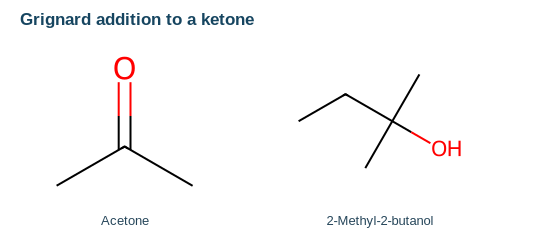
- Organometallic carbon attacks an electrophilic carbonyl carbon; protonation during workup converts alkoxide to alcohol.
- Formaldehyde gives a primary alcohol, other aldehydes secondary, and ketones tertiary. Water, O–H, N–H and other sufficiently acidic protons consume the reagent before the desired addition.
| Carbonyl partner | After RMgX and workup |
|---|---|
| Formaldehyde | Primary alcohol |
| Other aldehyde | Secondary alcohol |
| Ketone | Tertiary alcohol |
| Ester, excess reagent | Usually tertiary alcohol; two additions |

- Generate the alkoxide under dry reaction conditions and protonate it only during the separate workup.

B. Oxidation, Substitution and Dehydration
1. Alcohol transformations and vicinal diols
a. Primary and secondary alcohols
- A primary alcohol can be oxidized to an aldehyde under suitable anhydrous mild conditions, such as PCC, or further to an acid under suitable aqueous oxidizing conditions.
- Secondary alcohols oxidize to ketones. A tertiary alcohol lacks the carbinol C–H needed for ordinary alcohol-to-carbonyl oxidation.
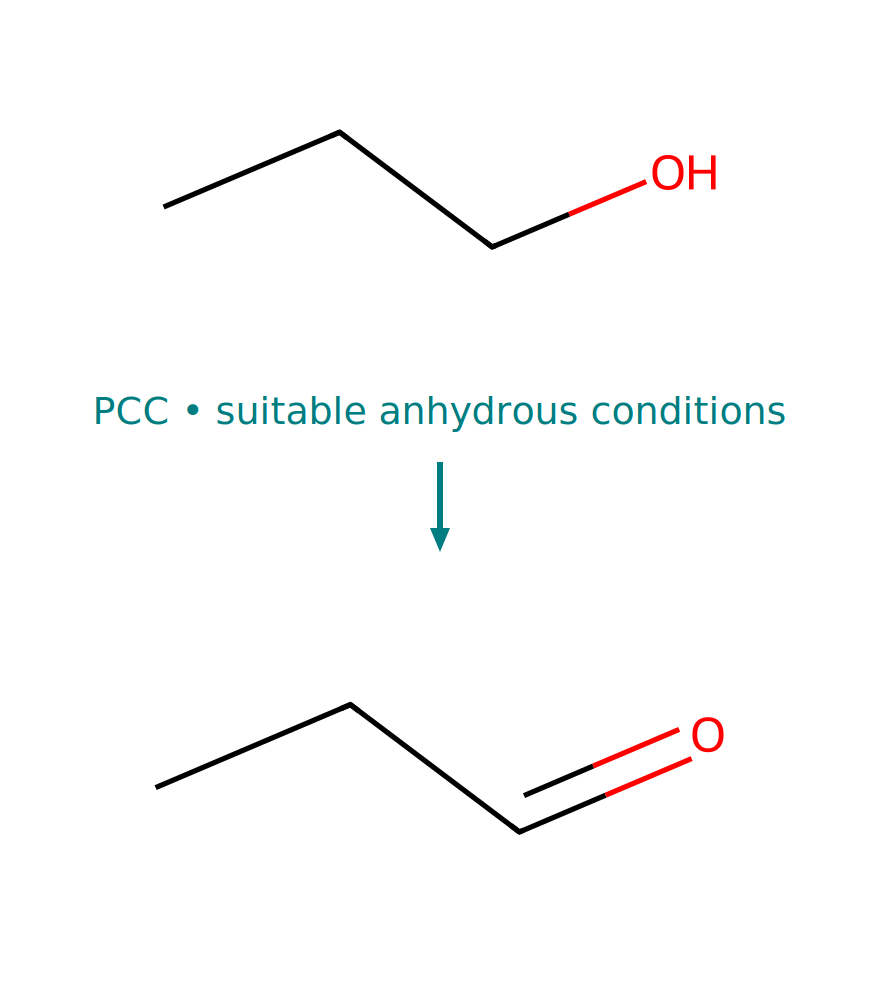
- An ordinary tertiary alcohol lacks the carbinol C–H required for alcohol-to-carbonyl oxidation; substantial oxidation would require a different pathway, such as C–C cleavage.

- Reagent identity, water and workup determine whether a primary-alcohol oxidation stops at an aldehyde or continues to an acid.
| Starting alcohol | Typical oxidation product |
|---|---|
| Primary + PCC | Aldehyde |
| Primary + aqueous strong oxidant | Carboxylic acid |
| Secondary | Ketone |
| Tertiary | No ordinary simple C=O conversion |
| Starting material | Mild/controlled oxidation | Further oxidation |
|---|---|---|
| Primary alcohol | Aldehyde | Carboxylic acid under suitable stronger/aqueous conditions |
| Secondary alcohol | Ketone | Usually no further oxidation under ordinary conditions |
| Tertiary alcohol | No ordinary carbonyl-forming oxidation | C–C cleavage required for substantial oxidation |
- PCC or Dess–Martin conditions commonly give an aldehyde from a primary alcohol and a ketone from a secondary alcohol. Jones/chromic acid or other strong aqueous oxidants can carry a primary alcohol to a carboxylic acid.
b. Making a leaving group
- Protonation converts OH into water, a much better leaving group. HX can therefore replace OH, with mechanism depending on substrate.
- PBr₃ converts many primary/secondary alcohols to bromides by displacement, commonly with inversion at a reacting stereocenter. SOCl₂ outcomes depend on conditions. Tosylation modifies O while retaining the carbon–oxygen bond.
- Alcohol oxygen can also form carboxylate, sulfate, nitrate or phosphate esters under appropriate conditions; these retain the carbon–oxygen bond and differ from substitution at carbon.

- Acid-promoted alcohol substitution involving a carbocation can allow rearrangement.
- Alcohol leaving-group activation uses reagents such as SOCl₂, PBr₃ or tosylation; retain the reagent-specific stereochemical distinctions.
c. Elimination
- Acid and heat can dehydrate an alcohol. Secondary/tertiary substrates often follow carbocation pathways with possible rearrangement; primary alcohols generally avoid a free primary carbocation.
- Product formation depends on accessible β-H atoms, alkene stability and reaction conditions. Conversion to a sulfonate followed by strong base offers an alternative elimination route.

d. Vicinal diol reactions
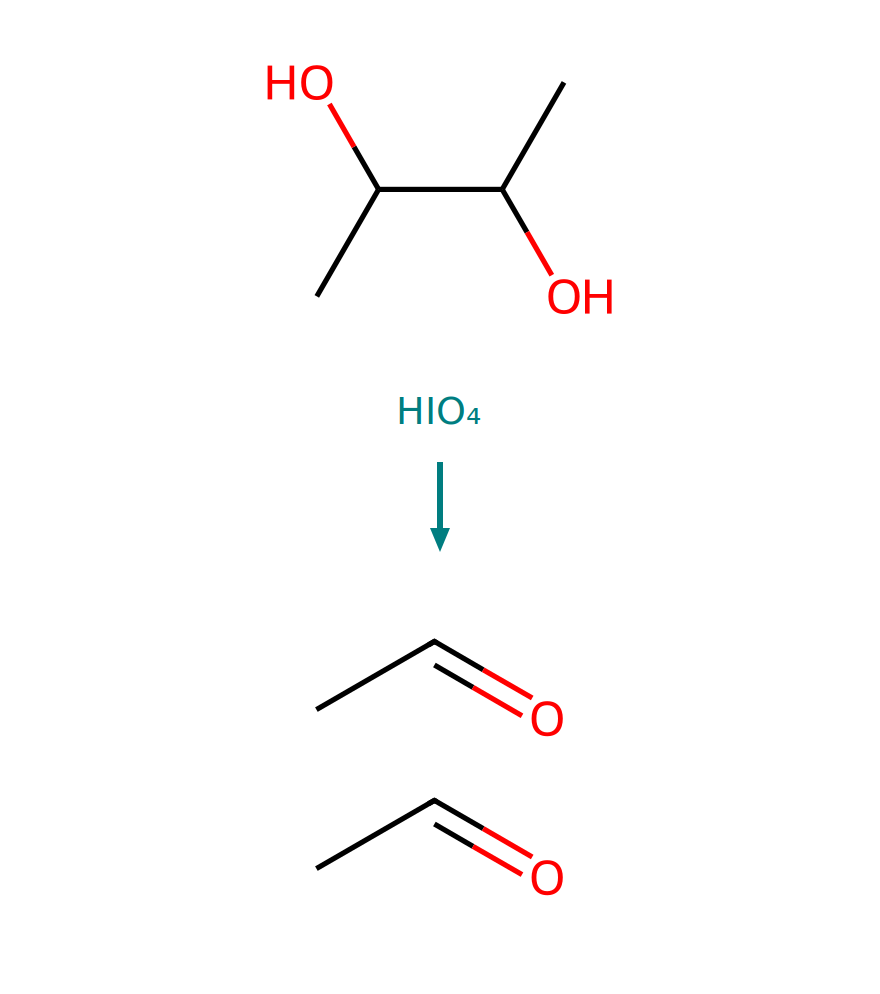
- Periodic acid cleaves appropriate vicinal diols to carbonyl fragments. Follow each former alcohol carbon to determine its carbonyl product.
- Acid can cause pinacol rearrangement of suitable diols through water loss, group migration and carbonyl formation. Migrating connectivity must be accounted for explicitly.
C. Phenol Acidity and Reactions
1. Ring activation and phenol oxidation
a. Conjugate-base stability
- Alcohols are weak acids; for common simple alcohols, pKa values are typically in the mid-teens.
- Phenol is more acidic than most simple alcohols because the phenoxide anion is resonance stabilized.
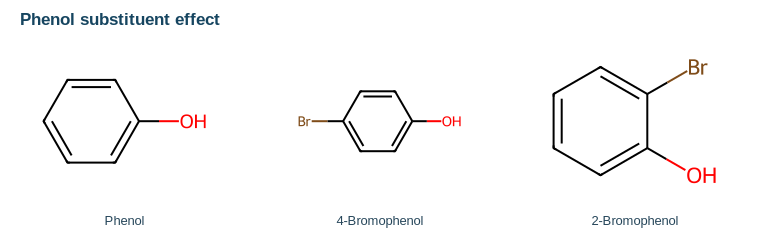
- Electron-withdrawing substituents on an aromatic ring can further stabilize phenoxide; the position and ability to participate in resonance matter.
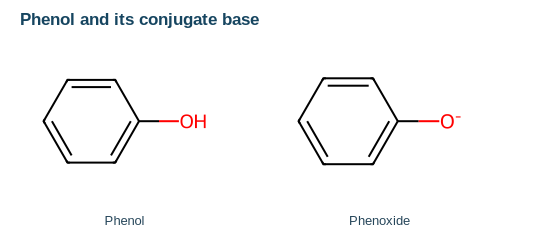
| Group | Hydrogen-bond donor? | Acidic behavior |
|---|---|---|
| Alcohol | Yes | Weak acid; pKa often about 16–18 |
| Phenol | Yes | pKa about 10 |
| Ether | No | Not an O–H acid |
b. Ring substitution
- The phenolic –OH group donates electron density into an aromatic ring by resonance and usually directs electrophilic aromatic substitution toward ortho and para positions.
- An electron-rich phenol can react with halogenating agents more readily than benzene; actual product distribution depends on reagent amount, solvent and conditions.
c. Oxidation
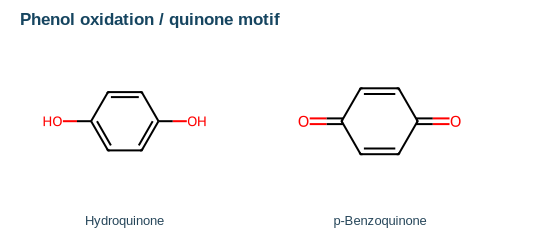
- Hydroquinone and related phenols can be oxidized to quinone-type structures.
- Quinone/hydroquinone interconversion involves changes in oxidation state and is important for redox chemistry.
D. Ether Synthesis and Cleavage
1. Williamson substitution and acid cleavage
a. Williamson synthesis
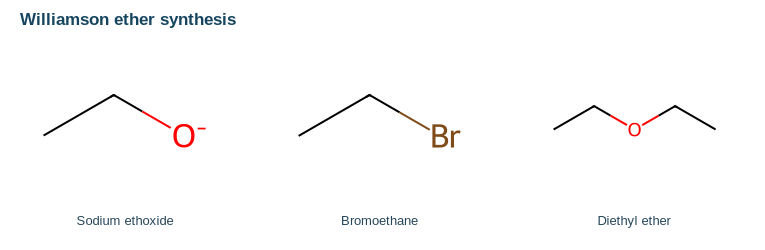
- An alkoxide attacks an appropriate methyl/primary electrophile by SN2. Choose the less hindered partner as the alkyl halide.
- Tertiary electrophiles tend to eliminate rather than form ethers by Williamson displacement. Phenoxide can attack an sp³ alkyl halide, but an aryl halide does not undergo ordinary SN2.
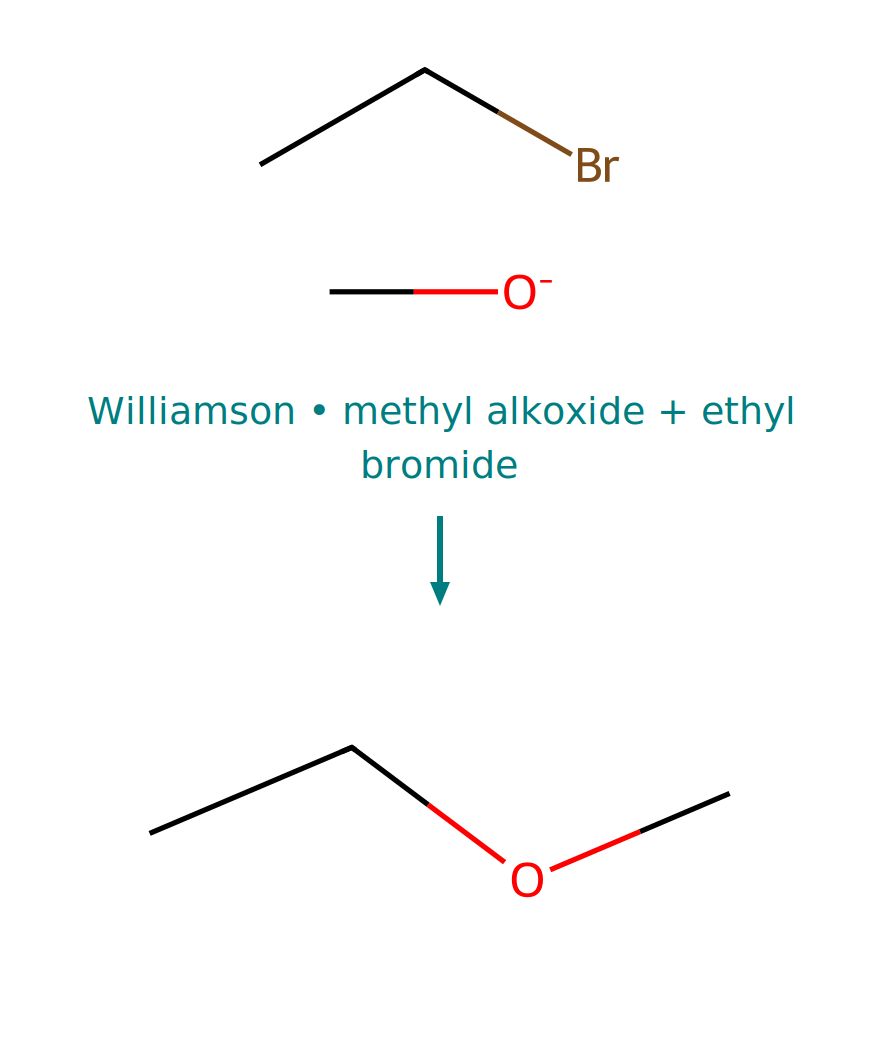
- A suitable sulfonate ester can also serve as the electrophile. With hindered secondary electrophiles, elimination may compete with SN2 ether formation.
b. Acid cleavage
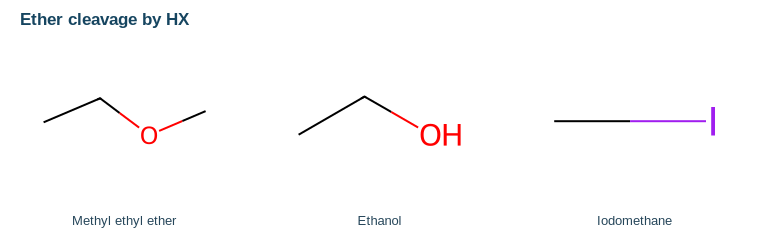
- HI or HBr protonates ether oxygen, enabling cleavage. A methyl/primary site commonly undergoes SN2; tertiary sites can undergo ionization.
- An aryl–O bond generally resists ordinary SN2 cleavage, so an aryl alkyl ether commonly cleaves at the alkyl side. Ethers can form peroxides during storage.
- Concentrated HI or HBr is commonly used for cleavage; the actual alkyl substitution pattern determines whether displacement or ionization is favored.
E. Epoxide Opening
1. Strain, formation and opening selectivity
a. Formation
- Peroxyacid epoxidation adds oxygen across an alkene. A halohydrin can form an epoxide by deprotonation and intramolecular SN2 displacement.
- The three-membered ring is strained and therefore reacts readily with nucleophiles.
b. Opening conditions
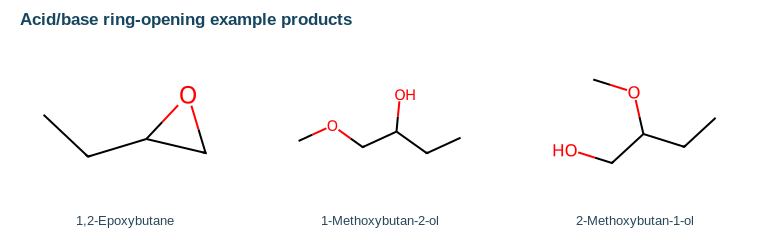
- Under basic or strongly nucleophilic conditions, attack usually occurs at the less substituted carbon with backside displacement. Under acidic conditions, positive-charge development can favor attack at the more substituted carbon, especially when stabilized.
- Opening is anti at the attacked carbon and breaks that carbon–oxygen bond. An acidic opening is not a freely rearranging carbocation process. Organometallic opening followed by workup can extend a carbon chain.
| Conditions | Typical attack site | Geometry |
|---|---|---|
| Base / strong Nu | Less substituted | Backside opening |
| Acid + weak Nu | Often more substituted | Backside relative to C–O |
| RMgX; then H₃O⁺ | Less hindered | New C–C bond |
| Condition | Typical nucleophilic site | Mechanistic feature |
|---|---|---|
| Strongly nucleophilic/basic | Usually less substituted carbon | SN2-like, anti opening |
| Acid catalysis | Often more substituted carbon where charge stabilization favors it | Protonation followed by backside attack; anti opening |
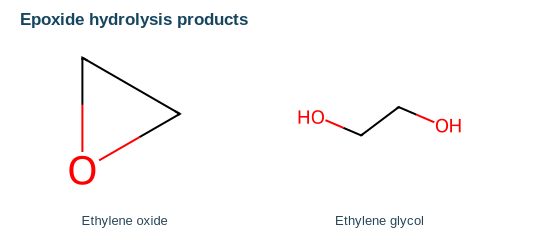
- After ring opening and protonation, hydrolysis of a simple epoxide gives a vicinal diol.
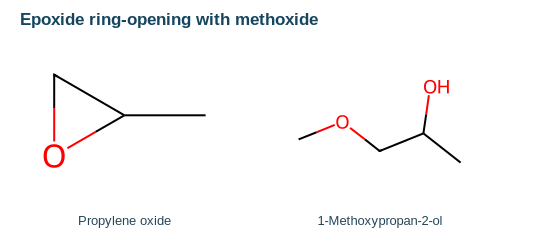
- Acidic opening reflects both steric effects and stabilization of developing positive charge; anti stereochemical relationships apply where the substrate permits them.

F. Related Sulfur Compounds
1. Thiols, sulfides and disulfides
a. Thiols, sulfides, and disulfides
- Thiols contain R–SH and can be deprotonated to thiolates, RS⁻, which are useful nucleophiles.
- Sulfides (thioethers) have the structure R–S–R′ and can be prepared by nucleophilic substitution with thiolates.
- Oxidation of thiols can form disulfides, R–S–S–R′; controlled oxidation and reduction of disulfide bonds are important in molecular chemistry.
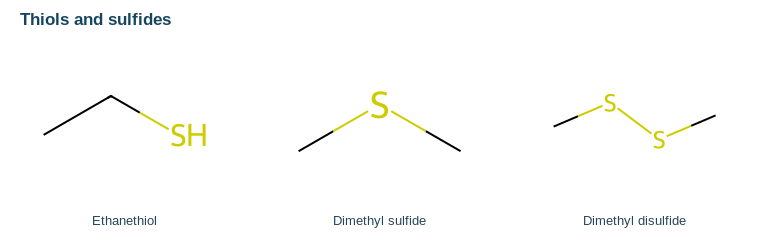
- Sulfur nucleophiles are often polarizable and effective at suitable sp³ electrophiles; the biological relevance of disulfide redox chemistry does not make sulfur and oxygen interchangeable.