Chapter V: Alkenes & Alkynes Practice Questions
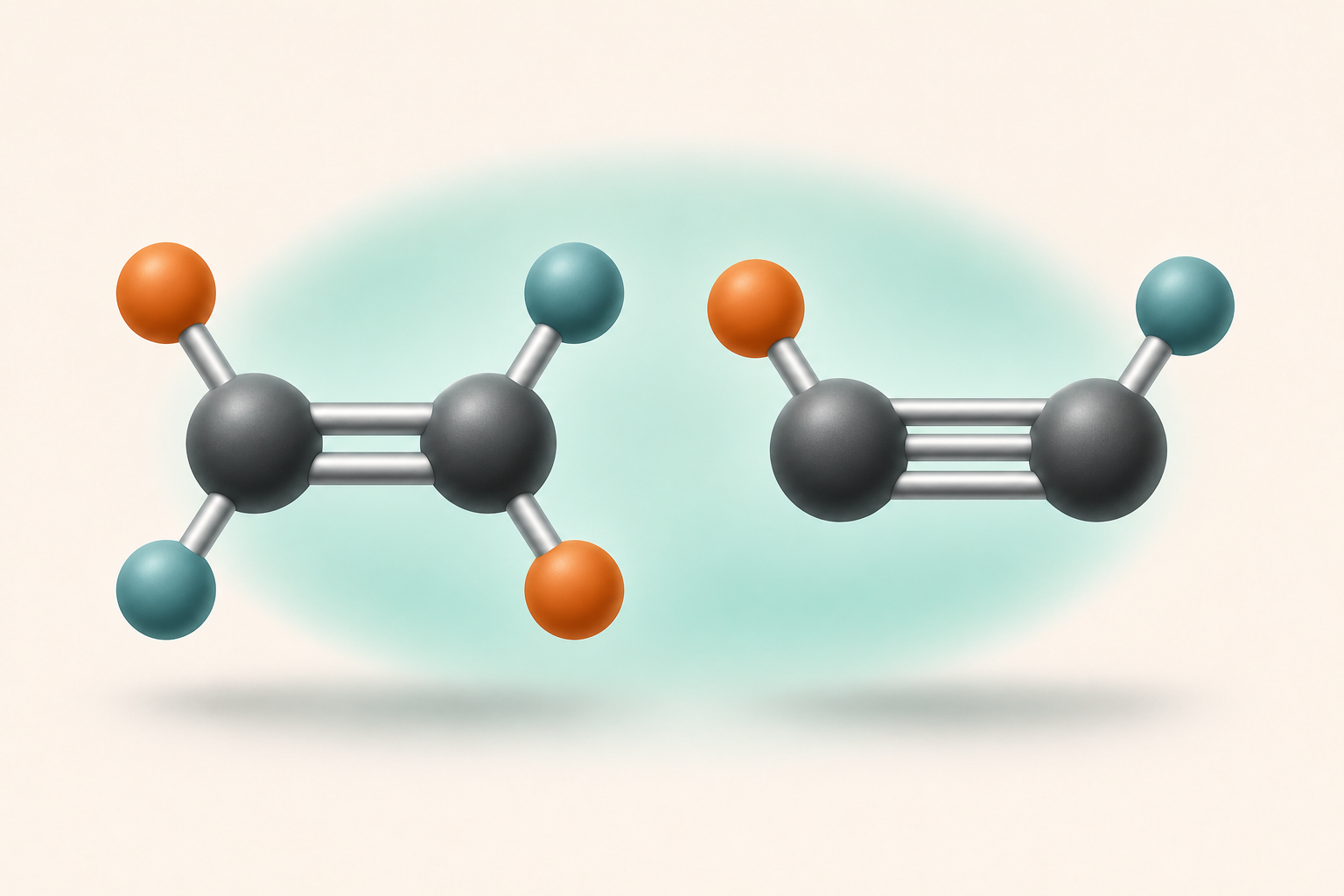
Organic chemistry alkenes and alkynes: symbolic carbon double and triple bonds.

DAT & OAT Organic Chemistry: Alkenes and Alkynes Practice Questions

Each of the two quizzes contains 20 questions covering key concepts from the Alkenes and Alkynes summary.

The time limit is 20 minutes per quiz.

After completing a quiz, select "See Result" to review your answers and explanations. Incorrect answers are marked in red, and correct answers are marked in green.

V. ALKENES & ALKYNES TEST 1

1 / 20

Which is the principal alcohol product?

Reaction scheme. 1) BH₃·THF; 2) H₂O₂, NaOH, H₂O

2 / 20

Which chain-propagation event controls the anti-Markovnikov constitution?

CH₂=CHCH₂CH₃ + HBr; peroxide initiator, radical conditions

3 / 20

Which quantity is unchanged by the catalyst alone?

Alkene reaction: uncatalyzed Ea=80, catalyzed Ea=50 kJ/mol; same temperature

4 / 20

Which organic product has the expected atom balance?

Reaction scheme. 1) OsO₄, NMO; 2) Aqueous workup

5 / 20

Why are both steps propagation?

HBr radical addition: Br radical + alkene → carbon radical; carbon radical + HBr → product + Br radical

6 / 20

Which is the carbonyl product of the following reaction?

Reaction scheme. HgSO₄, dilute H₂SO₄, H₂O

7 / 20

Where does the nonexchangeable D enter?

HC≡CCH₂CH₃ → ketone → alcohol; Hg²⁺/aqueous acid, then NaBD₄/MeOH and H₂O

8 / 20

Which product has the expected carbon framework and unsaturation?

Reaction scheme. 1) NaNH₂, liquid NH₃; 2) EtBr; 3) H₂/Lindlar

9 / 20

Which geometric alkene is favored in the standard dissolving-metal reduction?

Reaction scheme. 1) Na, liquid NH₃; 2) Protonation

10 / 20

Which carbon becomes the aldehyde carbon?

CH₂=CHCH₂CH₂CH₃ → alcohol → aldehyde; BH₃/oxidation then PCC/dry CH₂Cl₂

11 / 20

Which is the final organic product?

Reaction scheme. 1) BH₃·THF; 2) H₂O₂, NaOH (aq.); 3) PBr₃ (dry ether)

12 / 20

Which product places the incoming methoxy group at the correct original alkene carbon?

Reaction scheme. 1) mCPBA; 2) NaOCH₃, MeOH; 3) H₂O

13 / 20

What is the alcohol class at the former carbonyl carbon?

HC≡CCH₂CH₃ → ketone by Hg²⁺/H₂O; then CH₃MgBr/dry ether, H₃O⁺

14 / 20

Which mass balance is correct for organic carbon?

Terminal alkyne → ketone → alcohol; Hg²⁺/aqueous acid then NaBH₄

15 / 20

Which feature distinguishes the final product from full hydrogenation?

HC≡CCH₃; NaNH₂, then CH₃CH₂Br; then H₂/Lindlar

16 / 20

Which comparison is expected?

Compare H₂/Lindlar with Na in liquid NH₃.

17 / 20

Which distinction from dry PCC oxidation matters?

CH₂=CHCH₂CH₃ → primary alcohol → acid; BH₃/H₂O₂ then aqueous Cr(VI)

18 / 20

Which statement describes the second stage?

CH₂=CHCH₂CH₃ → primary alcohol; then TsCl/pyridine → sulfonate

19 / 20

Which relative diol geometry follows ordinary backside ring opening?

Cyclohexene → epoxide, mCPBA; then aqueous H₃O⁺

20 / 20

In an achiral environment, what stereochemical outcome is expected from NaBH₄ reduction of the ketone?

HC≡CCH₂CH₃ → CH₃COCH₂CH₃ → CH₃CH(OH)CH₂CH₃

Your score is

The average score is 0%

0%

V. ALKENES & ALKYNES TEST 2

1 / 20

Where is the label in the resulting methyl-carbinol fragment?

Hg²⁺-catalyzed aqueous hydration, then NaBH₄.

2 / 20

Which error would produce an incorrect final skeleton?

Dry solvent; then Na in liquid NH₃.

3 / 20

Which intermediate must exist before reduction?

HC≡CH; deprotonate once, add CH₃Br; repeat deprotonation and CH₃Br; then Lindlar

4 / 20

Which observation supports completion of stage 3?

CH₂=CHCH₂CH₃; 1) BH₃/THF 2) H₂O₂/NaOH 3) PCC/dry CH₂Cl₂

5 / 20

Which reagent order fits the specified intermediates?

CH₂=CHCH₂CH₃ → HOCH₂CH₂CH₂CH₃ → BrCH₂CH₂CH₂CH₃

6 / 20

Where does sulfur enter under basic epoxide opening?

CH₂=CH-CH₂-OCH₃; mCPBA, then NaSCH₃ in dry polar solvent, H₂O

7 / 20

Which carbon bears Br in the final constitution?

HC≡CCH₂CH₃ → ketone → alcohol → bromide; Hg²⁺/H₂O, NaBH₄, PBr₃

8 / 20

Which atoms supply the ester's OCH₂CH₃ group?

CH₂=CHCH₂CH₃ → alcohol → acid → ethyl ester; BH₃/H₂O₂, aqueous Cr(VI), EtOH/H⁺

9 / 20

Which final thioether linkage follows this sequence?

Reaction scheme. 1) BH₃·THF; 2) H₂O₂, NaOH (aq.); 3) PBr₃; 4) NaSCH₃; Steps 3–4: dry conditions

10 / 20

Which final constitution is supported without assigning stereochemistry?

Reaction scheme. 1) Hg²⁺, H₂O (acidic); 2) NaBH₄; isolate alcohol; 3) SOCl₂, pyridine

11 / 20

Which atom replaces carbonyl oxygen in the final C=N bond?

CH₂=CHCH₂CH₃ → terminal alcohol → aldehyde; then NH₂OH/buffer, remove water

12 / 20

Which proposed result improperly retains a leaving-group atom?

CH₂=CHCH₂CH₃ → alcohol → bromide → CH₃S-linked product

13 / 20

What happens to the oxygen introduced in hydration?

HC≡CCH₂CH₃ → ketone → alcohol → bromide

14 / 20

Which bond-count change characterizes the cycloaddition?

Thermal Diels–Alder reaction.

15 / 20

How many carbons are in the final alcohol?

CH₂=CHCH₂CH₃ → terminal alcohol → aldehyde → secondary alcohol; BH₃/H₂O₂, PCC, CH₃MgBr/H₃O⁺

16 / 20

Which property must X have?

HC≡CCH₂CH₃ → X → CH₃CH(OH)CH₂CH₃; Hg²⁺/H₂O then NaBH₄

17 / 20

Which intermediate X forms before reduction to (Z)-2-pentene?

Reaction scheme. 1) NaNH₂; 2) EtBr; Dry solvent

18 / 20

Which distinction identifies the final reduction method?

CH₃C≡CH → X → E-CH₃CH=CHCH₂CH₃; acetylide ethylation, then Na/NH₃

19 / 20

Which product set accounts for all six starting carbons?

Reaction scheme. 1) O₃; 2) Zn, H₂O

20 / 20

Which structure is intermediate X?

Reaction scheme. 1) BH₃·THF; 2) H₂O₂, NaOH

Your score is

The average score is 0%

0%