Chapter VIII: Aldehydes & Ketones Practice Questions
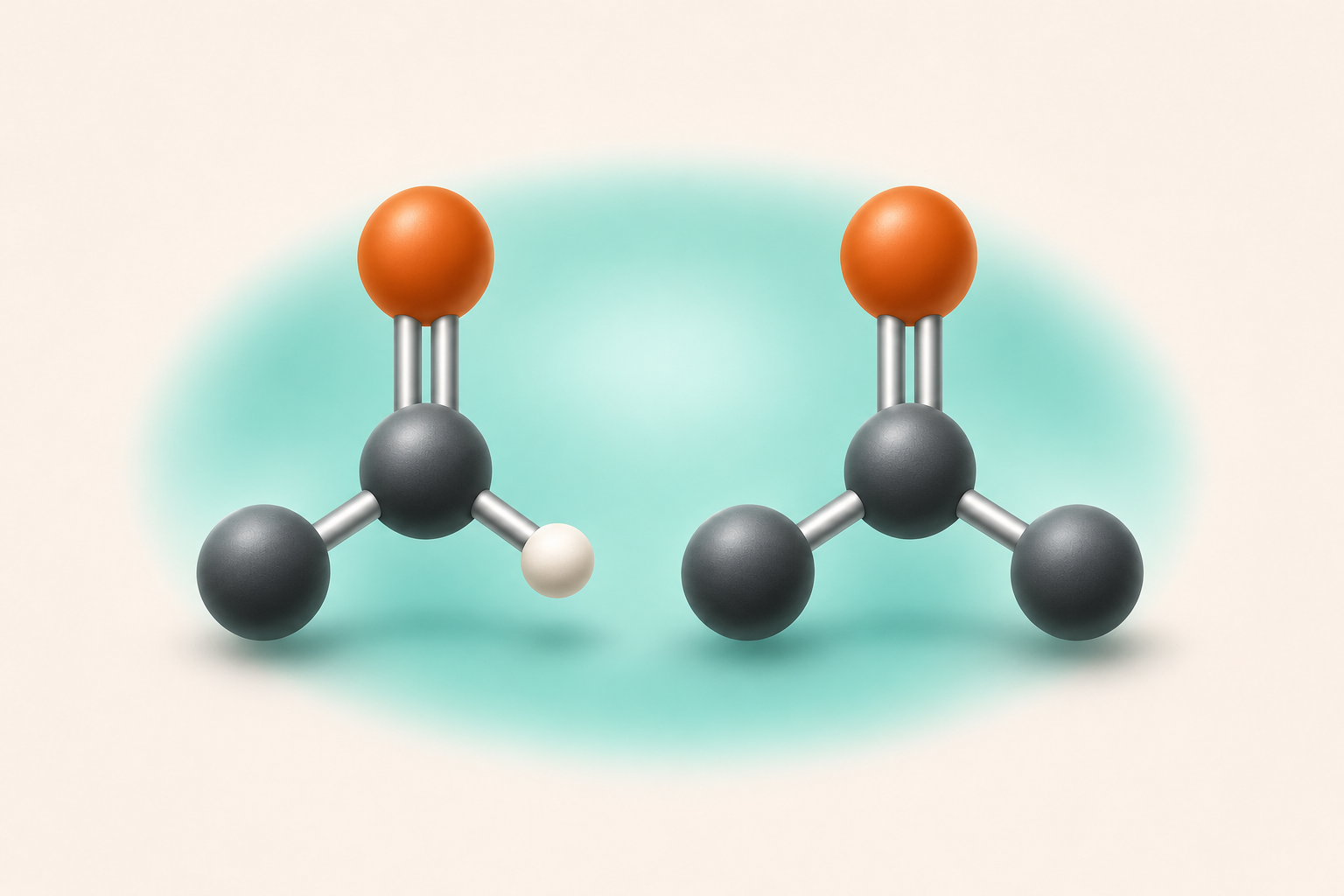
Organic chemistry aldehydes and ketones: contrasting carbonyl molecular motifs.

DAT & OAT Organic Chemistry: Aldehydes, Ketones, and Condensations Practice Questions

Each of the two quizzes contains 20 questions covering key concepts from the Aldehydes, Ketones, and Condensations summary.

The time limit is 20 minutes per quiz.

After completing a quiz, select "See Result" to review your answers and explanations. Incorrect answers are marked in red, and correct answers are marked in green.

VIII. ALDEHYDES & KETONES TEST 1

1 / 20

Which fragment supplies the new C-C bond?

CH₃CH₂CHO + CH₃MgBr/dry ether; then H₃O⁺

2 / 20

Which group pair replaces the carbonyl oxygen environment?

CH₃COCH₃ + HOCH₂CH₂OH; catalytic pTsOH, toluene, remove H₂O

3 / 20

Which carbon count and functionality identify the organic alkene product?

CH₃CHO + preformed Ph₃P=CH₂; dry THF

4 / 20

What does protecting one OH allow?

HOCH₂CH₂CH₂OH; one end selectively protected; PCC/dry CH₂Cl₂

5 / 20

Which linkage defines the condensation product?

Mildly acidic buffer; remove water.

6 / 20

Why is a ketone obtained rather than a tertiary alcohol?

CH₃CH₂CN + CH₃MgBr/dry ether; then acidic hydrolysis

7 / 20

Which product atom arrangement results?

Reaction scheme. HCN, catalytic CN⁻

8 / 20

Which carbonyl location follows the usual terminal-alkyne hydration rule?

CH₃CH₂C≡CH; HgSO₄, aqueous H₂SO₄

9 / 20

Which original aldehyde atom becomes the ketone carbon?

CH₃CHO → alcohol → ketone; EtMgBr/H₃O⁺, then PCC

10 / 20

Why is the second stage oxidation?

CH₃CH₂CHO → CH₃CH₂CH(OH)CH₃ → CH₃CH₂COCH₃

11 / 20

Which net framework change occurs?

CH₃CHO → CH₃CH=CH₂ → CH₃CH₂CH₂OH; Ph₃P=CH₂, then BH₃/H₂O₂

12 / 20

Which group is directly attached to the final OH-bearing carbon?

CH₃CN → ketone → alcohol; EtMgBr/acidic hydrolysis, then NaBH₄

13 / 20

What site carries ¹³C after both steps?

Convert the alkyne shown to the ketone, then to the alcohol.

Chemical structure for this question

14 / 20

But-1-yne has been converted to butan-2-one. Which product set results when this ketone is reduced in an achiral solvent?

Butan-2-one reacts with sodium borohydride in an achiral solvent to give an unknown product set

15 / 20

Which atom is absent from the isolated acyl-derived aldehyde?

CH₃CH₂CO₂CH₃ → acyl alcohol → aldehyde; LiAlH₄/H₂O, then PCC

16 / 20

Which reagent order is suitable?

C₆H₅CHO → C₆H₅CH(OH)CH₃ → C₆H₅COCH₃

17 / 20

Which carbon becomes the CH₂OH carbon?

C₆H₅CHO → C₆H₅CH=CH₂ → C₆H₅CH₂CH₂OH

18 / 20

Which product reflects Wolff–Kishner deoxygenation?

Reaction scheme; NH₂NH₂, KOH; High-boiling solvent; heat

19 / 20

Which nitrogen fate is consistent with acidic hydrolysis of the Grignard adduct?

C₆H₅CN → C₆H₅COCH₃ → C₆H₅CH(OH)CH₃

20 / 20

Why is the ketone itself not a tetrahedral stereocenter at C=O?

CH₃CH₂CN → ketone → alcohol; carbonyl-stage product is chiral only after reduction

Your score is

The average score is 0%

0%

VIII. ALDEHYDES & KETONES TEST 2

1 / 20

Which isotope placement discriminates hydride addition from mere O-H exchange?

HC≡CCH₂CH₃ → CH₃COCH₂CH₃ → alcohol; NaBD₄, H₂O

2 / 20

Which final mass-accounting statement is correct?

CH₃CO₂CH₂CH₃ → ethanol; isolate acyl-derived ethanol; PCC

3 / 20

Why does this sequence give an aldehyde rather than a ketone?

HCHO + EtMgBr/ether, H₃O⁺; then PCC

4 / 20

Which net change in carbon count occurs?

CH₃CH₂CHO → CH₃CH₂CH=CH₂ → terminal alcohol; Wittig then hydroboration-oxidation

5 / 20

Which neutral condensation product is obtained under the conditions shown?

Question structure or specified model

6 / 20

Which final reduction product is consistent with one carbonyl and no carbon loss?

Reaction scheme. 1) CH₃MgBr (dry ether); 2) Acidic hydrolysis; 3) NaBH₄; 4) Aqueous workup

7 / 20

Which observation would contradict the proposed completed sequence?

HC≡CCH₂CH₃; Hg²⁺/H₂O then NaBH₄

8 / 20

Which proposed PCC endpoint violates the original carbon mapping?

CH₃CH₂CO₂CH₃ → acyl-derived CH₃CH₂CH₂OH → aldehyde

9 / 20

Why is regioisomer selection simplified for the initial enolate?

CH₃CH₂COCH₂CH₃; 1 eq LDA/THF, −78 °C, then 1 eq CH₃I

10 / 20

Which carbon is added relative to the starting aldehyde?

CH₃CH₂CHO → secondary alcohol by CH₃MgBr; PCC → ketone

11 / 20

Which final product class follows?

HC≡CCH₂CH₃ → ketone → alcohol → bromide; Hg²⁺/H₂O, NaBH₄, PBr₃

12 / 20

Which step introduces nitrogen?

CH₃CHO → CH₃CH(OH)CH₂CH₃ → CH₃COCH₂CH₃ → oxime

13 / 20

What is the net carbonyl-to-carbonyl change for Wittig/BH₃-oxidation/PCC?

CH₃CHO → terminal alkene → primary alcohol → aldehyde

14 / 20

Where would a carbon-count check fail if the final drawing were CH₃CH₂CH₂Br?

Where would a carbon-count check fail if the final drawing were CH₃CH₂CH₂Br; original chemical diagram preserved

15 / 20

Which structural connection persists through the final condensation?

C₆H₅CHO → C₆H₅CH(OH)CH₃ → C₆H₅COCH₃ → C₆H₅C(=NOH)CH₃

16 / 20

Which carbon is the final CHO carbon?

C₆H₅CHO → C₆H₅CH=CH₂ → C₆H₅CH₂CH₂OH → C₆H₅CH₂CHO

17 / 20

Which endpoint follows replacement of the alcohol group?

Reaction scheme. 1) Hg²⁺, H₂O (acidic); 2) NaBH₄; isolate alcohol; 3) PBr₃ (dry conditions)

18 / 20

Which species is the electrophile in oxime formation?

CH₃CH₂CH₂OH → CH₃CH₂CHO → CH₃CH₂CH=NOH

19 / 20

Which change distinguishes the nitrile stage from ester Grignard overaddition?

CH₃CN → CH₃COCH₂CH₃ → alcohol; EtMgBr/acid workup, then NaBH₄

20 / 20

Where is the oxygen label after NaBH₄/H₂O workup?

HC≡CCH₂CH₃ → ketone → alcohol; hydrated in H₂¹⁸O, ideal no later O exchange

Your score is

The average score is 0%

0%