IX. Chemical Equilibrium

Key focus of this chapter: equilibrium constant

This chapter focuses on equilibrium constant and gives concise summaries of the important things about Le Chatelier’s principle, acid and base equilibrium, pH, and solubility product constant in more detail.

A. Reversible and irreversible reactions

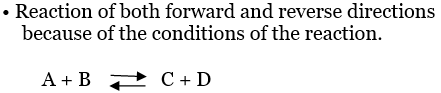
Reversible reaction

Irreversible reaction

B. Equilibrium state

: a state of balance in a reversible reaction, which is reached when the forward and reverse reactions have the same reaction rate (velocity) and the concentrations of reactant and product are no longer changing.

Fig. 1 Equilibrium state of reaction rate and concentration over time

  • Forward and reverse reactions continue at equal rates at equilibrium.
  • Reactant and product concentrations remain constant; they need not be equal.

C. The equilibrium constant, K

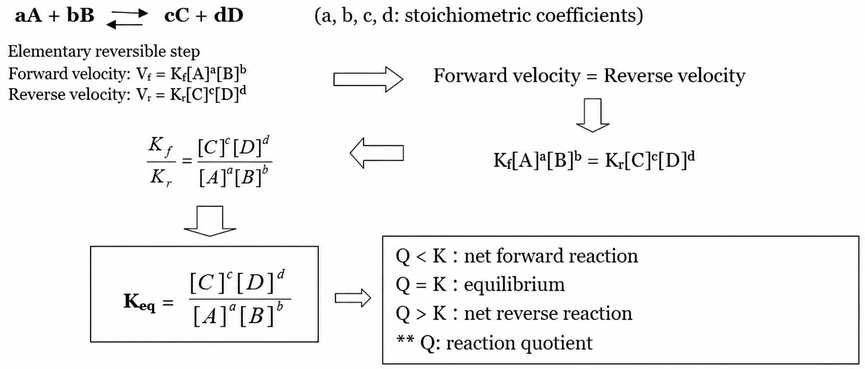
1. Keq

  • For a specified reaction, K depends on temperature and is independent of initial concentrations and a catalyst.
  • Pure solids and pure liquids have unit activity and are omitted from the usual equilibrium expression. Dissolved species and gases are included.
  • Q < K means net forward reaction; Q > K means net reverse reaction; Q = K means equilibrium, for any value of K. K > 1 or K < 1 describes the relative equilibrium preference, not whether the system is at equilibrium.
  • Rate-law exponents generally must be measured experimentally; the derivation K = kf/kr using stoichiometric exponents applies to an elementary reversible step.
equilibrium constant, Keq

2. Kc and Kp

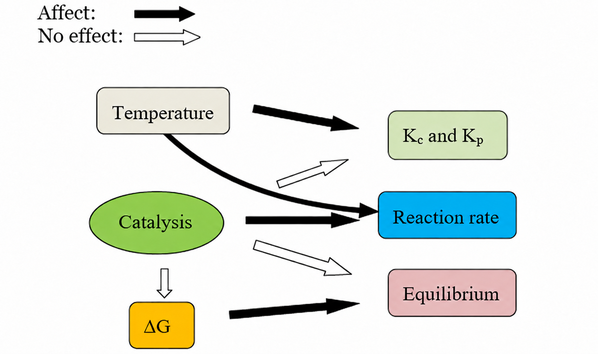
Fig. 2 Factors affecting equilibrium and reaction rate. Temperature can change K and the equilibrium composition and also affects rate constants. A catalyst speeds approach to equilibrium but does not change K, ΔG°, or the equilibrium composition at a fixed temperature.

Temperature affects rate and equilibrium constants; catalysts increase rate without changing equilibrium

D. Le Chatelier’s principle

: when an equilibrium system is disturbed, its composition changes in a direction that counteracts the disturbance. The gas-pressure rules below refer to changing volume at a fixed temperature; adding an inert gas at constant volume does not shift ideal-gas equilibrium.

Changes of conditions

Direction of reactions

Concentration

Pressure (volume)

& Mole

Temperature

 & ΔH

Qs/ Which of the following shifts the equilibrium in the forward direction in the reaction shown?

     A. Adding WO3

     B. Adding H2

     C. Removing W

     D. Removing H2O

     E. Both B and D

     ANS: E   Adding WO3 or removing W does not affect the direction of equilibrium, because they are solid. When adding H2 or removing H2O, the equilibrium moves in a forward direction to relieve the stress of the different concentrations between the reactants and products.

Qs/ Which of the following is the reverse direction of the equilibrium from the reaction shown?

     A. Increasing pressure

     B. Decreasing pressure

     C. Increasing volume

     D. Removing Y

     E. A and C

     ANS: A   When the pressure is increased, the equilibrium moves from big moles of the product (2Y + 2Z) to small moles of the reactant (3X).

Qs/ Which of the following shifts the equilibrium in the forward direction in the reaction shown?

     A. Adding X

     B. Removing Y

     C. Decreasing pressure

     D. Increasing temperature

     E. All are correct

     ANS: E   When the reaction is endothermic (ΔH >0), the direction of the equilibrium is shifted forward by an increase in temperature.

E. Acid and base equilibrium

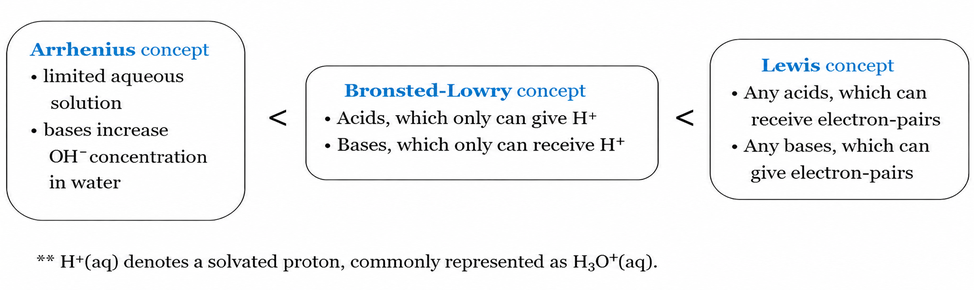
1. Acid and base theory

Acid

Base

2. Acid and base strength

a. Acid strength

b. Acids and bases in a solution

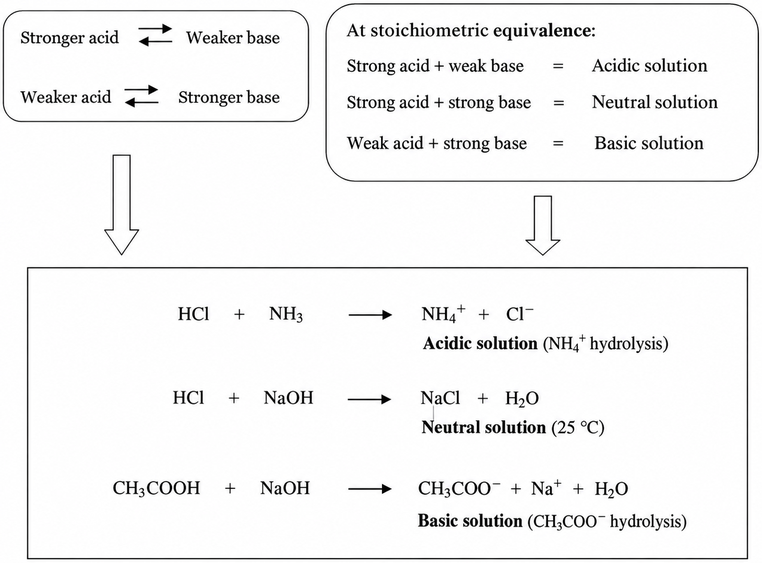
  • A proton-transfer equilibrium favors the weaker acid and weaker base.
  • The salt from stoichiometric neutralization of a strong acid and weak base generally gives an acidic solution; a weak acid and strong base generally gives a basic solution. Excess acid or base changes this conclusion.
  • Mg(OH)2 is sparingly soluble; distinguish the extent of dissolution from dissociation of the dissolved portion.

Strong acids

• 100% dissociation of H

Weak acids

• Partial dissociation of H

Strong acids and strong bases

Strong acids and weak bases

Weak acids and strong bases

Weak acids and weak bases

with halogens

with soluble compound anions

with 1A group

with 2A group

3. Equilibrium constant, Ka, Kb, and Kw

a. Ka (acid-dissociation constant) and Kb (base-dissociation constant)

: equilibrium constants for acid and base ionization.

  • They depend on temperature; larger Ka or Kb corresponds to a stronger acid or base in the same solvent.
  • For a conjugate acid–base pair at the same temperature, KaKb = Kw.

b. Kw (ion-product constant for water)

: Kw = [H3O+][OH−] in the dilute-solution approximation. At 25 °C, Kw ≈ 1.0 × 10⁻¹⁴. Its value varies with temperature.

Equilibrium

constants

Equilibrium Equations

Qs/ Calculate the value of Ka when 0.002M of HOBr is 0.1% dissociated in a solution.

Qs/ At 25 °C, Ka of HNO2 is 4.5 × 10⁻⁴. Calculate Kb of its conjugate base, NO2−.

F. pH

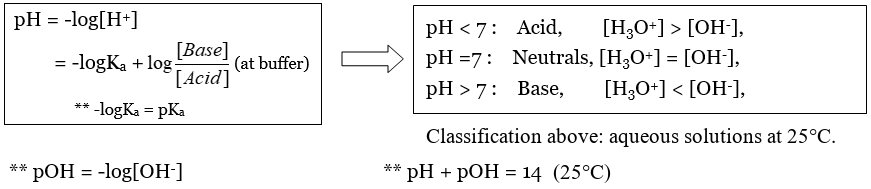
For dilute aqueous solutions, pH ≈ −log[H3O+] and pH + pOH = pKw. At 25 °C, pKw ≈ 14 and neutral pH ≈ 7; neutral pH changes with temperature. Acidic or basic pH is determined by the ion concentrations, not by a universal comparison of Ka with Kb.

Qs/ Calculate the pH of a solution containing [H+] = 0.000035 M.

pH = −log(3.5 × 10⁻⁵) = 4.46 (4.5 to one decimal place).

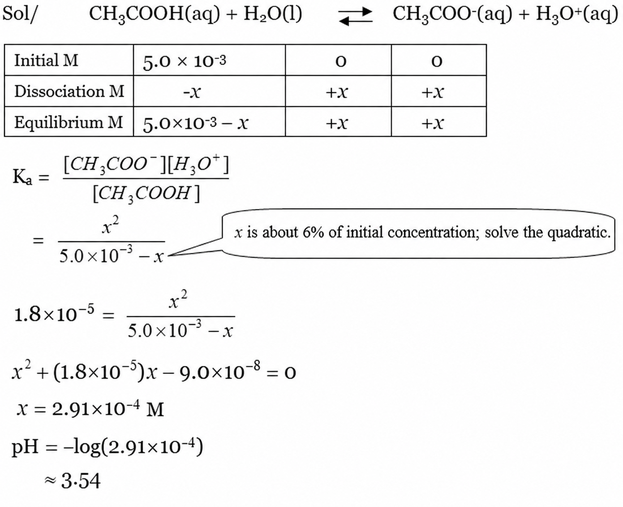
Qs/ For 0.005 M CH3COOH with Ka = 1.8 × 10⁻⁵, calculate pH.

The quadratic equation x2/(0.005 − x) = 1.8 × 10⁻⁵ gives [H3O+] ≈ 2.91 × 10⁻⁴ M and pH ≈ 3.54. The approximation x ≈ 3.0 × 10⁻⁴ M gives 6% ionization, slightly exceeding the usual 5% guideline.

G. Solubility product constant, Ksp

: the equilibrium constant for dissolution of a sparingly soluble ionic solid into its ions in a saturated solution. Compare the ion product Qsp with Ksp to predict precipitation.

Larger Ksp implies larger molar solubility only when comparing salts with the same dissolution stoichiometry under comparable conditions; conductivity and freezing point also depend on ion concentrations and properties.

Conditional comparison for the diagram above: saturated, dilute solutions; same solvent, temperature and dissolution stoichiometry; no common ions or side reactions; comparable ionic charges and mobilities. Higher Ksp then gives higher molar solubility and ion concentration. Conductivity rises only under those ion conditions; freezing-point lowering depends on total dissolved-particle molality.

Qs/ What is the expression for Ksp of Ca3(PO4)2 in a solution?

Qs/ Calculate Ksp for a saturation of BaF2 when the concentration of Ba2+ is 2.0 × 10⁻⁵ M.