X. Electrochemistry
Key focus of this chapter: reduction potential
This chapter focuses on reduction potential and gives concise summaries of the important things about reduction half-reaction, electrochemical cells, standard free-energy change, and quantitative electrolysis in more detail.
A. Standard reduction potential, E° (V)
: the potential of a reduction half-cell relative to the standard hydrogen electrode under standard-state conditions (unit activities; gases at 1 bar).
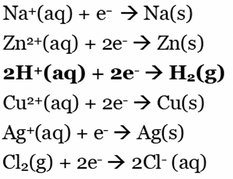
2H+(aq) + 2e− → H2(g), E° = 0 V.
The sodium half-reaction is Na+ + e− → Na(s), and the chlorine half-reaction is Cl2(g) + 2e− → 2Cl−(aq).
1. Standard electrode potential
Meaning | |
Easily release electrons rather than hydrogen → oxidation | |
Easily accept electrons rather than hydrogen → reduction |
Reduction half-reaction | Strength oxidation (Anode) | Strength reduction (Cathode) | |
|
|
|
|
- Qs/ Which of the following represents the reaction for the strongest reduction in a galvanic cell?
![]() |
ANS: C
The strong reduction means the strong ability to accept electron(s). Therefore, the most positive standard reduction potential is + 0.80V
2. Anode and cathode
Meaning | Galvanic cells | Electrolytic cells | |
Anode | Releasing electron (oxidation) | Negative (-) | Positive (+) |
Cathode | Accepting electron (reduction) | Positive (+) | Negative (-) |
B. Reduction potential in cells
1. Electromotive force (E.M.F.)
: the cell potential difference between cathode and anode when no current flows.
- E°cell = E°red,cathode − E°red,anode = E°reduction + E°oxidation.
- For the reaction as written under standard conditions, E°cell > 0 implies ΔG° < 0; E°cell < 0 implies ΔG° > 0. Under nonstandard conditions use Ecell and ΔG.
- Oxidation always occurs at the anode and reduction at the cathode. Reversing a half-reaction reverses its potential sign; multiplying its coefficients does not multiply the potential.
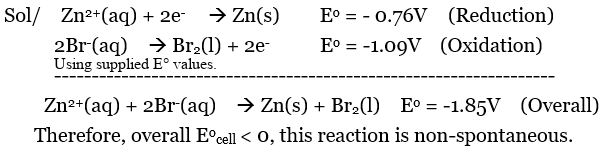
• Qs/ Determine whether Zn2+(aq) + 2Br−(aq) → Zn(s) + Br2(l) is spontaneous under standard conditions.
Zn2+ + 2e− → Zn is reduction (−0.76 V). 2Br− → Br2 + 2e− is oxidation (−1.09 V). E°cell = −1.85 V, so the reaction as written is nonspontaneous under standard conditions.
|
|
2. Shorthand notation
- Ex/ The spontaneous reaction is Cu(s) + 2Ag+(aq) → Cu2+(aq) + 2Ag(s), under standard conditions. It is a reaction between copper metal and silver ions.
Processing | Reactions | |
Reduction half-reaction | ![]() | |
Oxidation and reduction | ![]() | |
Multiply coefficient to cancel electrons | ![]() | |
![]() | ||
Shorthand notation and meaning for galvanic cell | Shorthand notation | ![]() |
Meaning for galvanic cell | ![]() | |
C. Electrochemical cells
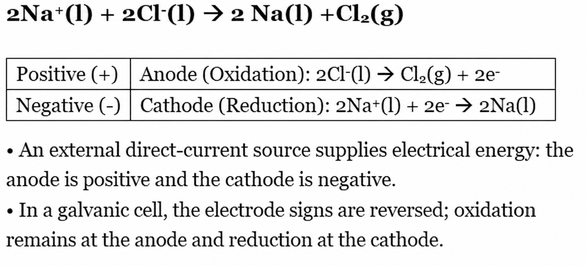
: systems in which oxidation and reduction are coupled. A galvanic cell produces electrical energy from a spontaneous reaction; an electrolytic cell consumes electrical energy to drive a nonspontaneous reaction.
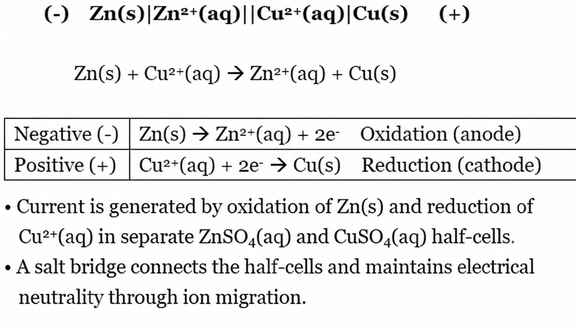
In a Daniell cell, Zn is oxidized in a Zn2+ solution and Cu2+ is reduced to Cu(s) in a Cu2+ solution. The salt bridge carries ions to maintain electrical neutrality; electrons flow through the external circuit from anode to cathode.
Cell type | Features | |
| Voltaic cell |
|
Daniell cell |
| |
|
| |
D. Standard free-energy change
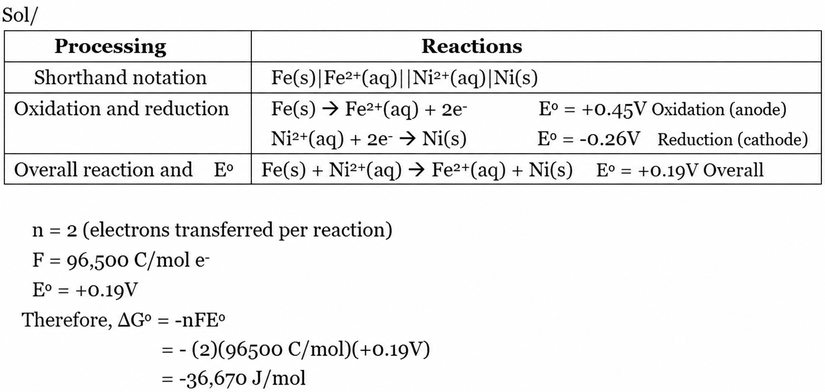
ΔG° = −nFE°cell, where n is the number of electrons transferred per balanced reaction and F ≈ 96,485 C/mol of electrons.
![]() |
Qs/ Calculate ΔG° for Fe(s) + Ni2+(aq) → Fe2+(aq) + Ni(s), using the supplied standard reduction potentials.
Oxidation: Fe(s) → Fe2+(aq) + 2e−. E°cell = +0.19 V, n = 2, and ΔG° ≈ −36.7 kJ/mol of reaction.
![]() |
|
E. Quantitative electrolysis
1. Electric charge, Q (C)
Q = It, with current I in amperes and time t in seconds. The coulomb (C) is a unit of charge, not current.
2. Faraday constant, F
F ≈ 96,485 C/mol of electrons. The amount of electrons transferred is n(e−) = Q/F. For a product requiring z electrons per particle, n(product) = Q/(zF).
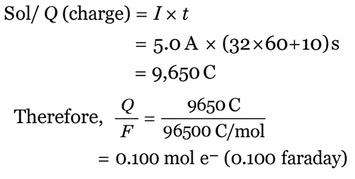
Qs/ Calculate the charge passed and the amount of electrons when a current of 5.0 A passes through aqueous AgNO3 for 32 minutes and 10 seconds.
Q = 5.0 × 1930 = 9650 C, corresponding to approximately 0.100 mol of electrons (0.100 faraday of charge).
|
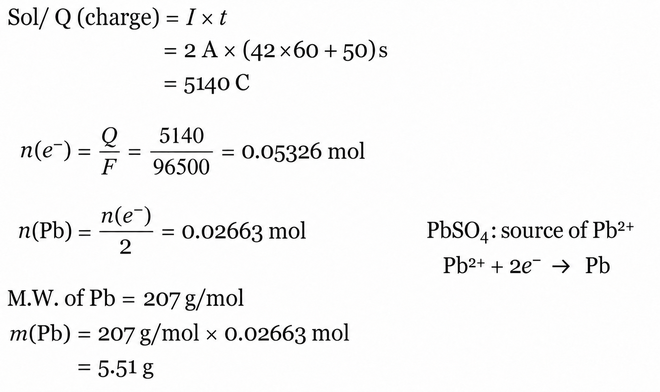
Qs/ How many grams of Pb are produced from a lead storage battery when this battery is charged for 42 minutes and 50 seconds with a constant current of 2A?
PbSO4(s) + H+(aq) + 2e– → Pb(s) + HSO4–(aq)
|