VIII. Chemical Kinetics

Key focus of this chapter: reaction rate

This chapter focuses on reaction rate and gives concise summaries of the important things about rate law, catalysis, and reaction mechanisms in more detail.

A. Reaction rate

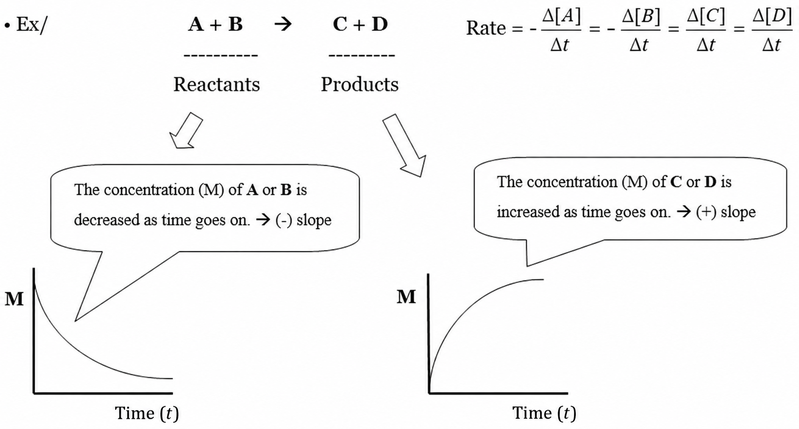
: the change in reactant or product concentration per unit time, commonly expressed in M/s.

  • For many reactions, the rate decreases as reactants are consumed; this is not universal (a zero-order rate is constant while the rate law applies).
  • Reactant concentrations decrease, so a minus sign makes disappearance rates positive. Product concentrations increase, giving positive formation rates.
  • For aA + bB → cC + dD, the normalized reaction rate is −(1/a)Δ[A]/Δt = −(1/b)Δ[B]/Δt = (1/c)Δ[C]/Δt = (1/d)Δ[D]/Δt. Stoichiometric coefficients relate species rates; they do not by themselves determine how fast a reaction proceeds.
  • Qs/ Write the reaction rate for the reaction.

               CS2(g) + 3O2(g)  →  CO2(g) + 2SO2(g)

B. Factors that affect reaction rate

Concentration

• Increasing the concentration of the reactant increases the colliding particles, so it increases the reaction rate.

Pressure

• Increasing the pressure of the reactant (gas) increases the colliding particles by decreasing a volume, so it increases the reaction rate.

Surface area

• Increasing the surface area of the reactant increases the colliding particles by increasing contacting area, so it increases the reaction rate.

Catalysis

• Using catalysis increases the reaction rate by decreasing activation energy.

Temperature

• Increasing the temperature increases the number and the intensity of collisions of particles in the reactant, so it increases the reaction rate. (In gas, the reaction rate increases 2 times as a temperature increases 10 oC.)

Types of reactant

• The reaction rate of ionic bonded molecules is faster than the reaction rate of covalent bonded molecules, which involve more bond rearrangement.

Fig 1. Factors that affect the reaction rate

C. Rate law

: an experimentally determined relationship between reaction rate and reactant concentrations raised to reaction orders, for example Rate = k[A]m[B]n. Reaction orders generally cannot be inferred from the coefficients of an overall reaction.

1. Rate constant k

: the proportionality constant for a specified reaction and rate law at a given temperature. Its value depends on temperature and the reaction pathway, including catalysis.

** For a fixed temperature and pathway, k does not change with reactant concentration.

  • Unit of rate constant

Overall reaction order

Rate raw

Rate constant, k

k unit

Qs/ From the experimental data for the reaction, calculate the reaction order (m, n) of CH4 and O2, the overall reaction order, and the rate constant k.

     CH4(g) + 2O2(g)  →  CO2(g) + 2H2O(g)      Rate = k[CH4]m[O2]n

Trial

1

2

3

     0.01              0.03

     0.02              0.03

     0.02              0.09

0.3

1.2

3.6

     Sol/

2. Half life, t1/2

: the time required for the reactant concentration to decrease to one-half of its initial value. Successive half-lives are constant for first-order kinetics.

  • Ex/ For a first-order reaction, the half-life is 2 minutes and the initial reactant concentration is 36 M.

Qs/ A compound undergoes first-order decay: 64 g decreases to 16 g in 24 hours. Calculate the half-life.

Sol/

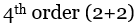
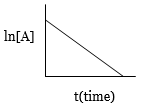
3. Simple types of reaction order    

Reaction orders

Rate law

  Equation

(concentration vs. time)

Graph

Half-life, t1/2

Zeroth order

First order

Second order

D. Catalysis

: acceleration of a reaction by a catalyst, which is regenerated and is not consumed overall.

  • A catalyst provides an alternative reaction pathway with a lower activation barrier.
  • At a fixed temperature, a catalyst increases the rates of both forward and reverse reactions. It does not change ΔG, ΔH, ΔS, the equilibrium constant, or the equilibrium composition.
  • A transition state is a local energy maximum along a reaction pathway; a multistep mechanism may have more than one transition state.

Fig. 2 Exothermic reaction with catalysis

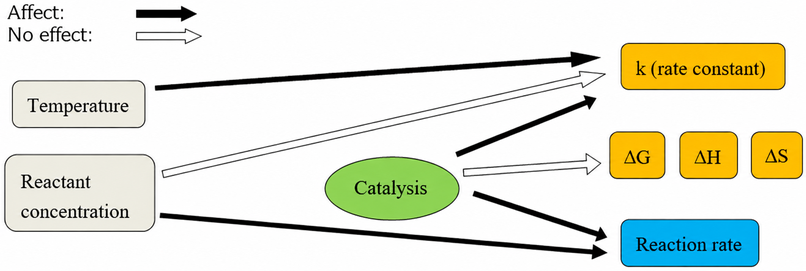
Fig. 3 Factors affecting reaction rate. Reactant concentration affects the rate through the rate law; it does not itself create catalysis. Temperature affects k. A catalyst changes the pathway and activation barrier, without changing reaction thermodynamics or equilibrium at a fixed temperature.

Effects of temperature, reactant concentration, and catalysis on rate constant and reaction rate

E. Reaction mechanisms